One and a Half Years After Li Jian Takes Charge of Honor: What Score Can He Achieve in the 'College Entrance Examination' of Business Performance?
 06/09 2026
 656
656

Honor Faces a Transformation Challenge.
Manual labor/Brother Digger
Manual editing/Uncle Jiao
Produced by/Unicorn Observer
As the nation steps into the college entrance examination season, Honor has preemptively launched its Honor 600 series—a mid-range flagship model targeting young consumers, perfectly timed with the 618 shopping festival and the wave of phone upgrades during this period. This launch marks a pivotal turnaround battle for Li Jian, who has recently taken over as CEO, as Honor grapples with a market share dilemma.
On January 17, 2025, Honor underwent a significant leadership transition. Zhao Ming, who had steered Honor for many years, stepped down as CEO, and Li Jian, boasting 20 years of experience at Huawei, assumed the helm of this smartphone giant, which had been independent for just over three years.
By that time, the industry landscape had dramatically shifted: Huawei's consumer business had made a robust comeback in the domestic market, the overall growth of the smartphone market had plateaued, and Honor was faced with the dual tasks of safeguarding its domestic market share while pursuing global expansion, an initial public offering (IPO), and strategic transformation.
As of June 2026, Li Jian has been at the helm of Honor for one year and five months. What kind of 'college entrance examination' report card has he presented?
Over the past year, Honor has experienced a divergent path: thriving overseas while facing pressure domestically. It has witnessed explosive growth in international markets, a high-profile rollout of its AI ecosystem strategy, and a steady acceleration of its IPO process. However, its core domestic market share has continued to decline, high-end product competitiveness remains lacking, and offline channels and user perception are under severe strain.
This mixed report card is both a direct consequence of the new management's strategic decisions and a reflection of the survival challenges faced by leading domestic smartphone brands today.
Is the new path Li Jian has charted for Honor a breakthrough solution or a high-stakes gamble fraught with uncertainties?
01 Continued Decline in the Domestic Core Market
In its early days of independence, Honor swiftly gained a foothold under Zhao Ming's leadership, leveraging Huawei's spillover user base, mature technology system, and offline channels.
In the first quarter of 2024, Honor's domestic market share soared to 17.1%, topping the domestic smartphone market and reaching its peak since independence.
However, hidden risks lurked beneath these highs.
On one hand, Huawei's consumer business fully restored its production capacity, with new releases in the Mate and Pura series driving significant sales. Users who had once switched to Honor as a 'Huawei alternative' began to flock back, shaking Honor's domestic growth foundation. On the other hand, the stalled IPO process raised higher expectations from capital markets regarding Honor's growth potential and profit model. Meanwhile, as the global smartphone industry entered a phase of intense competition (inventory competition), traditional approaches relying solely on hardware specifications and offline channels reached their growth limits, with AI emerging as the universally acknowledged next frontier for the entire industry.
Against this backdrop of multiple pressures, Honor initiated a management overhaul.
From the outset, Li Jian's appointment was entrusted with a clear mission: reduce reliance on the domestic market, accelerate global expansion, drive a comprehensive transformation toward an AI-powered terminal ecosystem, establish new technological barriers, and set a clear timeline for going public.
Unlike Zhao Ming's management style, which emphasized products, technology, and user experience, Li Jian, with a background in Huawei's overseas business, excelled in organizational transformation, large-scale expansion, and capital storytelling.
Upon taking office, he immediately launched sweeping reforms—restructuring the organizational architecture, introducing competitive bidding for core positions, and shifting strategic focus. A top-down transformation swept across Honor, destined to endure growing pains and fundamentally shaping its subsequent market performance.
The domestic market, which had been the cornerstone of Honor under Zhao Ming, became the biggest weakness in Li Jian's report card.
Data vividly reflects the downward trend: In 2024, Honor's annual domestic market share stood at 14.9%, ranking fourth in the industry. By 2025, it fell to 13.4%, dropping out of the domestic top five to sixth place.
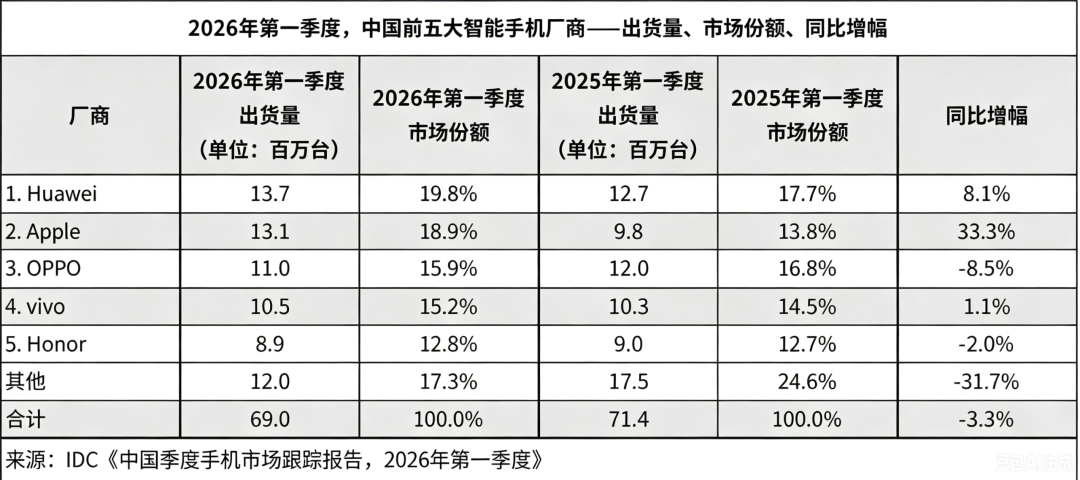
In the first quarter of 2026, Honor regained fifth place but saw its share slip further to around 12.8%.
The decline in domestic market share stems from a confluence of factors.
First, Huawei's return created direct pressure. The 2,500-4,500 yuan mid-range price segment, a traditional stronghold for Honor, became a key focus for Huawei's new releases. Leveraging its brand appeal, self-developed technology, and a comprehensive ecosystem, Huawei precisely targeted this segment, diverting a large number of core users. Meanwhile, OPPO and Vivo continued to deepen their presence in lower-tier offline markets, further eroding Honor's offline base through frequent new releases, price promotions, and channel rebates.
Second, internal organizational changes caused short-term business disruptions. Li Jian implemented the 'Eagle Plan,' introducing competitive bidding for 38 core positions in the China region, resulting in a turnover of over 40% of department heads. This large-scale personnel adjustment caused short-term team turmoil and reduced execution efficiency at the frontline. In the first half of 2025, Honor significantly slowed its pace of new phone releases, with only two models launched over six months. The product gap directly led to stock shortages in stores, channel partners switching to competitors, and a sharp decline in offline distribution rates and terminal activity.
Product shortcomings were also prominent. The high-end flagship Magic 8 series aimed to compete with Huawei's Mate series but failed to differentiate itself in core technology, brand recognition, or overall experience, selling only one-fifth as many units as Huawei's models in the same price range. Its grip on the 4,000-6,000 yuan high-end market remained weak. The mainstream volume-driving Digital series (Honor 500/600), focused on female selfies and sleek design, appealed to a narrow audience and lacked a universal blockbuster model capable of driving overall market growth. The only standout, the Magic V6 foldable phone, claimed the top spot in domestic foldable sales but remained constrained by the niche market's overall size, unable to reverse the broader market downturn.
A deeper dilemma lies in brand perception. Five years after independence, most consumers still view Honor as a 'Huawei alternative,' failing to establish a distinct brand identity. When Huawei returned, this perception became a shackle, depriving Honor of its core traffic source. Coupled with the enterprise's 'profit-focused, cost-controlled' strategy under IPO pressure, domestic marketing efforts weakened, further shrinking brand influence.
02 Overseas Markets Become the Core Growth Engine
If the domestic market represents regret, then overseas markets stand as Li Jian's most impressive achievement one and a half years into his tenure at Honor.
While domestic share continued to decline, Honor's overseas business followed an upward trajectory, fundamentally rewriting its traditional 'domestic-focused, overseas-supplemental' structure.
In 2025, Honor's global shipments reached approximately 71 million units, up 9% year-on-year. Overseas sales surged 47%, accounting for over 50% of total shipments for the first time, officially establishing Honor as a global brand.
Regionally, growth was widespread: Latin America and the Middle East & Africa both exceeded 10 million units in annual shipments. The Middle East region saw a 73% sales increase, solidifying its second-place industry ranking. Southeast Asia and Europe's high-end markets achieved steady breakthroughs, with multiple models ranking among the top three in regional sales. In Southeast Asian countries such as the Philippines, Thailand, and Malaysia, first-sale data showed year-on-year increases of up to 175%.
The rise of overseas markets was no accident. On one hand, overseas markets lacked the 'Huawei return' shock, allowing Honor to shed its 'Huawei alternative' label and compete on product quality, price advantages, and localized services. On the other hand, Li Jian fully leveraged his overseas experience from Huawei, optimizing the overseas organizational structure, replacing most regional leaders, and implementing younger, localized management teams. Channel expansion and marketing efforts accelerated across the board.
Unlike the low-end competition in China, Honor pursued a mid-to-high-end strategy overseas, with the share of models priced between $300-$500 steadily increasing. Product profitability far exceeded domestic levels. Overseas business not only filled the gap left by declining domestic sales but also optimized the company's overall profit structure, providing ample cash flow for R&D investment and IPO progression.
03 The Challenge of Implementing AI in a Grand Narrative
Beyond hardware products, Li Jian set 'transforming into an AI terminal ecosystem company' as Honor's ultimate goal, launching the Alpha Strategy and announcing plans to invest over $10 billion in AI over the next five years. The company simultaneously introduced the AHI (Artificial Human Intelligence) concept, focusing on cutting-edge areas such as human-machine interaction and physical AI.
Over the past year and a half, Honor has been highly active: establishing an Embodied Intelligence Lab and a New Industry Incubation Department, unveiling the Robot Phone and the consumer-grade humanoid robot 'Lightning' at industry exhibitions, and becoming one of the few Chinese smartphone makers to venture into humanoid robots.
Strategically, Honor aims to break free from traditional smartphone hardware competition by targeting AI and robotics, seeking to capture the next wave of intelligent terminals and build long-term technological barriers. This grand strategic narrative also aligns precisely with capital markets' valuation preferences for tech companies.
However, in the consumer market, the AI strategy remains more talk than action.
Multiple flagship phones marketed for their AI capabilities heavily promoted AI features but delivered mostly conventional functions like AI imaging and basic voice interaction, lacking transformative experiences. No true AI blockbuster products have emerged. New offerings like phone robots and humanoid robots remain conceptual, with a long road ahead before commercialization and scalable profitability.
At the product line level, Honor launched over 20 new models in 2025, adopting a 'machine sea' tactics in the second half to fill product gaps. However, the overall approach leaned toward following industry trends rather than driving innovation. Foldable phones emerged as the only benchmark category in the product matrix, enjoying both reputation and sales success. However, the niche market's size limited its ability to drive broader market breakthroughs.
Balancing billion-dollar long-term AI investments with current hardware growth challenges, Honor faces a contradiction between strategic investment and short-term market monetization. This AI gamble, while failing to translate into sales and profits in the short term, continues to consume significant R&D resources, testing the company's financial reserves and strategic resolve.
04 Li Jian's 'College Entrance Examination' Report Card
In just five years, Honor has undergone two distinct developmental phases under two leaders, each pursuing differentiated routes and delivering starkly contrasting results.
Neither approach is inherently superior; they simply reflect different times and choices. Zhao Ming fulfilled Honor's historical mission of 'establishing survival,' while Li Jian shouldered the responsibility of 'going global and facing the future.'
Reviewing Li Jian's one year and five months at the helm, his report card can be summarized as 'partially excellent, overall divergent, and controversial.'
In overseas markets, global expansion, IPO progression, and organizational efficiency optimization, Honor delivered excellent results, proving its ability to compete globally. The high-profile AI strategy laid out a long-term development blueprint and opened up capital market imagination. However, issues such as declining domestic core market share, insufficient high-end product competitiveness, vague brand identity, and slow AI implementation remain unavoidable shortcomings.
Fundamentally, Li Jian chose a 'long-term gain over short-term pain' path for Honor: voluntarily accepting short-term domestic market pressure in exchange for global growth and a ticket to the future AI era. With Huawei's strong return and extreme domestic market competition, defending the home turf has become increasingly difficult. Shifting focus globally and exploring new sectors represents a viable path for leading brands to break out.
At this juncture, Honor's challenges are just beginning. How can it halt the decline in domestic market share and defend its core base? How can it translate the grand AI strategy into tangible product value for users? How can it balance short-term profitability with long-term R&D investment to alleviate capital market concerns? How can it reshape its brand image and shed the 'Huawei shadow'?
One and a half years after the leadership change, Honor has completed a thorough transformation. It is no longer a smartphone brand solely reliant on the domestic market but a tech company betting on AI, competing globally, and heading toward the capital markets.
Li Jian's reform journey has yielded impressive results but also unavoidable risks. The next two to three years will be critical in testing the success of this strategic transformation, and how far Honor can ultimately go remains to be seen. (End)
-
![]()
Proposed to Raise 955 Million Yuan through Private Placement! Huicheng Vacuum Boosts Localization of Ultra-Precision Optical Coating Equipment
-
![]()
Cash Flow Soars 13-Fold! What Major Strategic Move is Wuhan Five Square Optoelectronics Planning?
-
![]()
Leaked Design of vivo X500: Reverts to Circular Camera Module in Top-Left Corner, Pays Homage to Classic X90 Aesthetic
-
![]()
DeepSeek Shows Signs of Foraying into Code Agents, Launches WeChat Official Account Focused on Harness
-
![]()
Auto Companies Deny Claims That ‘Cooperation with Huawei Is Non-Essential’, as Huawei Transforms into a ‘Public Platform’
-
![]()
Starship to Independently 'Return to the Launch Tower': SpaceX's Ambitions Extend Beyond Rocket Building to Dominating Space Transportation
-
![]()
Starship Set to Independently 'Return to the Launch Tower': SpaceX is Revolutionizing Space Transportation, Not Just Building Rockets
-
![]()
Anthropic and OpenAI Face Off Against Deepseek