With 70 Million Active Job Seekers, BOSS Zhipin Compels Employers to 'Pay for Access'
 06/10 2026
 654
654
Employers Face 3-Daily-Chat Limit: BOSS Zhipin’s ‘Paywall’ Rises Higher

On BOSS Zhipin, the disparity in privileges between VIP and non-VIP employers is growing.
Recently, an HR professional from a company complained to the New Insight Research Institute: "Without a BOSS Zhipin VIP subscription, we're limited to chatting with just three job seekers per day, and the advantages of paying are diminishing."
BOSS Zhipin initially gained fame with the slogan "Find a job on BOSS Zhipin, talk directly with the boss," streamlining the traditional recruitment process into instant messaging.
It reduced information asymmetry, enabling companies and job seekers to connect at a low cost. However, as the platform's user base expanded and commercialization pressures mounted, the rules started to shift rapidly.
In reality, BOSS Zhipin has tightened its free benefits, making paid access the norm. Both companies and users are faced with a choice: without payment, progress is nearly impossible. After payment, privileges improve significantly, but often result in the unsatisfactory feedback of being "useful but not enough."
Corporate clients feel this shift more acutely.
From BOSS Zhipin's latest financial report, it's evident that nearly all platform revenue comes from corporate clients' payments. The commercial logic, built on "paywalls" and algorithmic distribution, has become clear.
However, questions arise: if companies are squeezed by high fees, will there be a risk of losing SMEs due to increased labor costs? Additionally, with the widespread adoption of AI technology across industries, how far can BOSS Zhipin's traditional profit model, reliant on access restrictions, go?
I
Is 'Paying for Access' the Only Option for Employers on BOSS Zhipin?
Under BOSS Zhipin's free model, companies can initiate new conversations with only three job seekers per day and view job seeker information just 20 times.
In response, BOSS Zhipin stated that the number of basic benefit days for companies is dynamically adjusted by the system based on factors such as region, job postings, and competition levels, with the final count displayed by the system.
With such limited permissions, meeting a company's recruitment needs is nearly impossible, akin to leaving only a "sliver of an opening." Once a basic VIP subscription is purchased, the daily communication limit jumps to 60, with 120 proactive views, including access to three competitive job postings and 12 exclusive benefits.
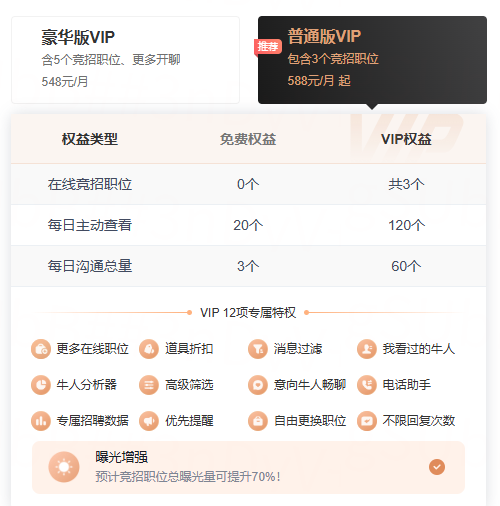
The VIP subscription system offers two tiers: basic and premium, with three duration options: 30, 60, and 90 days. Basic subscriptions range from 400 to 800 yuan, while premium subscriptions cost between 500 and 1,500 yuan, with an optional 100-yuan exposure enhancement feature.
BOSS Zhipin informed the New Insight Research Institute that online purchases are typically divided into monthly and quarterly plans, while offline annual memberships are handled by sales representatives.
This means the platform's App only displays some of the fee standards, with annual fees negotiated offline and exceeding 10,000 yuan.
Regarding the exposure enhancement feature, BOSS Zhipin explained that it increases the likelihood of job seekers seeing a company's postings but does not guarantee a specific number of views or communications.
The significant difference in privileges between subscribed and non-subscribed members has pressured many employers into compromising.
Without payment, effective recruitment is nearly impossible. Even after paying, companies face layered value-added services, with 488 yuan being just the entry point. For companies with heavy recruitment needs, monthly expenses can be substantial.
An HR professional from a company told the New Insight Research Institute that after purchasing a membership, they discovered that while it included three free competitive job postings, an exposure card service was also promoted during posting. The original price for seven days was 328 yuan, reduced to 288 yuan with the VIP discount. The exposure card fee nearly matched the VIP subscription cost, along with multiple discount coupons for services like search chat cards and top placement cards, all at significant costs. Although not mandatory, this indirectly increases the "psychological pressure" on companies to spend more.
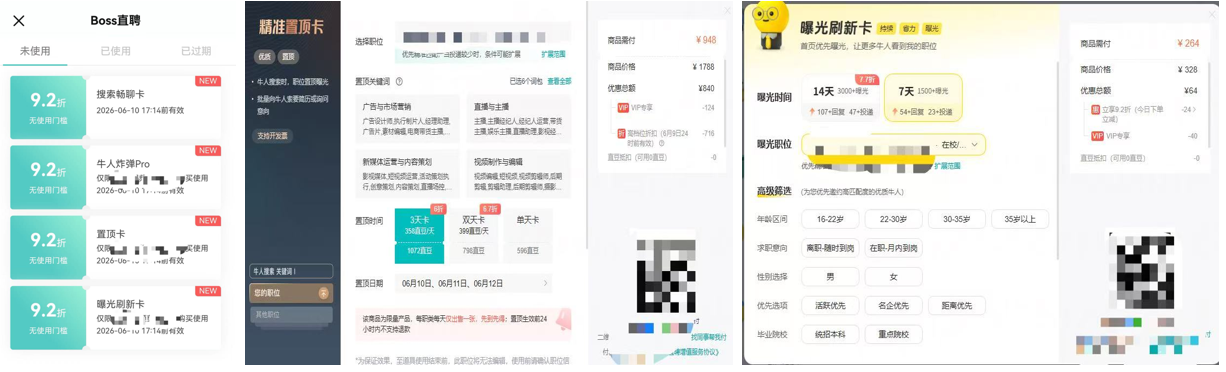
This strategy has proven highly effective, as seen in the latest financial report. In the first quarter of 2026, BOSS Zhipin's revenue reached 2.07 billion yuan, a 7.6% year-over-year increase, with corporate online recruitment services contributing 2.06 billion yuan, accounting for nearly 99% of total revenue.
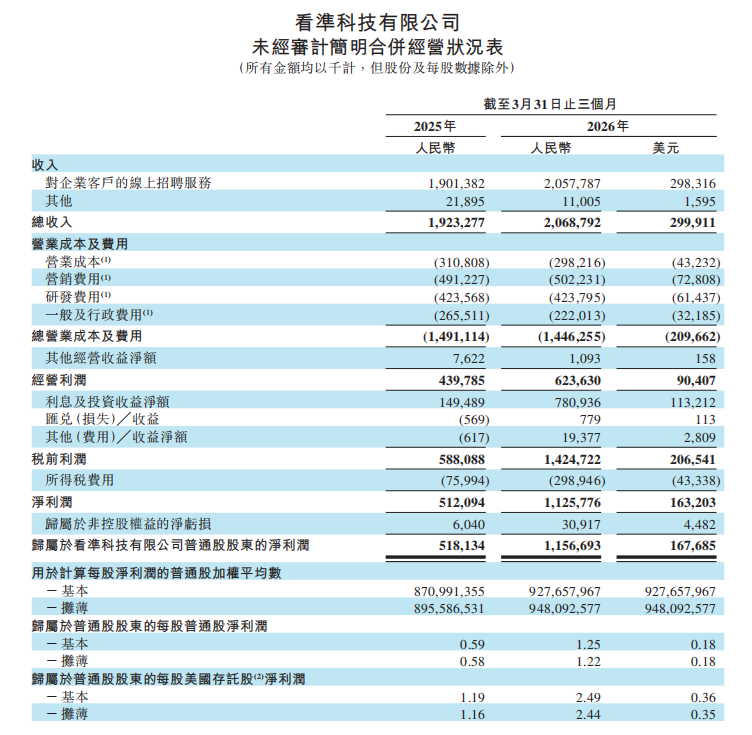
(Source: BOSS Zhipin's Q1 2026 Financial Report)
As of March 31, 2026, the number of paying corporate clients reached 7.1 million, a 10.9% increase from 6.4 million year-over-year. The blue-collar and lower-tier markets have become new growth engines, with blue-collar revenue exceeding 40% for the first time.
Platform revenue relies almost entirely on corporate payments, with negligible income from job seekers classified under 'other services,' totaling just 11 million yuan in Q1 2026. BOSS Zhipin leverages job seeker traffic as a bargaining chip to drive corporate payments.
With tens of millions of active users and a vast corporate client base, BOSS Zhipin should ideally serve as a neutral bridge between job seekers and employers, facilitating quick matches through efficient direct messaging, reducing information gaps, and achieving a win-win-win outcome for the platform, companies, and job seekers. Initially, the platform did just that, attracting many SMEs with multiple free communication opportunities, allowing them to connect at a low cost.
However, as the user base expanded and commercialization intensified, the platform seems to have shifted its approach. It began using its strong market influence to erect information barriers.
Previously open communication opportunities have been increasingly restricted, reducing free user permissions. "Direct messaging" has become a scarce resource, making it nearly impossible for companies to operate without paying. While payment grants more permissions, quota issues persist, necessitating the purchase of additional value-added services like competitive job postings and exposure enhancement cards.
Ultimately, this has led to a situation where many employers are "forced" to incrementally increase their spending, starting with VIP subscriptions and gradually upgrading to higher-tier services, layered with various "tools."
In other words, the platform's true profit does not primarily stem from providing higher-quality and more precise recruitment services but from continuously reducing benefits for both members and non-members, compelling companies to incur higher costs to connect with more candidates and view resumes.
In the short term, this approach is effective, with rising revenues and profits. However, for SMEs sensitive to labor costs, these high fees may gradually drive them away, posing a risk of user attrition for the platform.
Constantly demanding more from companies also leads the platform to overlook the sustainability of its core user base.
This model has sparked numerous complaints from employers. On the Heimao platform, searching for 'BOSS Zhipin' yields over 8,000 complaints, with the majority focusing on 'refunds.' Similar issues are also discussed on social media.
The New Insight Research Institute found that the most typical complaints involve disputes over refunds for 'prepaid' subscriptions. Some consumers who purchased memberships for a specific duration and stopped using them due to various reasons sought refunds for the unused portion, but the platform refused.
Netizens argue that since the product operates on a prepaid service model, charging per day of use, refunds should be reasonable and demand them from the platform.
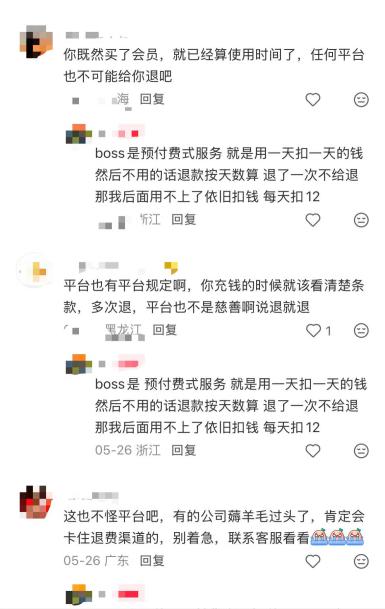
In response, BOSS Zhipin's customer service told the New Insight Research Institute that they do not have a prepaid model and are unclear about it. Generally, online purchases take effect within the purchased duration, with no separate prepaid benefits activated on a daily basis.
The New Insight Research Institute also reviewed the corporate purchase agreement on BOSS Zhipin and found a separate clause addressing fee refunds.
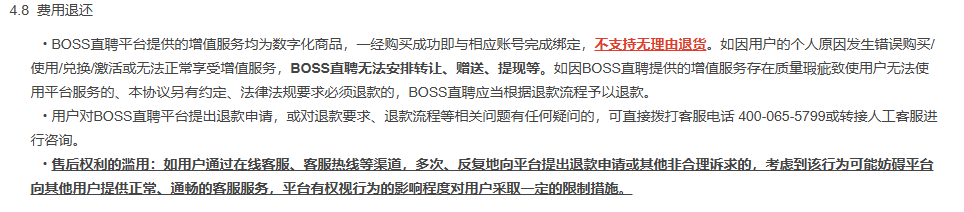
Apart from refund issues, some netizens have also questioned why their membership fees differ from others.
In response, BOSS Zhipin explained that online subscription packages are comprehensively determined based on the local competition level in the city where the employer posts jobs. Therefore, VIP fees may vary across positions and accounts, with specifics displayed on the page.
II
BOSS Zhipin Leverages Nearly 100 Million Job Seekers to Charge 'Employers'—Will There Still Be Employers to Chat With?
How long can BOSS Zhipin's high-fee model last?
The platform's greatest confidence lies in its extremely high user engagement. According to Securities Times, in Q1 2026, BOSS Zhipin's average MAU on the APP reached 60.9 million, a 5.7% year-over-year increase; in March alone, MAU exceeded 72 million, a 12.6% year-over-year increase.
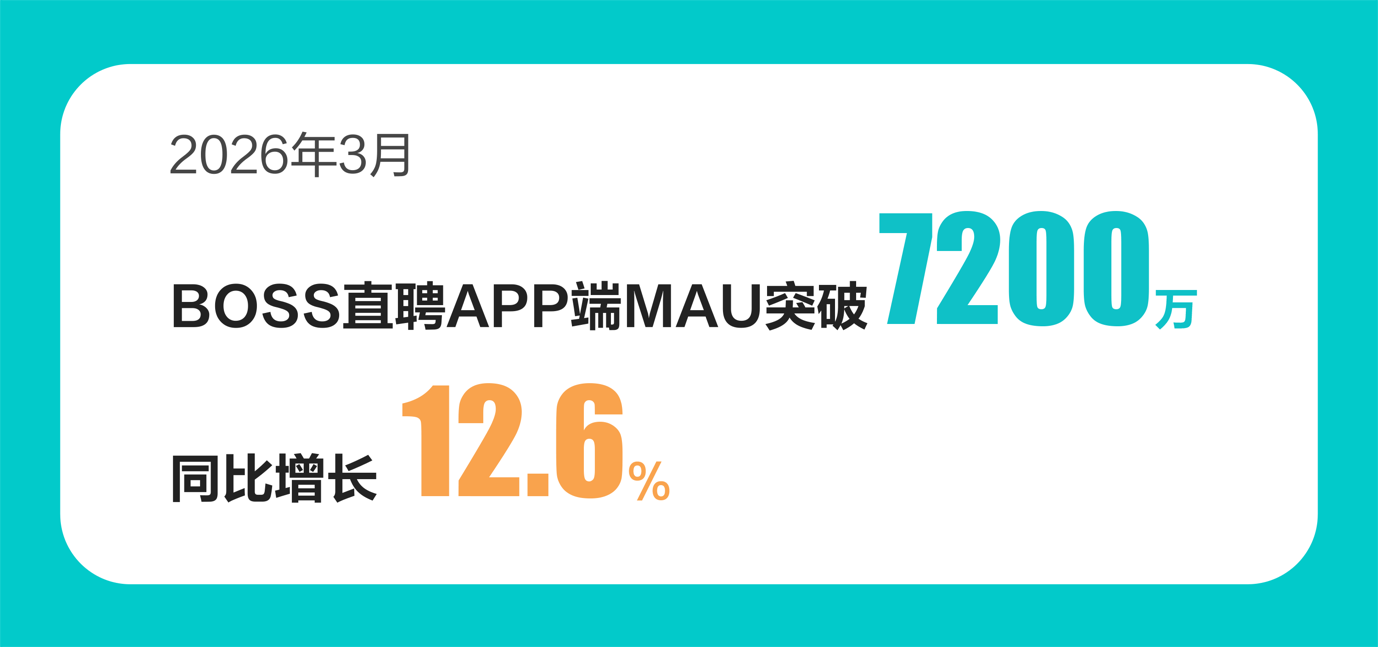
From January to April 2026, the cumulative number of new and improved users exceeded 15 million, with an expected annual total of over 40 million. This sustains a strong bilateral network effect, where free job seeker traffic continuously feeds the corporate side, creating a sticky cycle that is difficult to replicate quickly.
China has a large base of SMEs, and while recruitment is infrequent, the pain points are highly concentrated. Many companies do not recruit regularly but urgently need to reach candidates quickly when demands arise, such as position replacements, business expansions, or seasonal needs. Now, expanding into the blue-collar market further strengthens BOSS Zhipin's position.
Despite BOSS Zhipin's high user engagement, competitors are accelerating their market share gains, posing the greatest external challenge to the high-fee model.
Although Zhaopin and 51job have smaller MAUs than BOSS Zhipin, they attract some companies to diversify their recruitment platforms with more flexible packages, transparent pricing, and their established presence among mid-to-high-end key accounts.
Their cost-effectiveness in job exposure and resume services appeals to budget-conscious SMEs.
Moreover, with numerous promotional channels and diverse platforms available, short-video platforms like Douyin and Kuaishou are making significant strides in blue-collar recruitment, using live streaming job fairs and short videos to lower barriers for companies, offering more accessible and visually intuitive conversions. Professional networking platforms like Maimai are also diverting traffic from white-collar high-end positions.
While BOSS Zhipin's high user engagement makes it resilient in the short term, it also provides a 'target' for competitors to catch up in the long run.
BOSS Zhipin's high-fee model remains effective for now, largely due to its high user engagement and large SME base. However, increasing competitor competitiveness is slowly eroding its user base and willingness to pay. Thus, while BOSS Zhipin still has a window of opportunity, it is not invincible forever.
Beyond the clear payment barriers on the corporate side, the job seeker side is more nuanced.
BOSS Zhipin's VIP subscription for job seekers is primarily priced at 68 yuan for 30 days, offering ten benefits, including auto-follow-up chats, new job alerts, unlimited AI resume polishing, competitiveness analysis, message filtering, priority reminders, and resume refreshes.
This sounds appealing, especially in today's competitive job market.
However, many users who have subscribed feel it is 'not very useful.' While resume refreshes and priority reminders may marginally increase exposure, they do not address the fundamental issue of job matching.
Many job seekers complain that even after subscribing, their applications still go unanswered, or they receive numerous irrelevant 'spam' communications.
VIP subscriptions seem more like a psychological 'placebo' than an efficiency multiplier.
Conversely, most job seekers choose not to subscribe, relying instead on the platform's basic free features for regular applications and chats. The reason is simple: they see no need for it. These job seekers may believe that persistent messaging will eventually yield responses.
This creates an interesting contrast: corporate-side payments are 'mandatory,' while job seeker-side payments are 'optional.'
Revenue from job seeker VIP subscriptions is negligible but serves to educate users and collect data. Tools like AI resume polishing feed user behavior data back into the platform's models.
III
In the AI Era, How Long Can BOSS Zhipin's Model Last Amid Rapid Changes in the Labor Market?
Nowadays, every industry is talking about AI, and the recruitment sector is no exception.
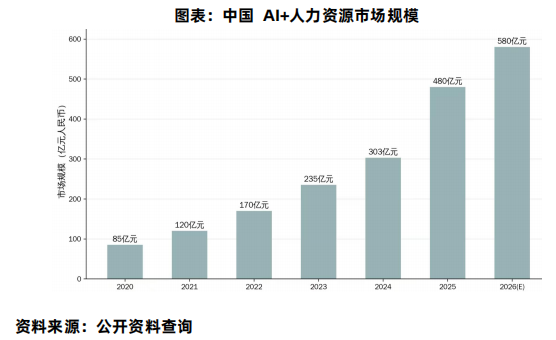
According to the latest market research data compiled by Shuoyuan Consulting, the Chinese AI+HR market surpassed hundreds of billions of yuan in 2025, showing strong growth momentum. It is expected to maintain a compound annual growth rate of over 20% by 2026, potentially reaching a trillion-yuan market size.
In 2024, BOSS Zhipin launched its proprietary 'Nanbeige' large model and began internal testing of its full-link AI recruitment agent, 'DeepHire.' The product's features seemingly cover the entire recruitment process. For job seekers, AI can polish resumes, auto-submit applications, and schedule interviews. For HR, it can batch-parse resumes, AI-score and rank candidates, auto-reply to inquiries, and even manage interview schedules.
Frankly speaking, AI provides substantial support to the recruitment sector and holds significant value for recruitment platforms themselves.
Take the traditional HR professionals, for instance, who are frequently inundated with a deluge of resumes. AI has the capability to swiftly analyze, evaluate, and recommend candidates, thereby minimizing ineffective interactions. The AI assistant of BOSS Zhipin can proactively search for and suggest candidates according to job requirements, leading to a notable increase in the average number of successful hires per recruiter.
Moreover, AI review enhances operational efficiency by detecting risky information, aiding the platform in maintaining order in high-frequency scenarios.
However, a fundamental question arises: Can AI genuinely enhance the 'actual' recruitment efficiency between job seekers and recruiters?
Yet, for the time being, this enhancement is somewhat constrained and finds it challenging to overcome structural bottlenecks.
Why do we assert this? AI excels in managing standardized, data-heavy tasks. It can expedite and broaden the 'matching' process, but it falls short in addressing the authenticity and willingness underlying the 'matching'.
Job seekers can employ AI to embellish their resumes, while companies can utilize AI to sift through resumes. Ultimately, it evolves into a contest between AIs, where the indicators of genuine abilities may be diminished. In the end, direct communication remains essential for verification, yet direct communication itself is hindered by paywalls.
At times, what bosses or HR ultimately prioritize is the 'synergy', reliability, and cultural alignment between individuals. AI can reduce the time from initiating a conversation to sending an invitation, but achieving the transition from invitation to onboarding still heavily depends on offline procedures.
The true competitive edge of BOSS Zhipin does not lie in AI technology, but rather in the vast amount of authentic interaction data accumulated in the 'direct chat' setting. This data facilitates quicker AI iteration and renders the platform more resilient in the face of regulation and competition.
In simple terms, recruitment platforms in the AI era will more closely resemble 'entities' that coexist with intelligent matching and service ecosystems, enabling AI to genuinely support human judgment rather than entirely supplant it.
Broaden our perspective, when labor is largely supplanted by machines, the relationship between humans and labor in the AI era transforms into an intelligent direct matching relationship. The significance of recruitment platforms like BOSS Zhipin may truly be put to the test in the annals of history.
-
![]()
Proposed to Raise 955 Million Yuan through Private Placement! Huicheng Vacuum Boosts Localization of Ultra-Precision Optical Coating Equipment
-
![]()
Cash Flow Soars 13-Fold! What Major Strategic Move is Wuhan Five Square Optoelectronics Planning?
-
![]()
Leaked Design of vivo X500: Reverts to Circular Camera Module in Top-Left Corner, Pays Homage to Classic X90 Aesthetic
-
![]()
DeepSeek Shows Signs of Foraying into Code Agents, Launches WeChat Official Account Focused on Harness
-
![]()
Auto Companies Deny Claims That ‘Cooperation with Huawei Is Non-Essential’, as Huawei Transforms into a ‘Public Platform’
-
![]()
Starship to Independently 'Return to the Launch Tower': SpaceX's Ambitions Extend Beyond Rocket Building to Dominating Space Transportation
-
![]()
Starship Set to Independently 'Return to the Launch Tower': SpaceX is Revolutionizing Space Transportation, Not Just Building Rockets
-
![]()
Anthropic and OpenAI Face Off Against Deepseek