Joint Interview with Five Major E-commerce Platforms: Ending Involution for a Healthier 618 Shopping Environment
 06/11 2026
 678
678
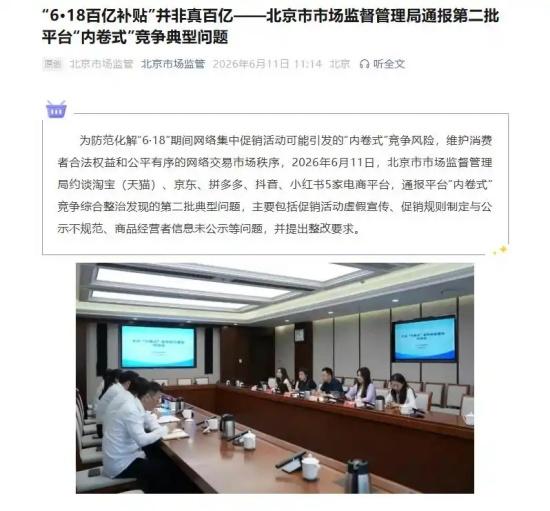
Today, the Beijing Municipal Market Regulation Administration conducted a collective interview with five leading e-commerce platforms—Taobao (Tmall), JD.com, Pinduoduo, Douyin, and Xiaohongshu. The aim was to address and rectify the chaotic and "involutionary" competition during the pre-618 period and in their daily operations. Key issues identified included false advertising in promotional activities, non-standard formulation and disclosure of promotion rules, and inadequate disclosure of information about commodity operators.
According to the official announcement, the prevalent issues among these five major e-commerce platforms primarily revolve around the following two aspects:
① Exaggerated 'Billion-Yuan Subsidies': The focal point of this interview is the misleading nature of the 'billion-yuan subsidies' promoted by major platforms. Regulatory authorities clarified that the so-called 'billion-yuan' figure is often just a vague promotional tactic rather than actual dedicated subsidy funds. None of the platforms could substantiate the actual subsidy amounts or the funding ratios between platforms and merchants, with some even engaging in false advertising. This suggests that platforms are using numerical tricks to create the illusion of low prices to attract traffic. The intervention of regulatory authorities effectively curtails marketing exaggerations and protects consumers' right to information.
② Unfair Rules: The most evident manifestation is the lack of transparency and the presence of unfair contract terms, often referred to as "overbearing terms." Promotion rules are convoluted and subject to arbitrary changes; information about the qualifications of commodity operators is not disclosed; some platforms even compel merchants to bear the full cost of subsidies.
I have observed that since February this year, the State Administration for Market Regulation has repeatedly cautioned against involutionary competition. This special rectification initiative exemplifies normalized regulation, aiming to preemptively safeguard the 618 shopping festival. In essence, this interview is not an isolated administrative action but signifies the preliminary establishment of a normalized governance mechanism by regulatory authorities to combat involutionary competition in e-commerce platforms.
From identifying problems to publicly naming them and demanding rectification within a specified timeframe, a comprehensive regulatory closed-loop is taking shape. Regulatory authorities have mandated platforms to conduct immediate self-inspections and corrections, emphasizing that they will continue to employ comprehensive regulatory mechanisms for dynamic monitoring. You might wonder why regulatory authorities feel compelled to halt involution. The rationale is straightforward: it yields three significant benefits:
1. Protecting Merchants' Viability
The essence of blind subsidy competition and price wars among e-commerce platforms is a zero-sum, or even negative-sum, game. To sustain low prices, some platforms forcibly transfer subsidy costs onto merchants, trapping them in a dilemma where they lose traffic if they don't lower prices but incur losses if they do.
This vicious competition severely erodes the profit margins of small and medium-sized merchants, impeding industry innovation and upgrading. In the long run, the costs of reduced product quality and service degradation will ultimately be borne by consumers. This interview sends a clear message: platform competition must transition from price wars to innovation and service comparisons.
2. Safeguarding Consumers' Legitimate Rights
Among the typical issues reported, multiple platforms set unreasonable terms in their promotion rules, unilaterally absolving themselves of legal responsibilities. For instance, Pinduoduo stipulates that it "shall not be liable for disputes related to commodities," while Xiaohongshu states that consumers "continue to participate, regarded as agreement" to rule changes, effectively depriving consumers of their right to negotiate.
Simultaneously, some platforms fail to prominently display promotion rules or provide incomplete core information such as winning probabilities. The intervention of regulatory authorities aims to rectify these overbearing terms that exacerbate difficulties for consumers in defending their rights and to restore a fair market environment.
3. Stabilizing the Industry Ecosystem
Irrational subsidies distort price mechanisms and undermine supply chain quality and industrial upgrading capabilities in the long term. The robust intervention of regulatory authorities will put an end to the extensive development model of "burning money to scale" and redirect resources toward technological innovation, service upgrades, and supply chain optimization. Henceforth, e-commerce, content e-commerce, and social e-commerce will all enter a new phase of compliant and refined operations. In essence, regulatory intervention facilitates the industry's transition from wild growth to high-quality development.
Overall, the collective interview of the five major e-commerce platforms represents a precise strike by regulators against the chronic issue of cutthroat low-price competition in the e-commerce industry. It serves as a warning to platforms to abandon the extensive expansion model of burning money for traffic and guides the industry toward compliant, healthy, and sustainable high-quality development. This is undoubtedly a positive step forward!
In my opinion, this interview marks a milestone in platform economy governance: it is not about restricting development but recalibrating direction—shifting from involutionary zero-sum games to win-win coexistence and from a traffic-first approach to a value-based one. For consumers, there are no 'billion-yuan subsidies' that materialize out of thin air—only more transparent rules, more genuine quality, and more reliable safeguards. This implies that this year's 618 shopping festival will feature a healthier consumer environment, and consumers will also become more discerning. What are your thoughts?
-
![]()
Proposed to Raise 955 Million Yuan through Private Placement! Huicheng Vacuum Boosts Localization of Ultra-Precision Optical Coating Equipment
-
![]()
Cash Flow Soars 13-Fold! What Major Strategic Move is Wuhan Five Square Optoelectronics Planning?
-
![]()
Leaked Design of vivo X500: Reverts to Circular Camera Module in Top-Left Corner, Pays Homage to Classic X90 Aesthetic
-
![]()
DeepSeek Shows Signs of Foraying into Code Agents, Launches WeChat Official Account Focused on Harness
-
![]()
Auto Companies Deny Claims That ‘Cooperation with Huawei Is Non-Essential’, as Huawei Transforms into a ‘Public Platform’
-
![]()
Starship to Independently 'Return to the Launch Tower': SpaceX's Ambitions Extend Beyond Rocket Building to Dominating Space Transportation
-
![]()
Starship Set to Independently 'Return to the Launch Tower': SpaceX is Revolutionizing Space Transportation, Not Just Building Rockets
-
![]()
Anthropic and OpenAI Face Off Against Deepseek