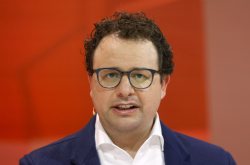
Ali Bids Farewell to Wu Zhao Amid AI Transformation Struggles
 06/12 2026
 515
515
A product manager, just one year into the job, brought down DingTalk's founder Wu Zhao with a 75,000-word resignation letter.
On June 4, 2026, a product manager with the alias 'Yousu' posted a lengthy article titled 'Inside DingTalk' on Alibaba's internal network. Six days later, the Alibaba Partnership Committee issued a rare statement, straightforward words (bluntly stating) that DingTalk's management style was 'not in line with Alibaba's culture.'
The following day, Wu Zhao stepped down as CEO of DingTalk, with 34-year-old Chen Yusen taking over.
Opinions on Wu Zhao have always been polarized. Some revere him as a god, capable of leading the team through three months of relentless revisions after a product was criticized as 'trash' by clients. Others view him as a demon, known for patrolling the office at midnight to see who was not at their desk, publicly questioning them the next day with 'Why did you leave early?'
The same persona could be seen as a fervent genius or a tyrannical zealot.
Wu Zhao's A state of almost paranoia or even madness (near-obsessive, even maniacal state) has remained unchanged. During DingTalk's early development, his obsessiveness was even more pronounced. The head of the open platform was once pushed to 'see results immediately, right now.' The recruitment ad on DingTalk's homepage read, 'Join the Product Madhouse.' Back then, this approach propelled DingTalk from zero to success.
He attempted to recreate DingTalk's startup days, with the entire team on edge, constantly accelerating, and the office lights never dimming. Yet, this tension now leaves many DingTalk employees feeling conflicted. Sacrificing their health and personal lives for a leader's achievements and a mature product with a large user base and stable revenue requires a compelling reason that resonates deeply.
These changes and reasons led to Wu Zhao's return to DingTalk and his subsequent downfall, proving that even strong leaders have historical limitations. Any interest distortions derived from power are inevitably revoked with the emergence of new power.
Whether Wu Zhao's management style clashed with Alibaba's culture may not be the core issue. The key question is: Why can't Alibaba tolerate Wu Zhao anymore?
I. DingTalk Falls Behind in AI
If we look solely at the results, the most apparent reason is that DingTalk's AI transformation failed to keep pace with Alibaba's aggressive AI strategy.
After Wu Yongming became CEO of Alibaba Group in 2023, he swiftly established two strategic priorities: 'user-first' and 'AI-driven.' Subsequently, Alibaba invested tens of billions in Tongyi's large language models. Capital expenditures surged to 86 billion yuan in FY2025, nearly triple the previous fiscal year.
Wu Yongming stated at an earnings call that Alibaba would pursue both AI to B and AI to C fronts simultaneously. He even claimed that if AGI were achieved, AI could influence or replace around 50% of current GDP components.
DingTalk is Alibaba's only super traffic portal besides Taobao, boasting over 600 million users and tens of millions of enterprise organizations. It should have been the most critical battleground in this AI war. Wu Yongming also publicly declared, 'DingTalk is our most important AI application for the To B sector.'
Thus, Wu Yongming brought back Wu Zhao, who had single-handedly transformed DingTalk from a marginal Alibaba business into a core asset, hoping he would breathe new life into DingTalk.
Wu Zhao did not deliver satisfactory results to Wu Yongming, with the most direct evidence coming from competitive performance.
Feishu CEO Xie Xin publicly stated, 'Feishu is at least 12 months ahead of DingTalk in terms of multi-dimensional tables.' He added a more pointed remark: 'If your office tools are mainly for clocking in rather than creation, then a year's accumulation might be 10 million clock-in records. AI can probably predict which employees will be late tomorrow.'
This somewhat harsh statement hit DingTalk's pain point. DingTalk's core scenarios have long revolved around management and employee monitoring. While Feishu's AI was helping users automatically generate meeting minutes, intelligently write documents, and automate table processing, DingTalk's AI was still addressing issues like 'how to let bosses see if employees have read but not replied.' Such fundamental differences determined their starting positions in the AI era.
DingTalk only launched multi-dimensional tables in 2022 and released the 'multi-dimensional tables + AI' feature in 2024, while Feishu had already led in this area for two years. Currently, DingTalk is still a follower. According to media reports, well-known companies like XPeng and Haidilao have abandoned DingTalk in favor of Feishu and WeCom for various reasons, representing a significant loss of revenue.
The talent drain at DingTalk is also noteworthy. According to incomplete statistics, core employees from DingTalk's AI product line left in batches from 2025 to the first half of 2026. DingTalk's headcount has dropped from a peak of over 1,900 to around 1,600.
A departed AI algorithm engineer wrote on an anonymous social platform, 'It's not because I'm tired, but because I see no hope. Every feature I worked on went through dozens of revisions before launch, only to be unused after going live and then scrapped and redone. After a year, I had written a lot of code but no business metrics to show for it.'
Forty-eight hours ago, Alibaba announced the establishment of the Token Foundry business unit, directly overseen by Alibaba Group CEO Wu Yongming. This marks Alibaba's third AI organizational restructuring in three months—from the ATH business group's formation in March to the new Group Technology Committee and Tongyi business unit upgrade in April. AI has been elevated to a 'CEO-level project.'
Previously, Alibaba had struggled in competing for traffic: losing to Tencent in social, Baidu in search, and ByteDance in short video. DingTalk, with its hundreds of millions of users and vast enterprise data, should have been the most valuable asset in the AI era but failed to become a potent weapon for AI business.
As the group surges forward, DingTalk, expected to be the vanguard of Alibaba's AI transformation, has failed to meet Wu Yongming's expectations. Wu Zhao indeed owes an explanation.
II. Why Did Wu Zhao's Iron Fist Fail?
Wu Zhao continued to drive DingTalk's AI transformation using methods familiar to old Alibaba hands.
He set ambitious strategic goals, proposing a grand blueprint for AI reconstruction, vowing to 'smash DingTalk and rebuild it with AI, forging a Sun Wukong.'
However, the product direction under this strategy remained vague.
'Inside DingTalk' described how DingTalk 8.0's flagship AI project, ONE, suffered from unclear positioning at inception. Should it be an AI assistant, an AI-native workspace, or an AI Agent platform? The team's understanding underwent multiple overhauls over several months.
Yousu recounted ONE's positioning shifts in the article: 'ONE was burdened with multiple conflicting goals from the start: to reduce ordinary employees' workload, serve as the face of DingTalk's AI transformation, boost organizational morale, and explore commercialization.' She summarized this as a 'wanting everything' top-down design, seeking intersections among large-scale, high-frequency, and paid models, attempting to bear (carry) both DAU and commercial imagination with a single product. These repeatedly adjusted definitions directly led to the product's eventual distortion.
Wu Zhao's strongly personalized decision-making pace and approach created a persistent and increasingly irreconcilable conflict with DingTalk's current organizational atmosphere.
Wu Zhao inherited a DingTalk with nearly 2,000 employees, most of whom had grown accustomed to stability and working within departmental silos. This was evident in the collaboration between DingTalk and Tongyi's large language models.
According to reports, there was an efficiency gap in collaboration between DingTalk's AI team and Tongyi's large language model team. When Tongyi Qianwen's underlying capabilities were updated, DingTalk often took weeks or even a month or two to adapt. Similarly, product requests from DingTalk faced long queues at Tongyi's end.
A former DingTalk employee revealed that an AI feature change might require reviews from multiple departments, including product, technology, design, legal, security, and PR, taking two to three weeks per round.
Yet, Wu Zhao's style was aggressive, favoring rapid decision-making and iteration. Imposing his top-down will onto DingTalk's existing decision-making chain created rhythm discrepancies, leading to substantial ineffective internal friction.
'Inside DingTalk' noted that time was compressed to the extreme within DingTalk. While this rhythm fostered strong team responsiveness in the short term, the side effects were equally apparent. She argued that speed must be layered; without clarity on user mindset, permission costs, and business scenarios, blindly rushing to occupy entry points, package Agents, and stack product launches would only disrupt the overall rhythm and cause the product to fall behind.
Wu Zhao's approach was effective and successful a decade ago.
In 2014, after the failure of 'Laiwang,' Wu Zhao withdrew from Alibaba's social battlefield. He relocated with seven or eight people to Hupan Garden, where Jack Ma had started his entrepreneurial journey, to begin building DingTalk.
Back then, Wu Zhao bore the 'loser' label, lacking an independent budget and even borrowing office furniture from neighbors. A quote hung on DingTalk's office wall: 'Born from adversity, DingTalk is our own cause.'
Those early DingTalk employees were largely kindred spirits in Wu Zhao's eyes. Young and eager to make a name for themselves within Alibaba, they formed an invisible barrier within the company, fostering a startup atmosphere of wolf-like ferocity, treating the company as home and work as life. Wu Zhao burned the midnight oil revising plans, and so did they. As one veteran DingTalk employee put it, 'Wu Zhao was burning himself, igniting his passion first, then setting the entire team ablaze.'
More critically, the market desperately needed DingTalk at the time.
The enterprise SaaS market in 2015 was virtually a blue ocean. DingTalk's entry with free calls, read/unread status, and DING messages was a dimensional strike.
SME bosses, frustrated by inefficient employee communication, finally felt they had a digital tool for 'managing people.' Demand was so strong that customers tolerated rough products and poor experiences.
Timing was on Wu Zhao's side. His iron-fisted approach created a virtuous cycle: clear demand → team strive (striving) → rapid product iteration → positive market feedback → even more team strive . His obsessiveness was seen as an innovator's trait akin to Jobs or Huang Renxun, as the product delivered results, and his loyal team members reaped rewards.
Fortune favors the bold no longer. Today, DingTalk is no longer a small project of seven or eight people in Hupan Garden but a behemoth with thousands of employees, dozens of product lines, and hundreds of millions of users. Under Ye Jun's leadership for five or six years, the organization developed its own rhythm and ecosystem. A veteran DingTalk employee wrote that working at DingTalk had felt 'as stable as a state-owned enterprise for five or six years.'
Wu Zhao's return disrupted this calm surface like a stone thrown into still water. He dismantled the original hierarchy, promoting flatness. He divided the R&D team into 5-7 person groups, requiring at least 30% of each member's code to be AI-generated, banning documentation, and having AI write it instead.
He attempted to recreate DingTalk's startup days, with the entire team on edge, constantly accelerating, and the office lights never dimming.
Yet, in today's market, this tension feels different.
Startup days were about carving out territory in uncharted waters, but now it's about competing with Feishu, a newcomer. An employee angrily posted on the internal network that DingTalk had launched 'Project Wangshu,' assigning people to monitor Feishu's office lights, forbidding DingTalk employees from leaving until Feishu's lights went out.
This inevitably leaves employees feeling conflicted. For most DingTalk employees today, DingTalk may never have been 'their own cause' but rather a stable, respectable, and low-risk job at a major company with decent pay. Sacrificing their health and personal lives for a leader's achievements and a mature product with a large user base and stable revenue requires a compelling reason that resonates deeply.
The market, DingTalk, and everything else has changed, but Wu Zhao hasn't. His unchanged approach led to his return and subsequent downfall, proving that even strong leaders have historical limitations. Any interest distortions derived from power are inevitably revoked with the emergence of new power.
Can 34-year-old Chen Yusen solve these problems?
III. Can 34-Year-Old Chen Yusen Deliver?
Chen Yusen fits the current mold for an AI leader.
Born in 1992, he was listed on Forbes Asia's '30 Under 30.' At 22, he founded Changting Technology, a cybersecurity company later acquired by Alibaba Cloud.
In 2025, he led a team within Alibaba Cloud to develop MuleRun, an AI Agent product that attracted over 210,000 registered users and nearly 5,000 creators within 10 days of launch. Within two months, it reached paid users in 43 countries, with over 43% of monthly paying users spending over $200 on the platform.
Regarding AI, Chen Yusen has made notable statements: 'I don't want to build a versatile chatbot. Agents must stably solve specific problems to be valuable.' 'Large models are glue, not the main body.'
He also pointed out that general-purpose large models lack enterprise business context, while ERP systems lack AI foundations, necessitating their integration. This pragmatic technical view inspires more confidence in his ability to lead DingTalk's AI transformation than Wu Zhao's grand narrative of 'smashing DingTalk and rebuilding it with AI.'
If we consider only technical ability and product thinking, Chen Yusen may be better suited than Wu Zhao to lead DingTalk's AI transformation. However, DingTalk's AI struggles are not solely about 'AI quality.'
Yousu accused Wu Zhao of vague positioning for DingTalk's AI products, 'wanting everything,' but this structural tension extends beyond DingTalk to multiple Alibaba business lines.
Qianwen oscillated between C-end entry points, first betting on Kuake as an 'AI super frame,' then shifting to a Qianwen-native app a year later when results fell short. These entry point shifts involved massive organizational and resource reallocations, yet Qianwen has yet to establish a clear advantage or differentiation in C-end super entry points.
Taotian has balanced its core e-commerce business with AI bets, spending 50 billion yuan on subsidies for instant retail price wars while integrating with Qianwen, leading to media jokes about entrusting 'half its life' to Qianwen. While maintaining its core business and pursuing AI, Taotian shows no clear signs of regaining its peak.
Alibaba Cloud must serve internal business lines' model needs, compete with external cloud vendors, and shoulder Tongyi's large model R&D. Computational resource allocation frictions persist, and the departures of executives like Lin Junyang reflect this structural contradiction.
Wu Zhao's struggles with DingTalk's AI transformation may merely reflect the broader group's transformation challenges. When multiple group-level goals misalign, any product becomes trapped in an nearly unsolvable 'impossible trinity.' Chen Yusen must address not just DingTalk's AI challenges but also these systemic organizational conflicts.
A highly combative, self-sacrificing, and obsessive predecessor has been replaced by a younger, more composed technical expert. The focus is not on who succeeds or fails or who is stronger but on how they are merely pieces in Alibaba's grand chessgame.
Currently, Alibaba's top leadership is exerting full effort, adjusting strategies, reorganizing, and investing heavily to gain an edge in the AI war. How effectively this intense will translates to frontline employees remains to be seen over the long term. For most DingTalk employees, finding cohesion in AI transformation and a reason to burn out may be one and the same.
-
![]()
Proposed to Raise 955 Million Yuan through Private Placement! Huicheng Vacuum Boosts Localization of Ultra-Precision Optical Coating Equipment
-
![]()
Cash Flow Soars 13-Fold! What Major Strategic Move is Wuhan Five Square Optoelectronics Planning?
-
![]()
Leaked Design of vivo X500: Reverts to Circular Camera Module in Top-Left Corner, Pays Homage to Classic X90 Aesthetic
-
![]()
DeepSeek Shows Signs of Foraying into Code Agents, Launches WeChat Official Account Focused on Harness
-
![]()
Auto Companies Deny Claims That ‘Cooperation with Huawei Is Non-Essential’, as Huawei Transforms into a ‘Public Platform’
-
![]()
Starship to Independently 'Return to the Launch Tower': SpaceX's Ambitions Extend Beyond Rocket Building to Dominating Space Transportation
-
![]()
Starship Set to Independently 'Return to the Launch Tower': SpaceX is Revolutionizing Space Transportation, Not Just Building Rockets
-
![]()
Anthropic and OpenAI Face Off Against Deepseek