How did the dot-com bubble burst 26 years ago?
 06/12 2026
 685
685

The development of the technology industry is not a straight line.
By Yang Bide, Hua Shang Tao Lue
March 10, 2000, United States.
On this day, the Nasdaq index reached its all-time high of 5,048 points. In the preceding years, the internet had become the era's most dazzling wealth myth, with countless startups able to attract capital simply by adopting a “.com” label.
However, the prosperity was short-lived. Over the next two years, the Nasdaq plummeted by 78%, thousands of internet companies went bankrupt or were acquired, and trillions of dollars in market value quietly evaporated.
This was the most famous tech and financial event of the early 21st century—the bursting of the dot-com bubble.
【01 The Emergence of the Bubble】
On August 9, 1995, Netscape, a U.S. internet browser company, went public on the Nasdaq.
On its first day of trading, its stock price more than doubled, reaching a staggering market capitalization of $2.9 billion. Both Wall Street and Silicon Valley believed that the internet might not only be a new technology but could also give rise to an entirely new industrial era.
In the following years, the internet began to move from the realm of scientific research into the mainstream market. Personal computers rapidly became widespread, and new innovations such as browsers, email, portals, and online shopping emerged one after another. Meanwhile, internet companies like Amazon, Yahoo, and eBay grew rapidly, forming a brand-new commercial world.

If the internet provided the space for imagination, the capital markets provided the fuel for the bubble.
At the time, the United States was experiencing economic prosperity, with the stock market continuously rising and large amounts of capital flowing into the financial markets. Investors were eagerly seeking new growth stories, and the internet became the most sought-after new sector.
The most typical example was Amazon. When Amazon went public in 1997, the company was still operating at a loss, but investors continued to buy its stock. They believed that by capturing users and the market, significant commercial value would naturally be created in the future.
This logic quickly swept across Wall Street.
Profitability was no longer the most important metric; user growth, website traffic, and market share were what mattered.
A notable case that shook the tech world occurred in 1999 when the internet company Broadcast.com was acquired by Yahoo for $5.7 billion in stock. Founder Mark Cuban thus joined the ranks of billionaires, and among the company’s approximately 330 employees, around 300 became millionaires.
Such wealth stories continuously stimulated market sentiment. More and more young people flocked to the internet industry, and more and more investors began chasing tech stocks.
From 1998 to 2000, the internet boom gradually evolved from a technological revolution into a capital frenzy. A large number of companies went public with virtually no profits, and ordinary investors crazy (fengkuang—this Chinese term means "frantically" and is kept for emotional intensity, but translated in context below) bought tech stocks, leading the market to believe that as long as a company was associated with the internet, wealth would keep pouring in.
As early as December 1996, then-Federal Reserve Chairman Alan Greenspan had warned of "irrational exuberance" in the market, cautioning that valuations were overheating (guore—meaning "overheated") and inflated. However, in the face of continuously rising markets, such warnings were quickly drowned out.
When more and more people stopped caring whether companies were truly creating value and only focused on how much longer stock prices could rise, the bubble was inflated to its limit.
【02 The Sudden Burst】
In March 2000, the Nasdaq surged to its all-time high of 5,048 points. However, just as the market was at its most feverish, danger was quietly emerging.
Changes in the macroeconomic environment became one of the key triggers for the bubble's burst.
As the U.S. economy cooled, the Federal Reserve began a series of interest rate hikes, and the direction of the capital markets quietly shifted. In the past, investors were willing to pay a hefty premium for the future. Now, they began to ask a more practical question:
When would these internet companies actually start making money?
Once this question was seriously asked, the true situation of many internet companies was exposed.
Shortly after the Nasdaq peaked, Barron's published a cover story that systematically investigated the cash burn rates of internet companies.
The article pointed out that many internet companies relied heavily on financing to sustain operations, with very limited self-generated revenue capabilities. Once capital markets stopped providing funding, some companies would likely quickly fall into financial distress.
The most typical example was Pets.com. This online pet supplies retailer had been a star in the internet world, with massive advertising campaigns, including spending $1.2 million on a Super Bowl ad in 2000.
But having traffic did not equate to making money. Due to high logistics and operational costs, Pets.com was never able to establish a sustainable profit model and could only rely on financing to stay afloat.
Even more shockingly, just nine months after Pets.com went public on the Nasdaq in February 2000, the company announced it was ceasing operations, becoming one of the most representative cases of the dot-com bubble's burst.
Similar issues were not isolated incidents. The fresh food delivery (shengxian peisong—meaning "fresh grocery delivery") platform Webvan went public on the Nasdaq in November 1999, reaching a market capitalization of about $8 billion at its peak and being hailed as a star company "transforming retail through the internet."
To capture market share, Webvan invested heavily in building its own warehouses and logistics networks. However, its high operating costs were never covered by revenue, and the larger its scale became, the more severe its losses grew.
Ultimately, this company, once highly sought after by capital, declared bankruptcy in July 2001, less than two years after going public.
The market gradually realized that many internet companies had traffic but no profitability; they had users but no mature business models.
When more and more companies failed to meet performance expectations, investor confidence began to waver.
Subsequently, tech stocks continued to decline. Falling stock prices led to difficulties in financing, which led to company failures, which in turn further triggered market panic.
A rally driven by optimism ultimately turned into a stampede driven by fear. Over two and a half years, the Nasdaq fell from 5,048 points to around 1,100 points.
From being the darlings of capital to being ignored, a large number of internet companies were forced to lay off employees, go bankrupt, or be acquired at fire-sale prices. The internet wealth myth that countless people had believed in was shattered.
【03 After the Bubble Burst】
After the dot-com bubble burst, many people believed that the internet era had come to an end. However, history later proved them wrong.
What was eliminated first was not the internet itself, but companies that relied on conceptual financing and lacked business models.
The capital markets no longer believed that traffic was king and instead refocused on product capabilities, user value, and profitability models. Companies unable to create real value were quickly eliminated, and the internet industry began to return to its commercial fundamentals.
At the same time, truly outstanding companies began to navigate through the cycle.
Take Amazon as an example. During the dot-com bubble burst, its stock price fell from $113 to $5.51, a decline of 95%. Between 2000 and 2001, the market widely questioned founder Jeff Bezos's business model, with some even believing the company would fare no better than Pets.com.
However, Bezos did not halt core investments; instead, he continued to build warehouses, logistics, and technological infrastructure. Later events proved that it was precisely these layout (buju—meaning "strategic layout ") during the downturn that laid the critical foundation for Amazon's later growth into a global e-commerce giant and its pioneering of the cloud computing business.
Not only Amazon but also companies like eBay successfully navigated through the cycle. Meanwhile, most of the internet star companies that had once been highly visible and relied on capital infusions for growth largely disappeared into history.
Looking back, there were actually two major misjudgments by the market at the time.
First, it overestimated the speed at which the internet would change the world.
In the 1990s, people believed that the internet would disrupt nearly all industries within a few years. However, reality was far slower than imagined. It was not until the widespread adoption of broadband, the emergence of smartphones, and the rise of mobile internet that the internet truly permeated every aspect of people's lives.
Second, it equated the success of the internet with the success of all internet companies.
While the internet did ultimately change the world, the vast majority of internet companies that rode the wave did not survive to see the industry mature. Technological revolutions can create enormous opportunities for the era but do not guarantee that every participant will become a winner.
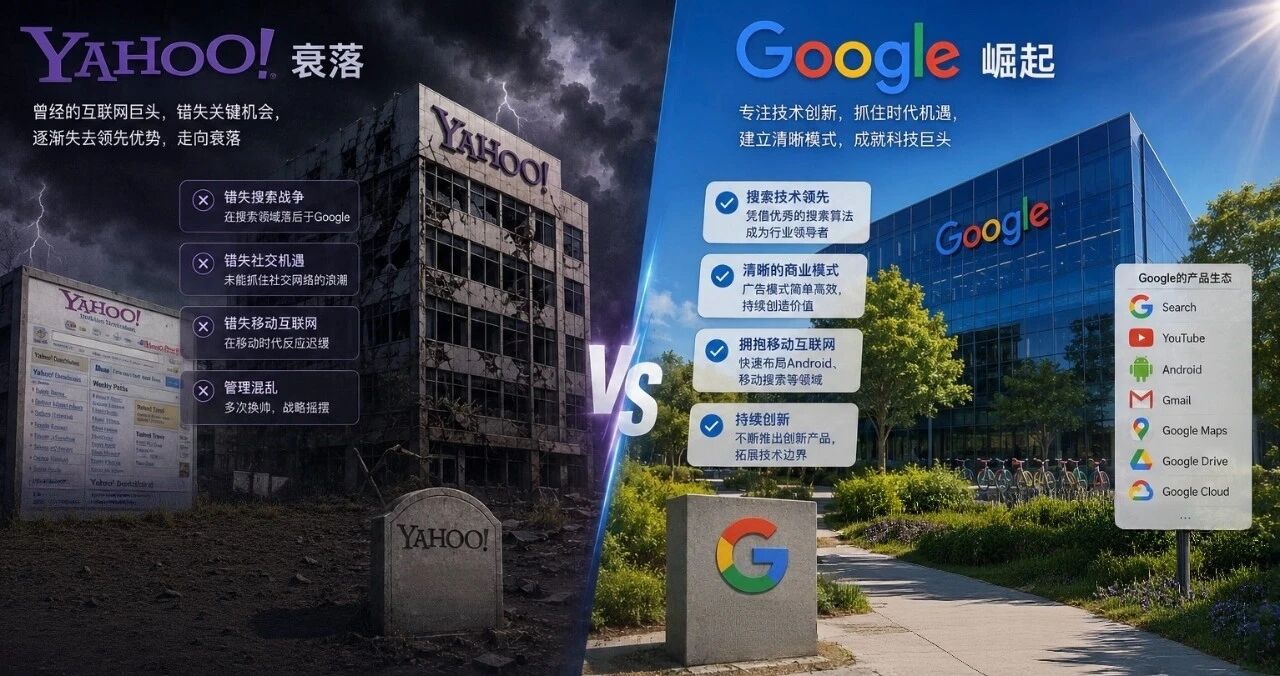
Yahoo and Google serve as two typical examples.
Around 2000, Yahoo was one of the brightest internet stars globally. At the peak of the dot-com bubble, Yahoo's market capitalization once exceeded $100 billion, and it was seen as a symbol of the internet age. However, as the internet shifted from competing on traffic to competing on technology and products, Yahoo gradually lost its leading edge, missing out on key opportunities in search, social media, and mobile internet, ultimately leading to its decline.
In stark contrast, Google, founded in 1998, was just an unremarkable startup during the height of internet mania. After the bubble burst and capital retreated, Google quickly rose to prominence with its superior search technology and clear business model, going public successfully in 2004. Today, Google has become one of the most influential tech companies globally.
History later proved that while technological revolutions change the world, the ones that remain at the table in the end are always the few companies that truly create value.
【04 Epilogue】
In 2002, many pessimistically believed that the internet had failed.
However, looking back from the vantage point of 2026, the internet not only did not disappear but profoundly transformed global commerce and people's lifestyles.
The greatest lesson from the dot-com bubble is that the development of technology, industries, and even market trends is rarely a straight line. People always overestimate how quickly new technologies will change the world in the short term while underestimating their long-term power to reshape it.
The bubble shattered false growth and speculative capital but often created room for truly valuable long-term companies to grow. The companies that collapsed back then were those unable to deliver on their promises. The ones that remained were those that truly created value.
History never repeats itself simply, but human nature's exuberance and fear always manifest in different ways time and again.
——END——
Welcome to follow【Hua Shang Tao Lue】to learn about influential figures and read legendary strategies.
All rights reserved. Unauthorized reproduction is prohibited.
Some images are sourced from the internet.
If infringement is involved, please contact us for removal.
-
![]()
Proposed to Raise 955 Million Yuan through Private Placement! Huicheng Vacuum Boosts Localization of Ultra-Precision Optical Coating Equipment
-
![]()
Cash Flow Soars 13-Fold! What Major Strategic Move is Wuhan Five Square Optoelectronics Planning?
-
![]()
Leaked Design of vivo X500: Reverts to Circular Camera Module in Top-Left Corner, Pays Homage to Classic X90 Aesthetic
-
![]()
DeepSeek Shows Signs of Foraying into Code Agents, Launches WeChat Official Account Focused on Harness
-
![]()
Auto Companies Deny Claims That ‘Cooperation with Huawei Is Non-Essential’, as Huawei Transforms into a ‘Public Platform’
-
![]()
Starship to Independently 'Return to the Launch Tower': SpaceX's Ambitions Extend Beyond Rocket Building to Dominating Space Transportation
-
![]()
Starship Set to Independently 'Return to the Launch Tower': SpaceX is Revolutionizing Space Transportation, Not Just Building Rockets
-
![]()
Anthropic and OpenAI Face Off Against Deepseek