Meituan’s Tabbit Makes Waves in Its First 100 Days
 06/12 2026
 475
475
Author | Wu Xianzhi
Editor | Wang Pan
In historical times, limited medical knowledge and poor hygiene often led to high infant mortality rates within the first 100 days of life. Surviving this critical period became a milestone, celebrated with the "100-day feast" in various cultures—a tradition symbolizing new beginnings and resilience.
A similar concept applies to product development.
On March 2, Tabbit, an AI-native browser developed by Meituan’s Guangnian Zhiwai team, entered public beta testing. After 100 days and 12 rounds of iterative updates, it officially launched its 1.0 version on June 9, coinciding with China’s intense college entrance examination period.
An industry insider previously shared with Photon Planet that the team initially had numerous ideas but remained uncertain about which features would truly resonate with users. Frequent iterations became their strategy to test market response. Now, after continuous feedback from users and the market, the 1.0 version marks the completion of its initial testing phase. Through a series of innovative features, Tabbit’s vision as an AI-powered browser has become clearer:
- Seamless model switching with a new multi-model response feature, enabling up to five AI models to answer the same question simultaneously.
- Enhanced contextual understanding, including cross-conversation memory, local directory mounting, and support for cloud-based MCP protocols.
- Refined "Smart Tricks" system with a "Smart Tricks Plaza" offering a wealth of one-click solutions.
- A kernel upgrade to Chromium 148, paired with synchronized UI and vertical tab bar optimizations.
In terms of pricing, Tabbit 1.0’s standard version remains permanently free, with weekly token quotas resetting automatically. The Pro version, meanwhile, has seen its quota increased tenfold. Interestingly, while Tabbit prominently advertises its "permanent free" model, the browser’s core value lies not in the browser itself but in its AI capabilities.
Tabbit’s First 100 Days: A Supporting Role Transformed
From its inception, Tabbit played a "supporting role" in the browser landscape.
In 1995, Internet Explorer (IE) came bundled with Windows, marking the 1.0 era of browsers. In 2008, Chrome emerged, ushering in the 2.0 era characterized by deep integration between browsers and search engines. However, in the mobile era, as apps became siloed, the browser’s role as a gateway diminished, overshadowed by search functionalities.
By 2025, U.S. browser company The Browser Company discontinued its Arc browser and launched Dia, an AI-powered browser, signaling the dawn of the browser 3.0 era. Shortly after, the parent company was acquired by OpenAI. Overseas, AI-native browsers and AI-transformed traditional browsers are racing ahead in parallel.
In China, AI-driven browser reconfiguration is underway, but the 2.0-era model persists. Browsers primarily serve as vessels for search, communities, SaaS, and plugins—a case of "changing the label without altering the contents."
While traditional browsers may face diminishing returns, AI browsers offer vast untapped potential.
Large language models have vastly enriched web content, with generated articles, reports, and images hosted almost exclusively on web pages. Traditional browsers, already overloaded with SaaS products, plugins, and small windows, struggle to accommodate this new supply. In contrast, AI browsers have the potential to become new containers for this content.
More importantly, traditional browsers and AI tools have failed to adequately address the fragmentation of user scenarios. For example, desktop agents do not resolve repetitive tasks like copying, pasting, uploading, capturing, and inputting, which consume time and result in information loss. Browsers, by their nature, share context with users. When embedded with large language models and agents, they can serve as excellent AI carriers.
Challenges remain. Changing user habits is never easy, and adapting to AI browsers’ new operational and interaction forms takes time. Tabbit’s initial strategy was to provide a low-barrier migration option, allowing users to set it as their default browser upon installation.
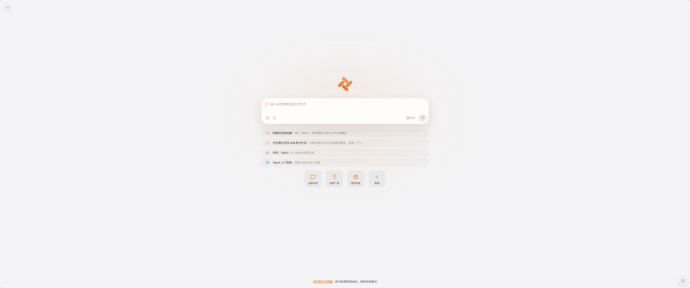
In terms of product design, Tabbit did not reinvent the wheel but retained two core modules of traditional browsers—tabs and bookmarks—while reconstructing them with AI.
When AI operates, it often needs to manipulate web pages, such as filling out forms or clicking links, which can monopolize the mouse and tabs—a common issue users face with AI browsers and agents. Tabbit addresses this through engineering, transforming tabs into tab groups. Users can organize these groups according to their habits or let AI handle the sorting, isolating user activities from agent operations.
When a user assigns a task to an agent, AI creates a new independent tab and runs automatically within it. Meanwhile, the user can browse or work in another tab without interference.

Traditional browser bookmarks only save URLs. Tabbit, however, bookmarks full content and creates RAG indexes, providing contextual support for agent operations.
To address the cross-application fragmentation of AI chat products operating outside user workflows, Tabbit designed the "Smart Tricks" feature. Combined with a sidebar query box, the browser gains the ability to "speak" and "act." For example, it can answer questions based on images and web context, capture content or even comments from the current page, and export them as CSV files.
Clearly, these capabilities still present a barrier to new users. Therefore, in the 1.0 version, Tabbit significantly expanded its "Smart Tricks Plaza," which integrates various functionalities.
A "Smart Trick" is a user-defined functional unit encompassing multiple capabilities, somewhat akin to an AI-enhanced macro command. Prompt template tricks, akin to Skills, compress complex prompts into shortcuts for one-click sending. Auto-execution task tricks allow users to save one-step or multi-step agent tasks as tricks for one-click reuse.
Additionally, Smart Tricks leverage AI to generate JavaScript scripts, modifying web page DOM or behavior, granting them unique web script rewriting capabilities. For example, they can transform Xiaohongshu’s homepage into a Douyin Feed-like layout or an Excel spreadsheet format.
The Functional Puzzle: Multi-Model Integration
Model capability is the "ceiling" for the AI browser experience. Previously, almost all AI browsers were deeply tied to a single model, with the browser’s usability entirely dependent on the model’s performance.
Dia was bound to ChatGPT, while Kuake and Qwen followed suit. This deep vertical integration allowed them to quickly establish user mindshare early on. However, under this model, the browser served merely as a "window" for the model, handling only basic conversations and simple generations.
Later entrants realized that browsers could do much more. Moreover, a "more is better" multi-model approach allows browsers to transcend the limitations of a single model. Starting with QQ Browser, efforts were made to break free from exclusive bindings, evolving from an initial dual-model setup (Hunyuan + DeepSeek) to today’s user-defined configurations.
Tabbit continues QQ Browser’s multi-model approach. Officially, the rationale is that users switch models based on their capabilities, and SOTA models frequently change. Cost considerations also play a role. Model prices fluctuate monthly, with some becoming increasingly expensive. As a provider of limited free integrations, Tabbit dynamically adjusts model calls to keep costs controllable.
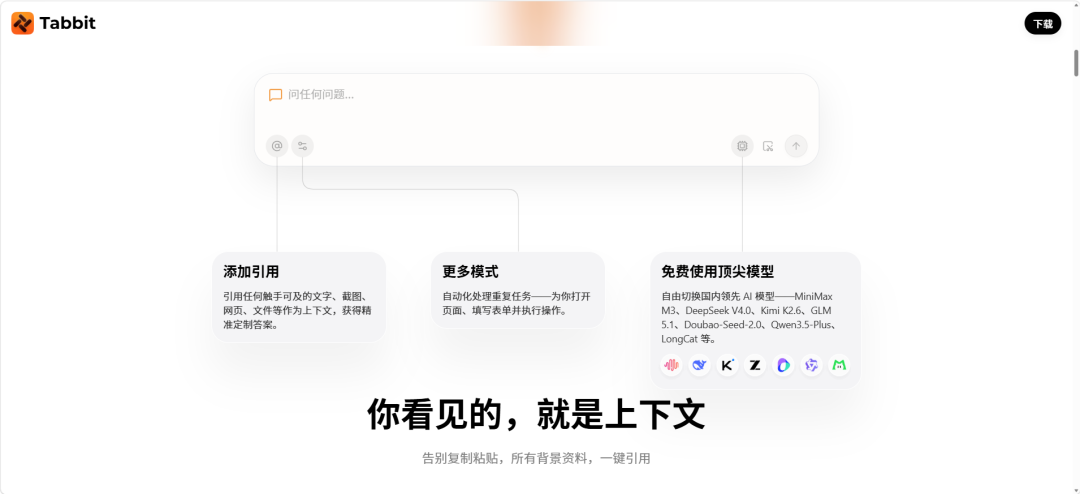
To date, Tabbit has integrated twelve models, including Kimi, MiniMax, DeepSeek, GLM, LongCat, and Qwen, and added a multi-model response feature. Different models excel in different areas, and many users query multiple models to verify results. The team identified this need and introduced the feature.
A strategy of abundance may seem simplistic. From a user perspective, the question is not just about quantity but about which model is best for coding, which for image generation, or even having the system make optimal choices.
Introducing multi-model support allows Tabbit to stand on the shoulders of giants, offering superior capabilities. Another innovation built on previous work is the transformation of the search box.
The Search Box: A Gateway to AI-Powered Interactions
The search box embodies the browser’s evolutionary stages. Early IE browsers could only input URLs in the address bar. With Chrome’s 2008 release, Google replaced the traditional address + search bar with the OmniBox, a supposedly universal input field for keyword searches.
Nearly two decades later, the OmniBox can no longer accommodate new demands. User input has become increasingly diverse, including text, images, documents, and web pages.
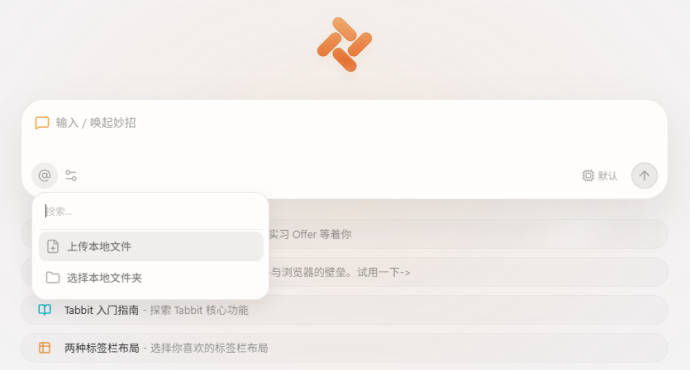
Tabbit follows Chrome’s philosophy, expanding the browser’s boundaries by transforming the search bar without altering user habits. Specific enhancements include: adding citation functionality, supporting local file uploads and batch processing of local folders; distinguishing between "Q&A" and "Tasks," corresponding to lightweight generation and long-running tasks, respectively.
From these upgrades, it is clear that Tabbit’s two main threads in building an AI browser are processing power and contextual completion. Aggregating multiple models addresses the question of "can it be done," while new features like cloud-based MCP, local directory mounting, and memory allow Tabbit to more fully understand the user’s scenario, extending beyond web pages, bookmarks, daily conversations, and task dialogues.
Compared to desktop agents, Tabbit’s cloud-based MCP solution offers several distinct advantages. It eliminates the need to install local environments like Python, saving space and avoiding local pollution. Task execution occurs entirely in the cloud, with AI transmitting only the final results to designated directories. Local directory mounting creates a secure boundary, restricting agent activities to within that circle.
Multi-model responses, Smart Tricks, and a series of contextual building blocks are gradually clarifying Tabbit’s full picture. Tabbit understands that no single feature alone can establish a moat, so it maintains frequent iterations, ensuring that at least one functionality stays three months ahead of competitors.
Meituan’s Approach: Less Intervention, More Imagination?
After Guangnian Zhiwai merged with Meituan, both internal teams released their official products.
The model team joined the LongCat project to continue advancing large model iterations, while the remaining members focused on AI applications. This small team has experimented with various product forms since 2023, eventually deciding to concentrate on AI browsers.
Creating a "new species" is risky and resource-intensive, but browsers offer a relatively stable path. Considering the proliferation of AI Copilot products from cloud giants, Tabbit appears more understated: as long as information is ultimately transmitted and stored in web form, browsers can handle daily office tasks, potentially opening up broader horizons.
If an AI browser possesses complete contextual awareness and agent automation capabilities, it will overlap significantly with AI Copilots. Both offer general capabilities, converge in agent automation, and blur entry-point boundaries. The primary difference may lie in their contextual home fields: browser AI agents operate primarily within the internet web ecosystem, while AI Copilots focus on the local desktop. Tabbit 1.0 takes a small step toward becoming an AI Copilot.
Evaluating Tabbit inevitably involves considering Meituan’s perspective. However, Meituan’s intervention in the team appears minimal so far.
An interesting detail: WeChat AI can now order Meituan takeout directly within chat interfaces, yet Tabbit lacks this functionality—a testament to the team’s independence. In the short term, beyond integrating LongCat, there have been no other moves to link Tabbit with Meituan.
According to an informed source (insider), "Judging by the models integrated, Meituan did not mandate exclusive use of LongCat. The product even incorporates competing models, and the team enjoys high autonomy in version features, iteration direction, and resource allocation."
Currently, Tabbit seems more like a pawn in Meituan’s efforts to expand its ecological imagination. As the browser takes on more daily work tasks, future integration with Meituan’s merchant platform appears both realistic and imaginative. After all, many business activities of Meituan merchants unfold on web pages, making Tabbit’s role increasingly vital.
-
![]()
Proposed to Raise 955 Million Yuan through Private Placement! Huicheng Vacuum Boosts Localization of Ultra-Precision Optical Coating Equipment
-
![]()
Cash Flow Soars 13-Fold! What Major Strategic Move is Wuhan Five Square Optoelectronics Planning?
-
![]()
Leaked Design of vivo X500: Reverts to Circular Camera Module in Top-Left Corner, Pays Homage to Classic X90 Aesthetic
-
![]()
DeepSeek Shows Signs of Foraying into Code Agents, Launches WeChat Official Account Focused on Harness
-
![]()
Auto Companies Deny Claims That ‘Cooperation with Huawei Is Non-Essential’, as Huawei Transforms into a ‘Public Platform’
-
![]()
Starship to Independently 'Return to the Launch Tower': SpaceX's Ambitions Extend Beyond Rocket Building to Dominating Space Transportation
-
![]()
Starship Set to Independently 'Return to the Launch Tower': SpaceX is Revolutionizing Space Transportation, Not Just Building Rockets
-
![]()
Anthropic and OpenAI Face Off Against Deepseek