The World's First Trillionaire Emerges: Is SpaceX's $2 Trillion Valuation Justified?
 06/15 2026
 607
607
By Liu Jun
This article is co-produced by NetEase News and Caijing Wuji.
As expected, SpaceX (SPCX.US) surged over 19% on its debut, pushing its market capitalization past $2 trillion. Elon Musk also became the world's first trillionaire through his combined stakes in SpaceX and Tesla.
SpaceX priced its IPO at $150 per share, meaning capital markets assigned a 94.7x price-to-sales ratio to a rocket company—one projecting $18.67 billion in 2025 revenue and a restated net loss of $4.94 billion after merging with xAI. The IPO raised at least $75 billion, 2.9x Saudi Aramco's $25.6 billion base offering in 2019.
No conventional valuation model justifies this price. But everyone knows buying SpaceX is essentially betting on three futures.
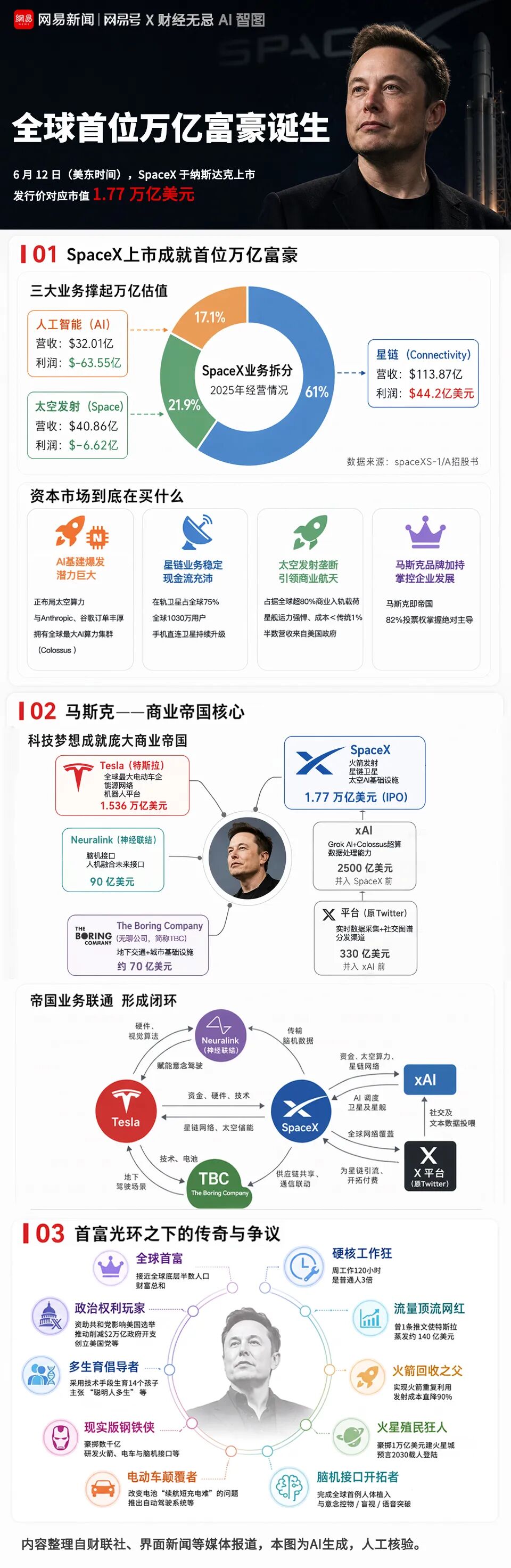
Musk holds six cards across four battlefields.
The space layer: SpaceX rockets and over 10,300 Starlink satellites. The Earth layer: Tesla's 6 million EVs and ramping Optimus robots. The data layer: xAI's Colossus supercomputer and Grok large model. The bio layer: A small card—Neuralink brain-machine interface, with negligible revenue but pointing to the longest-term bet—human-machine fusion.
These six cards span four battlefields, seemingly unrelated. What unites them are three 'pipelines' between the fronts.
Energy flow. Tesla installed a $375 million Megapack energy storage system for xAI's Memphis supercomputing center, supporting nearly 2 gigawatts of power demand—equivalent to a mid-sized city's electricity consumption. xAI and SpaceX's massive energy consumption, in turn, provides Tesla Energy with industrial-scale scenarios, elevating it from a single-product division to the energy foundation of the entire empire.
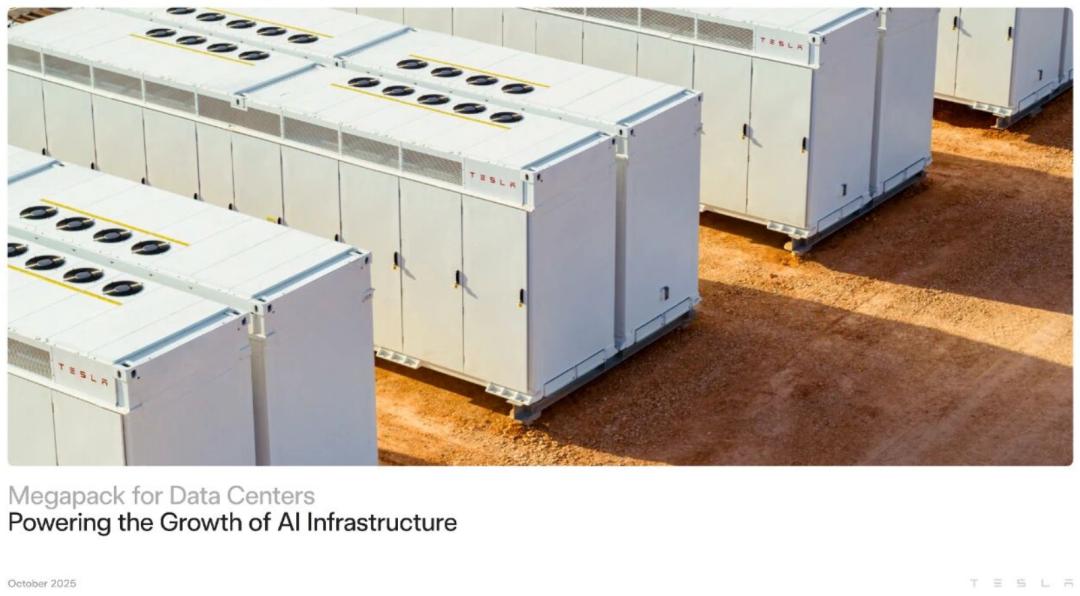
Without Tesla's batteries, xAI's supercomputers couldn't sustain operations; without xAI's computing demand, Tesla Energy's scale-up would lag by years.
This is a mutually beneficial deal, but both parties share the same boss—meaning no negotiation table, no Game of interests (interest game theory , 'interest game'), just a single command. Synergy efficiency is multiples of market-driven cooperation, but risks concentrate in the same decision-maker.
Data flow. Tesla's global fleet—6 million vehicles, each with 8 cameras—forms humanity's largest physical-world sensor network. FSD has accumulated 10 billion miles of driving data, adding 29 million miles daily.
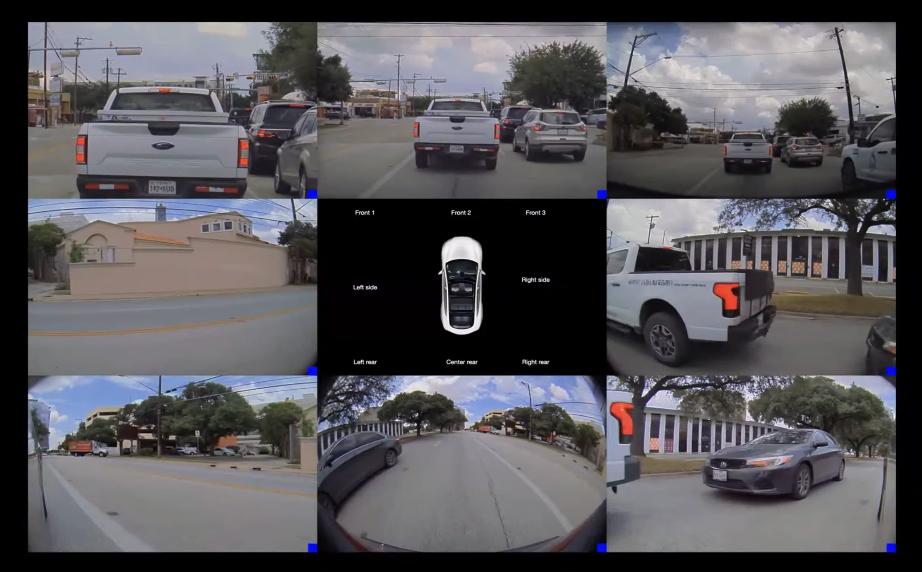
This data feeds into Colossus's 200,000+ GPUs, training better FSD, Grok, and Optimus models, which deploy back to the fleet via OTA, generating more data and scenarios.
Each rotation of this flywheel leaves competitors further behind. Waymo and Cruise don't lack algorithms—they lack 6 million vehicles driving 24/7 on real roads.
Cash flow. Falcon rocket launch costs $1,500/kg, less than a third of the industry average ($5,000/kg), capturing 80% of global launch share. Starlink covers 164 countries with over 12 million users, generating $11.4 billion in annual revenue and ~$4.4 billion in operating income.
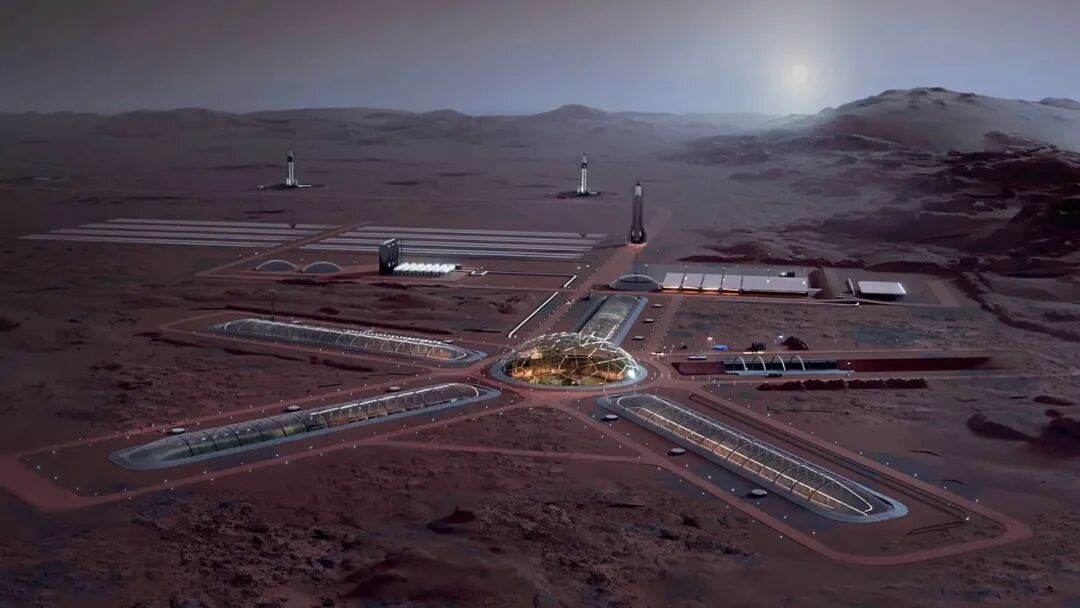
These funds fuel Starship's next-gen rockets and space-based AI data center deployments. Rocket cost reductions enable more satellite launches; satellite networks generate subscription fees; those profits build bigger rockets. A self-feeding cycle.
These three pipelines interdepend, forming a metabolic system for civilization-scale infrastructure.
Quarterly profits were never the goal—this foundation must bear the weight of sending humanity to multiple planets. Perhaps quarterly reports are merely thermometers, not engines, for this system.
Of course, the system's risk lies here—a break in any link loosens the entire chain.
The larger and more self-contained the closed loop (closed loop), the more traditional valuation models fail.
Morningstar assigns SpaceX a fair value of $780 billion, just 44% of the IPO price, arguing xAI's persistent losses and terminable AI computing contracts can't justify a trillion-dollar valuation.
Valuation authority Aswath Damodaran anchors fair value at $1.3 trillion, calling SpaceX's $26 trillion AI market size estimate overly aggressive. Goldman Sachs' bullish model projects $474 billion in revenue by 2030.
The bull-bear divide persists. SpaceX's value isn't found in financial reports. The true variable lies in three unrealized options.
Option 1: Global Monopoly—Starlink.
Starlink's EBITDA margin is 63%, with nearly $5 billion in annualized profit—the company's only consistently profitable business and cash engine for space dreams. With coverage in 164 countries and over 12 million users, Starlink is already a quasi-monopoly in space internet.
Exclusive access to low-Earth orbit spectrum and orbital slots will further raise barriers for this 'sky net' over time. Competitors must not only build satellites but seize occupied orbital positions—a physically escalating threshold.
Option 2: AI Infrastructure Supercycle.
Two weeks before the IPO, SpaceX secured $1.25 billion/month from Anthropic and $920 million/month from Google for AI computing, totaling $26 billion annualized—exceeding Starlink's annual revenue. Colossus supercomputer, built with 220,000 GPUs in 122 days, now drives the company's largest revenue growth and valuation expansion.
AI computing is evolving from an 'arms race' to an 'infrastructure arms race.' SpaceX holds Tesla's energy foundation and engineering capabilities, granting a unique cost structure. While competitors rent data centers and buy power/storage, SpaceX builds everything in-house. Vertical integration means pricing power in the AI era.
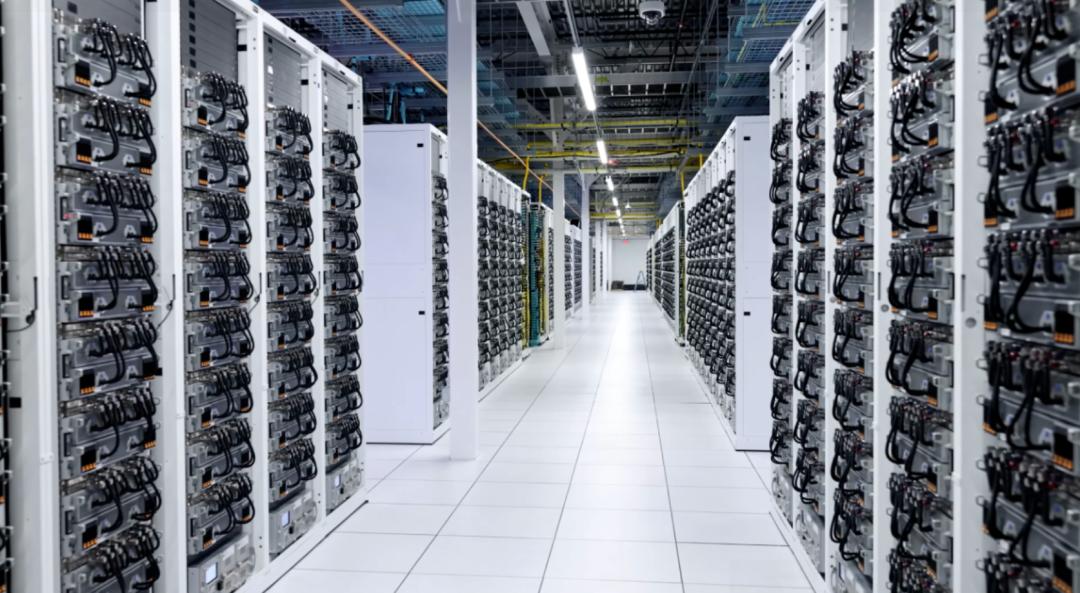
While rivals negotiate long-term power deals, SpaceX generates, stores, and consumes energy within its ecosystem—a closed-loop calculation.
Option 3: Space-Based Data Center Revolution.
Orbital solar radiation intensity is ~36% higher than ground-level, enabling continuous power generation without day/night or weather disruptions. The FCC has accepted SpaceX's orbital data center spectrum application and launched public review. Markets price this option at $30–50 billion.
This seems the most distant and sci-fi—but if realized, it would rewrite global computing and energy geography. Moving data centers to space solves cooling and land issues; the only hurdle is cheap, frequent rocket launches. SpaceX is solving that.
With SpaceX's listing, Musk becomes humanity's first trillionaire through 42% economic interest and 85% voting rights. He holds three tickets to different futures, each capable of redefining an industry.
Whether these options materialize hinges on one variable: Market forces and technical roadmaps can't control it—only one man's judgment, energy, and mental state.
This single point is harder to price and hedge than any financial risk.
Musk, 54, wears contradictory labels.
A 'first principles' devotee—rejecting analogies, reducing things to physical essentials. With rocket raw material costs at 2% of finished products, he slashed launch costs to 1/10th by building in-house. Battery materials cost ~$80/kWh; his factory reduced pack costs to ~$100.
Yet he's also a 'nanomanager'—ten billion times deeper than micromanagement. Three weeks before Model S delivery, he redesigned the body; employees always get three choices: rebut, clarify, execute.
In winter 2008, SpaceX's first three launches failed, and Tesla neared bankruptcy. He bet his last $35 million on both companies. A fourth failure would leave days of cash. That darkest moment became his grandest gamble.
Fourteen years later, his $44 billion Twitter acquisition became commerce's most controversial bet. To date, its financial returns remain murky, but it proved the same truth: Musk won't stop at anyone's 'appropriate' time.
'I want to die on Mars—just not on impact.'""This all-in ethos built his empire but backfired politically.
His 2025 political crossover leading DOGE to cut $2 trillion in government spending slashed Tesla's brand recommendation score from 8.2/10 (2023) to 4.0/10 (2025), eroding 36% of brand value and sending shares tumbling. A 2020 tweet once wiped $14 billion from Tesla's market cap in a day.
Creativity and destructiveness stem from the same mind.
Musk openly admits having Asperger's: social difficulties, hyperfocus, and ability to immerse for tens of hours on single problems. This neurodiversity may hold the key to understanding him. Genius and madness coexist—you can't separate them.
You can't buy SPCX stock and accept only the Mars colonist while rejecting the 3 AM tweet-disrupting market agitator. Betting on Musk means betting on the whole package—genius and madness, bundled together. That's the hardest-to-value, unhedgeable portion of $1.77 trillion.
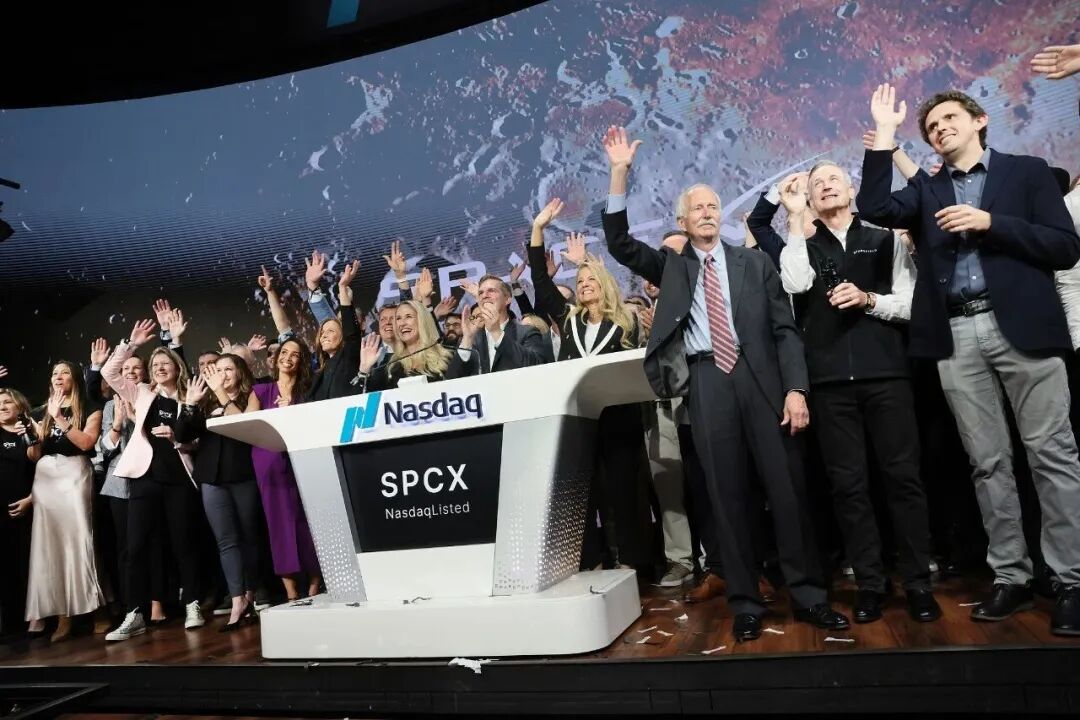
From SpaceX's 2002 founding to its 2026 trillion-dollar listing, Musk took 24 years.
In those 24 years, he didn't eliminate this single-point risk—he made it increasingly worth bearing. Each near-bankruptcy, market disruption, and political crossover accelerated this metabolic machine rather than ending it.
Perhaps that's what markets truly price: The present value of three options is part of it; the rest is this man's survival rate under extreme pressure—repeatedly cornered yet repeatedly emerging.
When the Nasdaq bell rang, financial statements never set the price. What justified $1.77 trillion was a narrative about humanity escaping Earth's cradle and a obsessive soul repeatedly validated—no matter how close to collapse.
Does this empire have an endgame? Maybe. But before it arrives, Musk has done something no one else could: He turned a rocket company's IPO into a nationwide referendum on the future.
-
![]()
Proposed to Raise 955 Million Yuan through Private Placement! Huicheng Vacuum Boosts Localization of Ultra-Precision Optical Coating Equipment
-
![]()
Cash Flow Soars 13-Fold! What Major Strategic Move is Wuhan Five Square Optoelectronics Planning?
-
![]()
Leaked Design of vivo X500: Reverts to Circular Camera Module in Top-Left Corner, Pays Homage to Classic X90 Aesthetic
-
![]()
DeepSeek Shows Signs of Foraying into Code Agents, Launches WeChat Official Account Focused on Harness
-
![]()
Auto Companies Deny Claims That ‘Cooperation with Huawei Is Non-Essential’, as Huawei Transforms into a ‘Public Platform’
-
![]()
Starship to Independently 'Return to the Launch Tower': SpaceX's Ambitions Extend Beyond Rocket Building to Dominating Space Transportation
-
![]()
Starship Set to Independently 'Return to the Launch Tower': SpaceX is Revolutionizing Space Transportation, Not Just Building Rockets
-
![]()
Anthropic and OpenAI Face Off Against Deepseek