Li Jie's 'High-Speed Charge' and J&T Express's 'Abrupt Halt'
 06/15 2026
 600
600

The 'Price War Champion' of the Express Delivery Industry Has Suffered Setbacks.
On June 11, CCTV reported that the State Post Bureau had launched an investigation into J&T Express, citing frequent workplace safety incidents and systemic issues in safety management.
Previously, the Changsha Postal Administration in Hunan Province had already penalized J&T Express for network disruptions and service quality issues, indicating that this was not an isolated incident.
The official stance is unequivocal: the express delivery industry must shift from reactive accountability to proactive systemic governance. J&T Express, the new 'Price War Champion,' stands at a pivotal juncture.
'OPPO Alumnus' Li Jie: Entrepreneurial Prowess, Governance Shortcomings
Early in his career, Li Jie played a pivotal role in the BBK marketing system. His 'OPPO DNA' has profoundly influenced J&T Express's corporate culture. However, this very trait has proven to be a double-edged sword.
OPPO-Inspired Strategy Drives 'J&T Speed.' J&T Express's meteoric rise was fueled by Li Jie's OPPO-inspired approach—a 'regional franchise' asset-light model that capitalized on a robust dealer network for rapid market penetration and swift channel expansion to capture market share.
This OPPO-inspired strategy, initially a proven formula in the consumer electronics sector, demonstrated remarkable adaptability when applied to the express delivery and logistics industry. J&T Express surged from obscurity to an industry leader, processing over 20 million parcels daily in less than two years.
Emphasis on Expansion Over Refinement. The OPPO-inspired approach reflects Li Jie's external strategy, while his core belief that 'scale is the ultimate defense' has driven his decision-making. Prioritizing market share acquisition above all else, this aggressive business philosophy was well-suited to the company's startup phase.
However, as J&T Express matures, the 'scale is the ultimate defense' mentality has become a strategic pitfall. Express logistics demand precision operations; securing market share is merely the first step, with standardized management being the linchpin for sustained success—a lesson Li Jie may not have fully internalized.
Systemic Risks Lurk Beneath the Founder's Aura. Li Jie, a bold and decisive entrepreneur, is widely credited with orchestrating J&T Express's acquisition of Best Inc.'s domestic operations and its subsequent Hong Kong IPO.
Yet, Li Jie's strong, almost 'maverick' persona could become a governance liability during the company's consolidation phase. Much like the outlaws of Liangshan, who dared not oppose their leader Song Jiang, if Li Jie remains the sole arbiter of decisions, it could trigger systemic compliance risks.
Structural Dilemma: Overseas Profitability vs. Domestic Losses
J&T Express's 2025 financial report reveals total annual revenue of $12.158 billion, up nearly 20% year-on-year, with adjusted net profit doubling—a seemingly rosy picture.
However, a closer examination reveals a structural imbalance: overseas markets are 'profitable,' while the Chinese market is 'hemorrhaging.'
Global Triumph vs. Domestic Struggle. In 2025, J&T Express's profit structure exhibited a stark domestic-international divide: the Southeast Asian market contributed roughly one-fourth of parcel volume and $538 million in adjusted EBIT, while the Chinese market accounted for about three-fourths of parcel volume but only $94 million in adjusted EBIT.
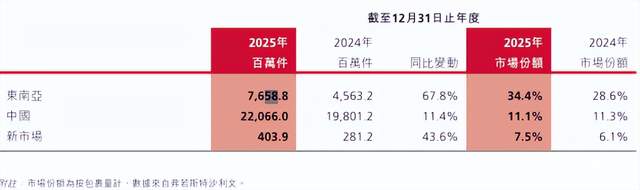
J&T Express's 2025 regional parcel volume distribution. Source: Official financial report.
With China's parcel volume triple that of Southeast Asia but profits only one-fifth, the question looms: Why?
Low-Price Model Reaches Its Limits, Resulting in 'Increased Volume, Decreased Profits.' In 2020, J&T Express entered the Chinese market with rock-bottom prices like '8 mao nationwide.' While initially successful, its prolonged reliance on low-price strategies has eroded domestic profitability.
Since July of the previous year, when the State Post Bureau launched an 'anti-price war' campaign, J&T Express has faced a quandary: raising prices means ceding market share, while lowering prices violates regulations.
Network Contraction and Endpoint Control Loss. More alarmingly, to sustain low prices, J&T Express has excessively slashed delivery fees in some regions, rendering grassroots outlets unprofitable. Some outlets now operate at a loss, prompting franchisees to 'jump ship.'
Official financial reports indicate a net reduction of 500 domestic outlets in Q4 2025, with service quality suffering as a result. As of press time, J&T Express has amassed over 57,000 complaints on the Heimao (Black Cat) complaint platform.
'Punishment-Centric Management': Profit at the Expense of Substance
A contentious aspect of J&T Express's management system is its 'punishment-centric' approach, using fines as a substitute for refined operational enhancements. This one-size-fits-all strategy is a ticking time bomb.
Fines as a 'Profit Lever.' This system offers two immediate perks: first, it exerts clear pressure on franchisees and couriers, with penalties for failing to meet targets, customer complaints, or procedural breaches creating a facade of order.
Second, internal fines transform service improvement costs into direct revenue for headquarters—a crucial consideration for a publicly traded company.
Headquarters' Comfort vs. Grassroots Strain. On the surface, 'punishment-centric management' appears efficient. The 2025 financial report shows adjusted net profit of $425 million, up 112.3% year-on-year, with headquarters' profitability significantly bolstered.
Yet, as financial metrics improve, pressure on the grassroots has intensified. Lower delivery fees and escalating fines have left some couriers and franchisees struggling to make ends meet, inevitably compromising service quality.
Price War Backlash and Regulatory Stop Signs. J&T Express's domestic operations have seen grassroots outlets default on wages and personnel 'abandon ship.' Since 2025, postal administrations in Liaoning, Henan, and other regions have repeatedly summoned J&T Express executives and imposed fines for outlet operational irregularities and parcel backlogs.
The facts are unmistakable: J&T Express's management capabilities have not kept pace with its rapid scale expansion. If these conditions deteriorate, the company could face even stricter regulatory measures.
Breakthrough: From 'Wild Growth' to 'Sustainable Development'
The regulatory investigation serves as both a cautionary tale and an opportunity. Since J&T Express must reform, it might as well seize the initiative.
Rebuilding Safety and Compliance Standards. Workplace safety is now an absolute priority. The State Post Bureau's investigation highlights J&T Express's failure to implement unified safety management, meaning headquarters must establish normalized control over all network outlets and embed compliance into every operational facet.
Transitioning from 'Scale First' to 'Service First.' The express delivery industry has entered a new era, where J&T Express's old model of rapid expansion through capital subsidies is no longer viable.
J&T Express must restructure its profit model by leveraging technology to enhance operational efficiency rather than relying heavily on manpower. It should also explore high-value-added services like cloud warehousing and reverse logistics (returns processing) to foster a virtuous cycle of improved service quality and business structure.
Leveraging Global Expertise for Local Adaptation. J&T Express's success in Southeast Asia and Latin America stems from respecting local market dynamics, forging long-term win-win relationships with franchisees, and prioritizing service reputation.
These principles are equally applicable to the Chinese market. J&T Express could revamp its domestic franchise ecosystem by reducing punitive fines and setting reasonable delivery fees to ensure healthy outlet operations. Above all, the company must demonstrate sufficient respect for its employees and franchisees.
Can J&T Express surmount this transformational hurdle? The market awaits a definitive answer.
-
![]()
Proposed to Raise 955 Million Yuan through Private Placement! Huicheng Vacuum Boosts Localization of Ultra-Precision Optical Coating Equipment
-
![]()
Cash Flow Soars 13-Fold! What Major Strategic Move is Wuhan Five Square Optoelectronics Planning?
-
![]()
Leaked Design of vivo X500: Reverts to Circular Camera Module in Top-Left Corner, Pays Homage to Classic X90 Aesthetic
-
![]()
DeepSeek Shows Signs of Foraying into Code Agents, Launches WeChat Official Account Focused on Harness
-
![]()
Auto Companies Deny Claims That ‘Cooperation with Huawei Is Non-Essential’, as Huawei Transforms into a ‘Public Platform’
-
![]()
Starship to Independently 'Return to the Launch Tower': SpaceX's Ambitions Extend Beyond Rocket Building to Dominating Space Transportation
-
![]()
Starship Set to Independently 'Return to the Launch Tower': SpaceX is Revolutionizing Space Transportation, Not Just Building Rockets
-
![]()
Anthropic and OpenAI Face Off Against Deepseek