SpaceX Becomes the Largest IPO in History: Has Capital Surrendered to Technology?
 06/15 2026
 663
663
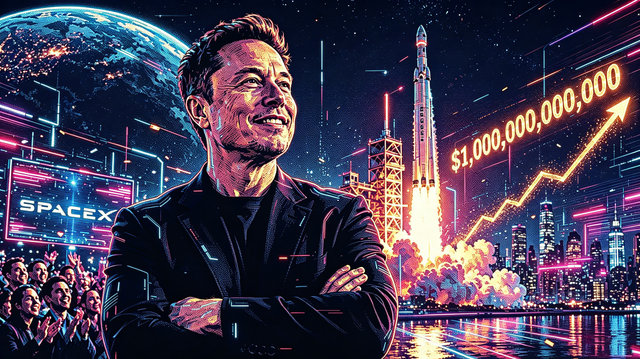
At $135 per share, with 555.6 million shares, the total raise is $75 billion.
On June 12, SpaceX landed on Nasdaq. The fundraising scale more than doubled the previous record of $29.4 billion set by Saudi Aramco in its 2019 IPO, dubbed the "largest IPO in history." Total subscription demand surged past $350 billion, nearly four times oversubscribed, with institutions pouring in $250 billion and retail orders exceeding $100 billion. Nearly one-third of institutions ultimately failed to secure allocations.
On its debut, shares opened at $150, peaked at $176 intraday, and closed at $160.95, up 19.22%. The market cap soared to $2.1 trillion, making the rocket-building company the world's sixth-largest publicly traded entity.
This time, Musk skipped Wall Street's traditional book-building process. Instead, he set a fixed price of $135 per share, as if to say: Take it or leave it. Twenty-three underwriters, including Goldman Sachs, Morgan Stanley, Bank of America, Citi, and JPMorgan Chase, went all-in. Analysts fielded 20 institutional inquiry calls per day—double the usual 10–15 for hot IPOs.
Historically, Wall Street repeatedly "taught lessons" to story-driven tech IPOs with post-listing declines or valuation crashes. Uber fell 7.6% on its debut, Lyft traded below one-third of its IPO price, and WeWork never even reached the market after its S-1 filing exposed a "rent-high, sublet-low" business model, collapsing its valuation from $47 billion. Snap surged 44% on day one but fell back to its IPO price within six months. This script worked every time—until SpaceX.
The question lingers: How did this company pull it off?
01
The IPO Curse of Tech Companies
In 2019, ride-hailing pioneer Uber went public at $45 per share, closing 7.6% lower on day one and wiping out billions in market value. That same year, rival Lyft debuted at $72 per share, then slid continuously, trading below one-third of its IPO price for extended periods. WeWork, once favored by SoftBank's Masayoshi Son, never even listed—its S-1 filing revealed a business model of "overpaying for rent and undercharging subtenants," crashing its valuation from $47 billion and forcing a withdrawal. Snap jumped 44% on debut but fell below its IPO price within half a year.
These companies shared a trait: They went public with "stories" that Wall Street systematically dismantled.
Capital markets operate on their own models, valuing companies based on profits, cash flow, and calculable certainty—not narratives about "future profitability." This became an unwritten rule: Tech IPOs typically marked valuation peaks, not starting points.
Top entrepreneurs caught on. Why go public if you don't have to? With abundant financing channels and deep private markets, there was no need to submit to public market scrutiny. Global payments giant Stripe, processing a significant share of Silicon Valley's online transactions and having raised tens of billions, delayed its IPO indefinitely. Databricks, a big data/AI unicorn, packaged data analytics as a corporate necessity, with clients clamoring to sign deals and its valuation soaring—yet it too postponed listing. "Delaying IPOs" became a statement: We don't need your valuation.
SpaceX outlasted them all. Founded in 2002, it remained private for over two decades, with private market valuations soaring from hundreds of millions to over $200 billion. Musk long viewed going public with caution, arguing that a private structure could block short-term noise and focus on decades-long goals like Mars colonization. It wasn't that SpaceX lacked IPO opportunities—it believed listing would be a distraction.
What changed was scale. Starlink deployment, next-gen heavy rockets, and Starship iterations—these projects burned cash faster than private capital could sustainably supply. Private markets had reached their limit; public markets were the only pool large enough. Going public became a mathematical necessity, not a choice.
Musk placed his bet. The result: the scene at the opening. Market enthusiasm bordered on hysteria, with media praising SpaceX to the skies. The curse that worked on Uber, Lyft, and WeWork failed here.
02
What Makes SpaceX Different?
When Uber went public, investors bought into the "vision of a mobility platform." When WeWork raised funds, SoftBank bet on a "space-as-a-service" paradigm. These narratives followed a familiar structure: Losses now are acceptable; profitability will come with scale.
SpaceX's IPO told a different story.
Its Starlink division generated ~$11.4 billion in revenue last year, with $4.4 billion in operating profit—a ~40% margin—and over 10 million global users. This time, capital markets faced not a story but hard numbers.
The rocket side mirrored this. Before SpaceX developed reusable rockets, launching a single mission cost ~$60 million, with the rocket discarded afterward. Now, Falcon 9 launch costs reportedly drop to ~$15 million per mission, a ~75% reduction. Critically, rockets are recovered and reused—some fly over a dozen times. In aerospace, this is akin to inventing an airplane that folds into your pocket after flight.
Lower costs reshaped the market. Launching a satellite was once a national budget item; now, SpaceX's pricing made commercial clients' math work. Launch frequency exploded—by 2025, SpaceX conducted ~51% of all global orbital launches. Not 51% of market share, but 51% of total launches. All other players combined barely matched its volume.
Its moat wasn't just cost but data and iteration speed. Every launch gave SpaceX engineering experience competitors couldn't buy. Rocket recovery tech, Starlink constellation density, ground station coverage—these barriers deepened exponentially with each launch.
Hence the institutional rush. Buying Uber was a gamble; buying SpaceX felt like catching up. The company's fundamentals were already clear—they just lacked public market access. This IPO wasn't about SpaceX needing money; it was about opening a door for capital that had waited years.
03
Who Really Won?
The easy conclusion: Silicon Valley beat Wall Street. Tech companies no longer dance to capital markets' tune; pricing power shifted to founders.
But that's too simplistic.
Wall Street's models never failed—they just met a rare opponent: a company combining "real profitability," "monopolistic moats," and "a long growth runway." SpaceX broke the curse by becoming a stock capital markets would naturally love. It played by Wall Street's rules—and aced them.
The real question is what this changes.
For Silicon Valley, SpaceX offers a new playbook. Past "story-driven" IPOs were pushed by VC timelines—fund, expand, scale, exit. The endpoint was capital withdrawal, not long-term health. This compressed the time to build real moats and forced founders to prioritize storytelling.
SpaceX took the opposite path. Two decades without IPOs meant two decades without explaining every decision to public markets. Failed rocket launches drew no analyst reports; R&D burns faced no quarterly pressure. This freedom bred unmatched technical depth. By the time it listed, it no longer needed the IPO to validate itself.
Can this be replicated? Probably not. The core barrier isn't just patience but a near-impossible prerequisite: finding investors willing to wait 20 years. Most VC funds have 10-year lifespans. SpaceX survived its darkest days because Musk repeatedly bet his last dollars and a few institutions shared his extreme long-term view. That combo is rare.
But SpaceX proved one thing: When technology is hard enough and time accumulates sufficiently, capital markets will negotiate, not dictate. The rules didn't change—someone just played them to the limit and held that ground.
That's what truly matters about SpaceX's IPO.
Epilogue
A Silicon Valley legend: Early in SpaceX's history, an employee, skeptical the company would ever go public, traded his stock for Chili's restaurant gift cards—redeemable for ~$30 in burgers and fries.
This story is often told to illustrate "long-termism."
But viewed differently, the more intriguing part is the two decades before that $75 billion moment: A company, without public market pricing, with even its own employees doubting its future, achieved something capital markets could no longer ignore.
The premise, of course, is that capital markets acknowledge this. They acknowledged SpaceX because it met their standards. But what about endeavors that never fit those standards—projects requiring longer timelines, harder-to-quantify progress, and more uncertain returns? Will anyone pursue them? Will capital wait?
That's the other question worth pondering after SpaceX's IPO.
-
![]()
Proposed to Raise 955 Million Yuan through Private Placement! Huicheng Vacuum Boosts Localization of Ultra-Precision Optical Coating Equipment
-
![]()
Cash Flow Soars 13-Fold! What Major Strategic Move is Wuhan Five Square Optoelectronics Planning?
-
![]()
Leaked Design of vivo X500: Reverts to Circular Camera Module in Top-Left Corner, Pays Homage to Classic X90 Aesthetic
-
![]()
DeepSeek Shows Signs of Foraying into Code Agents, Launches WeChat Official Account Focused on Harness
-
![]()
Auto Companies Deny Claims That ‘Cooperation with Huawei Is Non-Essential’, as Huawei Transforms into a ‘Public Platform’
-
![]()
Starship to Independently 'Return to the Launch Tower': SpaceX's Ambitions Extend Beyond Rocket Building to Dominating Space Transportation
-
![]()
Starship Set to Independently 'Return to the Launch Tower': SpaceX is Revolutionizing Space Transportation, Not Just Building Rockets
-
![]()
Anthropic and OpenAI Face Off Against Deepseek