Why Is the Gap Between Alibaba and Tencent Widening?
 06/15 2026
 515
515
Several years ago, whenever the topic of China's internet landscape arose, Alibaba and Tencent inevitably took center stage.
These two behemoths dominate China's internet sector. Alibaba, with its e-commerce core, has expanded into areas such as local life services, logistics, AI, and payments. It has also made substantial investments in numerous enterprises, forging a powerful alliance.
Alibaba's primary competitor was Tencent, which centered on social networking and branched out into gaming, content ecosystems, fintech, and beyond. Likewise, Tencent has made extensive investments without seeking controlling stakes, deploying capital across thousands of companies in e-commerce, transportation, local life services, gaming, technology, and more, thereby constructing a vast Tencent ecosystem.
In the past, these two companies faced no significant rivals in China and were the highest-valued internet enterprises, with comparable scales, making them well-matched competitors.
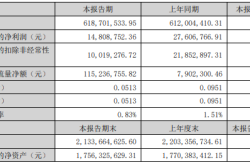
However, a closer look today reveals that Tencent appears to be strengthening, while Alibaba is gradually falling behind. The following image provides a comparison of their market capitalizations and financial data.
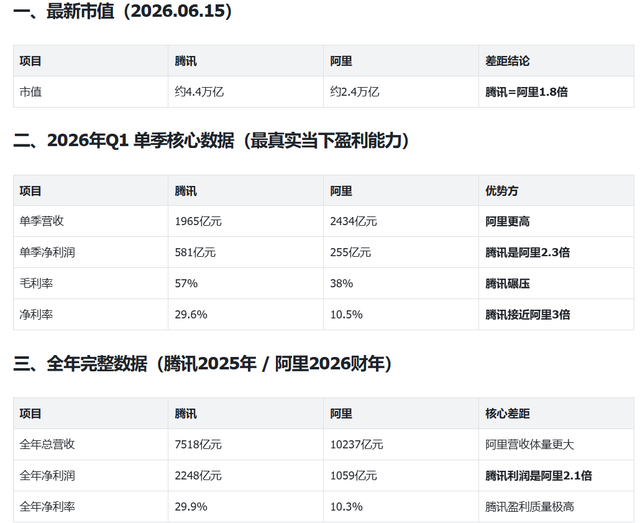
As evident, although Alibaba generates higher revenue, its market capitalization is approximately half that of Tencent's, and its profits are less than half, with a net profit margin only about one-third of Tencent's.
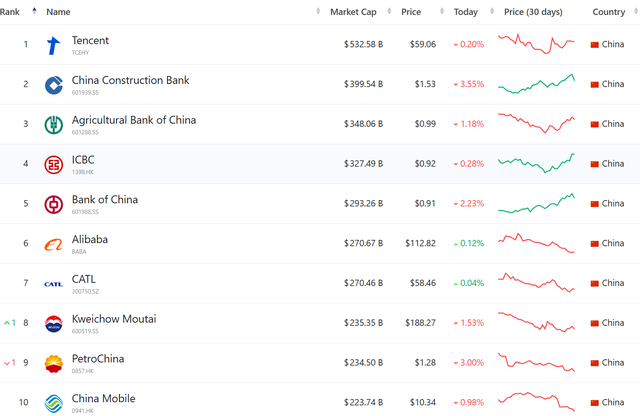
Alibaba has greater revenue but significantly weaker profitability compared to Tencent. Consequently, the capital market has also made its choice. Tencent's market capitalization exceeds $532 billion, ranking 23rd globally and first among mainland Chinese enterprises.
Alibaba's market capitalization is around $270 billion, ranking 62nd globally and sixth among mainland Chinese enterprises, seemingly no longer able to compete on equal footing with Tencent as before.
Why is this the case? On one hand, it relates to their respective business models.
Tencent's social networking dominance remains unchallenged. WeChat holds a monopoly in the mobile internet space, while QQ does the same in the PC internet space. Based on this foundation, various businesses have flourished.
Businesses and relationships built on social networking, in the absence of rivals, are utilized by everyone and are indispensable, growing stronger with an increasingly fortified moat.
Coupled with Tencent's investment strategy of providing capital without seeking controlling stakes or interfering in operations, while offering resources to foster growth, enterprises within the Tencent ecosystem tend to favor Tencent.
Although Alibaba's e-commerce sector remains robust, it now faces numerous challengers, including Pinduoduo, JD.com, and Meituan, which are constantly impacting Alibaba's core business in e-commerce and local life services.
In the payment sector, Alibaba has once again encountered its old rival, Tencent.
Additionally, in recent years, with Jack Ma's retirement, there have been some internal dissonances within Alibaba, such as the recent DingTalk incident, and the 996 work culture has faced widespread criticism.
Moreover, Alibaba's investment approach often involves acquiring controlling stakes and restructuring according to Alibaba's vision. However, successful transformations are rare, and most restructuring efforts have failed, hindering Alibaba's empire from continuously expanding.
Of course, Alibaba is currently strong in some cutting-edge software and hardware technologies, such as chips, AI, and cloud computing, but these have not yet fully materialized.
Meanwhile, Tencent's profits are steadily growing, and its profit margins are high, causing the gap in market capitalization between the two companies to widen. As for the future, it remains uncertain, so we shall wait and see.
-
![]()
Proposed to Raise 955 Million Yuan through Private Placement! Huicheng Vacuum Boosts Localization of Ultra-Precision Optical Coating Equipment
-
![]()
Cash Flow Soars 13-Fold! What Major Strategic Move is Wuhan Five Square Optoelectronics Planning?
-
![]()
Leaked Design of vivo X500: Reverts to Circular Camera Module in Top-Left Corner, Pays Homage to Classic X90 Aesthetic
-
![]()
DeepSeek Shows Signs of Foraying into Code Agents, Launches WeChat Official Account Focused on Harness
-
![]()
Auto Companies Deny Claims That ‘Cooperation with Huawei Is Non-Essential’, as Huawei Transforms into a ‘Public Platform’
-
![]()
Starship to Independently 'Return to the Launch Tower': SpaceX's Ambitions Extend Beyond Rocket Building to Dominating Space Transportation
-
![]()
Starship Set to Independently 'Return to the Launch Tower': SpaceX is Revolutionizing Space Transportation, Not Just Building Rockets
-
![]()
Anthropic and OpenAI Face Off Against Deepseek