Why Is NASA Planning to ‘Disassemble’ the Space Station? Post-2030, the 450-Ton Behemoth Will Plummet into the Pacific Ocean
 06/15 2026
 657
657
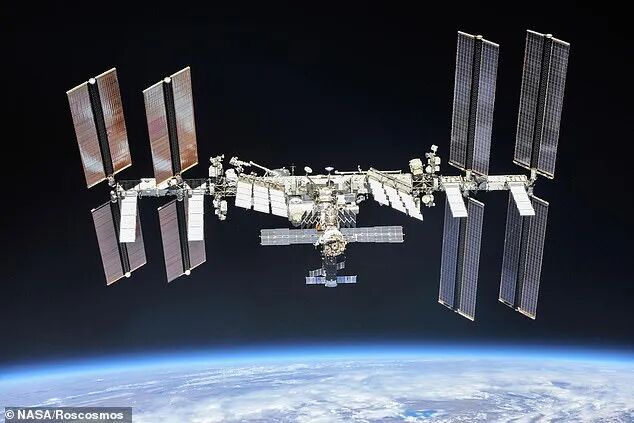
The International Space Station (ISS) has maintained a continuous human presence for over two decades. However, its tenure in low-Earth orbit cannot be extended indefinitely.
It might be challenging to fathom that the ISS, a monumental achievement costing humanity over a hundred billion dollars and taking more than two decades to construct, will not be preserved but will instead be intentionally guided back toward Earth.
To be more precise, NASA intends to decommission the ISS after 2030, orchestrating a controlled re-entry into Earth's atmosphere, with the residual debris descending into a secluded region of the South Pacific Ocean. While this scenario may evoke imagery from a science fiction film, it is not a harbinger of doom but rather a meticulously planned 'space funeral' that has been in the works for years.
Why Must It Be Disassembled?
The ISS, weighing approximately 450 tons, orbits Earth at an altitude of about 400 kilometers, completing approximately 16 orbits daily. Despite its seemingly stable trajectory, it is in a constant battle with the tenuous atmosphere: without regular orbital boosts, the station would gradually descend.
The challenge lies in the fact that a spacecraft as colossal as the ISS cannot be left to fall naturally. While the majority of its structure will incinerate during re-entry, not all components will vanish. Denser parts may penetrate the atmosphere, scattering debris over a wide area.
Thus, the true peril lies not in 'allowing it to fall' but in 'uncertainty regarding its landing spot'.
NASA's Goal: Ensuring Controllable Risks
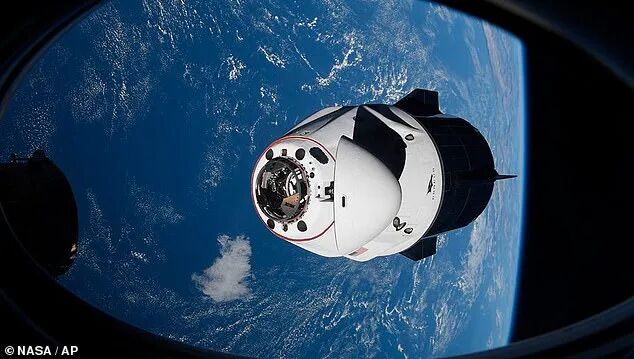
According to the plan, the ISS will progressively lower its orbit over the coming years. In the final phases, astronauts will evacuate, and as many critical devices and commemorative items as possible will be retrieved. Subsequently, a specially modified SpaceX 'deorbit vehicle' will dock with the station, providing the final impetus akin to a tugboat.
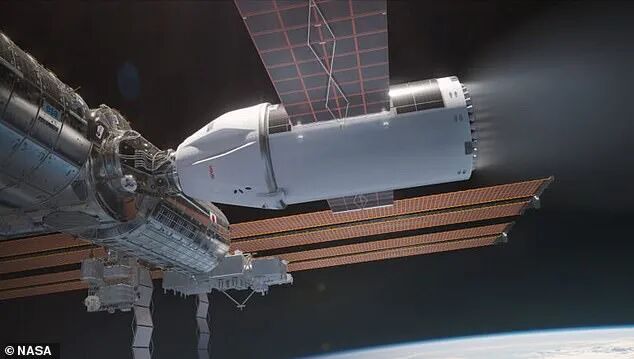
The deorbit vehicle will not 'detonate' the space station but will precisely adjust its orbit at a critical moment, ensuring debris lands in a predetermined oceanic zone.
This 'final push' is paramount. NASA previously selected SpaceX to develop the U.S. Deorbit Vehicle, with a potential contract value of approximately $843 million. It will require significantly more propellant than a standard Dragon spacecraft and must propel the station into a re-entry orbit within a precise timeframe.
The designated landing site is typically near 'Point Nemo,' one of the most isolated locations on Earth, often dubbed the 'spacecraft cemetery.' Debris from numerous retired spacecraft has been directed to this region.
Could It Pose a Threat to People?
This is, understandably, the public's foremost concern. The response is: while not entirely risk-free, controlled re-entry is engineered to minimize potential hazards.
Historically, fragments from the re-entry of the U.S. 'Skylab' in 1979 scattered over Western Australia. Given the ISS's substantially larger size, the risks would be even less acceptable if its orbit were to decay naturally. NASA's evaluation is that continued maintenance until the end of its operational lifespan, coupled with advance planning for a controlled deorbit, represents the safer course of action.
This endeavor underscores a significant milestone: humanity must not only master the art of launching colossal machines into space but also ensure their responsible return.
The ISS will not abruptly 'explode and vanish.' Instead, it will likely resemble a decommissioned offshore city, traversing the atmosphere after its final ignition, incinerating what can be burned and consigning the indestructible remnants to the most remote ocean.
Post-2030, what we bid farewell to is not merely a heap of metal but an era: the inaugural chapter in humanity's extended residence beyond Earth.
-
![]()
Proposed to Raise 955 Million Yuan through Private Placement! Huicheng Vacuum Boosts Localization of Ultra-Precision Optical Coating Equipment
-
![]()
Cash Flow Soars 13-Fold! What Major Strategic Move is Wuhan Five Square Optoelectronics Planning?
-
![]()
Leaked Design of vivo X500: Reverts to Circular Camera Module in Top-Left Corner, Pays Homage to Classic X90 Aesthetic
-
![]()
DeepSeek Shows Signs of Foraying into Code Agents, Launches WeChat Official Account Focused on Harness
-
![]()
Auto Companies Deny Claims That ‘Cooperation with Huawei Is Non-Essential’, as Huawei Transforms into a ‘Public Platform’
-
![]()
Starship to Independently 'Return to the Launch Tower': SpaceX's Ambitions Extend Beyond Rocket Building to Dominating Space Transportation
-
![]()
Starship Set to Independently 'Return to the Launch Tower': SpaceX is Revolutionizing Space Transportation, Not Just Building Rockets
-
![]()
Anthropic and OpenAI Face Off Against Deepseek