The Hidden Thread Behind Trillion-Dollar Valuation: As SpaceX Lands on Nasdaq, Where is China’s Aerospace Headed?
 06/17 2026
 661
661
Produced by | RoboIsland
In 1969, Armstrong set foot on the moon.
Half a billion people worldwide watched on television as humanity left its first footprints beyond Earth.
That year, Americans believed that by 1990, they would have established a permanent base on the moon, and by 2000, they would have landed on Mars.
Space was no longer distant—it was on the agenda for the next generation.
However, as the afterglow of Apollo faded, humanity’s pace of exploration did not accelerate as expected. Instead, it fell into a prolonged stagnation.
After the retirement of the Space Shuttle, the United States temporarily lost the capability to send astronauts to space and had to purchase seats on Russian Soyuz spacecraft at a high cost. The Apollo program became the pinnacle of human space exploration—and its last hurrah.
Half a century later, the most recent footprints on the moon remain those left in 1972.
That is until 2002, when a South African-American began seriously pondering a question: Why were the Russians charging exorbitant prices for a decommissioned intercontinental ballistic missile?
When he attempted to purchase a ballistic missile to convert into a rocket, he was spat on by Russian engineers. On the return flight, he told his traveling companion, "I think we can build our own rockets."
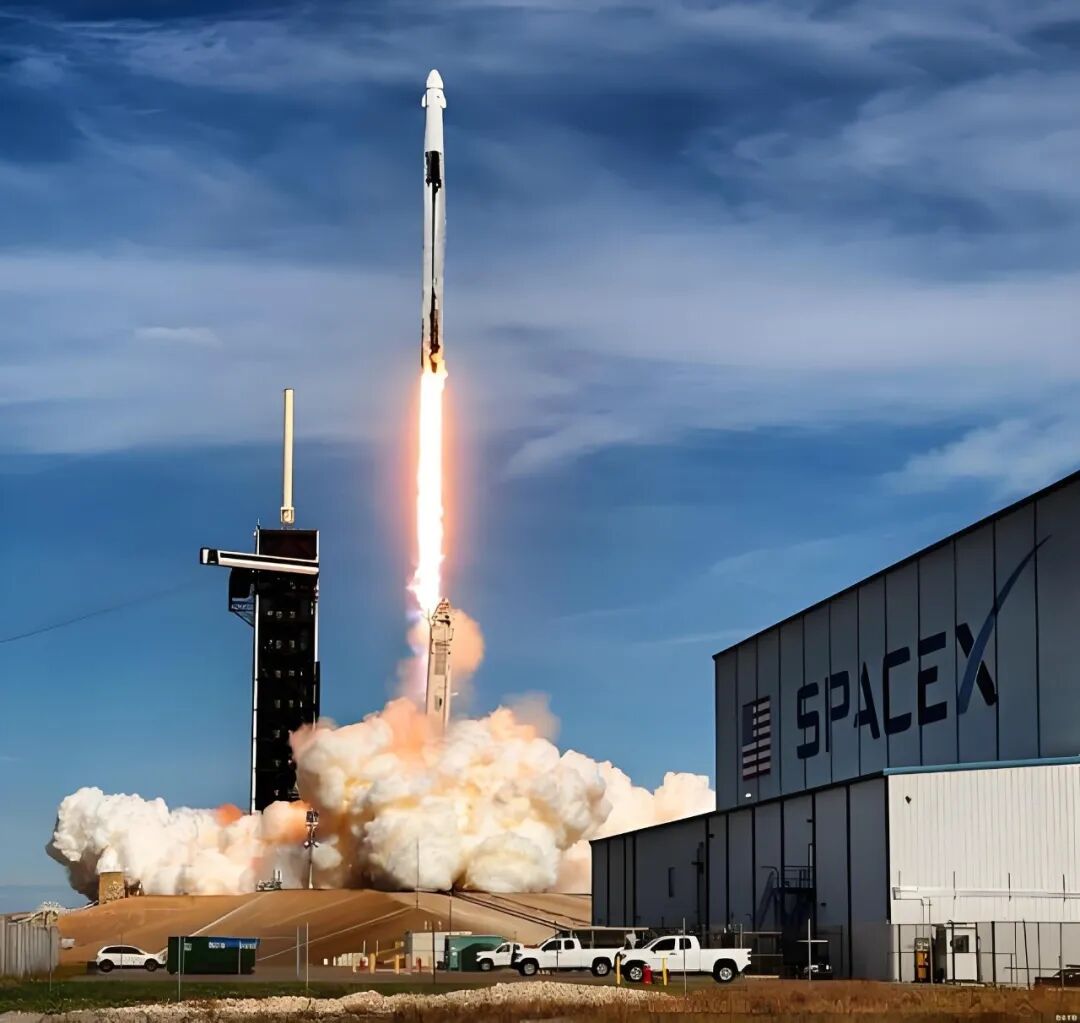
In June 2002, SpaceX was founded in an old warehouse in El Segundo, California. Twenty-four years later, this self-made rocket company landed on Nasdaq with a $2.1 trillion valuation, making American entrepreneur Elon Musk the first trillion-dollar billionaire in human history.
1. Dissecting SpaceX
SpaceX’s valuation is built on a three-layer interlocking flywheel.
The first layer is Falcon 9, the world’s first orbital-class reusable launch vehicle.
By 2025, it completed 170 launches, accounting for 83% of global orbital payloads. Its marginal cost per launch was reduced to approximately $15 million, just one-fourth to one-fifth of traditional pricing. This technological system forms the physical foundation for all of SpaceX’s operations.
The second layer is Starlink. By 2025, it generated $11.387 billion in revenue and $4.423 billion in operating profit, with a profit margin of 38.8%. Its user base surged from 2.3 million in 2023 to 10.3 million.
Starlink’s profitability far exceeds that of traditional telecom operators. Ground-based infrastructure requires digging trenches, laying pipes, building towers, and hiring maintenance staff for each new area. Once Starlink’s satellite constellation is deployed, the marginal cost of adding new users is nearly zero. This represents the ultimate version of fixed-cost amortization.
The third layer is xAI. After being integrated into SpaceX, it generated $3.2 billion in revenue in 2025 but incurred an operating loss of $6.355 billion, making it the heaviest ballast in the current machine.
Examining the logical chain between these three layers: Falcon 9’s low-cost launches enable rapid Starlink deployment; Starlink’s cash flow funds Starship development; once Starship matures, it will further reduce launch costs and enhance payload capacity. SpaceX simultaneously controls the transportation tools, launch demand, and end customers, forming a complete commercial closed loop .
Dissecting the machine also involves identifying its cracks. The true quality of Starlink’s profitability, the reliability of Starship, and the substance of the AI business are all valid arguments for questioning whether history’s largest IPO is a bubble.
Starlink’s ARPU (Average Revenue Per User) was $91 per month in 2024, dropped to $81 in 2025, and further fell to $66 in the first quarter of 2026.
The rationale for price cuts is expansion into low-ARPU markets in Africa, Asia, and Latin America. However, the North American market is nearing saturation, and the spending power of new users continues to decline. This means revenue growth relies on volume, profit growth on economies of scale, but the value per user is declining.
Since its maiden flight in 2023, SpaceX has invested $15 billion in the Starship program, with R&D spending reaching approximately $3 billion in 2025 alone.
Yet, the 12th test flight still experienced multiple technical failures. While Starship V3’s maiden flight completed its phased testing objectives, its first stage crashed into the Gulf of Mexico during recovery.
The prospectus explicitly lists Starship development delays as the highest risk factor. All long-term narratives, including Starlink V3 deployment, orbital AI computing power, and Mars colonization, hinge on Starship’s commercialization progress.
Every year of delay for Starship erodes the discounted value of these stories by one year.
xAI has signed computing power leasing agreements with Anthropic and Google totaling approximately $26 billion in annualized value. While this sounds like a robust moat, both contracts include 90-day early termination clauses—they are highly flexible procurement agreements, not long-term strategic contracts.
AWS, Google Cloud, and Microsoft Azure dominate the enterprise computing market with far greater ecological maturity and customer stickiness than SpaceX. xAI’s advantage lies in cost competitiveness, not platform defense. If computing power leasing prices decline or major clients gain bargaining power, the valuation logic of this business would need to be recalculated.
Governance also warrants scrutiny. Through a dual-class share structure, Musk retains 85.1% of voting rights post-IPO. Public investors are buying "options on Musk’s dreams" but have virtually no governance-level ability to correct course.
While other tech giants can debate management succession, SpaceX cannot be objectively assessed without Musk. Any sudden change in Musk’s status would likely trigger a rapid retraction of the current valuation premium.
2. China’s Manufacturing on the Supply Chain
Hidden within SpaceX’s $2.1 trillion valuation is a less visible but closely watched thread: the deep involvement of China’s supply chain.
Rocket engine combustion chambers and nozzles must withstand 3,000°C thermal erosion. According to market reports, a significant portion of the niobium alloy used by SpaceX comes from China’s Western Materials, reportedly one of SpaceX’s niobium alloy suppliers in mainland China.
Starlink ground terminals require high-frequency connectors capable of supporting 26-40GHz millimeter-wave transmission and stable operation under extreme temperatures—a highly technical threshold. Speculation suggests that Sunway Communication may be a core supplier in this segment.
Rocket cryogenic fuel tanks must endure extreme temperature differentials ranging from -200°C to 1,600°C. According to market rumors, Reisheng Technology’s aerospace-grade ultrafine glass fiber wool entered SpaceX’s supplier testing system, but as of early 2026, the company stated in filings that no orders for related products had been received.
Additionally, industry media reports that Parker New Materials supplies Falcon 9 and Starship with rocket body structural components and engine high-temperature alloy forgings, allegedly certified by NASA.
If these market rumors hold true, Chinese manufacturing has penetrated multiple critical segments of SpaceX’s supply chain.
However, it is worth noting that most of these supplier identities stem from media reports and industry speculation rather than official confirmation from SpaceX or the companies involved. SpaceX maintains a high degree of secrecy regarding disclosures about its core supply chain.
According to the founder of a domestic commercial aerospace enterprise, over 90% of components and 90% of the value in full rockets can now be completed within the private sector. While not official statistical data, this figure is widely cited in the industry to describe supply chain maturity.
According to market sources, some Chinese suppliers are transitioning from mere component supply to deeper supply chain integration. Although most of this information remains speculative, it reflects the increasingly important role of Chinese manufacturing in the space industry chain.
3. China Doesn’t Need a Second Musk
In 2025, China conducted 92 space launches, including 50 commercial launches—accounting for more than half for the first time. A total of 377 spacecraft were placed into orbit, with 309 being commercial satellites (82%). Commercial aerospace financing reached approximately $18.6 billion, with the industry scale reaching $2.5-2.8 trillion.
Behind these numbers lies an emerging industrial ecosystem.
In December 2025, the Zhuque-3 and Long March 12A rockets completed their maiden orbital flights. Although recovery attempts were unsuccessful, China’s reusable rockets officially entered the engineering verification phase. More critical than successful recovery is that key technologies have completed flight validation.
That same month, the Shanghai Stock Exchange issued guidelines for commercial rocket companies to list on the STAR Market, explicitly including commercial aerospace under the fifth set of listing criteria. No strict requirements were imposed on revenue or net profit, with "market capitalization + R&D" serving as the primary evaluation method.
LandSpace, CAS Space, Space Pioneer, Galactic Energy, and i-Space—the five leading companies—have all initiated STAR Market IPO counseling.
From a supply chain perspective, China’s commercial aerospace has moved beyond the initial setup phase. A decade ago, private rocket companies could not even source core components; today, according to industry insiders, the vast majority of core components and value in full rockets are now domestically sourced within the private sector.
From engines and rocket structures to satellite manufacturing and ground equipment, China’s supply chain is transitioning from scattered breakthroughs to systematic operation.
While SpaceX pursues a single-breakthrough, vertically integrated approach—extremely efficient but risk-concentrated—China’s commercial aerospace adopts a multi-path parallel strategy.
Multiple liquid reusable rockets, including Zhuque-3, Hyperbola-3, and Tianlong-3, are advancing simultaneously, with technical routes covering stainless steel rocket bodies, liquid oxygen-methane, and liquid oxygen-kerosene propulsion. This decentralized exploration raises total costs in the short term but also allows for greater experimentation.
In contrast to SpaceX’s "application-driven R&D" business model, China’s approach resembles an industrial cluster: rocket companies, satellite firms, operators, and material/component enterprises grow independently before synergizing through market forces to build an ecosystem.
China does not need to replicate a Musk or a SpaceX. Its strengths lie in full-chain manufacturing support, a massive domestic market providing application scenarios, and sustained policy-driven institutional dividends.
While SpaceX proved that the space economy could be self-sustaining, China aims to demonstrate that it can scale massively through alternative pathways.
4. Conclusion
With a recovered rocket, Musk transformed space from a national project into a calculable business.
This alone is a form of greatness—he brought space, once suspended outside government budgets, into the coordinate system of market logic.
Falcon 9’s reflights, Starlink’s millions of users, Starship’s roar—these are the hardest-core romances of our era.
But greatness and bubbles often walk a fine line.
The $2.1 trillion valuation corresponds to $18.7 billion in 2025 revenue, $4.9 billion in losses, and a prospectus projecting a potential $28.5 trillion market—$26.5 trillion of which comes from AI, a business currently losing $6.3 billion annually.
Goldman Sachs predicts SpaceX’s AI revenue will reach $322 billion by 2030, implying 100-fold growth in six years; Morningstar assigns a fair value of $780 billion, less than half the offering valuation; short-seller Steve Eisman dismisses the prospectus as "science fiction."
These controversies do not negation (negate) SpaceX’s achievements but remind us that capital markets can pay a premium for a "great story in progress"—yet ultimately demand tangible numbers on the profit statement.
In this prolonged game theory (game) between the stars and financial statements, China is no longer a bystander. It is a potential participant in SpaceX’s supply chain and, more importantly, a builder of China’s commercial aerospace sector.
Musk once said, "My primary motivation for accumulating personal wealth is to fund this cause. I truly have no other motive for accumulating assets except to do everything I can to make humanity a multi-planetary species." Whether this statement is entirely sincere, no one knows.
But one thing is certain: When someone writes "leaving Earth" into a business plan and actually makes the world believe it can happen, they create not just a business model but a re-anchoring of possibility.
SpaceX’s IPO is a slice of our era, carrying humanity’s oldest exploratory impulses alongside capitalism’s most naked pricing logic.
Greatness and bubbles, romance and calculation, the stars and financial statements—they have never been as intimately entangled as they are today.
The next decade will not see SpaceX as the sole answer to "who defines the space economy."",
-
![]()
Proposed to Raise 955 Million Yuan through Private Placement! Huicheng Vacuum Boosts Localization of Ultra-Precision Optical Coating Equipment
-
![]()
Cash Flow Soars 13-Fold! What Major Strategic Move is Wuhan Five Square Optoelectronics Planning?
-
![]()
Leaked Design of vivo X500: Reverts to Circular Camera Module in Top-Left Corner, Pays Homage to Classic X90 Aesthetic
-
![]()
DeepSeek Shows Signs of Foraying into Code Agents, Launches WeChat Official Account Focused on Harness
-
![]()
Auto Companies Deny Claims That ‘Cooperation with Huawei Is Non-Essential’, as Huawei Transforms into a ‘Public Platform’
-
![]()
Starship to Independently 'Return to the Launch Tower': SpaceX's Ambitions Extend Beyond Rocket Building to Dominating Space Transportation
-
![]()
Starship Set to Independently 'Return to the Launch Tower': SpaceX is Revolutionizing Space Transportation, Not Just Building Rockets
-
![]()
Anthropic and OpenAI Face Off Against Deepseek