Zhuque-3 Y2: No Need to Rush
 06/22 2026
 430
430
Recently, there has been a resurgence of buzz surrounding Zhuque-3 Y2, with many seeing fresh hope in LandSpace's Dragon Boat Festival poster, which hints at "back-to-back" advancements.

So, today, I'd like to weigh in with my thoughts.
On December 3 of last year, LandSpace achieved something remarkable: Zhuque-3's maiden flight was aimed straight for recovery—a first not only for China's private commercial space sector but also unprecedented among global orbital-class rockets. The outcome is well-known: successful orbit insertion, but recovery failed.
That setback deserves respect.
However, respect is one thing, and technological progress is another.
Rumors suggest that Zhuque-3 Y2 will attempt recovery again in the second quarter of this year (some say July). LandSpace officials sound optimistic. I still believe the challenge is commendable, but we need to approach it with sobriety, not blind optimism.
Because publicly available information suggests that Zhuque-3 Y2 faces even more complex technical hurdles than outsiders realize.
01 The "Downsized" Rocket
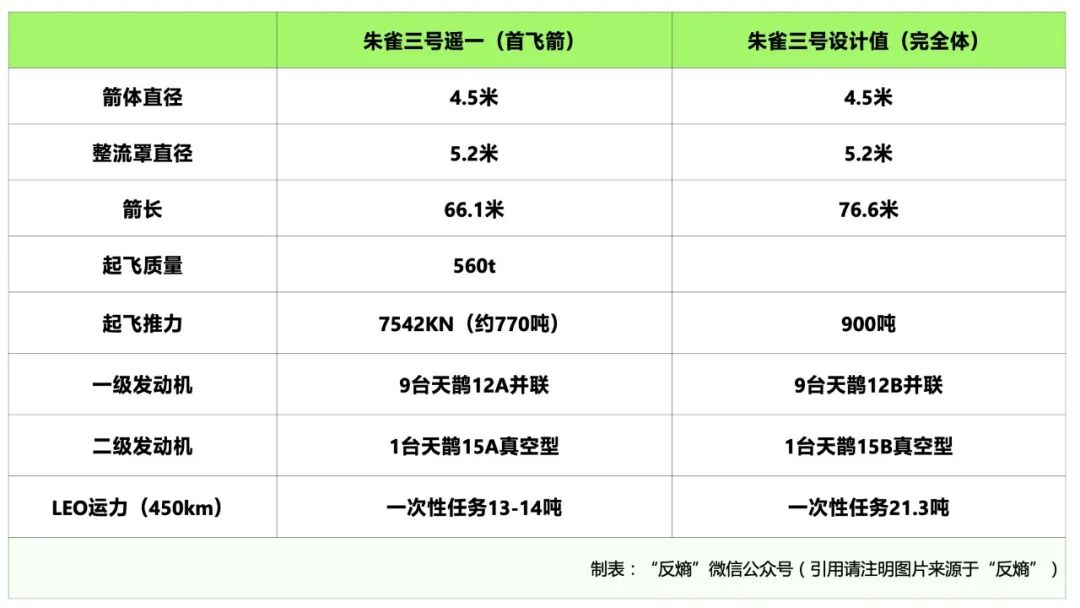
According to LandSpace's official disclosures, Zhuque-3's design height is 76.6 meters with an LEO payload capacity of 21.3 tons. However, in a December 3, 2025, CCTV News exclusive interview with Zhuque-3's chief designer Zhang Xiaodong, he bluntly stated: "The rocket's current state is an intermediate transitional version."
What does "intermediate transitional" mean? Let me try to explain.
First, consider the length. Anyone verifying will notice that Zhuque-3 Y1's stage measured 66.1 meters—10.5 meters shorter than the design. Don't underestimate those 10.5 meters: they mean shorter tanks, less propellant, lower structural loads. Aerodynamics change, elastic modes shift, and the rocket's center of mass and moment of inertia no longer align with the 76.6-meter design.
From a systems engineering perspective, the maiden flight validated a transitional configuration—nicknamed the "Youth Edition" by netizens. It proved "it can fly, it can orbit," but not that the "designed Zhuque-3" can fly.
Now, let's talk about payload capacity. In the same interview, Zhang mentioned that Y1's expendable capacity was roughly 13-14 tons. Against the design capacity of 21.3 tons (taking 13.5 tons as the midpoint), the actual capacity fell about 36% short. Rocket scientists know that engines are the biggest variable, but Y1's capacity shortfall likely stemmed from multiple factors: shortened tanks, a more conservative recovery profile, reduced separation speed, lower orbit altitude, etc.
This brings us to another critical issue: propulsion.
02 The Propulsion Puzzle
LandSpace's official WeChat post, "Zhuque-3 Reusable Y1 Launch Vehicle Successfully Reaches Orbit," details Y1's flight data.
Here's the thing.
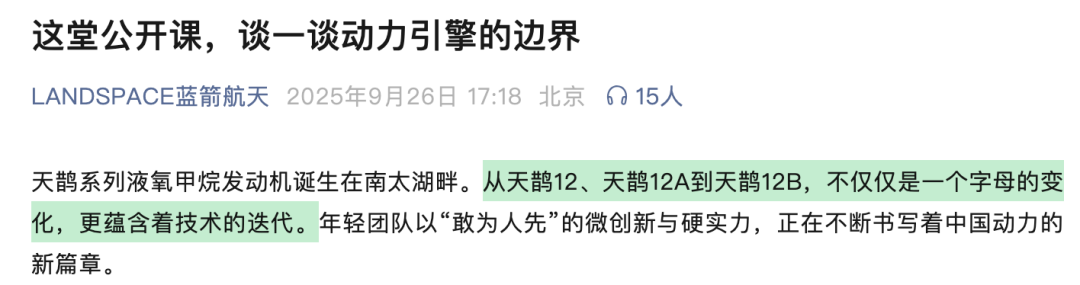
To quote LandSpace's September 26, 2025, article "The Boundaries of Propulsion Engines": "From Tianque-12 to 12A to 12B, it's not just a letter change but technological iteration."
That's true. Tianque-12A is a mature 80-ton-class LOX/methane engine; Tianque-12B is a 100-ton-class engine. Compared to 12A, TQ-12B boosts thrust by over 25%, with 3D-printed parts exceeding 70%, eliminating 30% of components, drastically reducing plumbing, and completely restructuring the internals. Industry reports call it "a complete overhaul inside and out."
This likely explains much of the capacity shortfall.
As of April 15, 2025, Tianque-12B has completed 550-second ground tests.
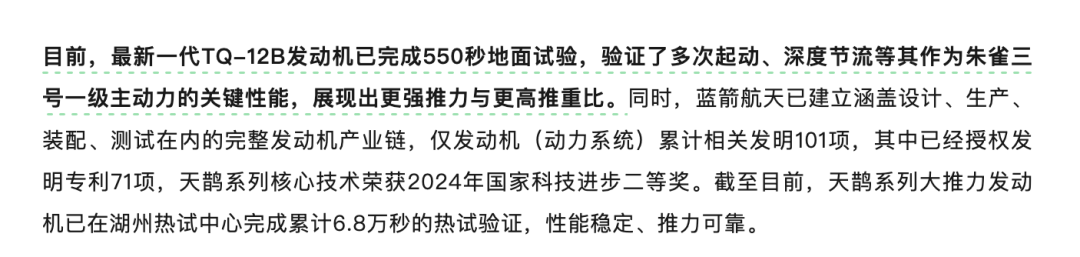
But it has never flown.
A maiden flight with a new engine is inherently high-risk—a lesson repeatedly proven in aerospace. Different engine models under the same brand require re-flight validation. Ground tests have limits: test stands can't simulate real overload environments, high-altitude ignition pressure spikes, stage separation shocks, or re-entry thermal loads. Only flight can truly verify these.
When SpaceX upgraded its Merlin engine from 1C to 1D—boosting thrust from ~556kN to 650kN and chamber pressure by nearly 60%—it built an entirely new Falcon 9 v1.1: longer tanks, octagonal engine layout, 43-foot fairing. Its September 2013 maiden flight tested controlled re-entry and ocean landing, but SpaceX kept expectations low—Musk estimated just a 10% success probability. It failed due to roll instability, and the rocket did not survive.
SpaceX positioned it as a low-expectation tech shakeout. For engine-swap maiden flights, the fewer overlapping goals, the better.
Though Merlin 1D had no issues in v1.1's first flight, SpaceX invested massive time and funds in ground testing beforehand. Earlier, Merlin 1C taught a lesson: during Falcon 9 v1.0's CRS-1 mission (fourth flight) in October 2012, a Merlin 1C engine shut down abnormally 79 seconds after launch, sending the secondary OG2 satellite to the wrong orbit. Thus, new engine reliability is honed through repeated real flights.
SpaceX's Raptor engine offers another mirror. From Raptor 1 to 2—thrust boost, part reduction, simplification—the path mirrors Tianque-12A to 12B. But Raptor 2 didn't mature overnight. From Starship's IFT-1 to IFT-5, the Super Heavy booster B12 needed four flights before a recovery arm catch. Raptor 2's stability stumbled until later flights.
Tianque-12B has never flown, yet Y2 targets recovery. Concerns arise.
Perhaps I worry too much—maybe Y2 still uses Tianque-12A. But then it wouldn't be the true Zhuque-3.
03 The Landing Site Selection Logic
Zhuque-3's deputy chief designer Dong Kai revealed more crucial information on the "Tech Insights" podcast. For absolute safety, Y1's landing site was set just 390 km from the launch site (vs. 600 km for the full configuration). Falcon 9's recovery barges typically operate beyond 600 km.
A closer landing site requires earlier stage separation—dropping from ~76 km to 66 km, sacrificing some velocity increment for the second stage to handle more work.
He broke it down: "Every 10 km increase in recovery range adds ~150 kg to payload capacity."
Y1 separated at ~66 km; the full 76.6-meter design separates at ~76 km—a 10 km gap. This isn't arbitrary downsizing but a physical limitation of the transitional configuration. Propellant load, flight profile, and full-envelope capability under the 76.6-meter design remain unverified from public info.
Two easily overlooked details:
First, Y1 did not disclose orbit parameters via public TLE data. Its payload was ballast, not functional. Using ballast isn't shameful—it's industry practice for maiden flights—but most carry test satellites. Simulated or pure cement ballast lacks functionality. This suggests the team knew this flight fell short of the "design state."
Second, the second stage orbited but lower than expected.
At 20:39 on January 30, 2026, Y1's second stage re-entered the South Pacific as planned, ablating and disintegrating. From launch on December 3, 2025, it orbited for 58 days.
Natural re-entry in 58 days implies a low orbit—likely not a typical long-duration orbit. Generally, a >400 km circular orbit takes years to naturally re-enter. Y1's 58-day re-entry suggests a conservative trajectory, the second stage not planned for long-term orbit, starting to decay immediately after insertion and re-entering naturally after 58 days—all "as expected."
This again shows Y1 operated in a "safety-first" conservative mode:
Rocket shortened by 10.5 meters, separation height reduced by 10 km, engine swapped to mature Tianque-12A, orbit lowered. These four conservative measures combined enabled the second stage's successful orbit insertion.
As noted earlier, Y2 may not adopt design values yet, but Y3, Y4, Y5... the Zhuque-3 we expect must eventually return to its true form, pushing all boundaries to their limits. Conservative success ≠ design-state success.
P.S. I too hope Y2 achieves recovery in one go. But there are two scenarios: If Y2 still uses provenQ T-12A, my core argument—new engines must fly first—still stands. If Y2 flies with 12B and succeeds, I'll gladly eat my words, as it would mean a Chinese team blazed a trail even SpaceX hasn't taken.
04 The Limits of Scale-Model Testing
From SpaceX's first orbital-class recovery attempt (September 2013 CASSIOPE mission) to its first successful landing (December 2015 OG2 mission), it took 27 months and 7 tries. First validating propulsive descent, then ocean soft landing, then drone ship targeting and leg locking, before finally achieving land success.
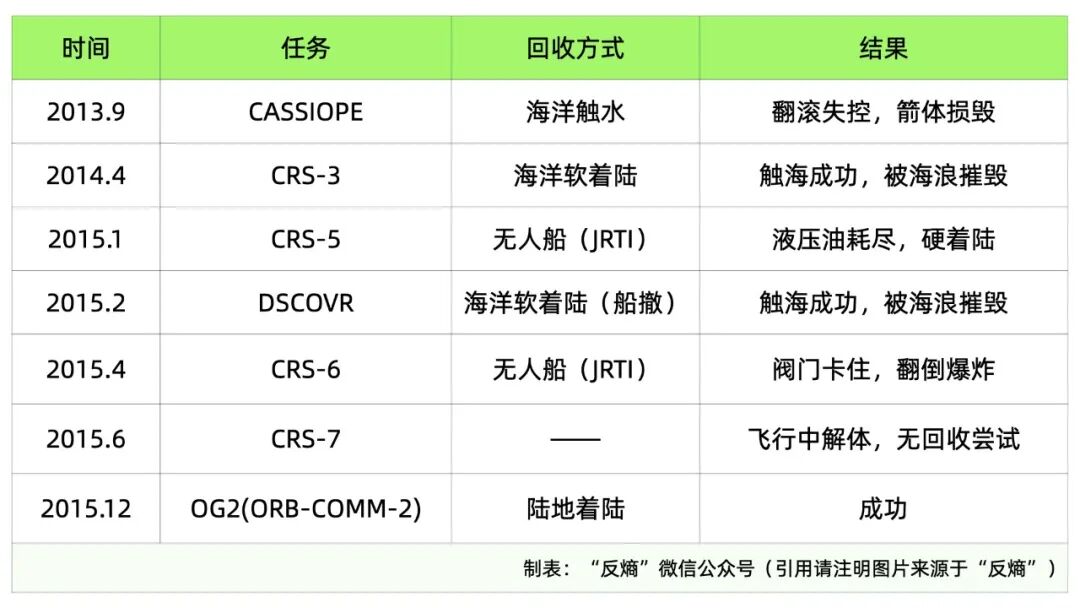
Note: CRS-7 disintegrated mid-flight due to a second-stage helium tank failure and didn't reach recovery, but is included in the 27-month timeline.
From Y1's failure to Y2's launch, LandSpace has about 6 months. I'd even prefer Y2 avoids a new engine and elongated rocket. China's private commercial space needs steady validation, not another letdown after high hopes.
LandSpace's VTVL-1 test vehicle conducted two vertical takeoff/landing tests: a 350-meter test in January 2024 and a 10 km test in September 2024. The 10 km flight was impressive: 200.7-second duration, 1.7-meter landing accuracy, -1.65 m/s vertical velocity, 0.3-degree attitude deviation, and successfully countering 36 m/s crosswinds at altitude.
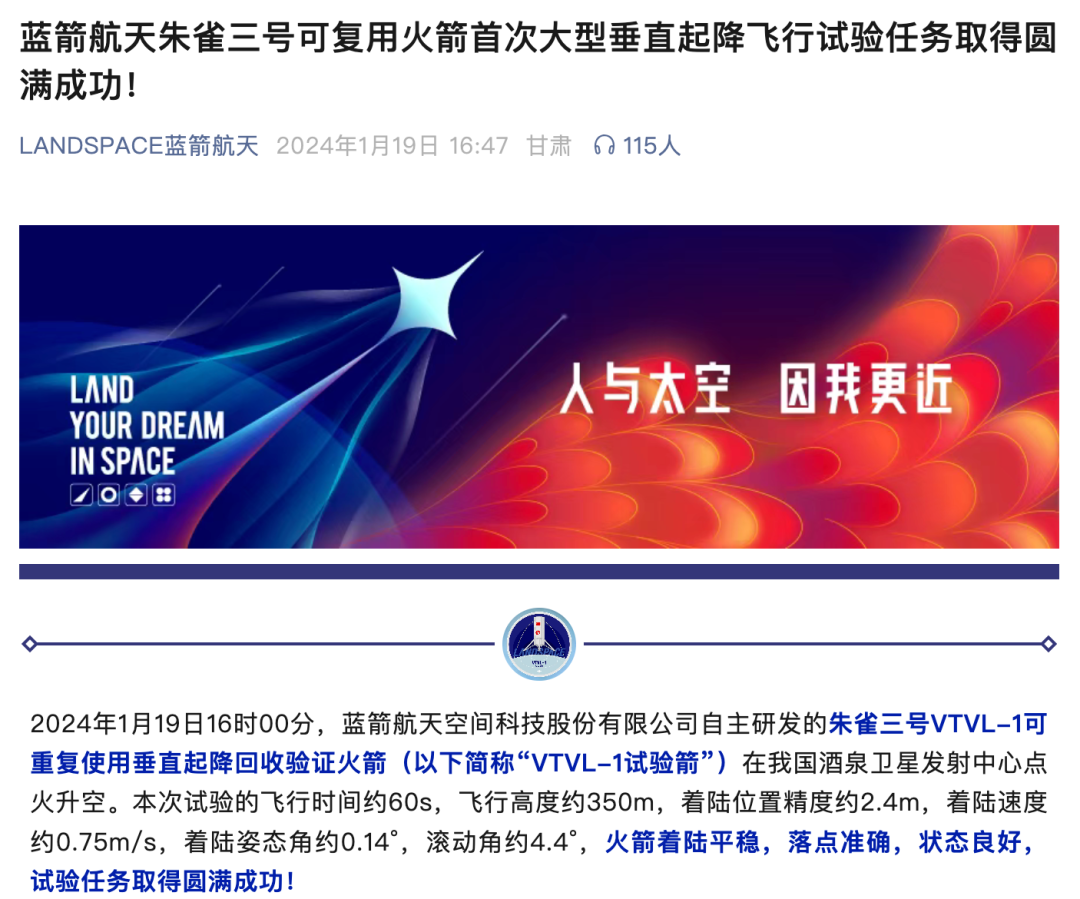
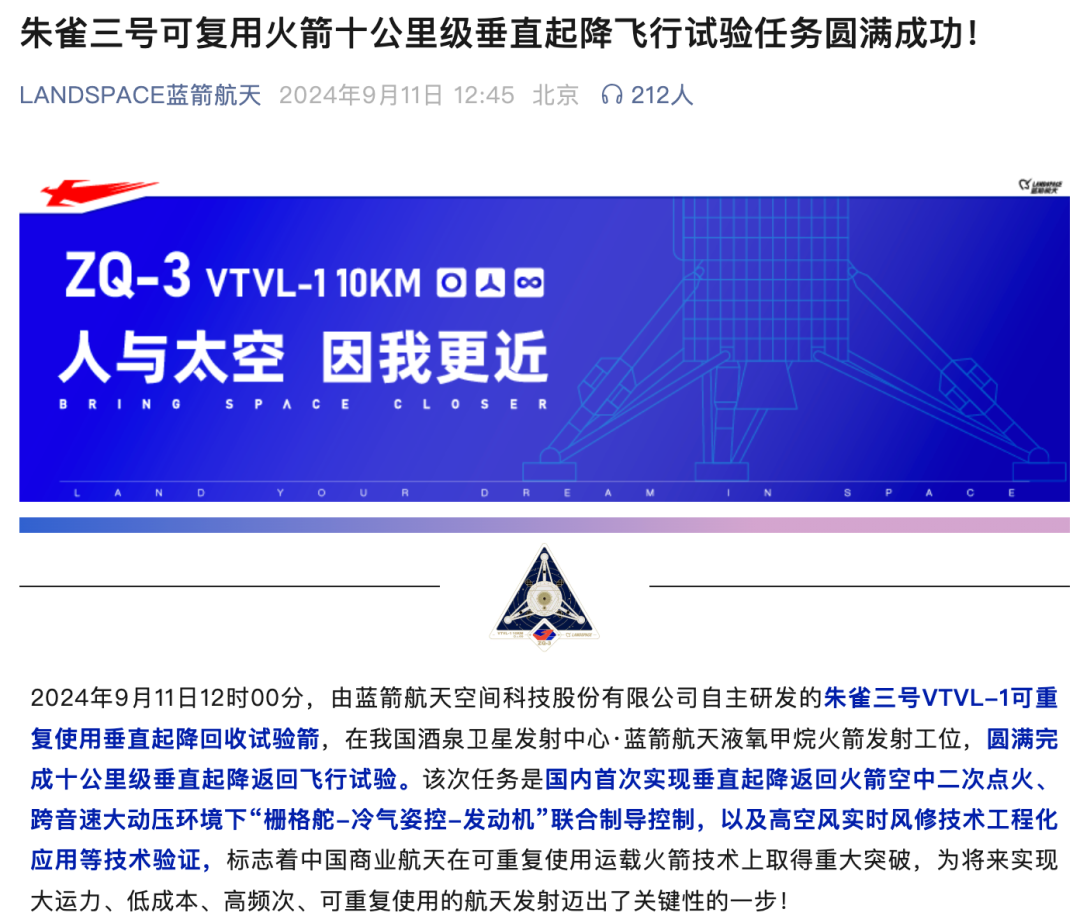
But that was a 3.35-meter-diameter, 18.3-meter-long suborbital test vehicle with a standard takeoff mass of ~50.3 tons (max ~68 tons)—orders of magnitude smaller than Zhuque-3's first stage. The 10 km test stayed subsonic/transonic, while orbital re-entry speeds reach ~2000 m/s (hypersonic). Thermal loads differ by an order of magnitude, and aerodynamic complexity isn't comparable.
Compared to SpaceX's incremental path—Grasshopper from 1.8 m to 744 m, F9R Dev1 to 1000 m (where it exploded)—LandSpace's VTVL-1 jumped straight to 10 km, impressive. But it validated a 3.35-m scale model, not the 4.5-m full-scale design.
LandSpace needn't replicate SpaceX's exact path, but orbital recovery remains a systems engineering challenge requiring massive real flight data. There are no shortcuts.
05 You're Already Moving Fast Enough
LandSpace has a trait: it doesn't chase timelines but technical closure.
In 2018, Zhuque-1 fell 15 seconds short of orbit using a purchased solid engine—a pathfinder. But LandSpace never intended that route.
By 2017, TQ-12 LOX/methane engine development had begun. Three months before Zhuque-1's launch, LandSpace held a LOX/methane rocket strategy conference at the Water Cube. Self-developed liquid engines were always the plan.
In 2022, Zhuque-2 Y1 failed due to second-stage thruster issues. Instead of compromising, they investigated and succeeded with Y2—the world's first orbital LOX/methane rocket.
That rhythm was right.
But Zhuque-3's recovery pace seems different. VTVL-1 validated just one engine, 10 km vertical landing. Y1 jumped to nine engines, orbital re-entry recovery. The technological leap is vast.
I understand the urgency. 2026 is a commercial space window; markets wait for no one. LandSpace needs to prove recovery to investors, delivery pace to clients.
But space doesn't respect market rhythms.
LandSpace's best work emerged when it controlled the pace. Choosing the hardest path—LOX/methane—at founding, no one rushed them. After Zhuque-2 Y1's failure, they took time to investigate and return—no one rushed them then either.
First, make sure TQ-12B flies successfully. A clean, non-recovery full-range flight to confirm the combustion stability, turbopump response, and throttle accuracy of the engine in a real orbital environment. Then, ensure the complete 76.6-meter rocket body flies successfully, verifying the aerodynamic characteristics, structural loads, and guidance control logic after elongation. After that, combine the two and fly steadily once more. Finally, talk about recovery.
After completing these steps, it might not be until the third or fourth remote flight test, or even later. However, Chinese space enthusiasts will not think any less of LandSpace because of this. Every time SpaceX experiences a failure, they are open about it, and the public does not mock them for it; instead, they only become more eager for the next
-
![]()
Proposed to Raise 955 Million Yuan through Private Placement! Huicheng Vacuum Boosts Localization of Ultra-Precision Optical Coating Equipment
-
![]()
Cash Flow Soars 13-Fold! What Major Strategic Move is Wuhan Five Square Optoelectronics Planning?
-
![]()
Leaked Design of vivo X500: Reverts to Circular Camera Module in Top-Left Corner, Pays Homage to Classic X90 Aesthetic
-
![]()
DeepSeek Shows Signs of Foraying into Code Agents, Launches WeChat Official Account Focused on Harness
-
![]()
Auto Companies Deny Claims That ‘Cooperation with Huawei Is Non-Essential’, as Huawei Transforms into a ‘Public Platform’
-
![]()
Starship to Independently 'Return to the Launch Tower': SpaceX's Ambitions Extend Beyond Rocket Building to Dominating Space Transportation
-
![]()
Starship Set to Independently 'Return to the Launch Tower': SpaceX is Revolutionizing Space Transportation, Not Just Building Rockets
-
![]()
Anthropic and OpenAI Face Off Against Deepseek