Robots Embark on 200-Hour Factory Trials: Is AI Truly Ready for Industrial Deployment?
 07/01 2026
 376
376
In the first half of 2026, two robotics live streams unexpectedly failed to garner significant attention within the robotics community.
Overseas, three robots tirelessly sorted parcels alongside a conveyor belt for 200 consecutive hours.
Domestically, eight wheeled robots conducted plug-and-play equipment testing on a tablet quality inspection line, operating from 8 AM to 7 PM, in sync with factory workers' shifts, for six straight days.
01
Live Streams Showcasing Robots in Action: Potential Reactions from Business Owners
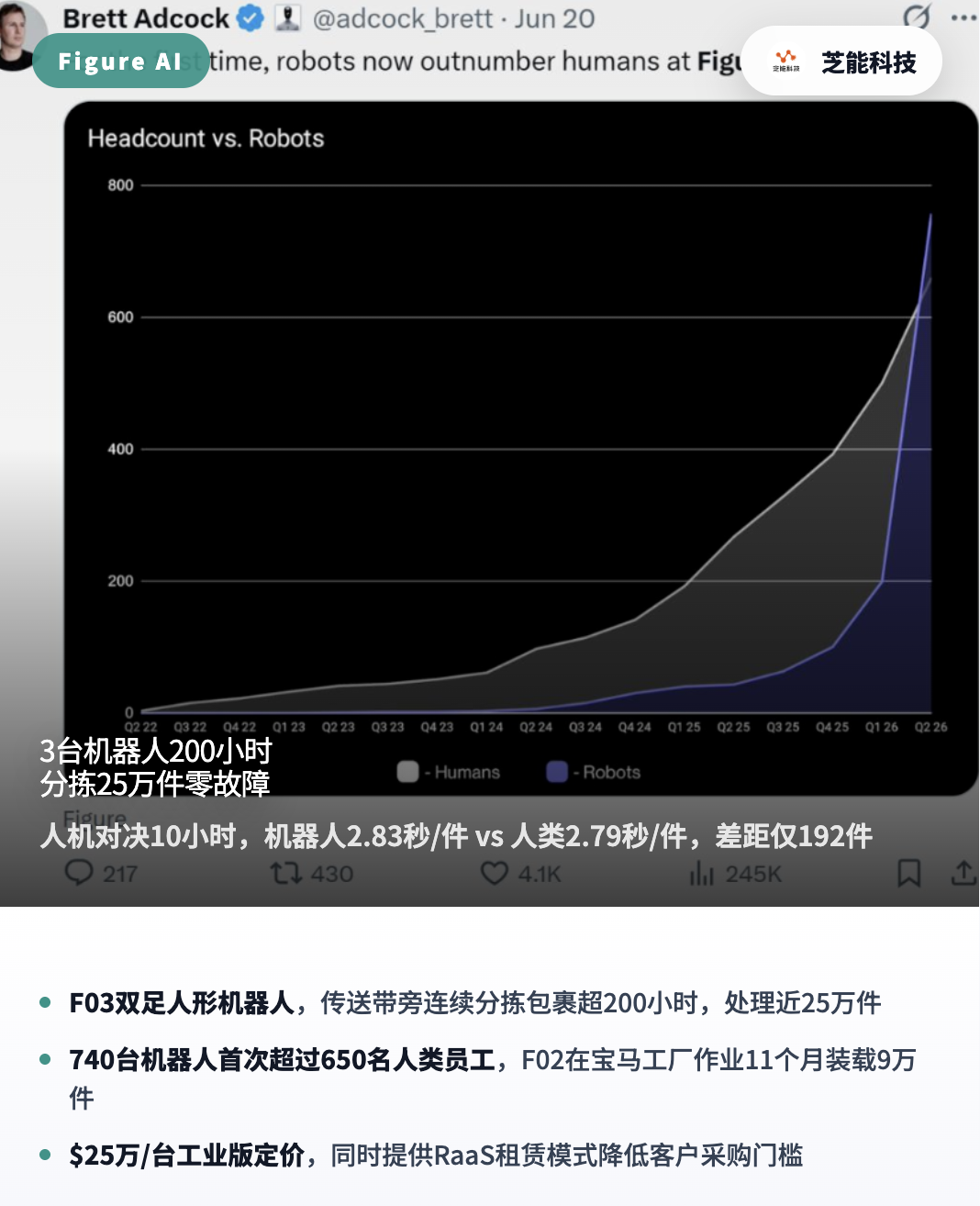
During Figure AI's May live stream, three F03 humanoid robots (Bob, Frank, Gary) were seen sorting parcels beside a conveyor belt. Over the course of 200 hours, they processed nearly 250,000 items without any hardware failures.
A human-robot competition was also staged: a human intern managed to sort 12,924 items in 10 hours, while the robots sorted 12,732 items, a mere difference of 192 items. The average speed was 2.79 seconds per item for humans and 2.83 seconds per item for robots.
Zhiyuan launched its second live stream at Longcheer Technology's factory in Nanchang, Jiangxi.
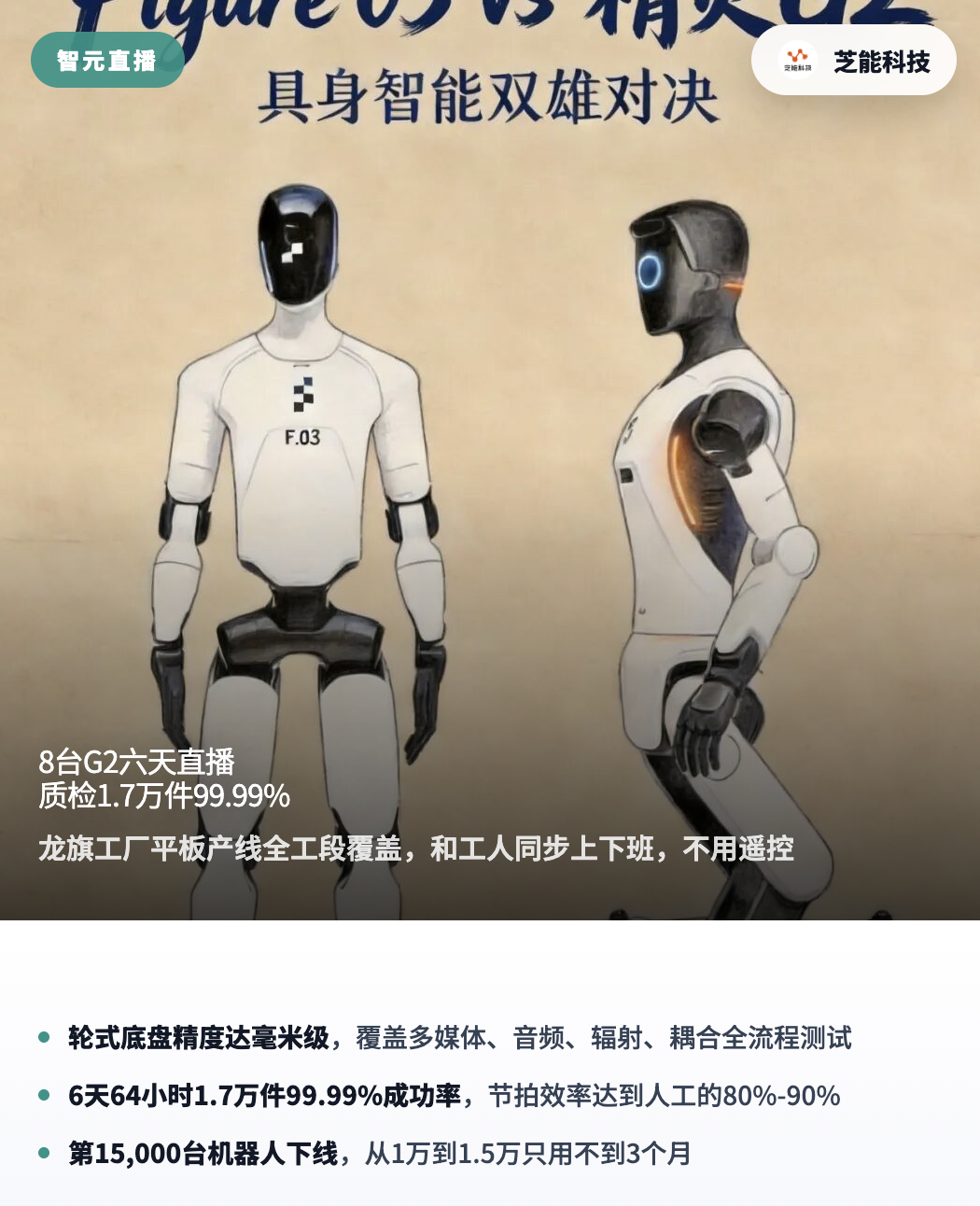
Eight Elf G2 robots, equipped with wheeled chassis, covered all processes in the tablet quality inspection section—including multimedia interface testing, audio testing, radiated spurious emission testing, and coupling testing—completely autonomously, without manual remote control. Over six days, they accumulated over 64 hours of operation, processed 17,000 products, and achieved a remarkable final success rate of 99.99%.
Zhiyuan also announced the rollout of its 15,000th embodied intelligent robot. It took less than three months to go from the 10,000th to the 15,000th unit.
Following the two live streams, some critics argued that Figure's scenario was too simplistic, with a constant-speed conveyor belt, fixed parcel sizes, and repetitive actions. Others claimed that Zhiyuan's robots were not humanoid enough, with their wheeled chassis deemed "not advanced."
During Figure's 200-hour live stream, viewers could tune in at any time to watch the robots process parcels one after another.
Zhiyuan's live stream encountered a minor hiccup: communication abnormalities between the robots and testing equipment caused two tablets to overlap, necessitating manual intervention. The success rate dipped from 100% to 99.96%.
Zhiyuan's system promptly reported the anomaly, switched to other workstations, and resumed operation after about two minutes. The fault was fully documented. The entire production line did not come to a halt due to this single workstation's interruption.
02
The Disparity Between Factories and Laboratories
Longcheer's production line employs 7,000-8,000 workers annually, hiring 20,000-30,000 people each year, with an average employee tenure of only three to four months. Training new hires takes 15 days. This scenario is not about "machines replacing humans" but rather the "challenge of hiring and retaining workers."
Robots that performed flawlessly for hundreds of hours in labs began exhibiting various "quirks" when deployed on real production lines. "The electromagnetic environment on production lines is far more complex than in labs, with interference from multiple devices and cell phone signals. Two robots 'collided' due to sensor misjudgments, and communication protocol mismatches caused lost instructions."
From Elf G2's initial "internship" on Longcheer's secondary production line in December of the previous year to its official integration into production in March, then to two robots live-streaming eight hours flawlessly in April, and finally to eight robots live-streaming six days on a full-function quality inspection section in June—the process took over six months of refinement.
From March 15 (integration) to the live stream day, over 100 days of actual operation identified and resolved about 60 issues. Having two wheeled robots operate smoothly at one workstation did not guarantee that eight robots could operate in parallel without conflicts across the entire production line.
Zero mistakes in eight hours did not equate to a 99.99% success rate over six days, let alone replication in other factories, production lines, or products.
Robots' biggest shortcomings in factories lie not in AI algorithms but in three pure engineering issues: joint lifespan, heat dissipation, and consistency.
◎ Let's first discuss lifespan.
Few robot companies dare to publicly state their products' actual service lives; most only mention "design lifespan." The Optimus dexterous hand has a lifespan of about six weeks, with replacement costs ranging from 10,000 to 80,000 yuan per unit. Under stable walking conditions, most bipedal humanoid robots have a lifespan of only 2,000-3,000 hours.
Robots do not perform repetitive circular motions like industrial robotic arms. Their joints frequently endure dynamically changing impacts, with different walking speeds corresponding to different frequencies and directions of forces on their legs.
After dozens of hours, temperature rise and slight wear cause subtle vibrations; after hundreds of hours, transmission backlash accumulates continuously; after thousands of hours, thermal drift and mechanical wear superposition, significantly reducing positioning accuracy.
Figure AI's F02 operated for 11 months and 1,250 hours at a BMW factory, loading over 90,000 parts, but its forearm exposed severe hardware faults—prompting a complete redesign of the wrist electronics in the F03.
◎ Consistency involves two levels.
Single-machine consistency refers to whether the same robot maintains the same motion accuracy after dozens of hours as it did initially. Multi-machine consistency refers to whether models trained in the same scenario can be interchanged among ten robots of the same model.
Neither issue has been resolved yet—each robot has slight differences in factory parameters, and wear levels vary in the first month after delivery. This is why Zhiyuan spent over six months deploying at Longcheer, progressing from "two robots operating smoothly" to "eight robots operating in parallel."
◎ Heat dissipation is easily overlooked.
At the 2026 Humanoid Robot Half-Marathon, many robots required staff to follow them for "manual cooling" during operation. During prolonged continuous operation, rising joint temperatures alter grease viscosity, cause dimensional changes due to metal thermal expansion, and reduce motor efficiency.
These changes do not occur suddenly but accumulate gradually. During six consecutive days of high-intensity operation (11 hours daily), whether the cooling solution can hold up directly affects whether positioning accuracy and success rates can be maintained.
03
What Tasks Can Robots Accomplish, and What Tasks Remain Beyond Their Reach?
The two live streams provided a relatively clear boundary.
◎ Robots can handle: constant-speed conveyor belt parcel sorting, tablet quality inspection loading/unloading, and precise placement at single workstations. Conditions include controllable environments, predictable motions, allowance for wheeled chassis, and operational accuracy within 1-2 millimeters.
◎ Robots cannot yet handle: flexible assembly (mixing parts of different models, fastening with varying directions and forces), exception handling (damaged parcels, dropped parts, non-conforming materials), cross-process free movement, and continuous operation for 3,000 hours without downtime.
Robots' "brains" have not yet reached the Scaling Law moment; they cannot "know what to do at a glance." Each scenario requires joint algorithm teams to conduct pre-training and post-training for specific processes.
Global high-quality real-machine data totals less than one million hours, while emerging embodied intelligence requires at least 100 million hours. Feeding AI with real factory data has not yet reached that scale.
◎ Figure AI pursues a bipedal humanoid + AI-first approach. The F03 industrial version sells for $250,000 per unit, with monthly RaaS lease fees reduced to about $1,000. Its self-built BotQ factory increased production capacity from one unit per day to one unit per hour. Valued at $39 billion.
The strategy is to maximize efficiency in controlled environments, use capital market AR narratives to inflate valuations, and then penetrate real-world scenarios.
◎ Zhiyuan pursues a wheeled embodied intelligence + mass production at low prices approach. The G2's industrial price is set based on two years of labor costs—about 300,000 to 340,000 yuan. Annual capacity exceeds 100,000 units. Valued at 15 billion yuan.
The strategy is to use six-day live streams in real factories—including awkward moments—to force iterative improvements, treating scalable deployment as a moat.
◎ Domestically, companies like Unitree, DynamicX, Dobot, and Galaxy General are also pursuing full-stack layouts, developing both bipedal and wheeled robots.
A growing consensus in the industry: the division of labor between legs and hands may arrive sooner than expected.
Wheeled chassis are already near-mature solutions in factories with flat floors. Bipedal robots have greater imagination space in unstructured environments (stairs, outdoors, homes) but factories are not their primary arena. Goldman Sachs previously judged that adaptive forms (wheeled lower bodies with humanoid upper bodies) can cover 70-90% of industrial applications.
Summary
All new technologies must pass through commercialization, mass production, and profitability filters. Immature technologies are eliminated, while those that pass enter a megaphone mode, releasing tremendous energy.
The robotics industry is currently at the entrance of this funnel, with both companies advancing one step further inside. However, achieving a megaphone mode where "any factory, any production line, can buy, plug in, and operate" still requires overcoming several hard challenges: joint lifespan, cooling solutions, consistency control, dexterous hand costs, and exception handling capabilities.
-
【In-depth】Current Market Status and Key Enterprise Analysis of Confocal Fluorescence Microscopes in 2026
-
![]()
Avita Releases Updated Prospectus: Projecting Over 120,000 Vehicle Sales and Over 60% YoY Revenue Growth by 2025
-
![]()
Navigating the Electric Wave: Mercedes-Benz Embraces the Three-Pointed Star, Audi Sheds the Four Rings
-
![]()
BYD Delegates Power, Geely Centralizes It: Which Transformation is Better Suited for the Future?
-
![]()
National Standard for Agent Interconnection Released: Why Might the Physical World Still Be Unreachable Despite Unified Interfaces?
-
![]()
Mobile Imaging: As Capabilities Grow, So Do the 'Add-Ons'—Why?
-
![]()
The imaging capabilities of smartphones are continuously improving, but why are there more and more 'add-ons' for shooting?
-
![]()
Alibaba's AI 'Crucible': Navigating Overseas Blockades, Organizational Upheaval, and the Lag in Commercialization