Alibaba's AI 'Crucible': Navigating Overseas Blockades, Organizational Upheaval, and the Lag in Commercialization
 07/01 2026
 374
374
By|Bishan
Source|Bowang Finance
On the afternoon of June 25, Alibaba's shares listed in Hong Kong experienced a sharp decline of 5%, plummeting to HK$94.55—the lowest point since February 2025.
The source of this panic was not poor financial performance but a letter. The U.S. AI company Anthropic wrote to the U.S. Congress, alleging that Alibaba's Tongyi Qianwen team had utilized nearly 25,000 fake accounts to engage with the Claude model over 28.8 million times in what it termed a "large-scale model distillation."
Anthropic branded this as the "largest known instance of unauthorized distillation to date." However, industry insiders are aware that distillation is a fundamental technique in AI, pioneered by Nobel laureate Geoffrey Hinton and commonly employed by leading firms like OpenAI and Anthropic itself. Just a month prior, developers discovered that Claude Opus 4.8 responded with "I am Tongyi Qianwen." When it comes to distillation, the question of who is distilling whom remains ambiguous.
Stock prices, however, do not delve into technical subtleties; they respond to perceived risks. On June 26, Alibaba's shares fell an additional 5.57%, closing at HK$89.50. Nearly 10% of its market value evaporated in just two trading days.
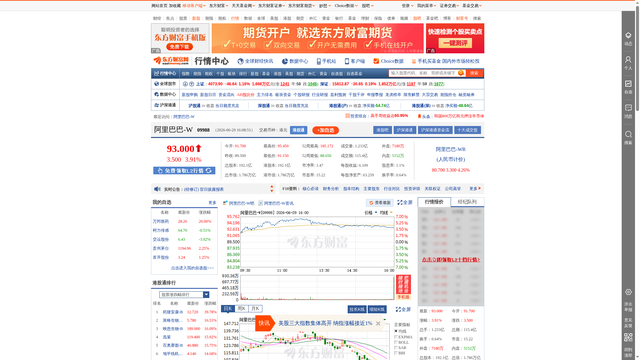
Screenshot 1: East Money’s quote for Alibaba-W (09988) at HK$93.00, with a market capitalization of HK$1.786 trillion
01 External Pressure: The Stronger the Tech, the Tighter the Blockade
Anthropic's accusation is not an isolated incident. Looking back over the past six months, a coordinated effort against Alibaba AI becomes apparent.
In February 2025, Apple and Alibaba announced a partnership to launch Apple Intelligence, powered by Alibaba's models, for iPhones in mainland China—a mutually beneficial arrangement. Apple needed a compliant local AI partner, while Alibaba sought access to hundreds of millions of consumer-end users. However, progress stalled. According to the Financial Times, the jointly developed AI product got held up at China’s Cyberspace Administration after submission for review. Sources cited escalating U.S.-China geopolitical tensions as the reason for the prolonged approval process for AI collaborations involving U.S. entities.
Ultimately, a tech partnership foundered at the negotiation table over tariffs.
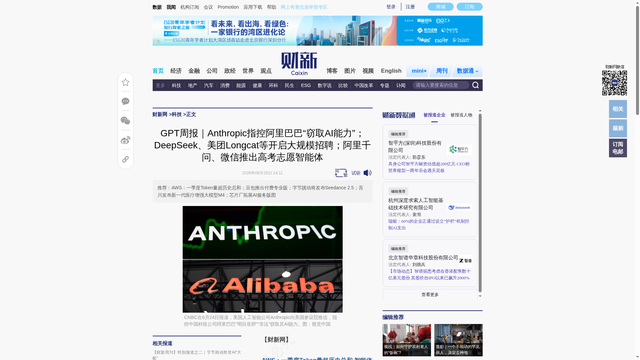
Screenshot 2: Sina Finance reports on Anthropic's accusation of Alibaba's "distillation attack"
In September 2025, Anthropic suspended AI services to "Chinese-controlled entities"—a first for a U.S. AI firm. By November, on the day the Qianwen APP launched, foreign media cited a White House memo alleging that Alibaba provided technical support to China’s military. The report heavily relied on suggestive language such as "possibly" and "internal rumors," emphasizing that no "factual verification" had taken place. The tactics mirrored those used against Huawei.
The latest blow came on June 24 with the "distillation accusation." Notably, it occurred just a day after Alibaba filed a lawsuit against the U.S. Department of Defense in California federal court on June 23, demanding its removal from the "Chinese military enterprises list." Coincidence? Unlikely.
Anthropic had previously made nearly identical accusations against DeepSeek, Moonshot AI, and MiniMax. Labeling routine model interactions as "theft" seems like a pretext. Nevertheless, capital markets reacted swiftly—stocks dropped regardless.
Alibaba Cloud’s AI-related revenue has achieved triple-digit growth for 11 consecutive quarters, reaching RMB 8.971 billion in Q4 FY2026, accounting for over 30% of external commercial revenue for the first time. Qwen 3 scored 1,433 points on LMSYS Chatbot Arena, ranking third globally. Qianwen 3.7-Max secured 1,541 points in CodeArena’s blind programming test, soaring to second place worldwide and breaking Claude’s code monopoly.
The sharper the technological edge, the denser the external blockades. This is not solely Alibaba's challenge—it is a hurdle faced by all Chinese tech firms on the global stage.
02 Internal Strife: Three Reorganizations in Three Months
If external pressures from the Pacific region represent external variables, internal consumption has posed a tougher recent challenge for Alibaba.
On June 4, Teng Yaxin, a former AI product manager at DingTalk’s Wukong Business Unit, published a 75,000-word resignation essay titled "Inside DingTalk" on Alibaba’s intranet. She detailed the lifecycle of DingTalk’s flagship AI project, ONE, accusing the team of pandering to superiors, fostering a toxic overwork culture, and prioritizing leadership whims over product logic. Six days later, Alibaba’s Partnership Committee intervened, criticizing DingTalk’s management in a rare intranet post. Subsequently, DingTalk CEO Chen Hang (Wu Zhao) stepped down, replaced by Chen Yusen, born in 1992.
Alibaba restructured its AI organization three times in three months. In March 2026, it launched the Alibaba Token Hub Business Group; upgraded its Technology Committee in April; and merged the Tongyi Large Model Business Unit with the Future Life Lab in June to form the Token Foundry Business Unit, led directly by Wu Yongming.
Each reorganization aimed to address the same issue: granting AI operations sufficient decision-making speed and resource priority within the sprawling organization. Yet, frequent structural changes themselves erode execution efficiency and talent retention.
In early March, Tongyi Lab planned to split the Qwen team from vertical integration into horizontal units—pre-training, post-training, text, and multimodal. Lin Junyang, who led Qwen 3.5’s open-source efforts and advocated for "small teams, big loops" full-stack approaches, departed. According to iBlackhorse, after HappyHorse (Qianwen’s C-end product) launched, team members received massive headhunter calls. ByteDance, Tencent, and multiple AI startups poached talent, with Tencent offering salaries approximately 50% above market rates for AI experts.
Tongyi’s core figure, Zhou Jingren, was promoted to Chief Scientist but relieved of product line responsibilities. Opinions differ in tech circles: was this a "coronation" or "sidelining"?
In three months, Alibaba witnessed: a flagship product’s CEO replacement, star technologist exits, a chief scientist’s demotion, and three organizational reshuffles. Such turmoil exacts a heavy toll on any tech firm.
03 The Real Commercialization Gap: 21 Percentage Points
Alibaba AI’s true challenge may lie not in external suppression or internal chaos but in a more fundamental issue: strong technology but weak productization and commercialization.
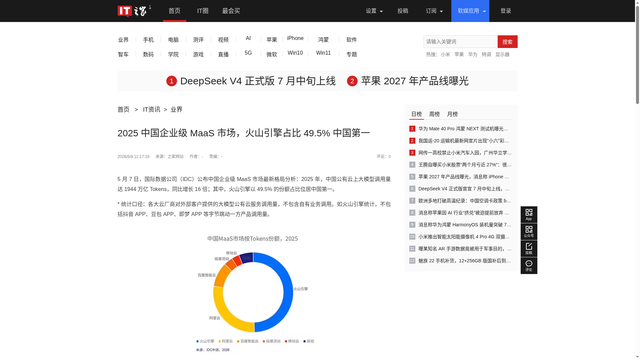
Screenshot 3: IDC reports that Volcano Engine leads China’s 2025 enterprise MaaS market with 49.5%, while Alibaba Cloud holds approximately 30%
According to IDC, China’s enterprise MaaS market saw token calls surge 16-fold year-over-year to 1,944 trillion tokens in 2025. Volcano Engine dominated with 49.5%, while Alibaba Cloud held approximately 30%. The nearly 20-point gap means that for every 10 token calls, 5 run on Volcano Engine and only 3 on Alibaba Cloud.
This is not a technological gap but a deficit in productization, scenario integration, and commercialization. Global AI commercialization split clearly in 2026: programming and video became the two frontlines. Cursor’s annual revenue exceeded $2 billion; Anthropic’s Claude Code captured 54% of programming model shares; ByteDance’s Seedance 2.0 generated over RMB 1 billion monthly for Volcano Engine in video.
Alibaba’s Tongyi also targets programming and video. Yet, beyond acclaim from tech enthusiasts in open-source communities, few commercial products gain unanimous market adoption.
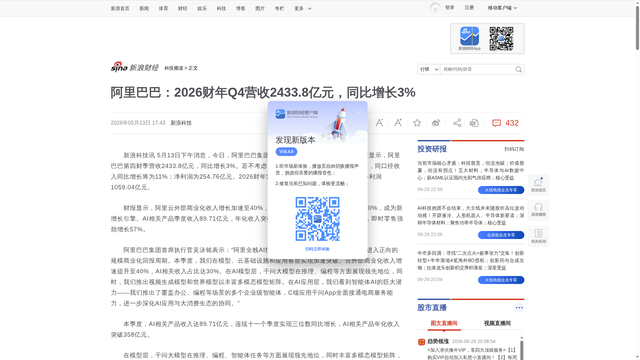
Screenshot 4: Sina Finance reports Alibaba Cloud’s Q4 FY2026 earnings: AI revenue RMB 8.971B, annualized RMB 35.8B
Alibaba Cloud’s Q4 FY2026 external commercial revenue grew by 40%, with AI-related products exceeding 30% of the mix for the first time, hitting an annualized ARR of RMB 35.8 billion. Wu Yongming stated at earnings: "Alibaba’s full-stack AI investment has officially moved past incubation into scalable commercial returns." The shift from "incubation" to "returns" marks Alibaba AI’s transition from spending to harvesting.
Yet, RMB 35.8 billion in annualized revenue carries little weight against a HK$1.786 trillion market cap. T-Head’s self-developed GPU chips have shipped 470,000 units cumulatively, generating over RMB 10 billion in annual revenue, with over 60% serving external commercial clients. Chips form the foundation of Alibaba’s AI stack—and its toughest challenge: long investment cycles and slow returns cannot yet buoy valuations.
04 Epilogue: Between Sowing and Reaping
Alibaba AI’s predicament can be summarized in three lines: geopolitical blockades will not cease, internal organizational pains persist, and commercialization remains a long road.
These pressures create Alibaba AI’s most complex landscape. Technologically, Alibaba is China’s sole firm achieving "four-layer vertical integration" of chips, cloud, models, and scenarios—a flawless full-stack capability. Yet, technical completeness does not guarantee commercial success.
Jack Ma recently took executives to transplant rice seedlings, noting that they need over 100 days to harvest. Between AI’s sowing and reaping lies a prolonged wait. However, rice fields face weather and pests; Alibaba AI confronts extraneous variables unrelated to technology or products.
Whether it can weather these "off-board tactics" to convert technological advantages into market dominance may determine Alibaba AI’s harvest.
(All data as of June 29, 2026. Sources: Alibaba earnings, East Money, IDC, Financial Times)
-
【In-depth】Current Market Status and Key Enterprise Analysis of Confocal Fluorescence Microscopes in 2026
-
![]()
Avita Releases Updated Prospectus: Projecting Over 120,000 Vehicle Sales and Over 60% YoY Revenue Growth by 2025
-
![]()
Navigating the Electric Wave: Mercedes-Benz Embraces the Three-Pointed Star, Audi Sheds the Four Rings
-
![]()
BYD Delegates Power, Geely Centralizes It: Which Transformation is Better Suited for the Future?
-
![]()
National Standard for Agent Interconnection Released: Why Might the Physical World Still Be Unreachable Despite Unified Interfaces?
-
![]()
Mobile Imaging: As Capabilities Grow, So Do the 'Add-Ons'—Why?
-
![]()
The imaging capabilities of smartphones are continuously improving, but why are there more and more 'add-ons' for shooting?
-
![]()
Alibaba's AI 'Crucible': Navigating Overseas Blockades, Organizational Upheaval, and the Lag in Commercialization