UBTECH U1 Launch: Pre-sale Excitement Creates Unrealistic Hopes, Resulting in Disappointment at the Event
 07/01 2026
 377
377
After attending UBTECH's U1 launch event yesterday, my immediate impression was that the pre-sale promotions had set expectations sky-high, only to lead to a sense of letdown during the actual unveiling.
This scenario bears a resemblance to the marketing strategies employed for Chinese New Year blockbuster movies. Trailers often distill a 90-minute narrative into a two-minute highlight reel, amplifying lighting, pacing, and emotions to their peak. However, when audiences purchase tickets and settle into their seats, they discover that while the main feature isn't disappointing, it falls short of the grandeur they had envisioned.

This is precisely the challenge the U1 faced.
During the pre-sale phase, the U1 seemed almost human.
Available in full-sized male and female versions, it boasted ultra-realistic, robotic companionship with emotional depth, complete with makeup, hairstyles, and clothing options. All the promotional materials seemed to convey a single message: this isn't just another humanoid robot; it's a 'person'.
Yet, once a product claims to mimic humanity, people cease to evaluate it by robotic standards.
At the launch event, attendees scrutinized the skin texture, eye movements, and facial expressions. They listened intently to gauge whether the speech sounded natural and examined minute details like neck movements, mouth shapes, and blinking. Any imperfection was glaringly apparent.
This isn't a case of the audience being overly critical; rather, it's the product itself that has set expectations at near-human levels.
At yesterday's afternoon event, UBTECH revealed that the U1 series would prioritize emotional companionship over household chores, with deliveries set to commence on September 16th.
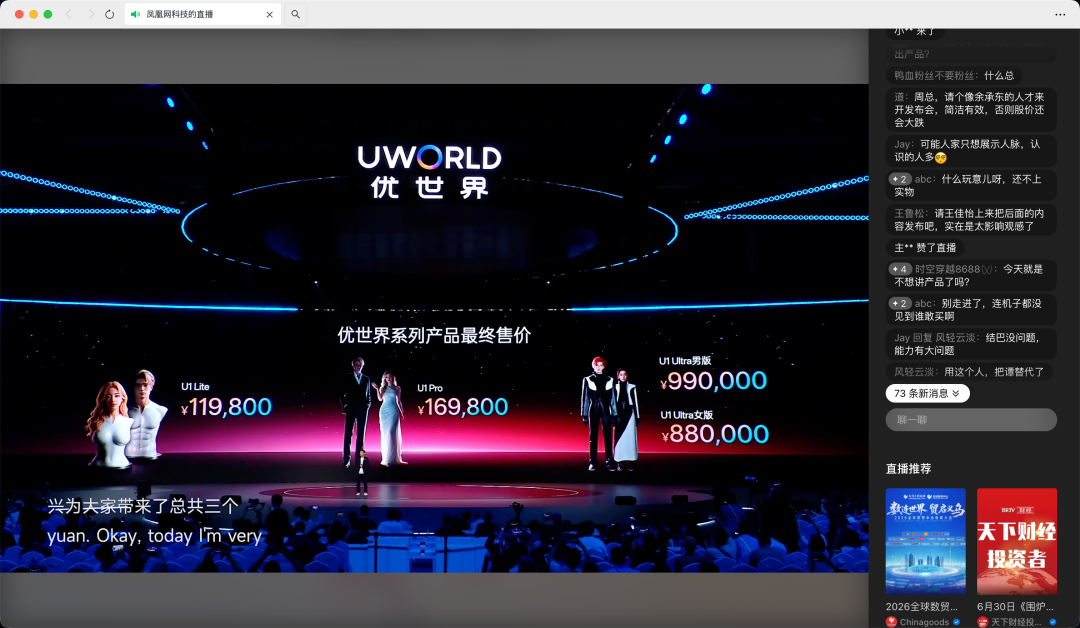
The pricing was also clearly disclosed.
The U1 Lite, priced at 119,800 yuan, is available only as an upper body and is designed for fixed scenarios such as desks or bedside tables.
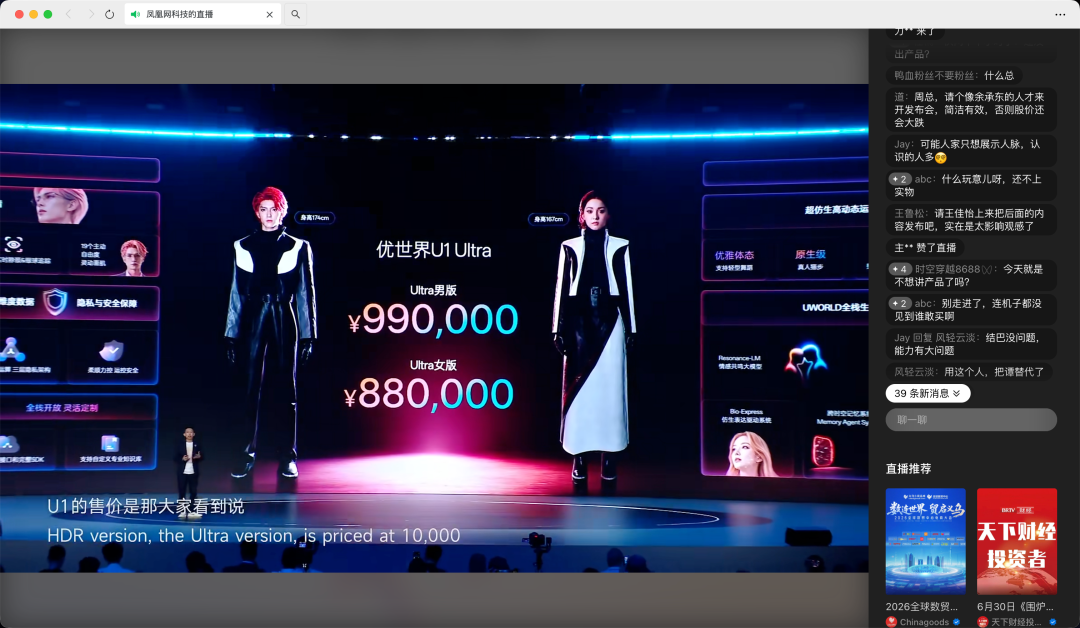
The U1 Ultra, with a price tag of 880,000 yuan for the female version and 990,000 yuan for the male version (the reason for the 110,000 yuan premium on the male version remains unclear), can replicate human gait and dance movements, resembling a high-end, custom-made model.
The most noteworthy offering is the mid-range U1 Pro, priced at 169,800 yuan. It features a 1:1 human proportion and emphasizes human-like expressions and neck movements, but lacks autonomous walking capabilities.
This is somewhat perplexing.
Upon encountering this form factor, users' expectations naturally soar: if it's a complete humanoid, shouldn't it be able to walk? Shouldn't it be able to approach me? Shouldn't it exhibit more natural bodily reactions?
However, the Pro model cannot walk autonomously.
This places it in a precarious 'semi-human' state. It resembles a human more than a desktop robot but lacks the mobility of a fully functional humanoid. It's significantly cheaper than the Ultra but still too expensive to justify solely on the basis of novelty.
Therefore, I believe the U1 Pro epitomizes the issues that emerged from this launch event.
It's the closest to what the general public can envision and might consider purchasing as a 'robotic companion,' yet it's also the most susceptible to revealing discrepancies: the body is complete, but the behavior falls short.
At the launch event, UBTECH founder Zhou Jian shared impressive figures.
Pre-orders across all channels exceeded 11,000 units initially and surpassed 13,000 units midway through the event. Crucially, these weren't casual reservations; they required a 3,000 yuan deposit.
Thus, I don't believe the U1 lacks market appeal. On the contrary, it has generated considerable excitement.
However, these 13,000 pre-orders cannot be simply equated with 13,000 guaranteed sales.
At least two pieces of information remain ambiguous: first, the distribution among the Lite, Pro, and Ultra versions; second, the subsequent refund policies for the 3,000 yuan deposit and how final payments will be processed.
If a significant portion of pre-orders are concentrated on the Lite, it suggests that the market is primarily driven by novelty. If the Pro accounts for a substantial percentage, it's more intriguing, indicating that people are genuinely willing to pay the price of a car for a 'fully proportioned robotic companion.' If there are orders for the Ultra, it primarily demonstrates the existence of high-end customization and novelty consumption.
Therefore, the true value of the 13,000 pre-orders lies not just in the total number but in the composition.
What has been proven so far is the hype; the true validation of the product will come from final payment conversions and the first batch of user feedback around the September delivery date.
On-site user feedback also highlighted the issues.
There was a human-robot dance performance at the event, but the female robot's movements weren't as fluid, and it didn't engage in verbal interaction with the audience. The open interaction outside the venue was also relatively basic, involving blinking, nodding, shaking the head, and some simple dialogue.
This is the core discrepancy of the U1 launch event: in the pre-sale videos, you see a 'person'; in the actual product, you see 'it trying to be human.'
The difference is subtle but significant.
Because the U1 isn't marketed for transportation, inspection, or factory work. It explicitly states that it cannot perform household chores. What it's selling is companionship, realism, emotional value, and a hint of adult fantasy that everyone understands but doesn't openly discuss.
So, let's not shy away from this issue.
'Selling only to adults' inherently brings the discussion to a more nuanced and sensitive realm. It's not a matter of vulgarity but of product positioning. Since it positions itself as a 'robotic companion,' users won't just ask if it can chat; they'll inquire if it's natural, authentic, and believable enough.
The value of the U1 lies in finally bringing something that was once confined to sci-fi, anime, adult consumption, and the loneliness economy into the open at a launch event.
Previously, people could pretend not to discuss it, but now they can't.
The market is indeed waiting for something like this. But what people are waiting for isn't a 'talking silicone doll' or a voice assistant with a large language model.
That's why yesterday's launch event felt so nuanced. It's like pushing the door open a crack—there's something inside, but it's still a distance from the image in people's minds.
My assessment of the U1 is straightforward: it's a product that can generate orders, spark discussions, and fuel imagination.
But it's not yet a product that can convince most people at the event that 'the era of robotic companions has arrived.'
For UBTECH to achieve this is no small feat. The 13,000 pre-orders also indicate that the demand is genuine. But for such products, users ultimately care less about promotional posters and more about close-up expressions, movements, and dialogue.
Next, UBTECH truly needs to refine several specific details to ensure they don't detractp from the experience.
For example, the transition between skin and skeleton, the way the eyes linger, the synchronization of mouth movements and facial expressions during speech, and whether it can react naturally when a user approaches.
Looking human from afar only draws a crowd. Not appearing out of place up close is what might convince people to pay the final balance.
-
【In-depth】Current Market Status and Key Enterprise Analysis of Confocal Fluorescence Microscopes in 2026
-
![]()
Avita Releases Updated Prospectus: Projecting Over 120,000 Vehicle Sales and Over 60% YoY Revenue Growth by 2025
-
![]()
Navigating the Electric Wave: Mercedes-Benz Embraces the Three-Pointed Star, Audi Sheds the Four Rings
-
![]()
BYD Delegates Power, Geely Centralizes It: Which Transformation is Better Suited for the Future?
-
![]()
National Standard for Agent Interconnection Released: Why Might the Physical World Still Be Unreachable Despite Unified Interfaces?
-
![]()
Mobile Imaging: As Capabilities Grow, So Do the 'Add-Ons'—Why?
-
![]()
The imaging capabilities of smartphones are continuously improving, but why are there more and more 'add-ons' for shooting?
-
![]()
Alibaba's AI 'Crucible': Navigating Overseas Blockades, Organizational Upheaval, and the Lag in Commercialization