Baidu's Dual Primary Listing Transfer: The Capital and Industrial Strategy Behind an 'Identity Upgrade'
 07/22 2026
 570
570
By Hengxin
Source: Bowang Finance
Recently, Baidu issued an announcement on the Hong Kong Stock Exchange: The company's board of directors has approved, in accordance with HKEX's Guidance Letter HKEX-GL112-22, the voluntary transfer from secondary listing to dual primary listing on the Main Board of the Hong Kong Stock Exchange, expected to take effect within the year. Post-conversion, both Hong Kong and Nasdaq will serve as primary listing venues, with ADS and Hong Kong shares remaining interconvertible.
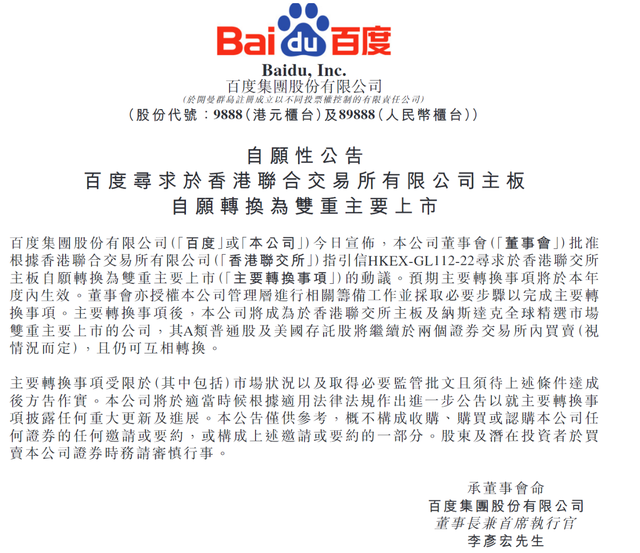
The news caused little stir in financial circles—after all, Alibaba, JD.com, and Bilibili had already led the way, making Baidu a 'latecomer.'
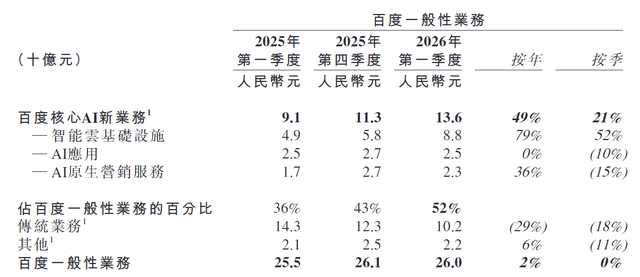
However, viewing this move through a longer time horizon reveals strategic intent: In the first half of 2026, Baidu pushed its AI chip subsidiary, Kunlunxin, onto the 'A+H' dual IPO track. In its Q1 earnings, AI-related businesses accounted for over half (52%) of core revenue for the first time, with intelligent cloud infrastructure revenue reaching RMB 8.8 billion (+79% YoY) and self-developed GPU cloud revenue surging 184% YoY.
Adjustments to capital structure are never isolated actions. Below, we dissect the regulatory implications, motivational chain, and valuation impact of this 'listing transfer' across three layers.
01
Secondary Listing vs. Dual Primary Listing: Regulatory Differences Outweigh Nomenclature
Many retail investors lump 'returning to Hong Kong' into a single category, but secondary listing (Secondary Listing) and dual primary listing (Dual Primary Listing) represent two distinct regulatory frameworks with different consequences.
Secondary Listing: The U.S. stock market remains the primary listing venue, with Hong Kong serving as a 'secondary trading market.'
Companies enjoy certain compliance exemptions from the HKEX, enabling faster processes and lower costs. However, Hong Kong and U.S. statuses are interdependent—if delisting risks arise in the U.S. due to regulations like the Holding Foreign Companies Accountable Act, Hong Kong listing eligibility may also be affected. Additionally, secondary-listed stocks carry an 'S' suffix in their code and are ineligible for inclusion in the Stock Connect, blocking southbound capital inflows.
Dual Primary Listing: Hong Kong and U.S. markets operate independently and equally, each subject to local regulatory, disclosure, and internal control rules.
This significantly enhances resilience against policy fluctuations in a single market. Critically, removing the 'S' suffix allows eligibility for Stock Connect, opening channels for mainland capital.
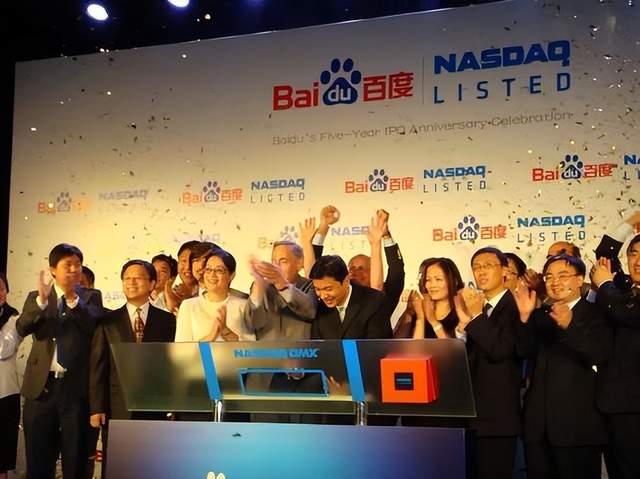
Baidu initially opted for secondary listing upon its Hong Kong return on March 23, 2021, with code 09888.HK bearing an 'S' suffix (later changed to Baidu Group-SW, where 'W' denotes weighted voting rights).
Post-conversion, the 'S' will be removed, theoretically granting access to the Stock Connect.
Following HKEX rule revisions in 2022, a 'voluntary conversion' pathway (Guidance Letter GL112-22) was opened for previously secondary-listed Chinese concept stocks. Baidu stands out as a high-profile case in this batch by size and attention.
According to *Securities Daily*, Zhang Yi, CEO of Guangzhou IIMedia Research Institute, stated that Baidu's 2026 capital adjustments and industrial deployments aim to fully realize the value chain of 'chips—frameworks—large models—industry applications,' accelerate R&D in core AI technologies, solidify its leadership in the global AI race, and achieve synergy between industrial growth and capital valuation.
02
Why Baidu Chose This Moment
While the announcement frames this as a 'voluntary conversion,' three strategic objectives align with Baidu's 2026 capital and industrial rhythm.
First Layer: Hedging Long-Term U.S. Market Uncertainties with a Dual Insurance Policy.
Despite progress in Sino-U.S. audit regulatory talks, long-term tail risks for Baidu's U.S.-listed shares persist among institutional holders. Dual primary listing ensures the Hong Kong entity's independent survival even in extreme Nasdaq scenarios, providing reassurance to stakeholders.
Second Layer: Securing Stock Connect Access as a Strategic Priority.
Baidu's Hong Kong shares currently see moderate daily trading volumes. On July 21, 09888.HK traded at ~HKD 106 with a market cap of ~HKD 289 billion and a PE-TTM of ~194x.
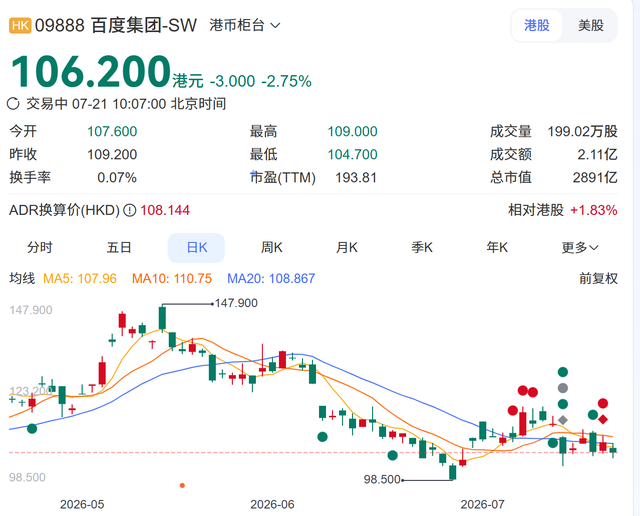
This high PE partly reflects recent earnings volatility and ongoing market revaluation between 'AI narratives' and 'traditional search fundamentals.'
Stock Connect inclusion could attract southbound capital, with liquidity premiums and mainland institutions' familiarity with AI full-stack stories potentially correcting valuation multiples—a path partially validated by Alibaba's dual primary listing.
Third Layer: Aligning with Kunlunxin's 'A+H' Capital Strategy.
This aspect remains underdiscussed in the market. In January 2026, Kunlunxin confidentially filed for a Hong Kong listing, followed by STAR Market Tutoring registration (coaching and filing) in May, with Baidu maintaining controlling stakes.
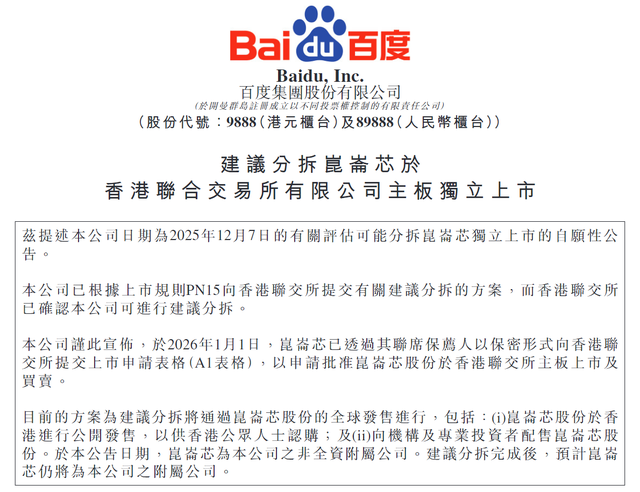
By first securing its own dual primary listing in Hong Kong, Baidu enables its chip subsidiary to pursue 'A+H' dual listings—a two-tier capital market structure aligned with the 'dual-home market' logic: reducing reliance on single markets, diversifying long-term funding sources, and matching the capital-intensive, long-cycle nature of AI computing.
Zhang Yi aptly noted, 'Synchronizing capital and industrial moves reflects Baidu's decade-long commitment to a full-stack self-research strategy.'
03
Listing Transfer ≠ Automatic Valuation Reset: Three Key Considerations
Such moves often trigger 'major positive' hype, but objectively, dual primary listing is a necessary but insufficient condition for valuation correction. Three factors warrant scrutiny:
1. Stock Connect-driven liquidity improvements are real but depend on weightings and passive fund inflow timelines.
Referring to prior Chinese concept stocks that converted to dual primary listing, inclusion typically triggers a pulse of passive fund and southbound allocations, though long-term valuations revert to fundamentals.
Baidu's current market debate centers not on 'accessibility' but on 'why AI revenue at 52% still warrants legacy internet valuations.'
2. The price gap between U.S. ADRs and Hong Kong shares remains narrow, with post-conversion arbitrage mechanisms intact.
On July 21, Baidu's Hong Kong shares traded at ~HKD 106, while ADRs converted to ~HKD 108, reflecting a -2% discount—within normal ranges. Post-conversion, ADS and Hong Kong shares remain interconvertible, preventing sustained price divergences and negating 'arbitrage opportunities from the listing transfer itself.'
3. The true valuation catalyst lies in AI commercialization speed.
Q1's 79% smart cloud growth and 184% self-developed GPU cloud growth are impressive, but the market awaits: unit economics of ERNIE Bot's API calls, profitability of Apollo Go's per-city models, and Kunlunxin's breakthroughs with external clients. These will determine whether Baidu transitions from a 'controversial stock trading at ~100x PE' to an 'AI leader with pricing (pricing power)' or remains range-bound.
An overlooked aspect: Dual primary listing subjects Baidu to dual disclosure and internal control requirements from both the SEC and SFC/HKEX, raising compliance costs.
For a tech giant, these costs are negligible, but internal process complexity surges.
Conclusion
Returning to the starting point.
Baidu's 'dual primary listing transfer' appears as a single announcement but forms one piece of a broader 2026 strategy: Kunlunxin's 'A+H' push, the parent company's Hong Kong identity upgrade, and AI revenue surpassing 50% of core income.
The endgame transcends 'returning to Hong Kong.' It involves framing the 'chips—frameworks—large models—applications' full-stack self-research narrative within a capital structure offering dual-market independence, broader funding channels, and regulatory hedging.
For investors, the event's trading window may be short—a few days of post-announcement sentiment spikes. The true metrics to track are threefold: the timing of year-end conversion, Stock Connect inclusion pace, and Kunlunxin's IPO progress.
If these milestones materialize sequentially, Baidu's 'capital foundation' for the AI cycle will be firmly established.
Whether valuations break out hinges on AI revenue growth and margin improvements—the listing transfer merely clears the table; the dishes must be served.
-
When Cost-Effectiveness Falters, Mobile Phone Sub-brands Engage in a Survival Showdown
-
![]()
Automotive-Grade Fragrance Generator: Safety as the Foundation, Pleasant Aroma as the Norm
-
![]()
Tengjing Technology’s Revenue Projected to Soar by Over 50% in First Half of 2026!
-
![]()
Insta360 Ramps Up 'Bundling' with Upstream Optical Supply Chain with 110 Million Yuan in Related Procurement
-
![]()
Following NIO and CATL’s Footsteps, Guangzhou Nurtures Another Billion-Dollar Unicorn
-
![]()
No Choice for Mobile Phone Companies | Waves
-
![]()
From Jiyue to Li Auto and Saido: The Expedition of AI Cars Has Just Begun | Business Wave
-
![]()
Why Chinese Domestic Brands Are Embracing the Supercar Race Despite Its Unprofitable Nature