From Jiyue to Li Auto and Saido: The Expedition of AI Cars Has Just Begun | Business Wave
 07/22 2026
 568
568
Edited by Yang Xuran
In the highly competitive field of new energy vehicles, the emergence of a new car brand is hardly news anymore.
Saido Technology, which evolved from Seres' former Landian business, unveiled its AI car brand AIVA in Beijing last month and plans to launch its first mass-produced model, the AIVA ME7, this year, in collaboration with ByteDance's Volcano Engine (Doubao) and CATL. This was likely one of the most unconventional car launch events in recent years.
Saido aims to explore a new path in car manufacturing: "AI defines the car—AI comes first, then the car."
Among the new forces, Li Auto is the most aggressive in transitioning to AI. Li Xiang himself has publicly stated on multiple occasions that the company's future positioning is as an AI company, not a traditional car manufacturer.
In practice, Li Auto is going all-in, betting heavily on Segmented business formats (Note: " Segmented business formats " is a specialized term meaning "sub-sectors" or "niche segments" in business contexts. If a more natural English equivalent is preferred, it could be translated as "various segments" or "specific areas") such as the VLA driver large model, operating system, AI glasses, and embodied intelligent robots. Li Xiang believes that currently, no more than three companies worldwide simultaneously control the four layers of technology: foundational models, chips, operating systems, and embodied intelligence—and Li Auto aspires to be among them.
Looking back further, the Jiyue 01, jointly developed by Baidu and Geely, was hailed as the "world's first AI car robot," attempting to integrate Baidu's Apollo autonomous driving, ERNIE large model, and Geely's SEA architecture. However, it ultimately failed to achieve a viable commercial closed loop (Note: " closed loop " is translated as "closed loop," a term commonly used in business and technology to refer to a self-contained system), making Jiyue a typical example of failure in the new energy vehicle sector.
Compared to Jiyue's failure, the AI landscape has undergone significant changes. The widespread adoption of L4 autonomous driving seems increasingly imminent, and various AI applications and commercialization cases are emerging endlessly. Now is clearly an opportune time to discuss and explore the realization of true AI cars.
This article is an in-depth, value-packed piece from the Business Wave content team. We welcome your attention across multiple platforms.

The Radicals
Saido Technology, the latest entrant in AI cars, actually originated from Seres.
Saido was formerly Seres' Landian Electric, a sub-brand launched by Seres in March 2023, positioned in the 100,000-150,000 RMB new energy vehicle segment.
Seres' initial plan was to establish a dual-brand structure with Landian and Aito, forming a "high-low" combination. However, Landian's sales consistently fell short of expectations, declining over time. In 2023, the brand sold fewer than 10,000 units; in 2024, sales reached around 30,000 units; in 2025, they slightly exceeded 20,000 units; and in the first half of this year, total sales amounted to only 4,259 units.
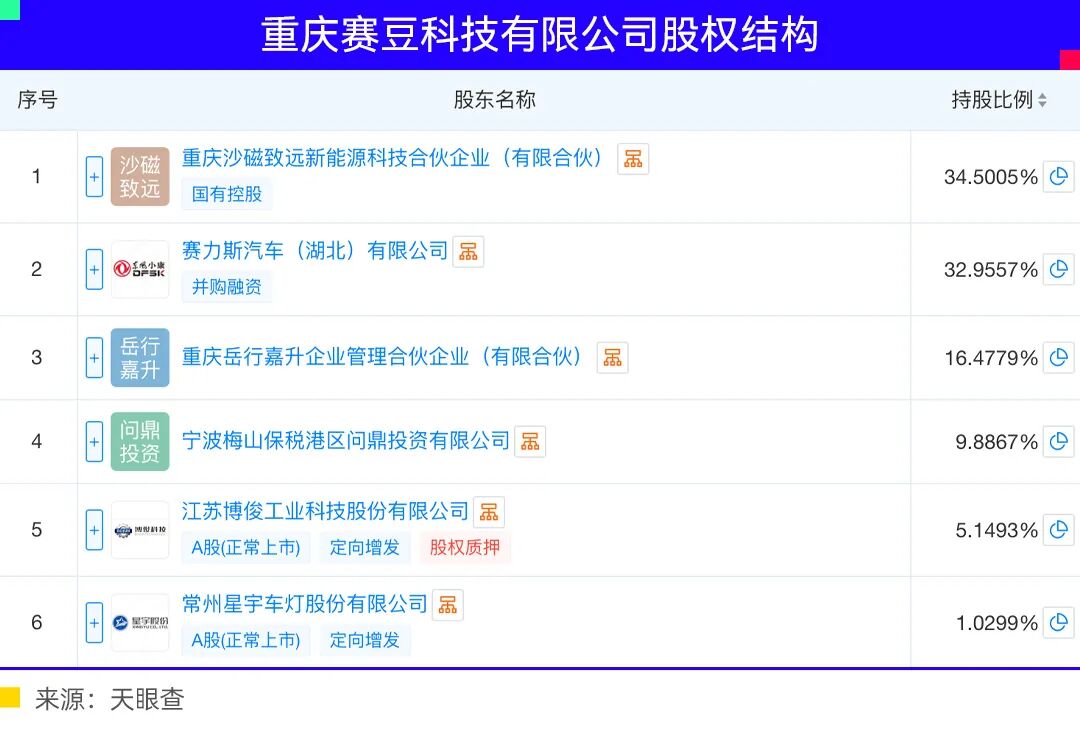
In February of this year, Seres initiated a plan to divest and restructure Landian's assets, introducing investors such as Chongqing State-Owned Assets, CATL, Bojun Technology, and Xingyu Shares. After the restructuring, Seres' stake dropped to 32.96%, relinquishing its controlling position. On May 29, the company was officially renamed "Chongqing Saido Technology Co., Ltd."
Just 10 days later, Saido Technology officially unveiled its AI car brand AIVA, emphasizing "AI defines the car—AI comes first, then the car."
Prior to this, with the advancement of AI technology, automakers have been continuously integrating intelligent driving, advanced chips, language large models, and intelligent cockpits into their vehicles. However, it is evident that simply adding AI functions to existing cars does not constitute a true "AI car."
At the launch event, Li Bo, President of AIVA, made the following analogy: "In the past, humans mined upfront; now, AI mines upfront, and humans refine afterward."
Saido aims to create an "embodied AI life form" in the automotive world. In its view, equipping existing hardware with AI functions merely qualifies as a "smart car," where AI is an add-on module. An AI car, on the other hand, is AI-dominated from the initial product definition, with hardware serving AI. A smart car is "fitting a car with AI," while an AI car is "building a car with AI."
For example, when someone says, "I'm cold," a smart car would simply raise the air conditioning temperature, while an AI car would recommend a more reasonable solution by considering temperature differences, user preferences, and heating efficiency.
Unlike Seres' deep collaboration with Huawei, Saido did not choose Huawei's Pangu large model. Instead, it relies on Volcano Engine for AI capabilities (Doubao large model) and intelligent cockpit technology.
The emergence of AI car brands essentially aligns with the historical trend of the rise of physical AI. Language large models represent "virtual AI" that processes text, images, and videos, while physical AI perceives, reasons, plans, acts, and reflects in real-world physical environments.
Besides the new brand Saido, Li Auto is the most aggressive among the new forces.
On June 15, at the Livis Day Li Auto Software and Embodied Intelligence Launch Event, Li Auto formally proposed a complete definition of embodied intelligent vehicles: intelligent entities that simultaneously possess four capabilities—electric vehicle, professional driver, AI computer, and life assistant.
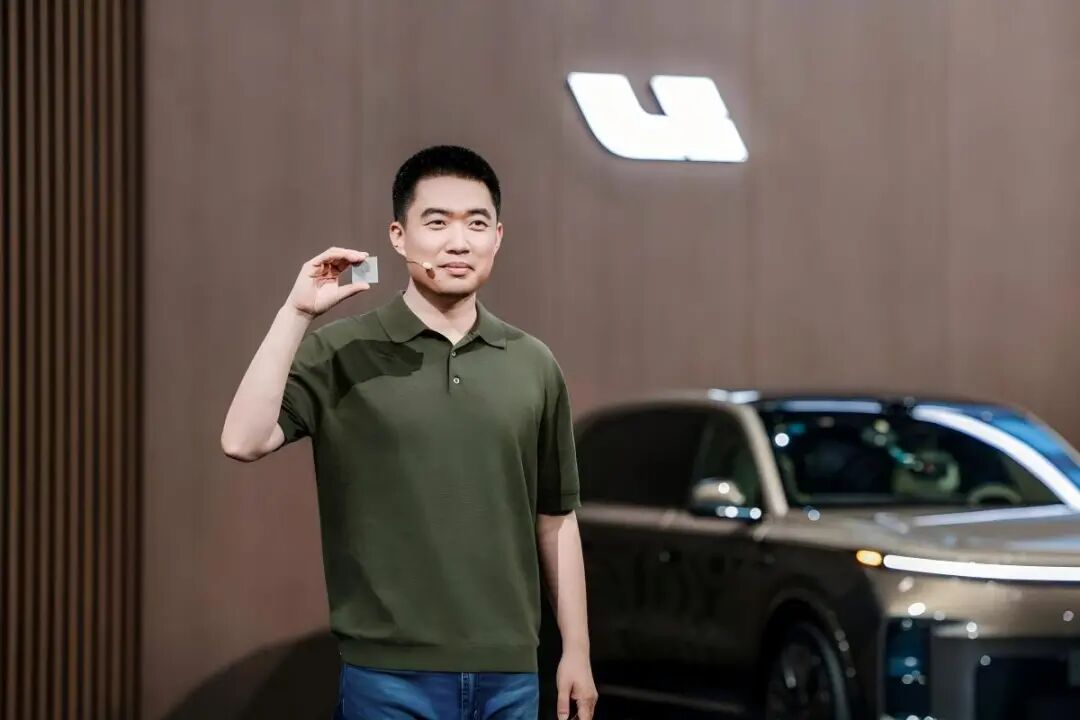
In Li Xiang's view, today's smartphones and smart cars are not truly AI-intelligent. They are essentially "feature-driven" rather than intelligent entities with life.
To achieve true AGI, Li Auto has built four major systems: self-developed large models (Mach Mind-Pro, Mach VLA), chips (Mach M100), an operating system (Star Ring OS), and robots (Nexus), attempting to transform Li Auto into a new species that integrates an "electric vehicle + professional driver + AI computer + life assistant."
The emergence of AI cars essentially represents a paradigm shift in the automotive industry from "hardware-defined products" to "software-defined cars" and further toward "AI-defined everything." Li Auto and Saido are the current pioneers in this transition.

The Arduous Journey
Besides Saido and Li Auto, Jiyue was an earlier explorer in AI cars.
In March 2021, Baidu and Geely jointly established Jidu Auto, hailed as the industry's first car robot brand. The following June, Jidu officially unveiled its first car robot concept vehicle, ROBO-01, in Baidu's metaverse.
This vehicle featured multiple futuristic designs: numerous active deformable structures, a "pop-up" adjustable LIDAR on the front hood, an active adjustable tail, butterfly doors in the front and suicide doors in the rear, and even a foldable U-shaped steering wheel. The speakers on both sides of the front compartment were also adjustable.
Inside the ROBO-01 concept car, most physical buttons were eliminated, relying entirely on touch or voice interactions. Even gear shifting could be commanded via voice.
Jidu's vision was to achieve driverless driving, transforming cars into wheeled robots that are also empathetic and understand human needs.
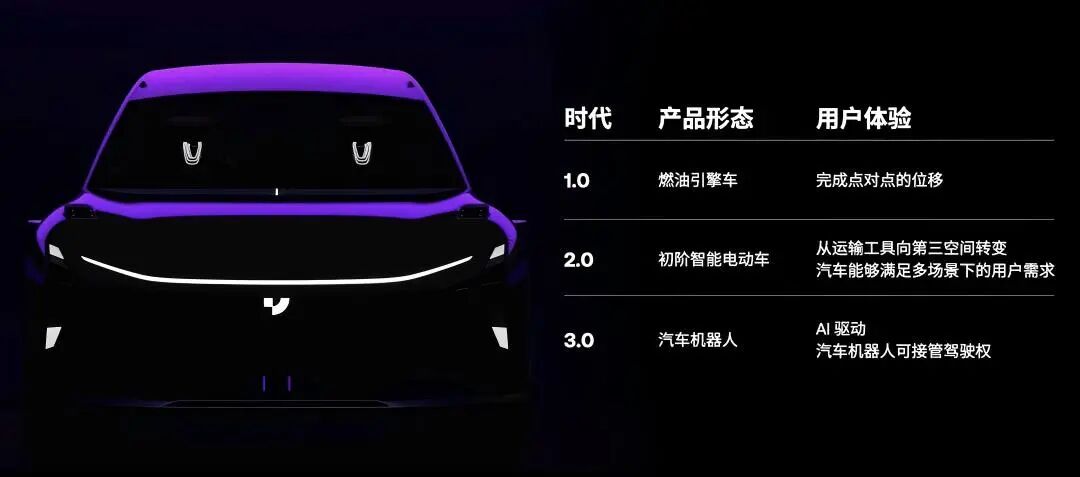
However, in the end, the complete version of this vehicle only existed in Baidu's metaverse, "Xirang." Due to its futuristic design and other reasons, the mass-produced version was delayed and never reached the market.
Subsequently, Jidu Auto underwent a strategic restructuring and was renamed "Jiyue Auto," with its equity structure adjusted to Geely Holding (65%) and Baidu as a minority shareholder (35%). The ROBO-01 was concurrently renamed Jiyue 01.
In October 2023, the Jiyue 01 was launched, continuing its positioning as the "world's first AI car robot," integrating Geely's SEA architecture and Baidu's AI foundation (ERNIE, Apollo Intelligent Driving). It was touted as the world's first smart car to "onboard" a large model.
On paper, Jiyue combined Baidu's over a decade of accumulation in artificial intelligence, seemingly born with a "golden key." However, its superior configuration and cutting-edge AI technology failed to fully translate into market recognition.
According to Yiche.com, in 2024, Jiyue's total sales across all models reached approximately 14,000 units, with the Jiyue 01 selling only 9,548 units and the Jiyue 07 around 4,000 units.
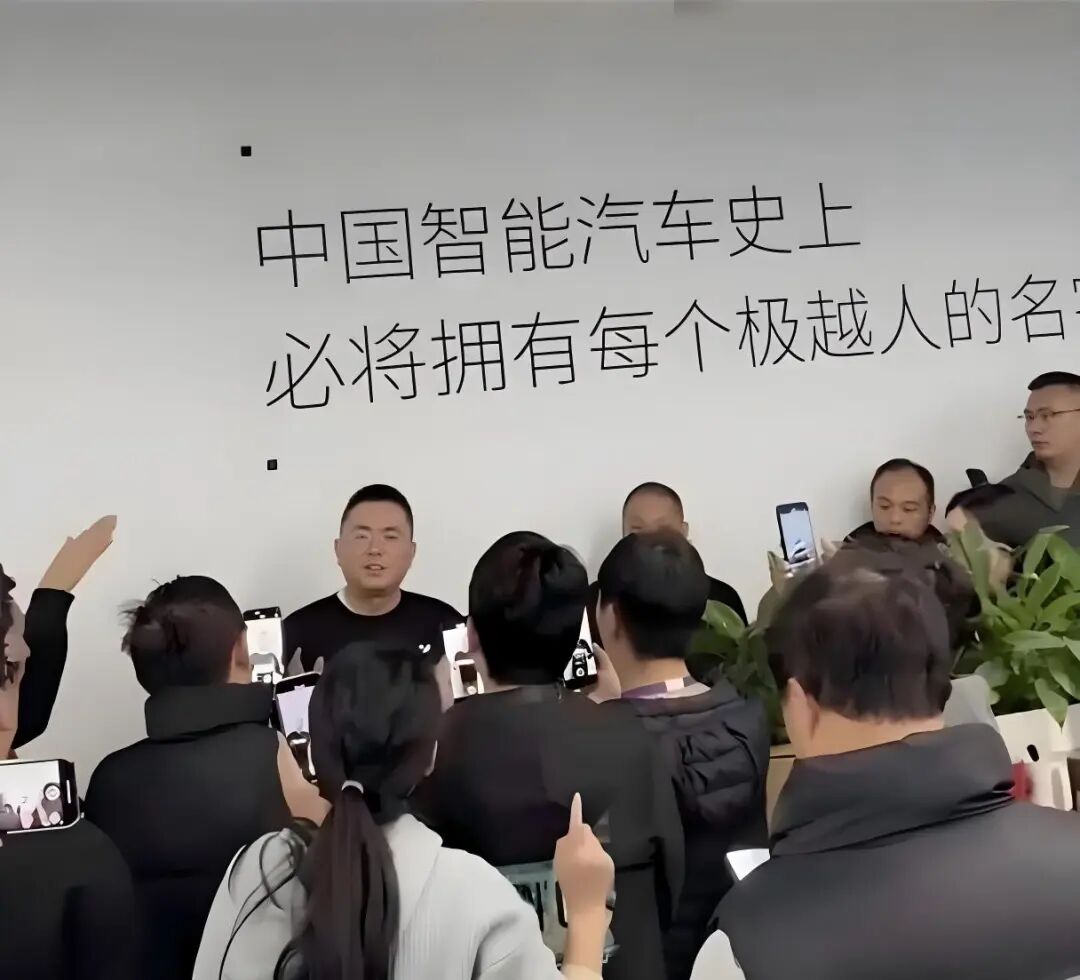
By the end of that year, rumors emerged that the major shareholder had suddenly "cut off funding," with 3 billion RMB in investment failing to arrive on time, plunging Jiyue into an operational crisis. CEO Xia Yiping was even "confronted" by employees. Subsequently, Geely and Baidu had to jointly issue a statement committing to assist in resolving the aftermath.
Jiyue's setback provides a valuable reference for the entire industry. The expedition from traditional cars to AI cars is extremely challenging. Technological advancement does not equate to commercial success. Organizational operations, channel construction, cost control, and brand trust are all crucial factors.
As a new product label, "car robots" still require time to build consumer awareness and trust.
According to a J.D. Power 2026 survey, consumer awareness of fully autonomous vehicles (AVs) rose to 58% (up from 43% in 2024), but confidence did not follow suit. Concerns about safety, performance, and trust remain major barriers to the widespread adoption of new technologies.
A joint survey by China Business Journal and Sina revealed that 82.68% of respondents worried about "system errors or unreliability causing accidents," while 63.05% were concerned about "exaggerated claims misleading users." Additionally, 40.08% of respondents were unwilling to pay extra for intelligent assisted driving, while 44.13% would only pay up to 5% of the vehicle's price.
AI intelligence is thriving in the automotive industry, but consumers still primarily view cars as a means of transportation, with reliability and safety being core considerations in purchasing decisions. The weight of AI in car-buying decisions is increasing but has not yet become a decisive factor.

The Implementation Challenge
"Optimistic but struggling to increase trust further" reflects the current consumer Contradictory mentality (Note: " Contradictory mentality " is translated as "ambivalence," a term that captures the coexistence of conflicting feelings) toward AI cars.
In both China and the United States, where AI application adoption is relatively high, most consumers are eager to experience autonomous vehicles due to a "novelty-seeking" mentality. In Europe, however, surveys show that only 13% of the public is willing to ride in autonomous vehicles, with over half lacking trust in AI's emergency decision-making.
Taking China's autonomous driving as an example, it is still in the Popularization period (Note: " Popularization period " is translated as " Popularization stage " or "adoption phase," meaning the period of widespread adoption) of assisted driving, with L2++ navigation-assisted driving becoming standard in mid-to-high-end models. Consumers are gradually getting used to "cars that can drive but require human supervision," with features like highway assisted driving and automatic parking gaining popularity among car owners.
L3 represents "hands-off" driving under limited conditions. The key inflection point will be when consumers accept Robotaxi services and believe "nothing will go wrong," at which point trust will be established.
L4 achieves high-level autonomous driving, where vehicles can largely operate intelligently on their own. The ideal L5 is fully autonomous driving, where steering wheels become "optional," and cars truly transform into "mobile intelligent spaces."
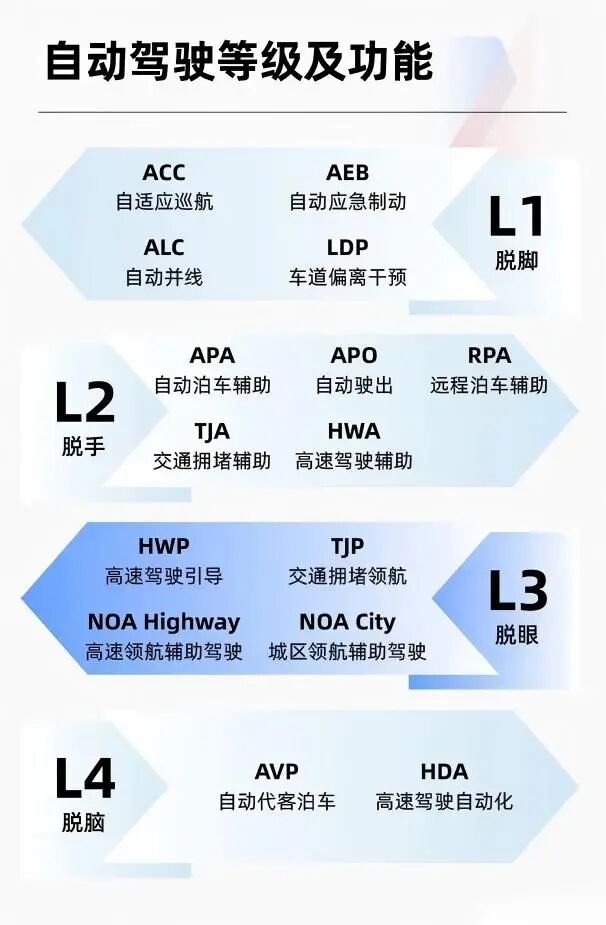
According to Horizon Robotics founder Yu Kai's reiteration in May this year, the timeline for autonomous driving's "three-step" progression should be: hands-off driving (L3) by 2028, eyes-off driving (L4) by 2030, and sleeping-while-driving (L5) by 2035.
Li Xiang is even more optimistic, believing that L4 autonomous driving will definitely be achieved by 2028 at the latest. The technical thresholds for realization require three major capabilities: a 3D ViT perception system (human-like 3D vision), a large model for the physical world, and a full drive-by-wire chassis with over 10,000 TOPS of computing power.
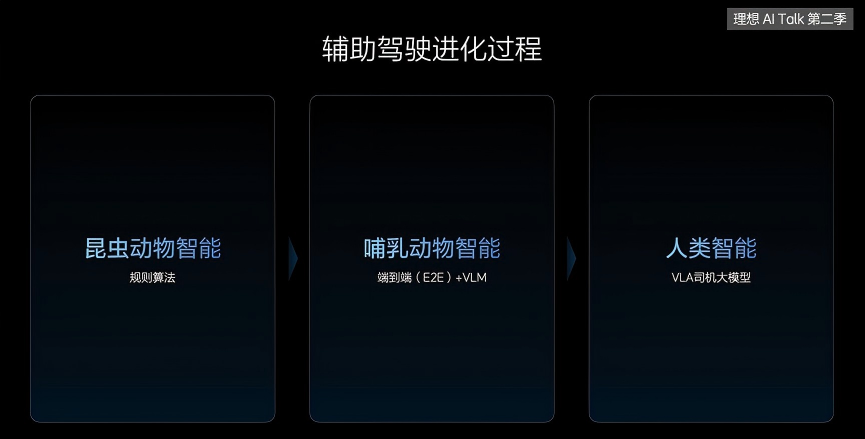
Li Xiang divides automotive AI intelligence into three stages: the first stage involves rule-based algorithms and high-definition maps, akin to "insect-level intelligence"; the second stage features end-to-end systems and VLM visual language models, approaching "mammalian intelligence"; the third stage involves the VLA driver large model, reaching "human-level intelligence" capable of seeing, understanding, and executing.
The foundation of technological implementation is data, especially data accumulated from real-world driving, which forms the basis of AI's "intelligence." The amount of data depends on sales and vehicle ownership. Currently, Tesla holds a first-mover advantage, with its FSD (Supervised) having accumulated over 10 billion miles (approximately 16.093 billion kilometers) in total driving distance—a milestone set by Elon Musk as necessary for achieving unsupervised autonomous driving.
Li Auto's assisted driving total mileage currently stands at approximately 8.48 billion kilometers (as of July 19), still some distance away from the aforementioned threshold.
Having AI cars run errands or pick up relatives independently is an even more distant goal, representing a more complex task than Robotaxi services—and a true manifestation of AI mobility. This requires at least L4-level intelligent driving capabilities, the ability to handle highly complex and unfixed scenarios such as residential areas, shopping malls, and schools, and the capacity to complete interactive tasks like identity recognition.
Some analysts believe that to achieve the aforementioned closed-loop scenarios, we may have to wait until at least 2040. Overcoming the psychological "safety" barrier for people is a timeline that is difficult to pinpoint with certainty.
Of course, what auto companies must do is inevitably strive to bring this timeline forward, again and again.

In Conclusion
From Ji Yue's shattered dream of the "car robot," to the aggressive bets by Li Auto and Saidiao, and then to the quiet expansion by giants like Tesla and Google, AI-powered vehicles have been spiraling upward through trial and error, never once stopping.
Building trust, defining marketing boundaries, clarifying responsibility divisions, and achieving commercial closed loops—each of these challenges requires the industry to gradually resolve them through exploration. Every technological revolution in history has undergone a similar period of skepticism, and AI-powered vehicles are no exception.
Unlike AI smartphones, AI glasses, or AI PCs, cars carry the happiness and safety of consumers' families, naturally demanding higher reliability. This means the maturation cycle for AI-powered vehicles may be longer, but it also means that once trust is established, the competitive moat for capable auto companies will be far deeper than that of consumer electronics.
"When will we be willing to fully hand over the steering wheel to AI?"
The answer to this question depends not only on a technological breakthrough but also on the simultaneous maturation of technology, regulations, infrastructure, and user trust. This will take time, but the direction is clear.
-
When Cost-Effectiveness Falters, Mobile Phone Sub-brands Engage in a Survival Showdown
-
![]()
Automotive-Grade Fragrance Generator: Safety as the Foundation, Pleasant Aroma as the Norm
-
![]()
Tengjing Technology’s Revenue Projected to Soar by Over 50% in First Half of 2026!
-
![]()
Insta360 Ramps Up 'Bundling' with Upstream Optical Supply Chain with 110 Million Yuan in Related Procurement
-
![]()
Following NIO and CATL’s Footsteps, Guangzhou Nurtures Another Billion-Dollar Unicorn
-
![]()
No Choice for Mobile Phone Companies | Waves
-
![]()
From Jiyue to Li Auto and Saido: The Expedition of AI Cars Has Just Begun | Business Wave
-
![]()
Why Chinese Domestic Brands Are Embracing the Supercar Race Despite Its Unprofitable Nature