How Can the Internet of Things (IoT) Leverage the Accelerated Development of Next-Generation Communication Networks?
 07/28 2026
 509
509
The Political Bureau meeting held on April 28, 2026, explicitly proposed strengthening the planning and construction of water networks, new-type power grids, computing networks, next-generation communication networks, urban underground pipeline networks, and logistics networks. The State Council executive meeting on May 9 provided more precise and specific deployments for the "six networks." Industry experts believe that systematically advancing the planning and construction of the "six networks" is not only an urgent need to expand effective investment and stabilize the economy but also a strategic move to cultivate new quality productive forces and shape future competitive advantages.
As one of the "six networks," the next-generation communication network bears the responsibility of unblocking the information arteries and serves as a crucial support for driving the digital transformation of the real economy and fostering the development of new quality productive forces. The Ministry of Industry and Information Technology (MIIT) recently stated that it is conducting research on the construction of next-generation communication networks and will prioritize their planning and construction to drive the development of the information and communications industry. In my view, the upgrading and transformation of the IoT is also one of the core tasks in the construction of next-generation communication networks. Paying close attention to the IoT demands in the economic and social spheres and planning the functions of next-generation communication networks are essential paths to enhance their synergistic efforts with the other five networks and to leverage their role in facilitating the digital and intelligent upgrading of various industries.
What role does the IoT play in next-generation communication networks?
The next-generation communication network is not a single communication technology network but a comprehensive foundational communication network that adapts to the development of the digital economy and new quality productive forces, integrates space, air, land, and sea, and deeply fuses communication, sensing, computing, and intelligence. The role of the IoT in the next-generation communication network can be examined from the "new" characteristics of the network.
At a recent press conference held by the State Council Information Office, Xie Cun, Director of the MIIT's Bureau of Information and Communications, stated that the "new" aspects of next-generation communication networks mainly encompass four dimensions:
First, the connected objects have expanded from traditional individual users to diverse entities, including humans, machines, objects, and embodied intelligence. Second, the coverage has broken through traditional terrestrial limitations and extended to full-domain coverage integrating space, air, land, and sea. Third, connectivity capabilities have significantly improved in terms of determinacy and stability, better meeting the differentiated needs of industry applications. Fourth, network functions have evolved from simple information transmission to a deep integration of multiple capabilities, including communication, sensing, computing, intelligence, and security.
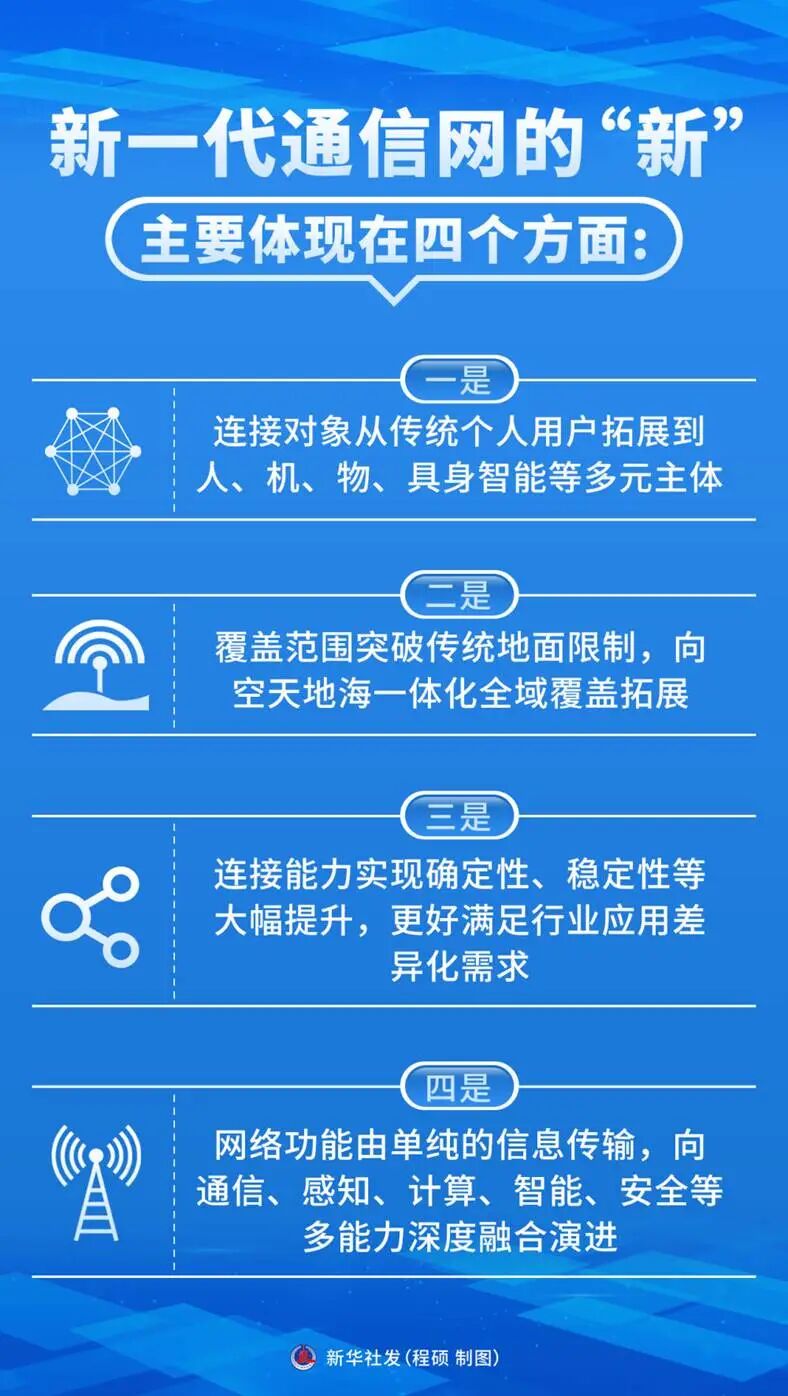
From these four characteristics, it is evident that the IoT plays an active and crucial role in each aspect, specifically including:
First, in terms of expanding the diversity of connected entities, beyond human connectivity, the IoT is indispensable for connecting machines, objects, and embodied intelligence. Over the past two decades, the development of the IoT has focused on continuously enhancing connectivity capabilities, making significant contributions to the interconnection of machines and objects. Various types of physical terminals, such as industrial IoT, connected vehicles, smart homes, and smart meters, have achieved extensive connectivity. According to IoT Analytics, by the end of 2025, the number of global IoT connections exceeded 21 billion, several times that of human connections. This large-scale connectivity has driven the maturation of various technologies, including cellular IoT, WiFi, Bluetooth, Zigbee, and LoRa. Today, with the rapid development of artificial intelligence, new forms such as IoT AI and embodied intelligence are emerging. These physical entities with stronger AI capabilities require higher stability and reliability in IoT connectivity, which is a key consideration for IoT connectivity providers to build a robust communication network for integrating the latest AI capabilities into all physical entities.
Second, in terms of breaking through traditional terrestrial coverage limitations, the IoT has always been a core function in the construction of full-domain coverage networks integrating space, air, land, and sea. Currently, with the development of fiber-optic and wireless networks, terrestrial network coverage has supported most physical entities, while space, air, and sea networks are also evolving rapidly. Taking satellite internet as an example, as one of the largest commercial aerospace market segments, both domestic and international entities are accelerating their deployments. Satellite IoT, an important component of satellite internet, has initially formed a commercial closed loop. Standardization organizations like 3GPP have introduced the first satellite IoT standard, IoT-NTN, in Release 17 and continue to strengthen it in subsequent standard evolutions. Overseas satellite operators such as Iridium, Globalstar, and Skylo have generated sustained revenue from satellite IoT. For instance, Iridium's ARPU for IoT data services is $7.7, and Globalstar's ARPU for commercial IoT users is $4.21. Chinese company GD High-Tech has obtained the first satellite IoT trial commercial license. These industry advancements provide communication support for various scenarios across space, air, land, and sea and are also important components of next-generation communication network construction.
Third, in terms of enhancing connectivity capabilities, especially for differentiated industry needs, this is a primary issue that IoT connectivity must address. In various sectors of the national economy, beyond human connectivity needs, more production and operation scenarios require the connection of various machines, vehicles, assets, and other physical entities to obtain real-time and authentic data, laying the foundation for improving overall digital management capabilities. Taking the industrial internet as an example, the application of 5G+industrial internet in recent years has, to a certain extent, aimed at enhancing IoT capabilities for complex industrial scenarios. It involves designing more suitable connectivity capabilities for equipment such as mining machinery, special vehicles, production line quality inspection, and industrial robots, as well as modifying 5G access and core networks to form dedicated networks using dedicated frequencies or network slicing. Currently, there are over 26,000 ongoing "5G+industrial internet" projects in China. It can be said that the determinacy and stability requirements for next-generation communication networks proposed by differentiated industrial internet applications are also requirements for the IoT.
Fourth, in terms of the deep integration and evolution of network functions, the IoT has entered the stage of Artificial Intelligence of Things (AIoT), making the deep integration of connectivity, sensing, and intelligence a crucial path for industry development. More than a decade ago, when defining the IoT, the industry pointed out its multi-layered architecture, including the perception layer, network layer, platform layer, and application layer, encompassing communication, sensing, computing, intelligence, and security. During industry development, communication became the most focused area, leading the market to generally assume that connectivity is the core function of the IoT. With the expansion of demands and technological progress, the integration of connectivity, sensing, and intelligence has become the main theme of the IoT, also constructing a foundation for next-generation communication networks.
In which areas should the IoT focus to build next-generation communication networks?
Building next-generation communication networks requires efforts in multiple areas. As an important component of next-generation communication networks, the IoT is a new type of digital information infrastructure built to meet the demands of the intelligent era. I believe that efforts can be made in the following areas to contribute to the construction of next-generation communication networks.
First, IoT connectivity needs to accelerate generational upgrades. The Outline of the 15th Five-Year Plan proposes accelerating the large-scale commercial use of 5G-A mobile communication networks, building 500,000 5G-A base stations, and strengthening 6G technology research and development, standard formulation, and application verification. Mobile communication networks are an important cornerstone of the IoT. According to MIIT data, as of the end of May, the three basic telecom enterprises had developed 2.98 billion mobile IoT terminal users, a net increase of 91.67 million from the end of the previous year. However, most of these nearly 3 billion mobile IoT terminal users use 4G network standards, including LTE Cat.1 and Cat.4. With the rapid growth of IoT connections, the pressure on the effective connection scale that 4G can support is increasing. At the same time, operators will not make large-scale investments in 4G networks, while the number of IoT terminals supported by 5G networks is very small, and the growth of 5G RedCap connections is slow. Given the commercial evolution trend of mobile communication networks, the industry needs to proactively accelerate the generational upgrade of IoT connectivity, gradually reduce reliance on 4G networks, increase the adoption of 5G, and promote the large-scale commercial use of 5G RedCap and eRedCap to reflect the latest achievements of next-generation communication networks. Similarly, with the emergence of new connectivity technologies such as satellite IoT and passive IoT, the industry needs to further explore more scenarios and accelerate the exploration of scenario adaptation for new-generation connectivity technologies.
Second, IoT network capabilities need to be further improved. Just as next-generation communication networks enhance determinacy and stability, IoT practitioners need to focus on building highly reliable and stable network capabilities. This can be advanced in two ways: on the one hand, deeply exploring the needs of various industries to provide dedicated IoT connectivity capabilities, typically offering wireless private network services. Previously, the General Office of the MIIT and four other departments jointly issued the Notice on Conducting Industrial 5G Standalone Private Network Pilots, releasing policy dividends for 5G standalone private networks, precisely to provide highly reliable and stable network support for industry application needs, with 5G+industrial internet private networks becoming a focus. On the other hand, aligning with the current trend of physical AI development, stable IoT connectivity capabilities need to be provided for new terminals formed during the development of IoT AI. For example, addressing the low-latency and high-uplink requirements for training, inference, and group networking and collaboration of humanoid robots, drones, and other forms, network connections, IoT modules, and connection management platforms all need further upgrades to ensure the effective operation of these terminals.
Third, the scenarios for IoT applications need to be further unlocked. The State Council Information Office press conference also proposed leveraging the supporting role of next-generation communication networks as a digital foundation to collaboratively enable innovative fusion applications of water networks, new-type power grids, computing networks, urban underground pipeline networks, and logistics networks. Similarly, the IoT plays an important role in enabling the other five networks, and these five networks themselves provide important scenarios for IoT applications. Additionally, various sectors of the national economy serve as a stage for the IoT to fully demonstrate its capabilities. During the digital and intelligent upgrading process of each industry, in addition to introducing popular large models and intelligent devices, consideration can also be given to interconnecting important physical assets, machinery, equipment, and instruments within the industry and enterprise to form a foundation for digital and intelligent upgrading and to unlock more scenarios for IoT applications.
Fourth, the value manifestation of the IoT needs to be further highlighted. Public data shows that in 2024, China's comprehensive revenue from mobile IoT was 45.271 billion yuan, corresponding to 2.6 billion IoT terminal users, with most of the revenue coming from connectivity. Based on existing data alone, the value brought by the IoT appears relatively limited. However, due to the difficulty of statistics, much of the hidden value brought by the IoT is difficult to estimate. Even some visible values are hard to fully calculate due to the difficulty of measurement methods, making it challenging to comprehensively assess the true value of the IoT. The same applies to the value calculation of the entire communication network, where visible data cannot fully reflect its value. Therefore, further research is needed in the future to explore forms of IoT value measurement that can objectively reflect more visible and hidden values, providing more confidence to industry practitioners.
Fifth, security governance for IoT devices needs to be further strengthened. The IoT has penetrated various areas of people's production and life, capable of acquiring vast amounts of data. The security and privacy issues it faces have always been one of the biggest challenges in the industry. When building next-generation communication networks, strengthening security governance capabilities in the IoT field is a top priority. In recent years, there has been a continuous increase in measures targeting IoT security. In addition to technological advancements, some institutional security measures have also been implemented. A typical institutional arrangement is the implementation of an IoT security labeling mechanism, which originated in multiple overseas countries, including Singapore, Finland, Germany, the UK, and Japan, and is being vigorously promoted in the United States. In July of this year, the Cybersecurity Labeling Management Measures, jointly issued by three departments including the Cyberspace Administration of China, came into effect. Although not specifically targeting IoT products, IoT products account for a significant proportion of products with internet connectivity functions, playing an important role in the network and data security governance of IoT products.
The construction of next-generation communication networks has begun. As an important component of these networks, the IoT needs to meet new requirements by accelerating the upgrading of its capabilities, expanding application scenarios, and contributing to the construction of China's "six networks."
-
![]()
SpaceX’s 13th Starship Mission Successfully Orbits Satellites, Yet Booster Fails in Ocean Test: Is the Reusability Dream Hitting Another Snag?
-
![]()
Major Optical Breakthrough! AR Glasses No Longer Resemble Cheap Sunglasses
-
![]()
Chen Yusen Makes the First Strategic Move
-
![]()
Exclusive | Qianwen Office Becomes Alibaba's 'Top Priority Project': All Talent and Computing Power from Alibaba Cloud and DingTalk to Be Integrated into the Product
-
![]()
2.8 Trillion Parameters Given Away: How Does Moonshot AI Make the Calculation?
-
![]()
How Can the Internet of Things (IoT) Leverage the Accelerated Development of Next-Generation Communication Networks?
-
![]()
Differentiation and Weaknesses: Multi-Dimensional Evaluation of Quality Performance in Chinese Automotive Manufacturing Plants under the AQEF Assessment Framework
-
![]()
Is Design the Root of the Problem? The Lexus ES Dilemma: Despite New and Old Models Coexisting Post-Redesign, Sales Plummet by 40%