Major Optical Breakthrough! AR Glasses No Longer Resemble Cheap Sunglasses
 07/28 2026
 345
345
Click the blue text to follow us
A Fruitful Collaboration Between China and Japan
Wearing AR glasses should ideally feel like a scene from Iron Man, where digital information seamlessly overlays the real world. However, in reality, when you put on AR glasses, the world often dims instantly, resembling a pair of cheap sunglasses.

Image Source: eBay UK
The core vision of augmented reality (AR) technology is to break the boundaries between digital and physical worlds, integrating virtual content seamlessly into real-world vision and providing an immersive interactive experience for people's lives and work. However, for a long time, mainstream AR glasses have had an unavoidable flaw: to ensure the realistic texture of virtual images, the devices often weaken and dim the real-world scene, resulting in blurred vision and an odd environmental perception for users, significantly impacting daily usability.
To make virtual graphics appear more 'real,' the real world has to sacrifice 'brightness'—this has been an awkward paradox plaguing the industry for years. However, this situation is about to change. A new display technology has been successfully developed, completely overcoming this industry pain point and enabling AR devices to achieve a dual balance of virtual realism and real-world clarity.
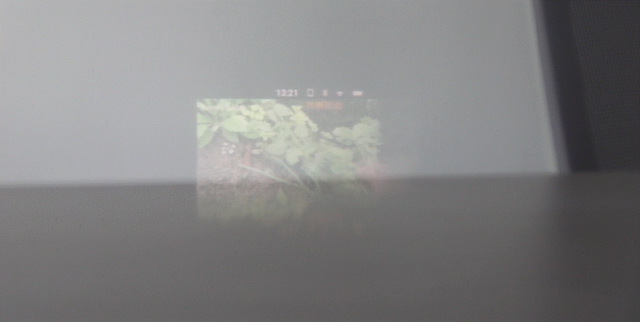
Under very bright conditions, the glasses' display performance is suboptimal. Image Source: VRAR Planet
Recently, overseas media reported that researchers from Japan's Shibaura Institute of Technology, Shanghai Jiao Tong University, and Japan's Nara Institute of Science and Technology have jointly developed this new display technology. The related research findings have been formally published in the international top journal IEEE Transactions on Visualization and Computer Graphics.
Instead of focusing solely on hardware parameters, the research team took a different approach: since the human eye is the ultimate judge, they adapted the display technology to human perception. They enabled AR to perceive the world like humans, providing a new thought process (translated as 'approach') and implementation plan for the iterative upgrade of AR display technology.
The Pain Point: Why Do AR Glasses Always Feel Like Wearing Sunglasses?
Most current AR glasses use 'optical see-through' technology. To create an occlusion effect, where a virtual object appears to be genuinely placed behind a real one—for example, making a virtual chair look like it's actually behind a table—the display must darken the real table. This technique is known as 'occlusion rendering.'
This works fine indoors, but outdoors under strong sunlight, the glasses must further reduce light transmission to counteract ambient light. The result is that while virtual objects become clearer, the user's vision becomes dim and blurry, not only affecting the visual experience but also posing safety risks—after all, no one wants a grayish view while crossing the street.
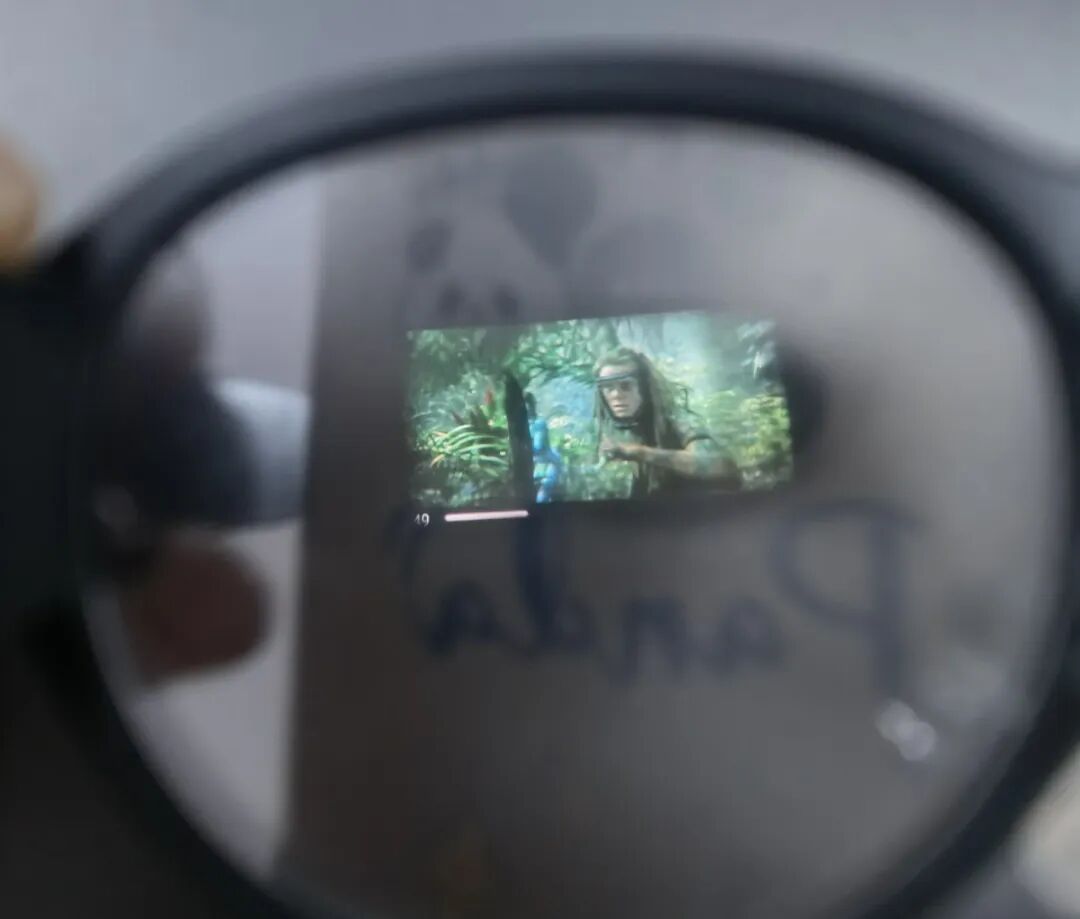
Full-color virtual images displayed in AR glasses. Image Source: VRAR Planet
The Solution: From 'Brute-Force Light Blocking' to 'Intelligent Balance'
To address this persistent issue, the research team proposed a new method called 'Mask Balancing.' Its core logic is no longer about simply blocking more light but intelligently distributing it.
The 'heart' of this system is a set of precision polarization optics, including polarization beam splitters and linear polarizers. The researchers transformed these components into an intelligent 'light regulation valve.' By fine-tuning the angles of these optical elements in real-time, the system can precisely control how much real-world light and virtual screen photons enter the eyes simultaneously. It's like a smart butler who, while observing the harsh sunlight outside and the brightness of an indoor projection, adjusts the curtains and lights accordingly to ensure both coexist harmoniously without overpowering each other.
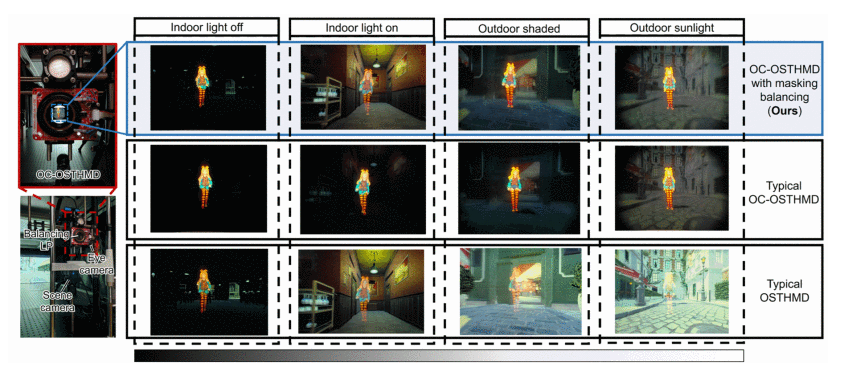
Image Source: IEEE Xplore
More Than Just Hardware: An Algorithm That 'Understands' You
Merely adjusting light mechanically wouldn't be groundbreaking. The true highlight of this technology lies in its 'perception-driven' characteristics.
The prototype device is equipped with eye-tracking and scene analysis modules. It knows where you're looking and can perceive changes in ambient brightness. Based on this, the algorithm dynamically fine-tunes the weighting of virtual and real images:
When you focus on a virtual menu, it slightly enhances the contrast of the digital content;
When you turn your head to observe road conditions, it immediately improves the transparency of the real world.
This dual-track strategy of balancing virtual and real ensures that virtual objects remain realistic while the real world doesn't dim.
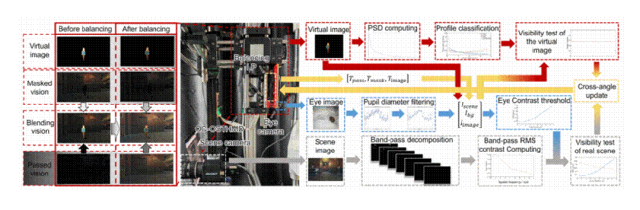
Image Source: IEEE Xplore
From Lab to Everyday Life
After multiple rounds of user testing, this system has proven to enhance real-world visibility while perfectly preserving the realism of virtual objects. This new technology boasts strong implementation value and broad applicability.
Currently, various civilian AR glasses are becoming increasingly popular, gradually entering the mass consumer market. The breakthrough in this technology has fully addressed the practical shortcomings of AR devices. In the future, AR glasses equipped with this technology will no longer be limited to entertainment scenarios but can be widely applied in professional settings such as medical assistance, industrial operations, outdoor navigation, intelligent classroom teaching, and cross-regional remote collaboration—perfectly suited for various work and life scenarios requiring clear observation of both real-world scenes and digital information.
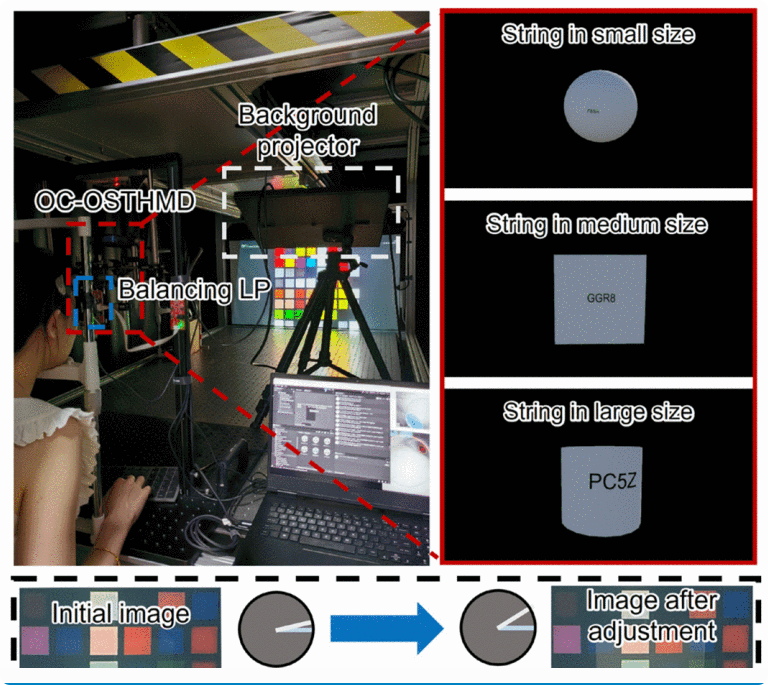
Image Source: IEEE Xplore
This means that future AR glasses will no longer be just toys for tech enthusiasts or indoor gaming devices. With the implementation of similar technologies in products from brands like XREAL and Snap, AR glasses will truly become productivity tools:
Medical Field: During surgery, doctors can clearly see both patient tissues and virtual navigation of blood vessel distributions without their vision dimming;
Industrial Maintenance: When inspecting complex circuits, engineers can overlay clear maintenance manuals without misplacing tools due to dimmed vision;
Daily Navigation: While walking, navigation arrows are clearly marked on the road, and you can still avoid oncoming pedestrians with ease.
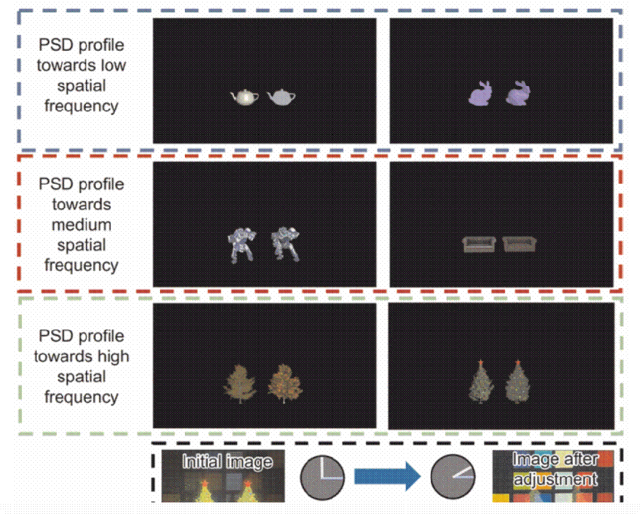
Image Source: IEEE Xplore
AR glasses are learning to perceive the world like humans—neither blinded by the virtual nor dulled by the digital. This innovation effectively solves the long-standing visual compatibility challenge in the AR industry, aligning augmented reality experiences with human visual habits and laying a crucial technical foundation for the full commercialization and practical application of AR devices.
-
![]()
SAIC’s Four Key Divisions See Leadership Overhaul: Lu Xiao Moves to Passenger Cars, Xu Ping Takes Charge of GM, Wu Yun Leads Volkswagen
-
![]()
Nearly a Year On, Traffickers Still Reap Tens of Thousands by Selling Zeekr 9X in Russia
-
![]()
Apple’s New Business Model: Pay $39 a Month, But at What Cost to Your Wallet?
-
![]()
Tencent Places Its Bets on WorkBuddy: The Next Frontier in AI-Driven Office Solutions, Vying for the Smart Gateway
-
![]()
Apple Reclaims Global Market Cap Crown: Is a Strong Device the True Path for AI?
-
![]()
Apple Regains Global Market Cap Leadership: Are Smart Devices the Future of AI?
-
![]()
RMB 3 Trillion Changxin Devours OVM
-
![]()
SpaceX’s 13th Starship Mission Successfully Orbits Satellites, Yet Booster Fails in Ocean Test: Is the Reusability Dream Hitting Another Snag?