Differentiation and Weaknesses: Multi-Dimensional Evaluation of Quality Performance in Chinese Automotive Manufacturing Plants under the AQEF Assessment Framework
 07/28 2026
 357
357
China's automotive industry is undergoing a critical transition from scale expansion to quality enhancement. By 2025, production and sales are expected to once again exceed 30 million units, while the market penetration rate of NEVs continues to rise, surpassing 40% and accelerating the restructuring of the industrial landscape. Against this backdrop, manufacturing quality control capabilities serve as the core foundation for supporting product competitiveness and building a positive reputation.
The Automotive Quality Excellence Factory (AQEF) assessment framework, jointly introduced by CarQ and CnC Consulting, utilizes real end-user complaint data as its core input. By integrating the 6M1E quality management framework and retail sales volume data from the China Passenger Car Association (CPCA), it calculates a weighted quality value expressed in PPM (parts per million). A lower PPM value indicates stronger quality control capabilities in manufacturing. Full-scale assessment data for 2025 reveals an industry-wide weighted quality value of 192.24, with significant differentiation observed across brands, energy types, production scales, and regions.
▍Quality Differentiation by Brand and Energy Type: Luxury Brands Lead, Joint Venture NEVs Face Pressure
The industry's quality landscape is first evident in the intersection of brand type and energy type. Data shows that traditional fuel vehicles have a total weighted quality value of 130.12, while NEVs register at 245.77—nearly double that of fuel vehicles—indicating weaker overall quality performance for NEVs.
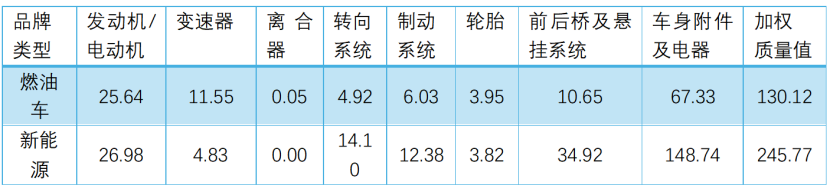
A deeper analysis combining brand type and energy type reveals clearer quality performance differences during the New Energy (new energy) transition: Luxury brand NEVs achieve a weighted quality value of 72.40, significantly outperforming their fuel vehicle counterparts at 137.57, demonstrating synchronized progress in electrification and quality stability. Domestic brand NEVs score 268.73, weaker than their fuel vehicle counterparts at 121.67, with a decline comparable to the industry average. Joint venture brand NEVs register the highest value at 320.23, experiencing a sharp decline compared to their fuel vehicle counterparts at 125.42.
Joint venture NEVs exhibit weighted quality values more than double those of fuel vehicles across systems such as body attachments and electrical components (153.20), engines/motors (72.03), front and rear axles/suspension systems (41.25), braking systems (15.46), and tires (18.44).
▍Gradient Differences by Plant Scale and Region: Leading Plants Excel, Regional NEVs Face Challenges
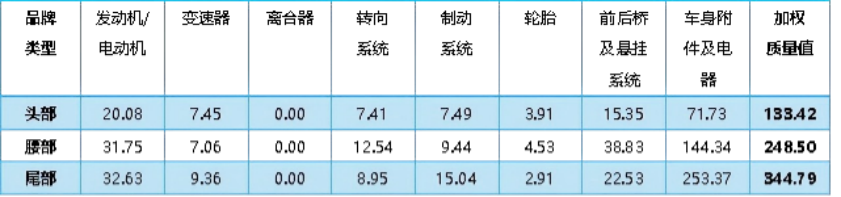
Actual production scale is another critical variable influencing quality performance. Classified by annual output, leading plants (over 200,000 units) achieve a weighted quality value of 133.42, mid-tier plants (50,000–200,000 units) score 248.50, and smaller plants (under 50,000 units) register at 344.79. The quality advantage derived from scale effects is evident.
System-specific gaps are most pronounced in body attachments and electrical components—71.73 for leading plants versus 253.37 for smaller plants, a 3.5-fold difference. Smaller plants also face more prominent issues in braking systems, with weighted quality values for safety-related problems like brake failure far exceeding the industry average.
From a regional perspective, Eastern China is the most concentrated hub for domestic new energy brands and autonomous NEV manufacturing bases, accounting for 38% of the nation's plants. The intensive application of electrification technologies, while accelerating product iteration and meeting consumer upgrade demands, has also led to concentrated terminal feedback on issues in chassis, body, and electronic components, dragging down the region's overall quality performance. More notably, significant quality differentiation exists within the region, with a stark gap between leading enterprises and laggards. This structural contradiction of "highly concentrated production capacity but uneven quality" poses the core challenge for quality improvement in Eastern China.
Northern China's advantage stems from its cluster of mature joint venture and luxury brand plants, with long-established quality management systems and stringent process standards. Northeast China leverages its manufacturing heritage as a traditional automotive industrial base, achieving the nation's lowest weighted quality value for front and rear axles/suspension systems due to mature chassis assembly processes. Central China excels in engine/motor system control capabilities.
Amid electrification and intelligent transformation, automotive manufacturing quality competition will no longer be solely a contest of production line hardware but a comprehensive battle involving systemic capabilities, supply chain coordination, and accumulated process expertise. For automakers, accurately identifying their positioning during the energy transition and across plant scale tiers—while addressing key weaknesses in body assembly, chassis tuning, and electronic matching—will be essential to maintaining quality standards amid industry transformation.
Layout | Yang Shuo Image Sources: CnC Consulting, Qianku Network
-
![]()
RMB 3 Trillion Changxin Devours OVM
-
![]()
SpaceX’s 13th Starship Mission Successfully Orbits Satellites, Yet Booster Fails in Ocean Test: Is the Reusability Dream Hitting Another Snag?
-
![]()
Major Optical Breakthrough! AR Glasses No Longer Resemble Cheap Sunglasses
-
![]()
Chen Yusen Makes the First Strategic Move
-
![]()
Exclusive | Qianwen Office Becomes Alibaba's 'Top Priority Project': All Talent and Computing Power from Alibaba Cloud and DingTalk to Be Integrated into the Product
-
![]()
2.8 Trillion Parameters Given Away: How Does Moonshot AI Make the Calculation?
-
![]()
How Can the Internet of Things (IoT) Leverage the Accelerated Development of Next-Generation Communication Networks?
-
![]()
Differentiation and Weaknesses: Multi-Dimensional Evaluation of Quality Performance in Chinese Automotive Manufacturing Plants under the AQEF Assessment Framework