Tencent Embarks on a Battle for the 'Desktop' Dominance
 07/30 2026
 329
329

Source | Bohu Finance (bohuFN)
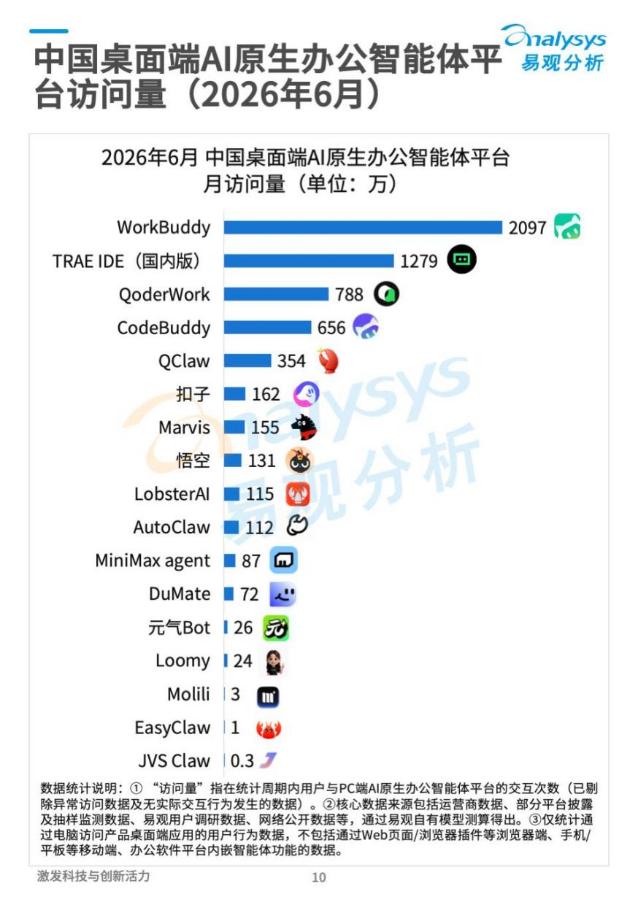
Recently, a report from Analysys highlighted that Tencent's WorkBuddy, with a remarkable 20.97 million visits, claimed the top spot in the domestic desktop-based AI-native office intelligence platform rankings for June. Just four months prior, at its launch, it had garnered slightly over 8 million visits.
In terms of product lineup, Tencent boasts four offerings on the list, collectively accounting for over half of the total traffic.
It's evident that Tencent is making a significant push into AI-powered office solutions with WorkBuddy. Weibo influencer Liang Bin (penny) revealed that Tencent's top decision-makers consistently attend WorkBuddy product meetings.

However, Tencent's celebration may be premature. Around the same time, Alibaba announced plans to merge three agent products—QoderWork, Wukong, and MuleRun—into 'Qianwen Office,' while ByteDance is advancing the deep integration of Doubao and Feishu.
With all three tech giants making strategic moves, the message is clear: WorkBuddy's success has underscored the value of desktop office agents, prompting these companies to consolidate their efforts and focus on this promising 'AI entry point.'
Of course, this is just the beginning. Whether it's Tencent, Alibaba, ByteDance, or traditional office software providers and vertical startups, the crux of this 'desktop battle' boils down to one question: Who can become the Windows of the AI era?
Fortunately, AI-powered office intelligence is still in its nascent stages, and the final outcome remains uncertain. Everything is still possible.
01 What Has WorkBuddy Done Right?
According to the Analysys report, Tencent dominates the domestic AI office intelligence market, with WorkBuddy leading in visits, surpassing the combined total of the second and third-place products. ByteDance's TRAE IDE (domestic version) ranks second, and Alibaba's QoderWork third.
Liu Yi, head of Tencent Cloud's CodeBuddy & WorkBuddy, described CodeBuddy's position as 'temporarily half a step ahead'—a modest statement that also reflects a clear sense of caution.
Looking back a year ago, Tencent faced controversy in the AI race. Despite holding strong cards like large models, cloud computing, and a social ecosystem, its Yuanbao remained lukewarm, and WeChat AI remained restrained.
Similarly, in traditional collaborative office solutions, according to QuestMobile data, DingTalk led with around 200 million monthly active users in 2025, followed by WeCom with around 100 million. While their positions weren't lagging, their AI feature rollouts were slower.
DingTalk and Feishu had already implemented AI spreadsheets, intelligent approvals, and AI meeting minutes. DingTalk even released multiple AI applications, such as DingTalk AI Magic Wand and DingTalk ONE, while WeCom didn't truly ramp up its AI efforts until the second half of 2025.
Just as outsiders thought Tencent would continue to 'run alongside' in the AI office race, WorkBuddy emerged as a 'dark horse.'
In early 2026, an open-source AI agent called OpenClaw suddenly went viral globally, with 'raising lobsters' becoming the hottest topic in the tech circle. Tencent saw an opportunity.
Tencent's leadership has long believed that the AI world is a 'multi-application' world, where not everything needs to go through chatbots. Agents are the next major battleground, and Tencent's ecosystem is highly suited for agent growth.
As early as 2022, Tencent began investing in AI Coding and released the programming tool CodeBuddy in 2024, which is now used by over 90% of Tencent's engineers.
However, the CodeBuddy team soon realized that CodeBuddy was designed for programmers. Non-programmers would be intimidated by a screen full of code. The next challenge was how to provide ordinary users with an 'out-of-the-box' AI workspace.
Thus, Tencent extended CodeBuddy into WorkBuddy—an agent product for users who don't write code. Before its official beta release, over 2,000 non-technical employees were already using it daily.
As a full-scenario AI agent desktop workspace, WorkBuddy focuses on 'completing a task with one sentence.' Unlike traditional chatbots that only answer questions, it can directly manipulate computer files and automate tasks.
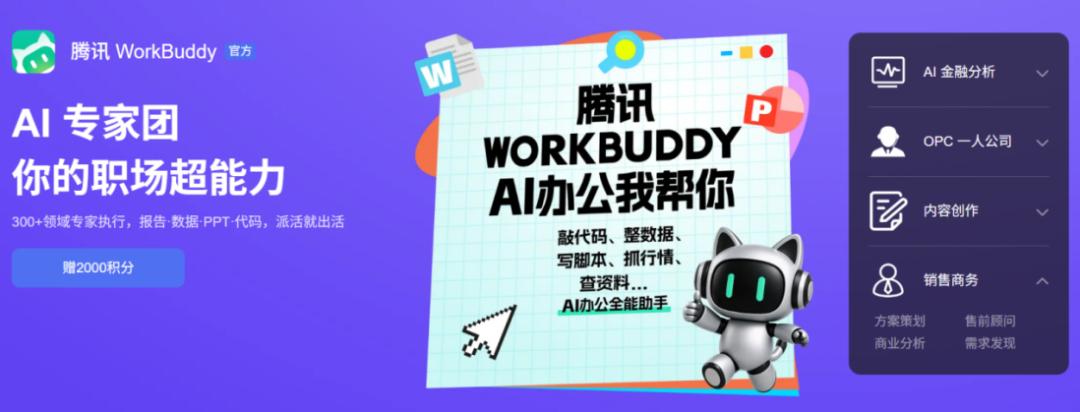
Wang Shengjie, a senior product expert at Tencent, discussed WorkBuddy's working logic: 'It's about ecosystem and openness. We aim to connect all Tencent products internally.'
Beyond agent capabilities, what truly matters is the workflow.
Looking back at Tencent's products, from QQ to WeChat, and then to WeCom and Tencent Meeting, their ability to retain users doesn't rely solely on powerful features but on connecting the capabilities, relationships, and ecosystems that users need while giving them choices.
For example, behind WorkBuddy are skill-ified products like Tencent Meeting, Tencent Docs, and IMA, which users can access anytime. Tencent also launched SkillHub, which houses over 13,000 AI skills, allowing users to easily assume different roles.
In terms of foundational models, WorkBuddy integrates multiple models, including DeepSeek, Hunyuan, GLM, and Kimi. Hunyuan isn't the only option. Most importantly, with the support of the WeChat ecosystem, it taps into the largest social network.
Models, products, scenarios, and ecosystems interlock like gears, allowing Tencent to maximize its capabilities.
02 Why Has the 'Desktop' Emerged First?
WorkBuddy's logic has proven successful.
Citigroup's research report noted that WorkBuddy's DAU/MAU ratio ranges between 65%-75%. According to Tencent's Q1 2026 earnings report, WorkBuddy's paid user retention rate exceeded 80%, indicating strong user stickiness and daily engagement.
These figures validate a trend: The demand for desktop office agents is far greater than expected.
Over the past two years, the AI industry hasn't lacked models, with parameters and rankings continuously escalating. However, behind the excitement, tech giants have been anxious about the same issue: how to retain customers and genuinely generate revenue.
This is why we've seen Doubao shift from free to paid, exploring the balance between paywalls and membership systems. Kimi has 'abandoned C for B,' with API revenue now accounting for over 70% of its total income. Alibaba Cloud and Baidu Intelligent Cloud have even raised prices...
Yao Shunyu, Tencent's chief AI scientist, highlighted the key point: The focus of the AI race's second half is shifting from pursuing model parameters to the collaborative design of models, products, and scenarios.
Tech giants are now leveraging their respective ecosystem capabilities to find the true anchor point for AI monetization—which entry point and scenario are most likely to convert model capabilities into sustained paid intention (willingness to pay).
In this process, the 'desktop' has emerged first.
According to iiMedia Research's '2026 China AI Office Intelligence Industry Development White Paper,' the Chinese AI agent market reached 80.4 billion yuan in 2025, up 123.2% year-on-year, and is expected to hit 696.8 billion yuan by 2030.
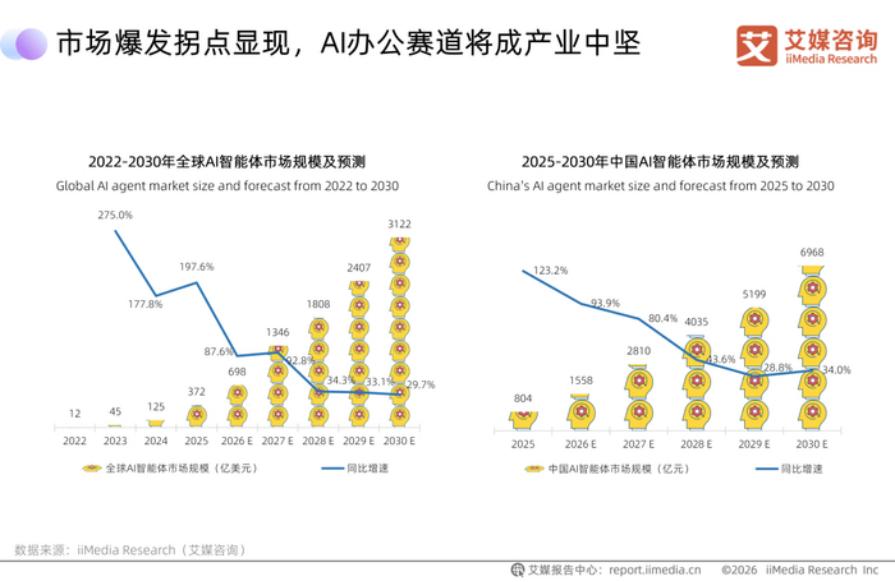
On one hand, desktop office solutions represent a 'super entry point.'
Behind an office desktop aren't just a few Excel sheets and PPTs but an entire enterprise architecture involving ERP, CRM, OA, finance, and more. Users also have demands like pulling up a data table or organizing meeting minutes anytime, anywhere.
These aren't isolated features but different links in a chain. Desktop office agents serve as both the 'entry point' and a way to connect them into a complete workflow, such as automatically generating to-do items during meetings or having AI reply to emails.
The more links an agent connects, the higher the user's switching costs become. This irreplaceability is precisely why tech giants are willing to bet on desktop office agents.
On the other hand, office scenarios are about 'getting things done.' Unlike the light interactions of chatbots where users 'ask and leave,' users open an agent in an office scenario to accomplish specific tasks. This 'task-oriented' demand naturally carries a willingness to pay.
According to Caijing, as of Q2 2026, Feishu's ARR grew by over 100% year-on-year, with 36Kr reporting that over 90% of new clients simultaneously purchased Feishu's AI products.
Tencent's earnings report showed that WorkBuddy's paid user retention rate exceeded 80% in Q1. These figures indicate that users are willing to pay for AI office solutions.
Thus, the 'desktop' emerging first isn't accidental—it's inevitable.
As large models become increasingly homogenized, infrastructure will determine the upper limit, while scenario penetration will determine the lower limit. However, what truly decides survival is agent capabilities—who can execute tasks for users more efficiently and elegantly will pull ahead of the competition.
03 Tech Giants Begin to 'Consolidate'
However, in the office intelligence sector, Tencent isn't the first to act. Tech giants all have their own cards:
Alibaba has QoderWork, Wukong, and MuleRun. Wukong targets enterprise organizations and is embedded in DingTalk's enterprise collaboration. QoderWork serves knowledge-based enterprise users, while MuleRun targets SMEs and individual users.
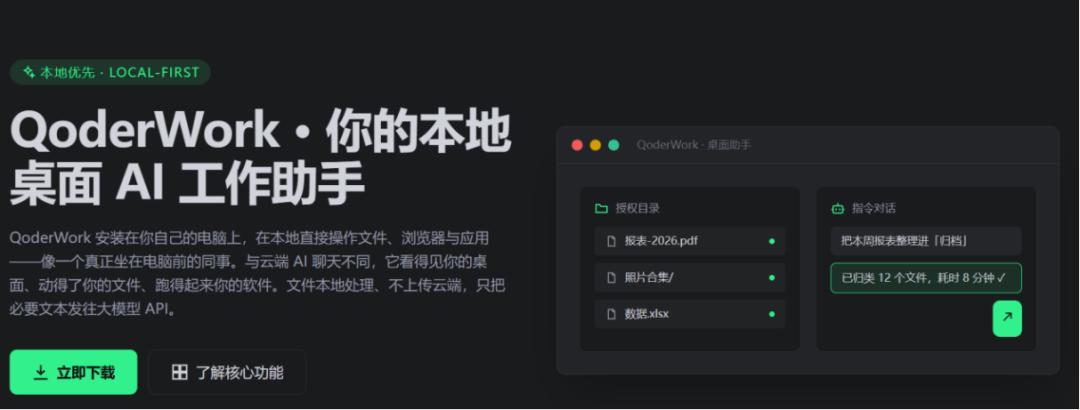
Among these, the most prominent isn't Wukong, heavily promoted in March 2026, but QoderWork, positioned as a desktop AI agent tool. Its DAU, weekly active users, and token usage rank first among all Alibaba's AI tools.
ByteDance offers the AI programming agent TRAE IDE and the all-in-one AI development platform Kouzi. However, strictly speaking, these products compete with programming software like Cursor. In comparison, Feishu is a more direct competitor to WorkBuddy.
Currently, Feishu has formed two paths: native and open. Feishu Daily is an intelligent agent-building platform for enterprises, helping them connect business data and workflows. Feishu CLI allows external or custom agents to integrate with Feishu.

If Alibaba and ByteDance's strength lies in integrating model capabilities into DingTalk and Feishu, two major collaborative office platforms, Tencent's advantage is its ecosystem—particularly the social distribution power brought by WeChat.
WorkBuddy's success as a 'dark horse' largely stems from its ability to address ordinary users' pain points. Not only is it 'out-of-the-box,' but it also allows easy sharing via WeChat, greatly facilitating daily office work.
However, all three tech giants face the same dilemma: Their products are too fragmented, operating independently with overlapping functions, leading to internal friction.
A report by 'Zimu Bang' mentioned that some Alibaba employees said they 'mostly use QoderWork and rarely open Wukong,' indicating that these two B-end-oriented products are cannibalizing each other. ByteDance upgraded TRAE Work to an 'AI-native workspace,' but due to unclear product lines, it barely made a splash.
Thus, tech giants are now collectively 'consolidating.'
In the office intelligence sector, their top priority isn't upgrading product capabilities but integrating fragmented products into a unified entry point and technical foundation.
Tencent issued an internal notice transferring QClaw product center-related businesses to Cloud Product Division VI, where WorkBuddy resides. QClaw is a more C-end-oriented AI personal assistant, reflecting Tencent's desire for a unified AI office entry point.
According to Caijing, Alibaba plans to launch 'Qianwen Office,' integrating QoderWork, Wukong, and MuleRun into one product. QoderWork will serve as the foundation for 'Qianwen Office.'
Other reports suggest that ByteDance intends to deeply integrate Feishu and Doubao rather than continuing to bet on TRAE Work. If successful, Doubao won't just be an AI assistant but a new entry point for the entire office scenario.
From 'racing' to 'consolidating,' tech giants are realizing that the market doesn't need so many agents.
Faced with the explosive AI and agent hype, tech giants adopted a 'horse racing' approach to let the market decide which products would survive. This logic wasn't wrong.
However, with computing costs remaining high and capital investments being scrutinized by the market, the 'racing track' for tech giants has narrowed. The direction is now clear—the next step is to unify product entry points and fully leverage platform ecosystem capabilities.
However, when all players aim to capture the 'super desktop' of AI office solutions, the hardest part isn't technical integration but truly entering the market and passing the commercialization test.
Especially in the intelligent office sector, C-end users' willingness to pay still needs continuous cultivation. The B/G-end market is the foundation for scalable revenue.
But this prerequisite is that products must first clear hurdles like data security, compliance audits, and private deployment while facing competition from traditional office software providers like WPS and Microsoft.
In the AI office race, all players are now in position. This time, everyone will give it their all.
The cover image and illustrations belong to their respective copyright holders. If the copyright owners believe their works are unsuitable for public browsing or should not be used without compensation, please contact us promptly, and our platform will make corrections immediately.
-
![]()
Opinion | Apple's Leasing Move Suggests AI Hardware Should Also Offer Consumers an Exit
-
![]()
The Time Google Missed, Translated into Cash Flow Costs
-
![]()
The Turning Point Has Arrived: What Will Define the Second Half of the Gimbal Camera Market?
-
![]()
The Inflection Point Has Arrived: What Will Determine the Second Half of the Gimbal Camera Market?
-
![]()
The Time Google Missed, Converted into Cash Flow Costs
-
![]()
Honor Reveals IPO Counseling Progress: Phase IV Wrapped Up, Awaiting Acceptance
-
![]()
Tencent Embarks on a Battle for the 'Desktop' Dominance
-
33,473 X9 Vehicles Recalled: Xpeng's Three Major Challenges