The Time Google Missed, Converted into Cash Flow Costs
 07/30 2026
 360
360
In early 2026, Sundar Pichai, in a rare admission during a BBC interview, stated that there were 'some irrational elements' in the current AI market. This comment was forwarded to social media by CNBC host Jim Cramer, who added a more straightforward piece of advice: stop irrational spending.
This virtual debate did not yield a clear winner but brought a critical question to the forefront: If even Google's CEO believes there is a bubble in this Track (translated as 'sector'), are the billions being poured into data centers a calculated layout (translated as 'strategy') or merely an arms race that no one can afford to stop?
Almost simultaneously, Warren Buffett provided his answer. Berkshire Hathaway's stake in Google rose from $4.3 billion when first disclosed in the third quarter of 2025 to approximately $31 billion by the end of the second quarter of 2026, making it Berkshire's third-largest holding after Apple and American Express. During a mid-July CNBC interview, Buffett personally confirmed that he led this investment and admitted, 'Not buying earlier was a mistake.' For an investor who has avoided tech stocks for decades, this was a rare statement.
A week later, Google released its second-quarter earnings. Revenue reached $119.8 billion, up 24% year-over-year, marking the best quarter in the past five years. Google Cloud revenue hit $24.8 billion, soaring 82% year-over-year, with an operating margin of 35.6%. Net profit surged to $112.1 billion, up 298% year-over-year.
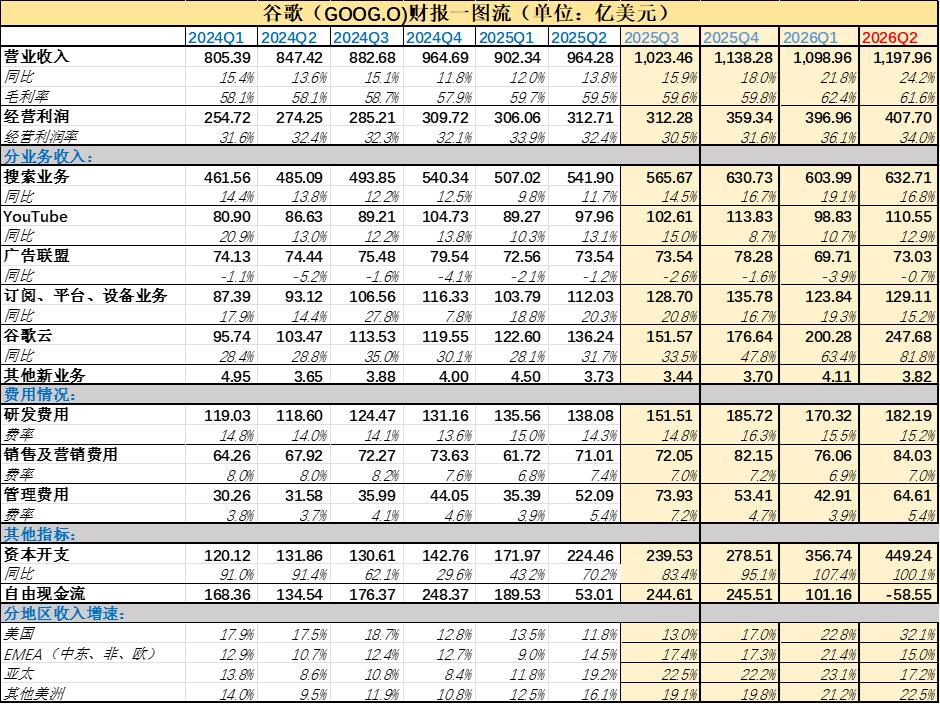
Image produced by Caibao Ji
Despite these explosive financial figures, Google's stock price plummeted over 7% in subsequent trading sessions, erasing tens of billions of dollars in market value overnight. The reason? Google revised its full-year 2026 capital expenditure guidance upward from $180-190 billion to $195-205 billion, with management also warning of a significant increase in 2027.
Pichai mentions a bubble, Buffett says he bought too late, and the market says spending is excessive—who is wrong?
01
Google Cloud: Fastest Growth, but Starting from Far Behind
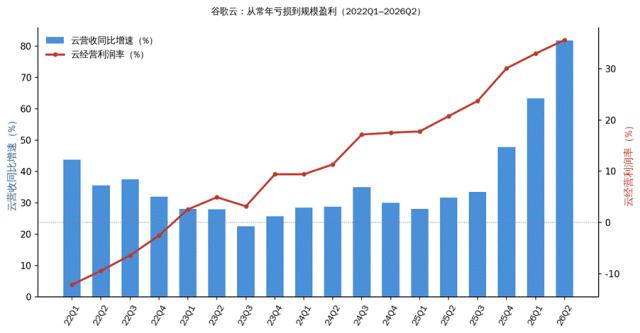
For a long time, Google Cloud was the awkward presence in Alphabet's earnings reports—impressive growth but consistent annual losses, with operating margins dipping as low as -62% in 2020.
This narrative was completely rewritten over the past two years.
In the third quarter of 2023, Google Cloud achieved full-year profitability for the first time, with margins steadily climbing to 35.6% by the second quarter of 2026. Growth accelerated sharply, from 28% in the first quarter of 2025 to 32% in the second quarter, then to 63% in the first quarter of 2026, and finally surging to 82% in the second quarter—the fastest acceleration in five years.
But beneath this impressive facade lies a mismatch between production and sales.
Management revealed during the earnings call that Google Cloud's contract backlog has surpassed $500 billion, with over half expected to convert into actual revenue within the next 24 months.
Google Cloud CEO Thomas Kurian admitted after the earnings release that actual customer spending exceeds committed amounts by approximately 50%, forcing the company to rent additional capacity from third-party AI cloud service providers. In an extreme case, Meta was denied some capacity requests due to Google's insufficient computing power and was even forced to restrict internal engineers' use of AI tokens.
Capacity bottlenecks are also reflected in market share.
According to Synergy Research, in the global cloud infrastructure market in the first quarter of 2026, AWS held 30%, Azure 25%, and Google Cloud just 13%. While Google Cloud's 82% growth rate is the fastest among the three, its 13% market share base limits its absolute volume of external orders—meaning it is running the fastest but still starting from far behind, making it a pursuer rather than a leader.
02
Search: Cyclical Dividends Outweigh AI Contributions
In the second quarter, Google's search and other businesses generated $63.3 billion in revenue, up approximately 17% year-over-year, one of the best growth rates in the past ten quarters; YouTube advertising revenue reached $11 billion, up about 13% year-over-year; total advertising revenue grew over 14% year-over-year.
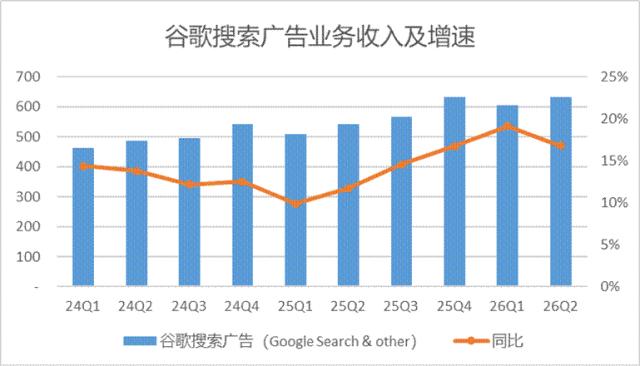
Management's explanation was straightforward: AI Overviews and AI models did not replace search but instead drove growth in search query volume itself, with users asking more detailed and frequent questions, leading to increased ad display opportunities.
Of course, we maintain our previous view: the U.S. economic cycle's dividends played a bigger role in these results than AI.
First, the U.S. digital advertising market is in a period of overall prosperity.
According to IAB (Interactive Advertising Bureau) data, U.S. digital ad spending is expected to grow by 9.5% to 11% in 2026, with digital video ad spending growing by 11%, nearly double the overall ad market growth rate. The total U.S. digital ad market is projected to reach $413.24 billion in 2026. As the largest player in the industry, Google is simply riding the rising tide.
Winterberry Group forecasts that U.S. advertising, marketing, and data spending will reach $664.2 billion in 2026, up 9.4% year-over-year, driven by catalysts such as the World Cup, Winter Olympics, and U.S. midterm elections.
Second, during the 2026 World Cup, YouTube's related content attracted 1.7 billion unique viewers.
The most critical evidence is regional performance: in the second quarter, revenue growth in the U.S. market surged to 32.1% year-over-year, significantly outpacing EMEA's 15.0%, Asia-Pacific's 17.2%, and other Americas' 22.5%—the fastest single-quarter acceleration in the U.S. market in the past fourteen quarters.
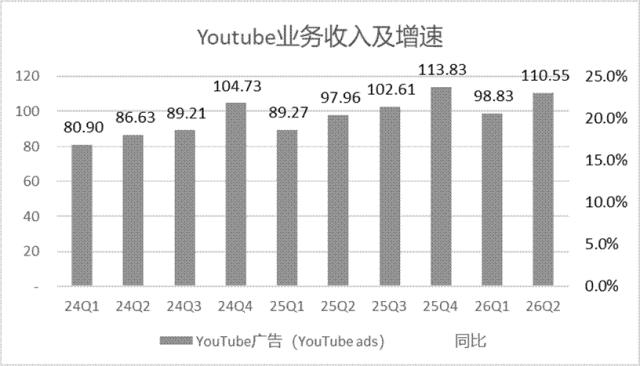
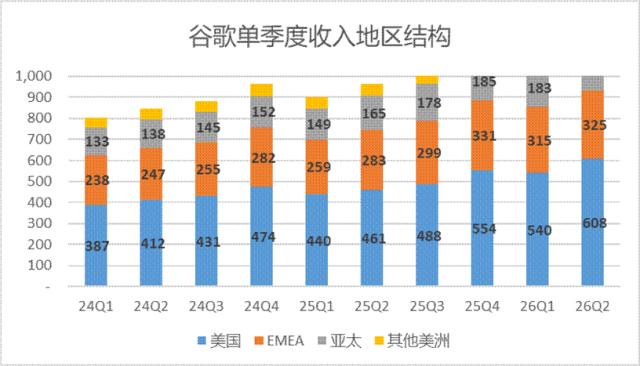
Therefore, attributing the second quarter's better-than-expected performance solely to AI may overestimate the short-term impact of technology itself and underestimate the weight of macroeconomic cycles and event-driven catalysts.
Google's advertising business stands on the shoulders of the entire digital ad market's high Prosperity level (translated as 'prosperity'), with the World Cup providing an additional boost. AI is a bonus but not the complete answer.
03
Capital Expenditure Acceleration: Catching Up on Lost Ground
Returning to the core issue: annual capital expenditures of $195-205 billion approach the company's total revenue for all of 2016, having grown over sixfold in 14 quarters from $6.289 billion in the first quarter of 2023 to $44.924 billion in the second quarter of 2026—approximately 7.1 times the original amount.
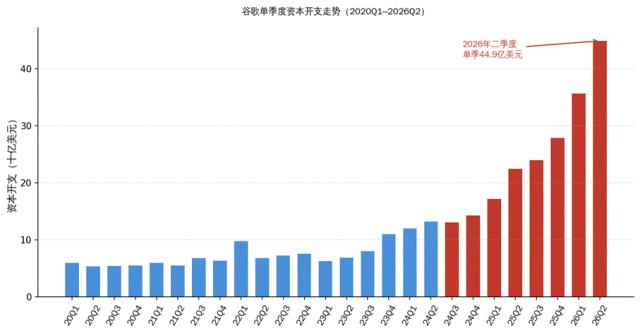
Data source: Alphabet's historical earnings reports, 2020Q1—2026Q2
Currently, three reasons support the judgment that 'there is no need to worry excessively.'
The first layer is capacity certainty.
Management admitted during the earnings call that demand for AI infrastructure remains strong, but supply bottlenecks continue to limit delivery speeds, with orders exceeding capacity. During this period of supply-demand imbalance, whoever builds capacity first will lock in customers and revenue within their ecosystem. Being late could mean watching enterprise clients sign with Microsoft or Amazon.
Nearly all this money is flowing into servers and data centers, indicating a pure capacity stockpiling strategy that can easily create a virtuous business cycle.
The second layer is cost curve certainty.
Developing in-house TPUs and building proprietary data center networks essentially involve using fixed asset investments to replace future marginal costs. Once economies of scale are achieved, Google Cloud's unit computing cost will be lower than competitors relying on external GPU purchases.
Notably, the company's overall R&D, sales & marketing, and administrative expense ratios combined not only did not expand in tandem with capital expenditures but actually declined from 31.2% in the first quarter of 2023 to 27.6% in the second quarter of 2026.
The third layer is that this round of increased spending is itself a capital expenditure race in which all giants are forced to participate.
If Google does not increase spending, Microsoft, Amazon, and Meta will; capacity and clients will be seized by others. If everyone increases spending, the industry's overall capital return rate will inevitably be diluted. Google's strategy is to make its cost and capital structures more resilient than competitors, betting that it can outlast them even if the race becomes protracted.
Comparisons with the three other giants clarify Google's position in this industry-wide spending spree:
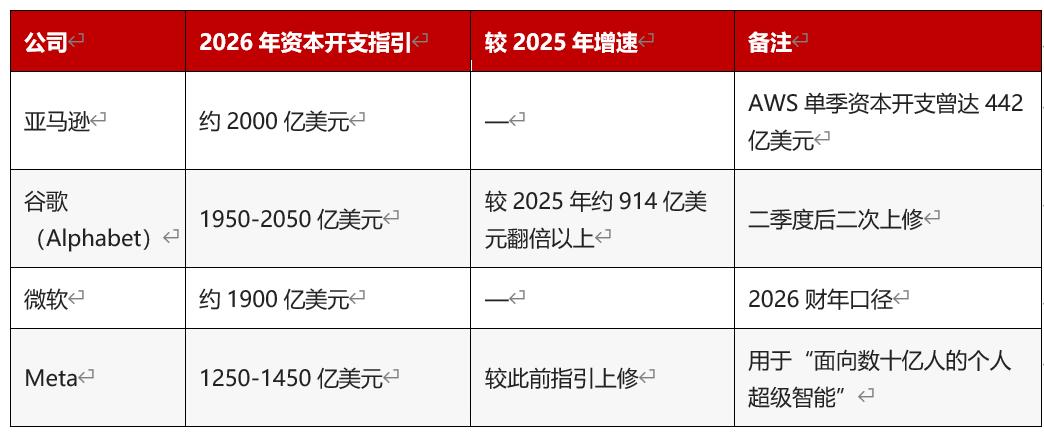
The four companies' combined capital expenditures in 2026 are expected to approach or exceed $700 billion, up over 70% from approximately $410 billion in 2025. This figure alone is sufficient to illustrate the problem: the entire industry is being driven by the same fear at the same time window to do the same thing—whoever lags risks being eliminated in this AI infrastructure land grab.
Therefore, while the market has legitimate short-term fears, it is not difficult to understand why Buffett dares to increase his stake in Google in the long run. After all, the current capital expenditures are not just burning money but are reserves for a highly certain, clearly timed industrial gap.
04
Not Putting All Eggs in One Basket
The second-quarter net profit included an extremely unusual line item: other net income reached $98 billion.
This line item was just $2.7 billion in the same period last year, primarily from unrealized gains on equity securities investments, with a significant portion of the $99 billion gain coming from the appreciation of Google's stakes in Anthropic and SpaceX.
This gain directly boosted net profit to $112.1 billion, up 298% year-over-year, with diluted earnings per share of $9.11, up 294% year-over-year. According to analysts' estimates, $6 to $7 of the $9.11 EPS came from this non-operating paper gain. Excluding this one-time benefit, the company's core operating profit still grew at a robust 30% rate.
This detail warrants separate discussion: Google has not bet all its AI chips on itself but is also a shareholder in cutting-edge AI labs like Anthropic. This serves as a hedge for its AI strategy—if Google's in-house Gemini system lags in certain areas, the company can still benefit from the industry's overall AI dividends as a shareholder.
Of course, this gain is highly volatile. SpaceX's stock price fell over 30% from its year-to-date high after the second quarter ended, and this line item may shrink significantly or even turn negative in the third quarter. Management also specifically warned in the earnings report that fluctuations in the fair value of equity securities will continue to cause significant volatility in non-operating income, and investors should not price such paper gains as sustainable profitability.
05
Google Blames Itself for Miscalculating AI's Accounting
When analyzing the valuation logic of large language model companies, we've broken down this framework: foundational model capabilities determine commercialization ceilings, commercialization feedback determines willingness to invest in infrastructure (Infra), and Infra investment in turn determines the speed of foundational model iteration. If any link in these three chains is missing, the entire cycle fails to function.
Google's predicament is precisely being stuck in the loop of 'weak foundational model → unclear commercialization path → reluctance to invest in Infra.' Management likely overestimated the strength of the consumer market boom in previous quarters' advertising and search businesses while underestimating the monetization capabilities of its in-house models. Consequently, Google lacked confidence in the 'foundational model-commercialization-Infra' virtuous cycle, leading to the need to pay a higher premium to catch up in stages.
Therefore, negative free cash flow will likely be the norm in the coming quarters. Third-party computing power usage in the third quarter may also pressure cloud business gross margins, while integration costs from the Wiz acquisition will continue to weigh on the income statement.
-
![]()
Opinion | Apple's Leasing Move Suggests AI Hardware Should Also Offer Consumers an Exit
-
![]()
The Time Google Missed, Translated into Cash Flow Costs
-
![]()
The Turning Point Has Arrived: What Will Define the Second Half of the Gimbal Camera Market?
-
![]()
The Inflection Point Has Arrived: What Will Determine the Second Half of the Gimbal Camera Market?
-
![]()
The Time Google Missed, Converted into Cash Flow Costs
-
![]()
Honor Reveals IPO Counseling Progress: Phase IV Wrapped Up, Awaiting Acceptance
-
![]()
Tencent Embarks on a Battle for the 'Desktop' Dominance
-
33,473 X9 Vehicles Recalled: Xpeng's Three Major Challenges