Xiaomi Increases Phone Prices, Adding Pressure on iPhone 18
 08/05 2026
 538
538
Author|Haotian
On August 2, 2026, Xiaomi's official online store updated its pricing, raising the costs of models such as the Xiaomi 17, Redmi K90, and Turbo 5 series by 300-500 yuan.
Notably, this marked Xiaomi's third smartphone price increase in 2026. On April 11, Xiaomi implemented its first price hike of the year, with the REDMI K90 Pro Max increasing by 200 yuan, while the Turbo 5 and Turbo 5 Max saw the elimination of their New Year special discounts. On July 6, Xiaomi initiated a second round of price increases, with the REDMI K90 and Note 15 series rising by 200-400 yuan.
Analyzing Xiaomi's recent three price adjustments, a clear trend emerges: the company has not hastily passed on all the increased costs of memory to consumers. Previously, price hikes were limited to mid-range and low-end products, but recent adjustments now also impact flagship smartphones.
This is primarily because flagship smartphones, compared to their mid-range and low-end counterparts, boast higher profit margins and greater "cost resilience." In May 2026, Xiaomi's Chairman and CEO, Lei Jun, stated, "Internally, we are employing various methods to enhance efficiency and strive to absorb the resulting cost pressures internally, rather than transferring them to consumers."
Now, the price increase for the Xiaomi 17 series largely signals that memory prices have reached a level that exerts significant pressure on the profitability of Xiaomi's flagship smartphones.
Considering that Apple has adopted a similar strategy to Xiaomi, leveraging its ecosystem advantages to mitigate the impact of memory price hikes, many netizens are concerned that the iPhone 18 series, set to debut next month, might also experience price increases.
01
Apple Combats Memory Price Hikes with Integrated Strategies
If one were to choose a keyword for the smartphone industry in 2026, many might opt for "price hikes." Not only Xiaomi but also OPPO, Vivo, Honor, and other smartphone manufacturers have repeatedly raised their device prices.
However, somewhat unusually, despite being positioned as a high-end brand and more readily accepted by consumers after price adjustments, the iPhone 17 series did not raise prices amid the surge in memory costs. Instead, Apple even frequently offered discounts during shopping festivals.
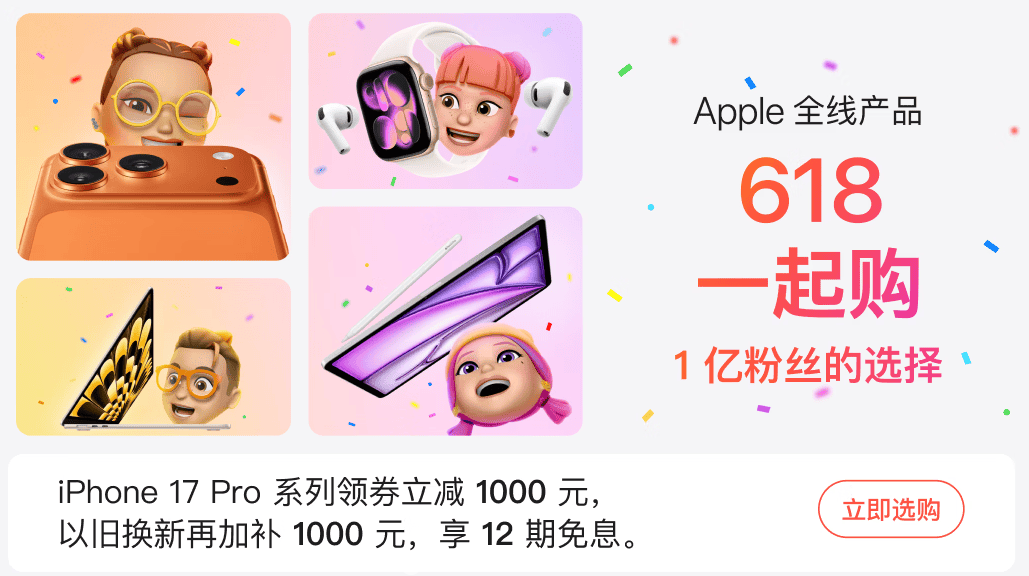
Image Source: JD.com
For instance, in January 2026, Apple's official flagship store launched a New Year promotion, reducing the iPhone Air's price by 2000 yuan. During the 618 shopping festival, the iPhone 17 series saw across-the-board price reductions, with the iPhone 17 standard model dropping by 200 yuan and the iPhone 17 Pro by 1000 yuan.
Apple's counterintuitive approach is primarily due to its greater flexibility in hardware and software dimensions, viewing the memory price hike crisis as an opportunity to expand its smartphone business's market influence.
From a hardware perspective, Apple can offset rising memory costs internally through large-scale procurement to stockpile inventory, cost reductions in non-memory components, and leveraging the iPhone's premium pricing power.
In the third fiscal quarter of 2026 (ending June 27, 2026), Apple's inventory reached $11.1 billion (approximately 75 billion yuan), up 94.74% year-over-year. Apple CEO Tim Cook stated that existing inventory partially offsets memory cost pressures.
During the same period, Apple's gross margin for hardware products was 40.1%. After excluding approximately 2.5% in tariff impacts, it was about 37.6%, down 0.1 percentage points sequentially. Due to its relatively larger profit margins, memory price hikes have not imposed significant downward pressure on Apple.
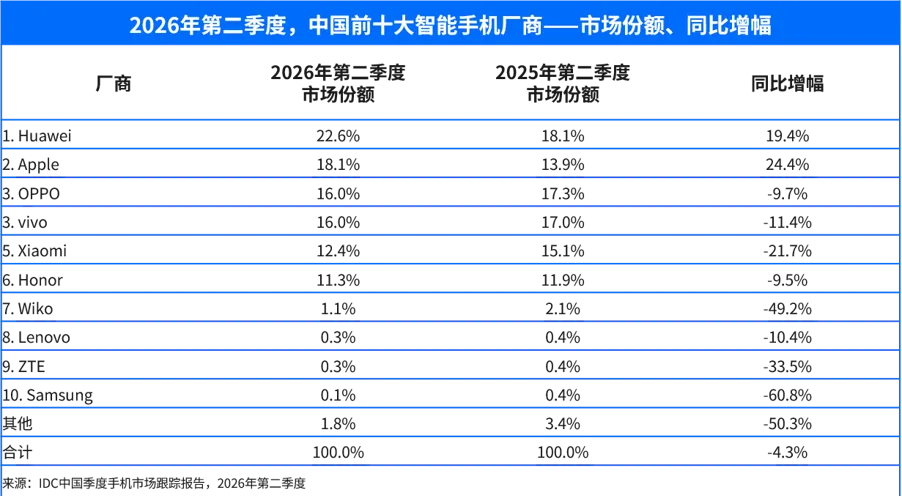
Image Source: IDC
Against the backdrop of widespread smartphone price hikes, the unchanged pricing of the iPhone has made it appear quite "cost-effective," becoming a focal point for consumers. Data disclosed by IDC shows that in Q1-Q2 2026, Apple's smartphone shipments increased by 33.3% and 24.4% year-over-year, respectively, ranking second in both periods.
Compared to numerous Android smartphone manufacturers, Apple's advantage lies not only in the higher market acceptance of its high-end products but also in its integrated hardware and software development, with its service business enjoying vast profit margins.
In the third fiscal quarter of 2026, Apple's gross margin for its service business was a staggering 75.6%. Leveraging hundreds of millions of hardware devices, software services such as the App Store, content subscriptions, and search engine entry points can easily achieve profit leverage effects, contributing substantial revenue to the company.
Although the gross margin for hardware products has declined under the heavy pressure of memory costs, Apple's service business has continued to thrive thanks to increased iPhone shipments. In the third fiscal quarter of 2026, Apple's service business revenue reached $30.74 billion (approximately 207.6 billion yuan), up 12% year-over-year, accounting for 28% of total revenue and contributing 42% of gross profit.
02
The New iPhone Approaches, and Price Hikes Seem Inevitable
If memory prices cease to rise further, Apple may continue to control iPhone prices to capture more market share.
Unfortunately, with the AI industry's explosion and surging storage demand, memory prices are expected to climb even higher. Analysts at Jefferies predict that in Q3 2026, memory prices will increase by 40%-50% sequentially, and by 30%-40% in Q4. In 2027, memory prices will continue to rise by 40%-45%.
"With storage chip prices skyrocketing, I believe the industry is facing a once-in-a-century surge in prices," Tim Cook said. "We expect storage procurement costs to rise further in the September quarter (the fourth fiscal quarter of 2026), with the buffer provided by inventory continuing to weaken."
Following tradition, Apple is expected to unveil the new iPhone in early September each year. The soaring memory prices will pose a significant challenge to the pricing of the iPhone 18 series, set to debut a month later.
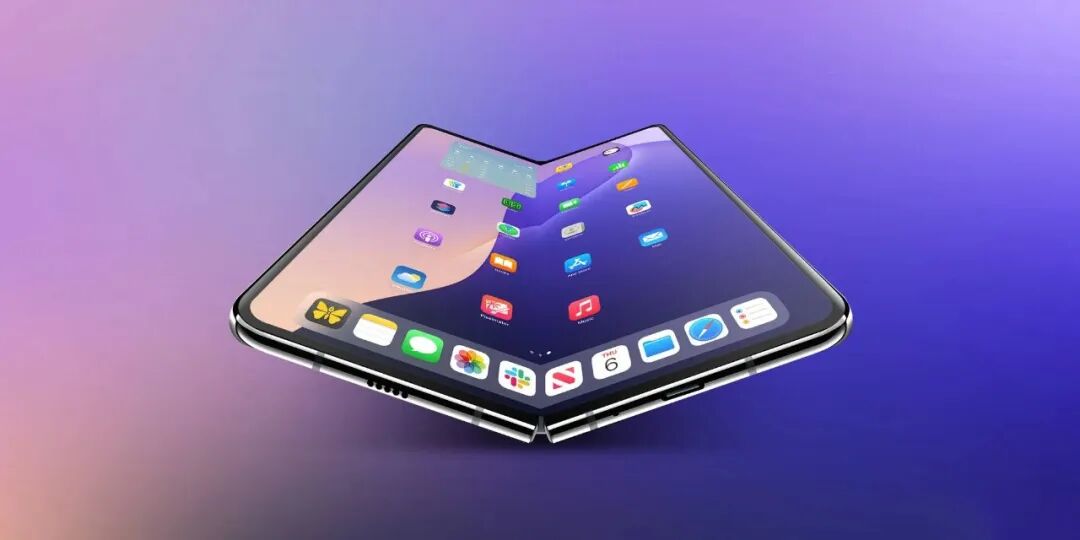
Image Source: Google
Based on online information, to avoid profit losses, Apple plans to delay the release of the relatively lower-priced iPhone 18 standard model until spring 2027. The autumn new product launch event in September 2026 will only introduce three models: the iPhone 18 Pro, iPhone 18 Pro Max, and a foldable iPhone.
Although the iPhone 18 Pro series and the foldable iPhone have higher price bases and can withstand a certain degree of memory price hikes, it's important to note that to enhance market competitiveness, the new iPhones will feature significantly upgraded configurations, leading to substantial increases in manufacturing costs.
It is reported that the iPhone 18 Pro series will be the first to feature a 2nm process A20 Pro processor. According to Cailian Press, the price of TSMC's 2nm process wafers will increase by 10%.
Additionally, according to Tianfeng International Securities analyst Ming-Chi Kuo, the main camera of the iPhone 18 Pro series will also introduce a variable aperture, with the average cost of lenses increasing by 50% compared to existing high-end 7P lenses.
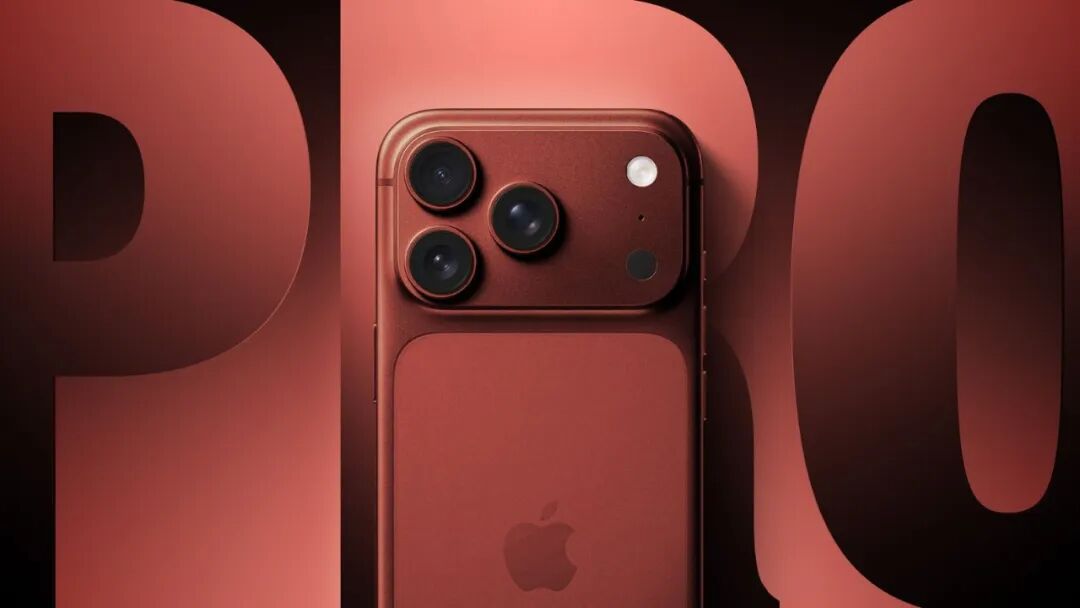
Image Source: MacRumors
To balance the high upstream manufacturing costs, Apple has no choice but to raise the prices of its new smartphone models.
On July 31, 2026, GF Securities analyst Pu Deyu posted on a social media platform that the iPhone 18 Pro and iPhone 18 Pro Max are expected to see price increases of $250-$300 (approximately 1691-2030 yuan). According to Bloomberg Technology reporter Mark Gurman, the starting price of the foldable iPhone will reach $2000 (approximately 13,500 yuan).
03
Smartphone Industry Under Pressure, Apple Seeks Shelter with Leasing Services
As is widely known, with rapid technological advancements, the smartphone industry has shown signs of performance surplus in recent years, and consumers' desire to upgrade their devices has been declining. Against this backdrop, the rapid rise in memory prices will further lead to a sharp decline in smartphone market demand.
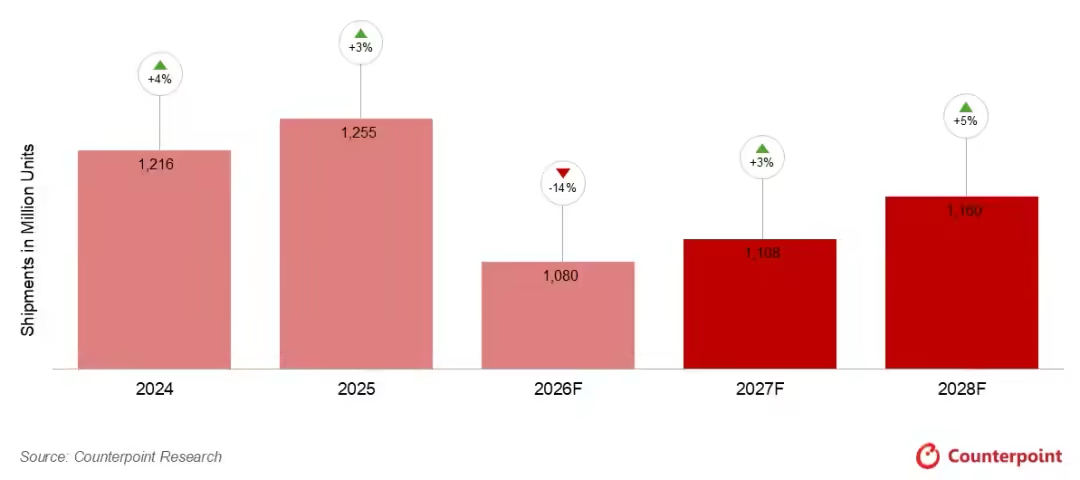
Image Source: Counterpoint Research
A research report disclosed by Counterpoint Research shows that global smartphone shipments are expected to reach 1.08 billion units in 2026, down 13.9% year-over-year, hitting a new low since 2013.
Against this backdrop, many smartphone manufacturers have adopted more cautious supply chain strategies. In June 2026, Nikkei Asia reported that Xiaomi, OPPO, Vivo, and other smartphone manufacturers had notified their suppliers to lower their full-year shipment targets for 2026, with some brands reducing them by up to 30%.
Apple also faces similar challenges. On the one hand, the price-advantaged iPhone 17 has preempted some consumer demand. On the other hand, the high-priced iPhone 18 Pro series has a limited audience. Against this backdrop, Apple will find it difficult to sustain steady growth in its performance.
Apple's performance guidance shows that in the fourth fiscal quarter of 2026, the company's revenue is expected to grow by 9%-11% year-over-year, not only below analysts' expectations of 12.1% but also lower than the previous quarter's 16%.
To avoid the downward pressure caused by memory price hikes, Apple is working to lower the purchase threshold for consumers.
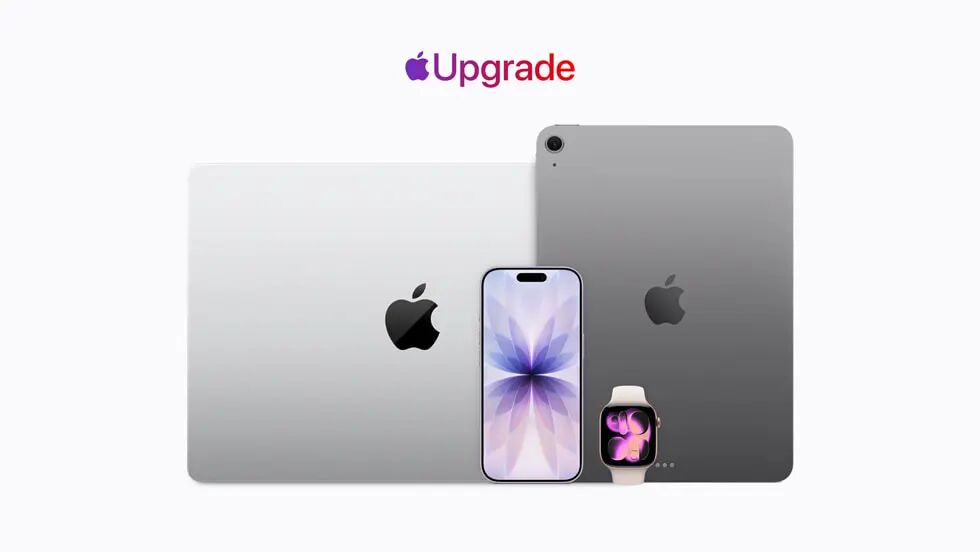
Image Source: Apple
In July 2026, Apple launched a product leasing service called Apple Upgrade in the United States, allowing consumers to lease iPhones, Apple Watches, Macs, and other devices for 12 or 24 months. After the lease term ends, users can choose to upgrade, buy out, or return the device.
Overall, the total cost of leasing a product through Apple Upgrade is roughly the same as that of financing it through Apple Card.
Taking the 256GB version of the iPhone 17 Pro as an example, with a 24-month lease through Apple Upgrade, the monthly payment is only $31.99 (approximately 216 yuan). If the user wants to buy out the device after the lease ends, they need to pay an additional $331.24 (approximately 2237 yuan). In contrast, financing through Apple Card costs $45.79 per month (approximately 309 yuan), with full ownership of the device upon completion of the payment plan.
A horizontal comparison reveals that the advantage of the Apple Upgrade leasing service lies primarily in its lower monthly payments, significantly lowering the purchase threshold for consumers and potentially stabilizing sales of iPhones and other hardware.
Similar to how the iPhone 17 attracted a massive number of consumers with its price advantage, the Apple Upgrade leasing service is also expected to attract more users to purchase iPhones and other products during the era of memory price hikes, thereby driving up Apple's service business performance.
Whether it's the iPhone 17 series actively absorbing memory price hike pressures or lowering the purchase threshold for consumers through the Apple Upgrade leasing service, both essentially reflect Apple's consistent business logic—sacrificing short-term profits to maintain the user base of its hardware ecosystem and amplify the long-term value of its service business.
However, it's important to note that Apple's previous business moat was primarily built on a closed loop of hardware, software, and services.
If AI technology redefines how humans interact with devices and establishes new entry points and ecological rules, Apple's business moat will face the challenge of drying up.
For Apple, memory price hikes represent only short-term operational pressure. How to prove its ecological value in the AI era will be the key to determining whether it can continue its legendary performance in the next decade.
Interactive Topic
What are your thoughts on the smartphone price hike trend? Are you considering purchasing the iPhone 18?
This article is original content from Farsight and is prohibited from being reproduced without authorization.
-
![]()
Unveiling Yin Tongyue's 'No Involution' Stance: Chery's Strategic Maneuvers
-
STO Express Faces Scrutiny: Franchise Model’s Safety Gaps Under the Microscope
-
![]()
The Richest Woman is Going Public Again! Valued at 22.5 Billion, Building an 'Optical Empire' with Her Brother
-
![]()
Buying More GPUs is No Longer Enough: Divergence in Monetization Progress Among the Top Four Cloud Providers
-
![]()
Leapmotor Exceeds 100,000 Units, Li Auto Faces Three Straight Months of Decline: China’s Auto Market Competition Intensifies in the Second Half
-
![]()
Can NASA Discover Extraterrestrial Life? UK Invests £3 Million, but First Must Block Out Stars
-
![]()
Huawei Expands Computing Power Business into the Pig Farming Sector
-
![]()
Asian Dragon Receives a 'Makeover': Is FAW Toyota Using the 'Crown' as a Substitute Strategy?