Q2 Earnings Forecast for Tech Giants: Tencent and ByteDance Compete for Growth, Baidu Continues to Lose Users, Alibaba and Meituan Keep Raising Costs
 08/05 2026
 416
416
User Data Reveals the Truth Earlier Than Revenue
Author|Qingyun
Editor|Xiaobai
Illustration|AI Generated
Produced by|Qiangdiao Next
The '2026 China Internet Mid-Year Report' released by QuestMobile provides a window to observe the Q2 earnings of tech giants in advance.
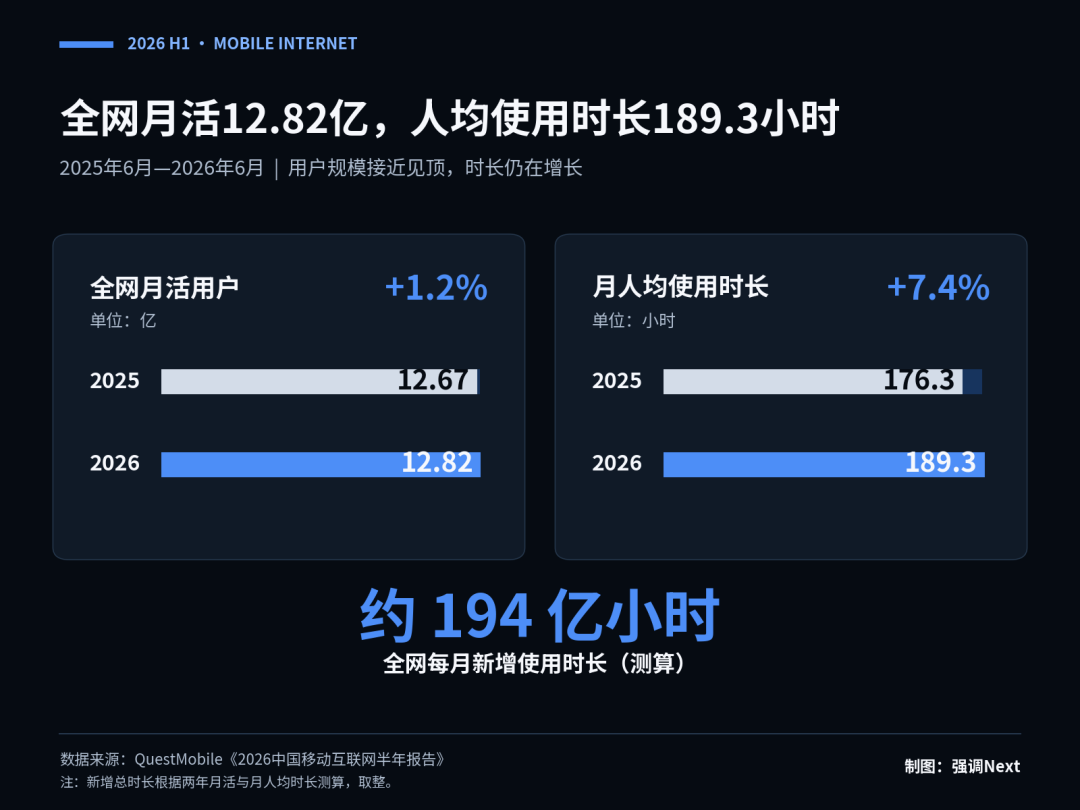
The data shows that as of June, China's mobile internet MAUs reached 1.282 billion, up 1.2% year-on-year; the average monthly usage time per person increased by 7.4% to 189.3 hours. Based on these two metrics, the total monthly increase in internet usage across the network over the past year is approximately 19.4 billion hours.
Meanwhile, in the first half of the year, the number of domestic game licenses increased by 21.1%, MAUs of short drama apps grew by 71.5%, AI-native apps approached 500 million MAUs, and merchants and riders in immediate retail continued to expand into lower-tier cities.
The user base is barely growing, yet the content, models, merchants, and services competing for users are rapidly increasing. The result is that individual content providers, developers, and merchants on the supply side find it increasingly difficult to directly reach demand and thus rely more on platform recommendations, advertising, and transaction gateways. This expansion of the industry has led to a paradoxical outcome: as participants increase, traffic and bargaining power become concentrated among a few platforms.
Hongguo (Red Fruit) has captured 90% of the net new users for short dramas, while Tencent's gaming time share has risen to over 70%. Doubao (Bean Bag) has achieved the largest user base with relatively little hard advertising, while Qianwen and Yuanbao account for nearly 70% of the hard advertising placements among the top 10 AI apps. On the other hand, Baidu App has seen a decline in users and search advertising revenue. In lower-tier cities, the supply of immediate retail has increased, but user growth has not kept pace.
This is no longer just a 'competition for existing users.' The mobile internet is shifting from competing for new users to competing for the organizational rights of existing demand. The advantages of Tencent and ByteDance lie not just in their large user bases but in their ability to repeatedly leverage the same users, accounts, recommendation systems, advertising, and payment capabilities for new businesses. For them, existing traffic is becoming a capital resource that can be internally allocated.
01. Producers Expand Aggressively, Hongguo and WeChat Capture Growth
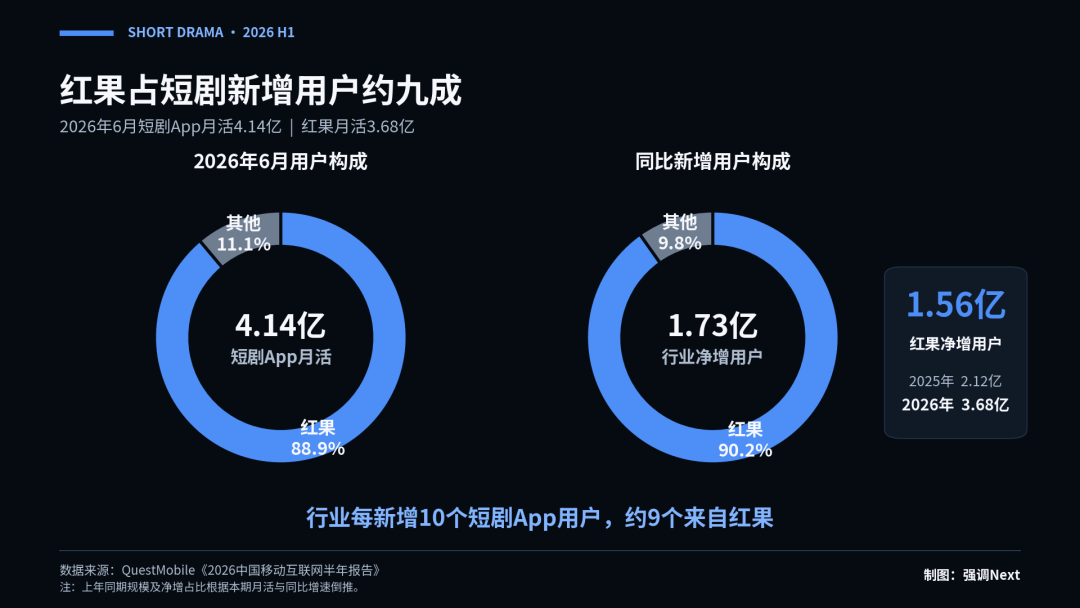
Short drama app MAUs increased from approximately 241 million to 414 million, a net increase of about 173 million. Hongguo's free short drama MAUs rose from about 212 million to 368 million, a net increase of about 156 million. Based on net growth, about 90% of the new users for short drama apps in the past year came from Hongguo. Hongguo's current MAUs also account for nearly 89% of the deduplicated industry scale.
This goes beyond the success of a single leading app. Hongguo is transforming short dramas from a content business into a distribution channel business.
Production companies bear the risks of topic selection, filming, and potential failures of hit shows, while Hongguo controls recommendations, procurement, settlements, and user data. Once the platform covers nearly 90% of industry users, the focus of competition for producers shifts from directly attracting consumers to securing procurement quotas and algorithmic placement from Hongguo. The more short drama content is supplied, the easier it is for individual pieces to be replaced, giving Hongguo greater selection power. Industry prosperity may not necessarily raise the profits of production companies but will undoubtedly increase the content Hongguo can distribute and monetize.
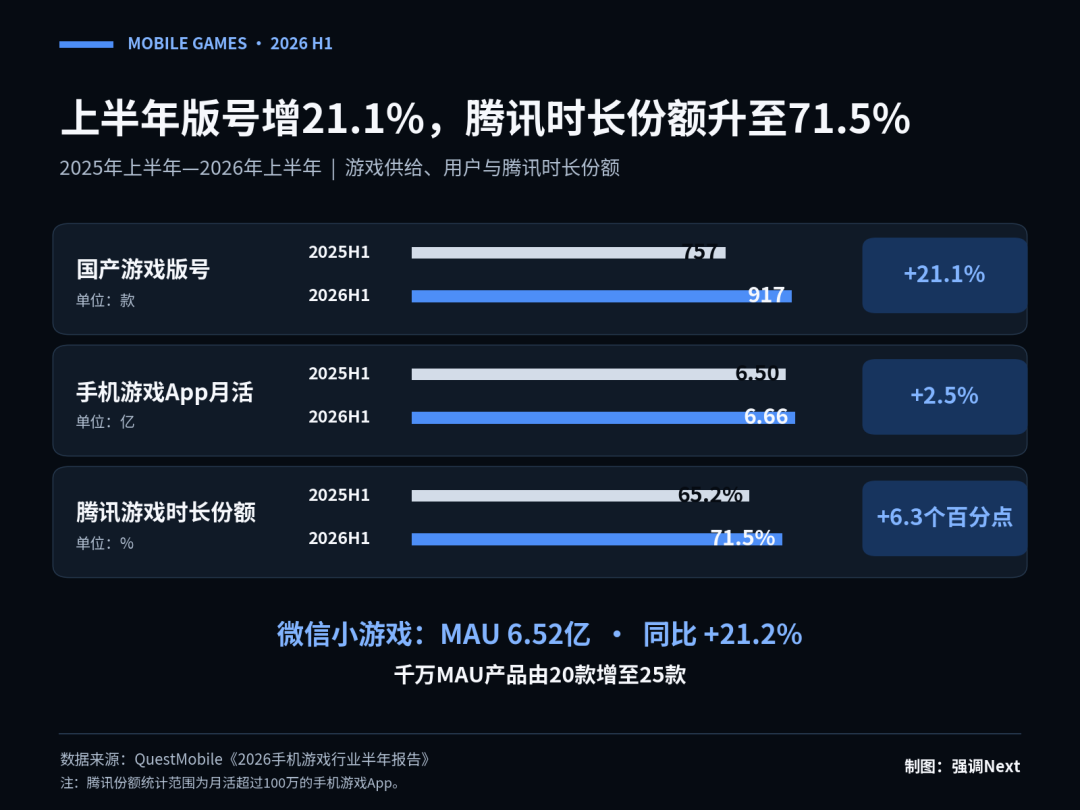
The gaming industry is even more direct. In the first half of 2026, the number of domestic game licenses reached 917, up 21.1% year-on-year; mobile gaming app MAUs were 666 million, up only 2.5%. The supply growth rate is about eight times that of user growth. However, among mobile games with over 1 million MAUs, Tencent's total usage time share rose from 65.2% to 71.5%, an increase of 6.3 percentage points in one year. WeChat Mini Games reached 652 million MAUs, up 21.2% year-on-year, with the number of products exceeding 10 million MAUs increasing from 20 to 25.
The increase in game licenses has not weakened Tencent but instead provided WeChat with more games to distribute. Tencent uses blockbuster titles like 'Honor of Kings' to lock in native mobile gaming time while using WeChat Mini Games to onboard third-party developers. Products do not need to be developed by Tencent but must still acquire users, advertise, and process payments through WeChat. Developers bear the risk of development failure, while Tencent retains channel revenue.
Thus, the relaxation of supply has not dispersed competition. When product growth far outpaces user growth, new licenses and short dramas become raw materials for Hongguo and WeChat Mini Games. The strongest advantages of ByteDance and Tencent lie in their ability to generate revenue and bargaining power from content produced by their peers.
02. AI Continues to Undermine Baidu Search
The impact of AI on Baidu is not just that users are switching to Doubao and DeepSeek but that the search advertising business is now in direct conflict with a superior AI experience.
QuestMobile data shows that in May 2026, the average number of uses per person in the traditional search industry decreased by 19.1% year-on-year, while the average duration per use decreased by 13.5%. The faster decline in usage frequency indicates that simple, repetitive queries requiring multiple clicks are disappearing first. Users are not stopping searching but are increasingly less likely to repeatedly open web pages for a single answer.
Baidu App is also contracting. Two QuestMobile rankings show that Baidu App's average MAUs dropped from 702 million in Q2 2025 to 640 million in June 2026, a difference of 61.41 million.
Baidu's financial reports provide even clearer data: from March 2025 to March 2026, Baidu App's MAUs fell from 724 million to 655 million, a decrease of 69 million.
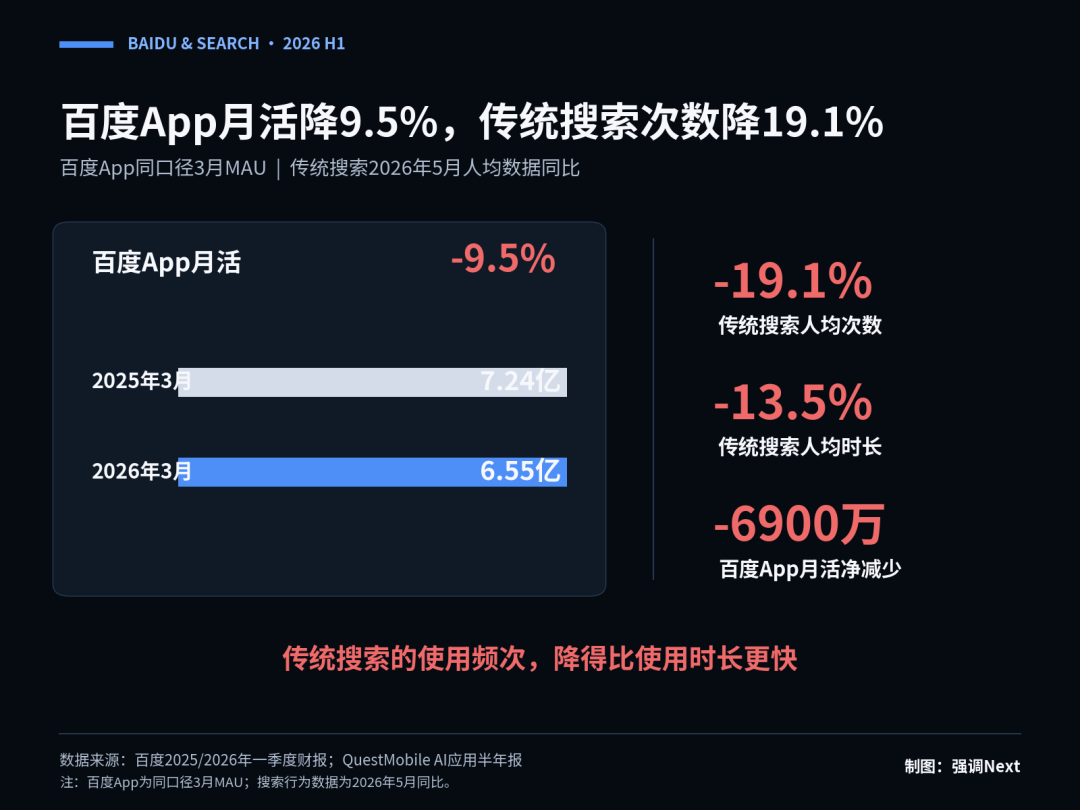
The truly dangerous signal has appeared on the revenue side. In Q1 2026, Baidu's online marketing services revenue fell from 16 billion yuan to 12.6 billion yuan, down 22% year-on-year. Revenue from Legacy Business, primarily traditional search and information feed advertising, declined by 29%. With simultaneous declines in users, search frequency, and traditional advertising, the commercial value of the old search chain is clearly shrinking.
Baidu faces a sharper problem than its peers. Traditional search relies on the 'retrieve-display-click-redirect' process to generate ad inventory. The more directly AI answers questions, the shorter this chain becomes, reducing the number of displayable ads and clicks. If Baidu retains more links and redirects to preserve ad slots, users will find it less direct than Doubao or DeepSeek. If Baidu improves the AI experience enough, it must voluntarily eliminate some traditional ad revenue.
While an AI revenue share exceeding 50% seems positive, the fact that part of this increase is due to a decline in non-AI revenue significantly diminishes its value.
03. Qianwen and Yuanbao: Buying Users on the Consumer Side, Seeking Revenue on the Enterprise Side
In the first half of 2026, Qianwen accounted for 35.9% of hard advertising placements for AI apps, while Yuanbao accounted for 32.8%, together totaling 68.7%. Doubao had only 6.2%, and DeepSeek did not rank in the top ten. In June of the same year, Doubao had 382 million MAUs, Qianwen had 167 million, DeepSeek had 130 million, and Yuanbao had approximately 49.84 million.
The disparity between hard advertising share and MAUs, which does not include search advertising, app store referrals, or internal group referrals, prevents direct conversion to customer acquisition costs. However, comparing placement intensity roughly by 'hard advertising share ÷ MAUs,' Yuanbao's intensity is about 40 times that of Doubao, while Qianwen's is about 13 times. Doubao's reliance on external hard advertising is significantly lower than that of Qianwen and Yuanbao.
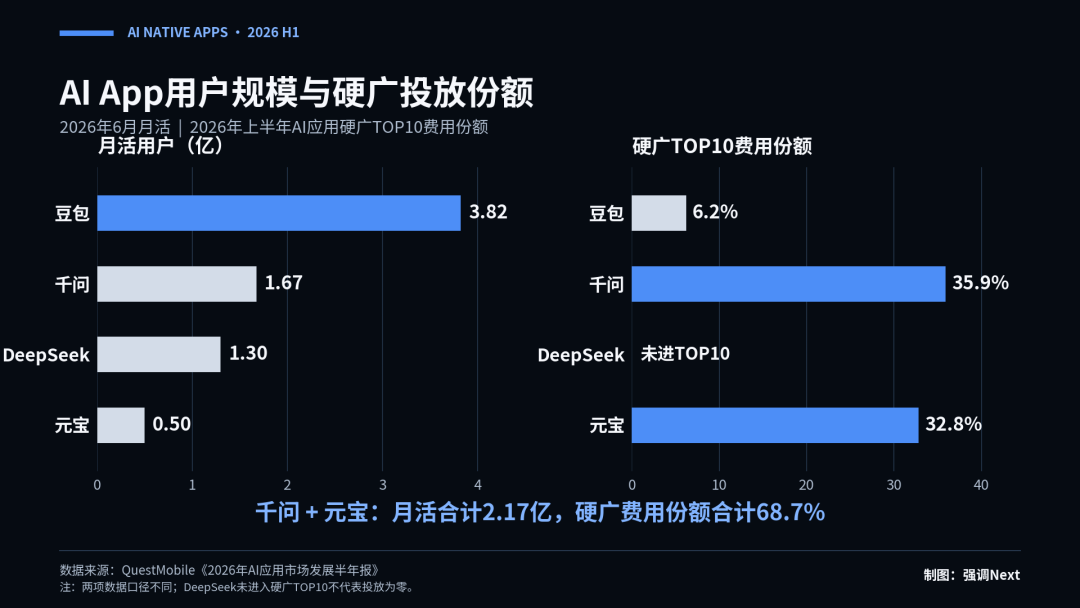
This data bursts the bubble of the assumption that 'tech giants with super apps will have no shortage of traffic for AI.' While WeChat has social relationships and payments, and Taobao has transactional intent, these types of traffic cannot be directly converted into a habit of asking questions on Yuanbao or Qianwen. Super apps solve the problem of 'where users are,' but AI products must also solve 'why users would switch to a new gateway.' There is no inherent connection between the two.
Doubao's advantage comes from the mature algorithmic recommendations and content consumption habits already trained by Douyin. The social intent of WeChat and the shopping intent of Taobao are further removed from general AI queries. Thus, Qianwen and Yuanbao must pay a high price in advertising to correct this intent mismatch.
AI apps face a second challenge: while traditional apps have low marginal costs for additional usage after acquiring users, AI-native products like Doubao incur inference costs with each use. Therefore, Qianwen and Yuanbao bear both customer acquisition and usage costs. Even if Doubao saves on some hard advertising, it must still cover computational costs through subscriptions, advertising, or transactional revenue. While 382 million MAUs prove that Doubao has secured a gateway, its revenue lags far behind, making it difficult to cover costs through personal subscriptions alone.
This is why AI for enterprise office (office work) has suddenly become a new battleground. While consumer-side chat struggles to find stable payers, enterprise office has clear budgets, seats, and workflows. Businesses are willing to pay for efficiency, and AI can integrate with documents, knowledge bases, approvals, and business systems, turning a single query into sustained engagement.
In the past two weeks, three tech giants have simultaneously consolidated their office product lines. Alibaba merged QoderWork, Wukong, and MuleRun into 'Qianwen Office,' which began public testing on August 3. The enterprise version charges based on 'seats + credit packages' and has preliminary (preliminarily) integrated with DingTalk. Tencent concentrated its office resources into WorkBuddy, integrating with Tencent Docs, Tencent Netdisk, and Tencent Lexiang. ByteDance incorporated its Feishu product team into Doubao and its sales system into Volcano Engine.
The competition is no longer about which chat app has higher MAUs but about who can first secure daily work gateways and the first AI budgets for enterprises. Qianwen extends its consumer-side brand directly to the enterprise side, while Tencent's true bet on office work lies in WorkBuddy, not Yuanbao. For Qianwen and Yuanbao, MAUs acquired through advertising remain just a continuously paid bill unless they lead to seats, usage, and enterprise contracts. Whoever captures AI office work first has the opportunity to recover AI application costs sooner and even turn it into a profitable business.
04. Meituan and Taobao Flash Delivery: Orders Haven't Sunk, But Costs Have
In June 2026, immediate retail users increased in first- to fourth-tier cities but decreased by 391,000 in fifth-tier and lower cities. Meanwhile, riders in these areas increased by 69,000, and merchants increased by 41,000. Riders and merchants moved down first, but user demand did not follow.
The so-called 'comprehensive expansion' of immediate retail into lower-tier cities currently resembles platforms pre-emptively laying out costs in these regions.
Meituan and Taobao Flash Delivery must do this. Once riders, merchants, and dispatch networks are locked in by competitors, latecomers can only rebuild supply with higher subsidies. The two companies are competing over who will fulfill future demand, effectively purchasing a competitive option in advance. The premium is the current subsidies and low order density.
The challenge in lower-tier markets is not just consumer spending power. With a more dispersed population, closer proximity to offline retail, and lower average order values, the same 30-minute fulfillment network requires more orders to offset rider waiting times, dispatch costs, and subsidies. Declining users and increasing supply mean that order efficiency per rider and per merchant is likely to suffer. While the report does not disclose order volumes or GMV, we cannot conclude that losses are widening, but 'increased city coverage' alone no longer proves successful expansion into lower-tier markets.
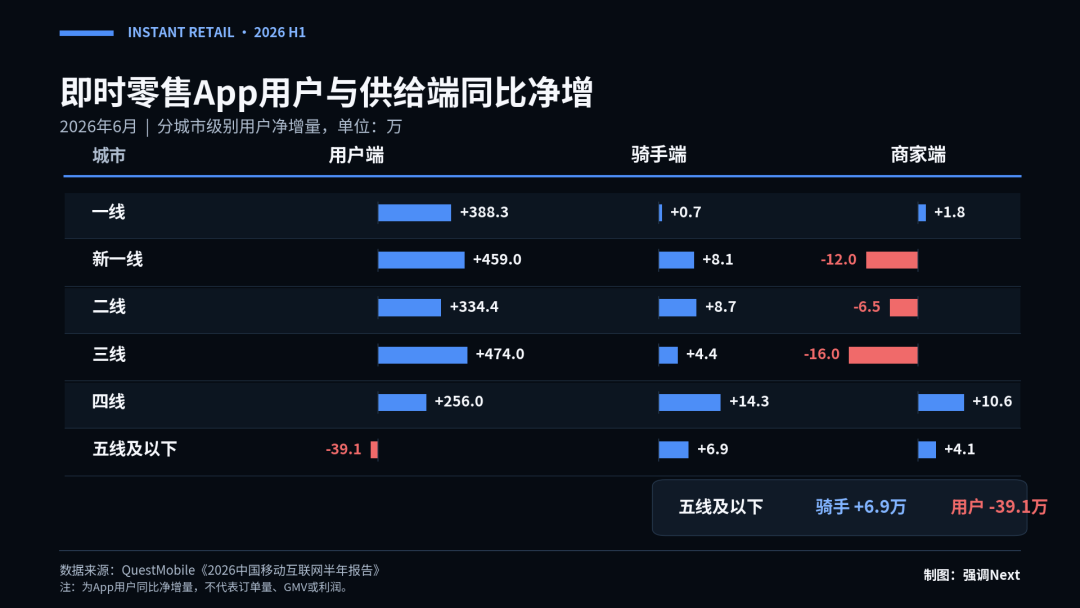
The situation is the opposite in higher-tier cities. The number of merchants decreased in new first-tier, second-tier, and third-tier cities, but users continued to grow, likely corresponding to the exit of inefficient merchants and a concentration of orders among remaining suppliers.
Based on the report's data, the true progress of immediate retail is as follows: higher-tier markets are beginning to cull supply, while lower-tier markets are still exchanging money for network coverage. The next focus will not be on how many cities are covered but on order volume per rider, order volume per store, and fulfillment losses per order in lower-tier cities.
05. Advertising Market Grows, But Distribution Is Uneven
In Q2 2026, the scale of internet advertising grew by 8.1% year-on-year to 216.98 billion yuan. However, in the first half of the year, 53.6% of brands increased their spending by more than 5%, while 44.9% reduced it by more than 5%, leaving only 1.5% of brands stable. While the advertising market appears to be recovering on the surface, it is undergoing a reshuffle internally: platforms that can prove conversions are taking more, while those that cannot are being cut.
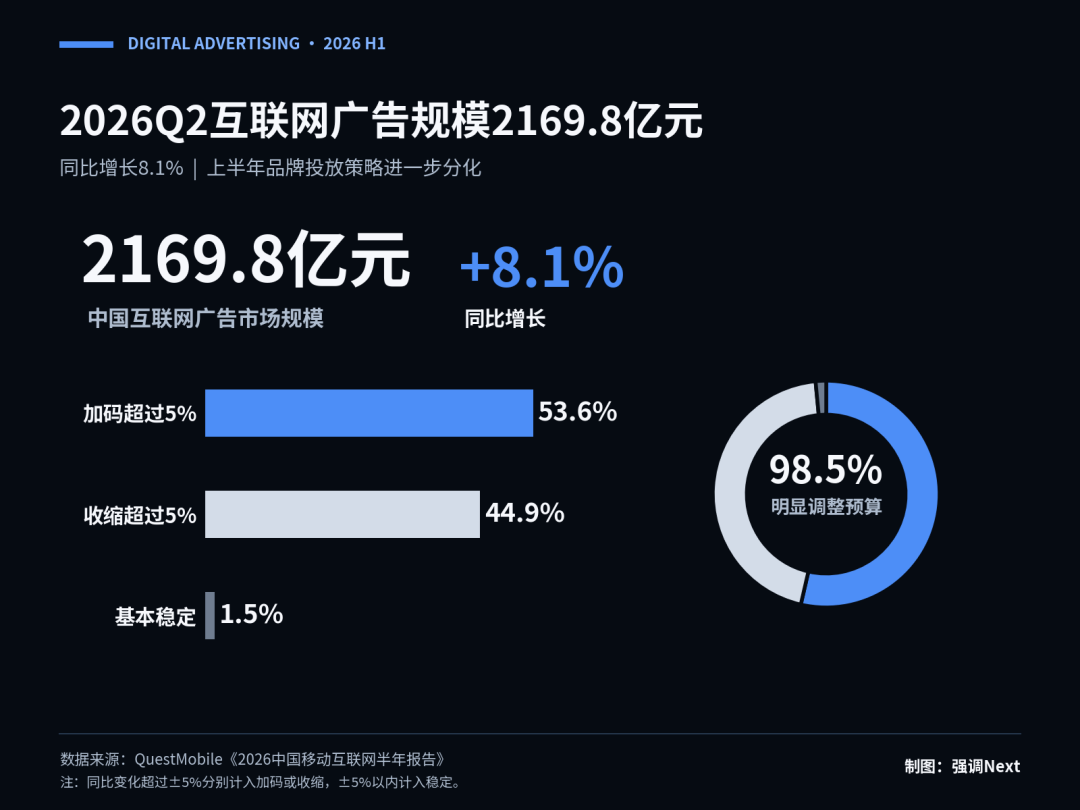
Douyin, WeChat, and Taobao can complete content, clicks, transactions, and payments within a single ecosystem, making them more valuable than platforms with mere large traffic volumes. Advertisers are not cutting all exposure but exposure that cannot explain sales results. While the total advertising pie is growing, nearly half of brand budgets are being cut because funds are shifting from weak attribution channels to strong closed-loop platforms.
The QuestMobile report documents a clear outcome: the mobile internet has not re-entered high growth, and a few platforms are capturing more industry growth.",
Next week, major companies will intensively release their second-quarter financial reports. The question of whose revenue the traffic growth has translated into, and whose costs it has become, will be further revealed.
- END -
-
![]()
Unveiling Yin Tongyue's 'No Involution' Stance: Chery's Strategic Maneuvers
-
STO Express Faces Scrutiny: Franchise Model’s Safety Gaps Under the Microscope
-
![]()
The Richest Woman is Going Public Again! Valued at 22.5 Billion, Building an 'Optical Empire' with Her Brother
-
![]()
Buying More GPUs is No Longer Enough: Divergence in Monetization Progress Among the Top Four Cloud Providers
-
![]()
Leapmotor Exceeds 100,000 Units, Li Auto Faces Three Straight Months of Decline: China’s Auto Market Competition Intensifies in the Second Half
-
![]()
Can NASA Discover Extraterrestrial Life? UK Invests £3 Million, but First Must Block Out Stars
-
![]()
Huawei Expands Computing Power Business into the Pig Farming Sector
-
![]()
Asian Dragon Receives a 'Makeover': Is FAW Toyota Using the 'Crown' as a Substitute Strategy?