SpaceX's First Earnings Report: Can a Space Company Make Money by Renting Out Computing Power?
 08/05 2026
 380
380
Author: Youjie Editorial Team
Editor: Youjie UnKnown
Original Content by Youjie Unknown
Less than two months after going public, SpaceX released its first earnings report as a listed company.
In the second quarter of 2026, SpaceX reported revenue of $7.814 billion, up 92% year-over-year, surpassing the market consensus of approximately $6.9 billion as estimated by S&P Visible Alpha. The loss per share was $0.09, less than half of the widely expected loss. Net loss narrowed from $1.008 billion in the same period last year to $541 million, while adjusted EBITDA surged 191% to $3.538 billion.
Viewed solely through these numbers, this was a standard earnings report that exceeded expectations. However, the capital market's reaction was far from standard.
SpaceX's stock price rose 9.4% before the earnings release, closing at $125.33. It fell more than 8% in after-hours trading, moving further away from its IPO price of $135.
Melissa Otto, Head of Research at Visible Alpha, believes the recent stock weakness partly stems from market concerns over "over-expansion" in AI and data centers. Investors are unsure whether the returns generated by AI infrastructure will justify the massive cash investments being poured in.
This highlights the core issue in SpaceX's first earnings report: the market does not doubt the company's ability to grow but wants to know how much money this growth will burn.
01 PART ONE
Profits Come from Starlink, Growth from AI, Risks Hidden in Capital Expenditures
SpaceX's financial structure is becoming more worthy of study than its rockets.
SpaceX's Q2 revenue reached $7.814 billion, up 92% year-over-year and 66% sequentially from $4.694 billion in Q1.
More notably, growth is increasingly translating into operating leverage: adjusted EBITDA reached $3.538 billion, up 191% year-over-year and 214% sequentially. Operating losses narrowed from $970 million year-over-year and $1.943 billion in Q1 to $143 million.
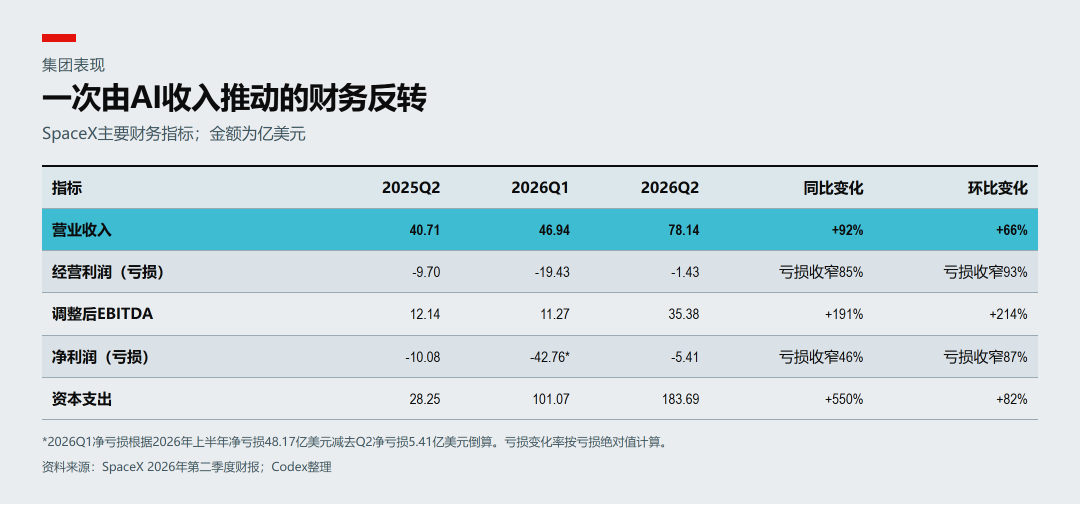
SpaceX's Key Financial Metrics, Source: SpaceX Q2 2026 Earnings Report
In other words, after experiencing slowing revenue growth and widening losses in Q1, SpaceX achieved a clear financial reversal in Q2.
However, this reversal was not driven by uniform improvement across all three business segments but primarily by profit growth in Starlink and a sudden surge in AI computing revenue.
The connectivity business, centered around Starlink, was the most solid part of this earnings report. Revenue in this segment grew from $2.588 billion year-over-year to $3.257 billion in Q1 and reached $4.291 billion in Q2. Operating profit increased sequentially from $923 million to $1.188 billion and then to $1.656 billion.
The Q2 operating margin was approximately 38.6%, higher than the same period last year and continuing to expand.
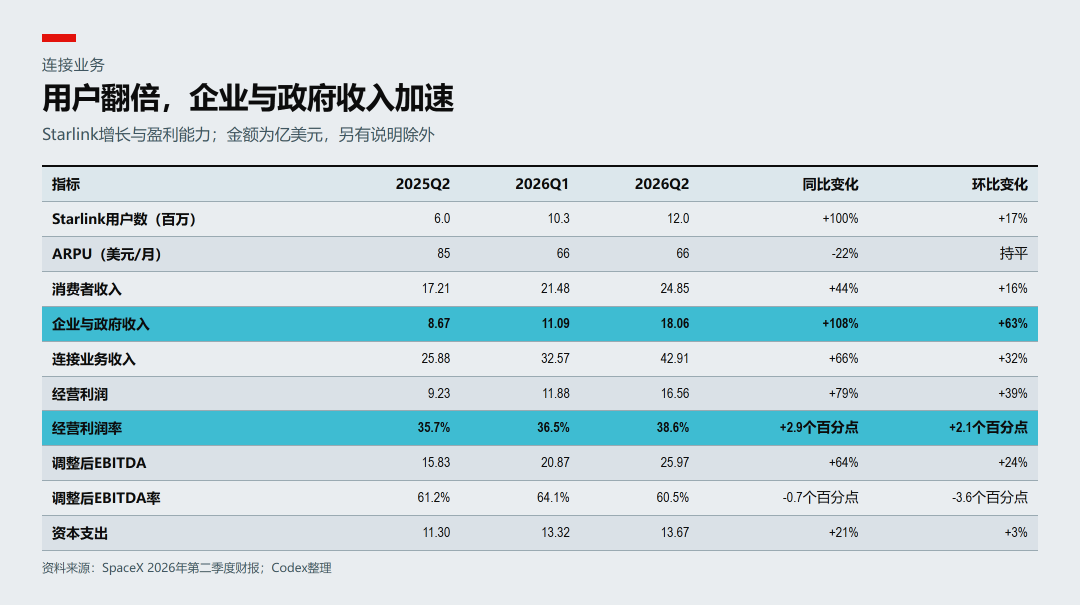
Starlink's Growth and Profitability, Source: SpaceX Q2 2026 Earnings Report
User growth did not come at the expense of significant price cuts.
By the end of Q2, Starlink had 12 million users, doubling from a year ago, with a net addition of 1.7 million in the quarter. ARPU remained at $66 for two consecutive quarters.
Meanwhile, enterprise and government revenue grew 108% year-over-year to $1.806 billion, significantly outpacing consumer business growth. Management stated on the earnings call that the company has not lost a single enterprise customer yet and expects enterprise revenue to eventually "substantially exceed" consumer revenue.
This suggests that the "global broadband subscription" model used to understand Starlink in the past is becoming outdated. Aviation, maritime, government networks, Starshield, and direct-to-phone services are transforming Starlink from a consumer-facing satellite internet service into a global communications infrastructure. Over $6 billion in multi-year U.S. government contracts and less than 10% penetration in the aviation market provide real-world support for this judgment.
A more critical variable is the next-generation V3 satellites.
Musk stated that a single V3 satellite will have ten times the capacity of a V2 satellite, and the number of future launches may also increase tenfold, resulting in a two-order-of-magnitude improvement in total bandwidth. Even if revenue per unit of traffic drops by 90%, Starlink's revenue could theoretically grow tenfold.
However, this projection depends on Starship being able to deploy V3 satellites at a sufficiently high frequency. Management expects that approximately 1,000 V3 satellites will be needed to achieve noticeable network improvements, a milestone that may be reached in Q2 2027.
Therefore, the current losses in the space business are more akin to infrastructure costs for the entire system.
This segment reported $962 million in Q2 revenue, up from $619 million in Q1 and $746 million year-over-year. However, operating losses still reached $542 million, with an adjusted EBITDA loss of $205 million. R&D spending rose to $1.076 billion, even exceeding the quarterly revenue of the entire space segment.
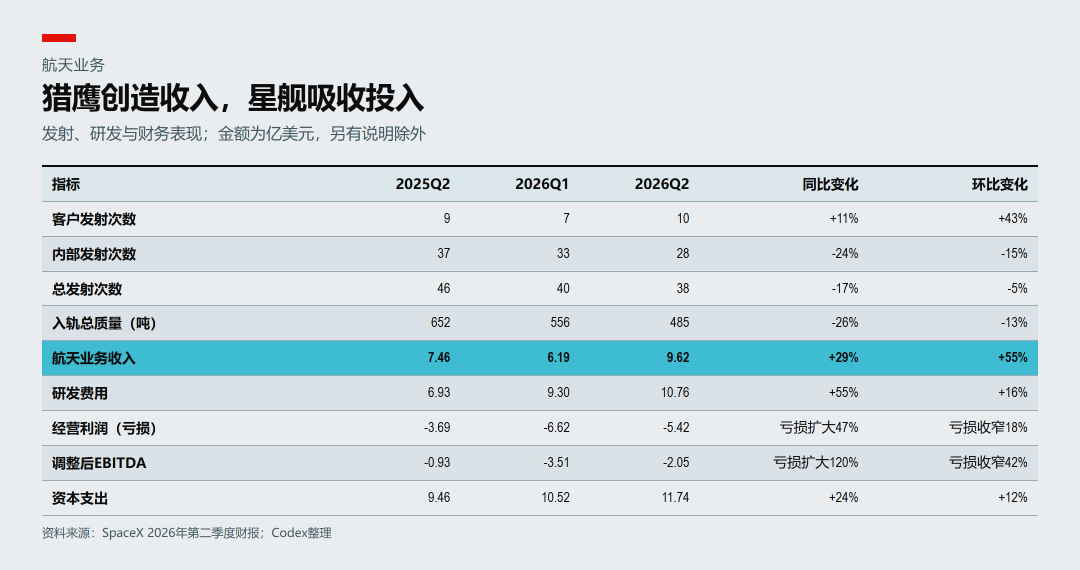
Launch, R&D, and Space Business Performance, Source: SpaceX Q2 2026 Earnings Report
SpaceX is generating revenue with Falcon rockets but investing R&D resources into Starship.
Two V3 test flights in the past 90 days reduced some technical risks. Management believes the biggest single challenge—the heat shield—may have been solved and hopes to attempt capturing spacecraft with the launch tower after regulatory approval.
However, "launching at least once per day a year from now," reducing orbit insertion costs by 99%, and ultimately delivering million-ton payloads to orbit annually remain engineering goals rather than established operational facts capable of generating cash flow.
What truly transformed this quarter's income statement was AI.
Revenue in this segment grew slightly from $737 million year-over-year to $818 million in Q1, then surged to $2.561 billion in Q2, up 247% year-over-year and 213% sequentially.
AI solutions and infrastructure revenue reached $2.194 billion, becoming the primary driver of the sudden acceleration. Adjusted EBITDA in this segment also turned from a loss of $276 million year-over-year and $609 million in Q1 to a profit of $1.146 billion in Q2.
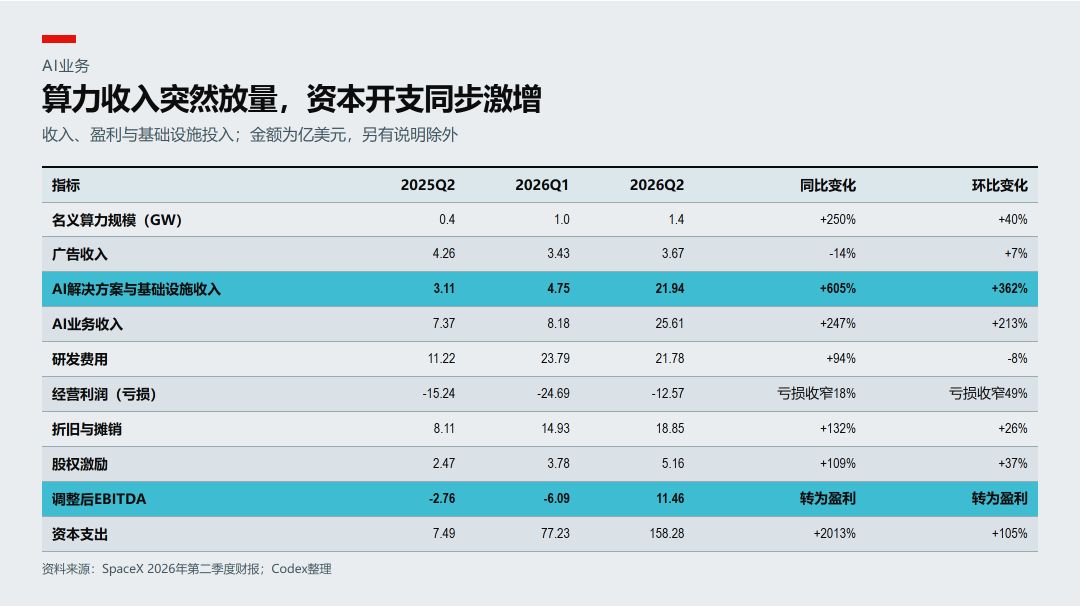
AI Business Revenue, Profits, and Infrastructure Investment, Source: SpaceX Q2 2026 Earnings Report
This change was primarily due to SpaceX beginning to lease computing power from its Colossus and Colossus II data centers.
The company signed $14.1 billion in cloud service agreements in Q2, contributing about $1.6 billion in incremental revenue for the quarter. In the weeks since Q3 began, it signed another $6.7 billion in new contracts with a service period of about six months, with volume ramping up starting in October.
From a short-term financial perspective, this was an extremely efficient monetization.
CFO Brett Johnson stated that the payback period for new computing power investments is less than one year. Management also expects computing capacity to grow from 1.4 GW at the end of Q2 to over 2 GW by year-end and approach 10 GW by the end of 2027.
This makes SpaceX look less like an AI model company and more like a new type of cloud service provider with access to electricity, land, GPU supply, data center construction capabilities, and potential orbital deployment capabilities.
However, adjusted EBITDA can obscure the true costs of this business.
While the AI segment contributed $1.146 billion in adjusted EBITDA in Q2, it still reported an operating loss of $1.257 billion. The difference primarily came from $1.885 billion in depreciation and amortization and $516 million in stock-based compensation.
The same holds true at the group level: $3.538 billion in adjusted EBITDA still corresponded to a $541 million net loss. For a company purchasing GPUs and building data centers at record speeds, depreciation is not just accounting noise to be ignored long-term but the way previous capital investments enter the income statement.
A more direct issue appears in the cash flow statement.
SpaceX generated $3.466 billion in cash from operations in the first half but had capital expenditures of $28.476 billion, resulting in a simple calculated free cash flow deficit of approximately $25 billion.
Quarterly capital expenditures rose from $2.825 billion year-over-year and $10.107 billion in Q1 to $18.369 billion in Q2, with $15.828 billion going toward AI infrastructure. The CFO expects capital expenditures in the next two quarters to remain similar to Q2 levels.
SpaceX had $100 billion in cash, cash equivalents, and marketable securities at quarter-end, but these funds were not primarily the result of past operational accumulation.
The company raised approximately $85.7 billion in net proceeds through its IPO in Q2, subsequently issued $25 billion in investment-grade bonds, and used part of the proceeds to repay bridge loans. Financing cash flow reached $100.291 billion in the first half, far exceeding operating cash flow.
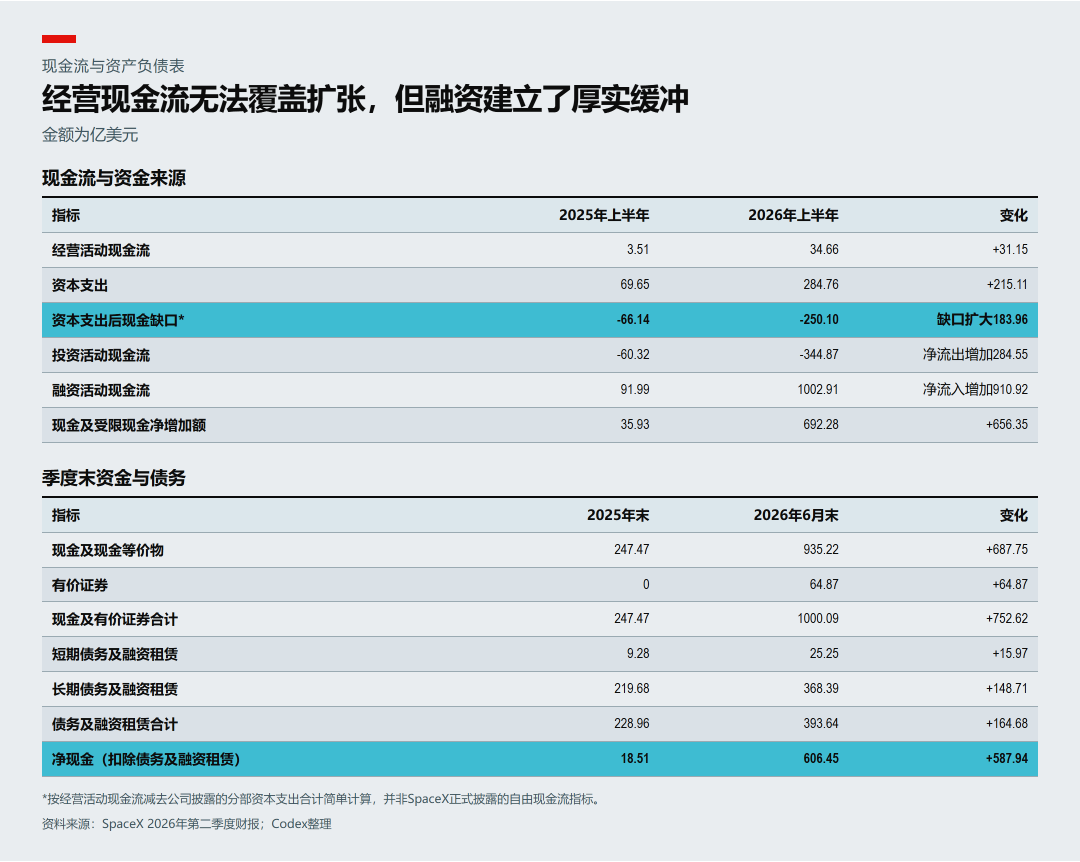
Cash Flow and Balance Sheet Conditions, Source: SpaceX Q2 2026 Earnings Report
This earnings report thus exposes the core cycle of SpaceX's model: Starlink generates profits, capital markets provide cash, which is invested in AI, Starship, and next-generation satellites, with these infrastructure assets then creating the next round of revenue.
Theoretically, as long as each round of monetization outpaces the next round of investment, this flywheel can keep accelerating. Any delay in any link could transform it from a flywheel into a funding gap.
02 PART TWO
Wall Street Believes in SpaceX's Capabilities but Hasn't Accepted Its Price
After the earnings release, market bulls and bears do not disagree on whether SpaceX is a good company but on how much unrealized future potential can be priced in ahead of time.
Optimists see three mutually reinforcing infrastructure networks: Starship reduces orbit insertion costs, low-cost launches expand Starlink capacity, Starlink provides profits and global connectivity, while AI absorbs the company's capabilities in energy, manufacturing, software, and large-scale deployment.
Research from Hargreaves Lansdown suggests that SpaceX's vertical integration—designing, manufacturing, and launching satellites in-house—creates a flywheel effect that competitors cannot easily replicate. AI computing leasing provides a faster revenue path than developing proprietary models.
Management further pushes this logic to an extremely aggressive endpoint: SpaceX expects its annualized recurring revenue (ARR) run rate, based on December revenue, to reach $100 billion by year-end. Its internal target of $1 trillion in annual revenue has been moved up from 2031 to 2030, with Musk even stating there is a "non-zero probability" of achieving it by 2029.
The problem is that the market cannot yet confirm whether this ARR will have the same sustainability as traditional subscription businesses.
The newly signed $6.7 billion in cloud service contracts in Q3 have a term of only about six months. While they can significantly raise the December revenue run rate, they do not automatically equate to long-term, stable, renewable annual revenue.
Current AI computing prices are also driven by supply shortages. Once Nvidia chips, electricity, and data center supplies improve, whether SpaceX can maintain its current high returns remains unknown.
Bears see a different set of numbers: capital expenditures already exceed revenue by more than two times, free cash flow is deeply negative, Starship commercialization still depends on a series of uncompleted engineering milestones, and the current valuation requires most of these high-risk projects to succeed simultaneously.
Reuters previously summarized this relationship as "AI is burning through the cash earned by Starlink," noting that if AI revenue fails to grow at the pace management suggests or Starlink user growth matures, the company's financial risks will rise significantly.
Additionally, SpaceX's short-term stock price is influenced by a factor unrelated to operational performance but impossible to ignore.
Starting August 6, up to 911.5 million shares held by employees and some early investors will be unlocked, exceeding the approximately 640 million shares publicly traded before the earnings release. SpaceX released less than 5% of its total shares during the IPO, and scarcity briefly pushed the stock price to $225. As share supply increases, this scarcity premium is disappearing.
As of mid-July, 27 out of 32 analysts tracked by LSEG still recommended buying, with only one recommending selling. However, SpaceX's stock price had already nearly halved from its post-IPO high before the earnings release.
Analysts are pricing in an infrastructure empire for 2030, while the stock market is pricing in capital expenditures, contract quality, and unlock-related selling pressure for the next few quarters.
SpaceX's first earnings report proves that Musk is assembling rockets, communication networks, and AI computing power into an unprecedented infrastructure company. What it has not yet proven is whether this story can generate cash faster than it consumes it.
— END —
ABOUT Youjie UnKnown
Exploring the Boundaries of the Unknown World
We focus on business, technology, and epochal transformations, documenting changes that are happening but not yet fully understood.
-
![]()
Ruide Intelligence and Gudong Intelligence Forge Ahead in Strategic Partnership, Eyeing Trial Production at Intelligent Optics Base in Second Half of the Year!
-
![]()
Thriving Beyond Family Succession: An Optical Pioneer Blazes a Trail for Private Firms
-
![]()
Samsung China Takes Another Step Back
-
![]()
Samsung China Takes Another Strategic Retreat
-
![]()
Xpeng Unveils New Large Five-Seater G9L, He Xiaopeng Claims It Outperforms 99% of Vehicles in the 300,000 RMB Price Range
-
Anthropic’s $10 Billion Multi-Year Compute Deal Unveiled
-
![]()
Bidding Adieu to the 'Wild West' Phase: What is the Competitive Edge of Lightning Warehouses?
-
![]()
SpaceX's First Earnings Report: Can a Space Company Make Money by Renting Out Computing Power?