Thriving Beyond Family Succession: An Optical Pioneer Blazes a Trail for Private Firms
 08/05 2026
 488
488
Recently, Yongxing Optics unveiled a letter from Honorary Chairman Cao Qidong to all shareholders on its official WeChat platform, formally revealing a meticulously crafted management succession plan that has been in the works for years.

Previously, the company convened its first extraordinary shareholders' meeting of 2026 and the inaugural session of the ninth board of directors on July 20, endorsing multiple proposals aimed at restructuring governance. The co-chairman role was officially phased out, with Cao Qidong assuming the title of honorary chairman. Founding member Mao Lei was elected as chairman, and Cao Zhixin as vice chairman, while the new senior management team was fully appointed. This institutional transition, years in the making, has now been smoothly executed.
The linchpin of this succession lies in its 'institutionalization.' Since its IPO in 2018, Cao Qidong has systematically constructed a succession framework encompassing three key areas: talent development, equity structure, and governance systems. This transition necessitated only three board director adjustments, with all core executives retaining their positions. The actual controllers, Cao Qidong and his son Cao Zhixin, collectively own 29.10% of the shares, ensuring a robust governance structure.
Simultaneously, the company's articles of association were amended, eliminating clauses related to the co-chairman position and adjusting the registered capital from 110.9367 million yuan to 110.7291 million yuan. The ninth board of directors now comprises nine members, with clearly defined responsibilities.
Cao Qidong, 75, served as chairman for 19 years. His decision to step down was not impromptu but a 'long-term strategy forged through years of deliberation and proactive succession planning.' Post-retirement, he continues to offer guidance on corporate strategic planning and cultural preservation as honorary chairman.
The new chairman, Mao Lei, born in 1961, is a professor-level senior engineer and recipient of special government allowances from the State Council. He joined Yongxing Optics in 1997, when it was founded by Cao Guangbiao, and has served in various capacities, including vice chairman, general manager, and technical director. He has been instrumental in key transformations such as acquisitions, integrations, and IPO transitions.
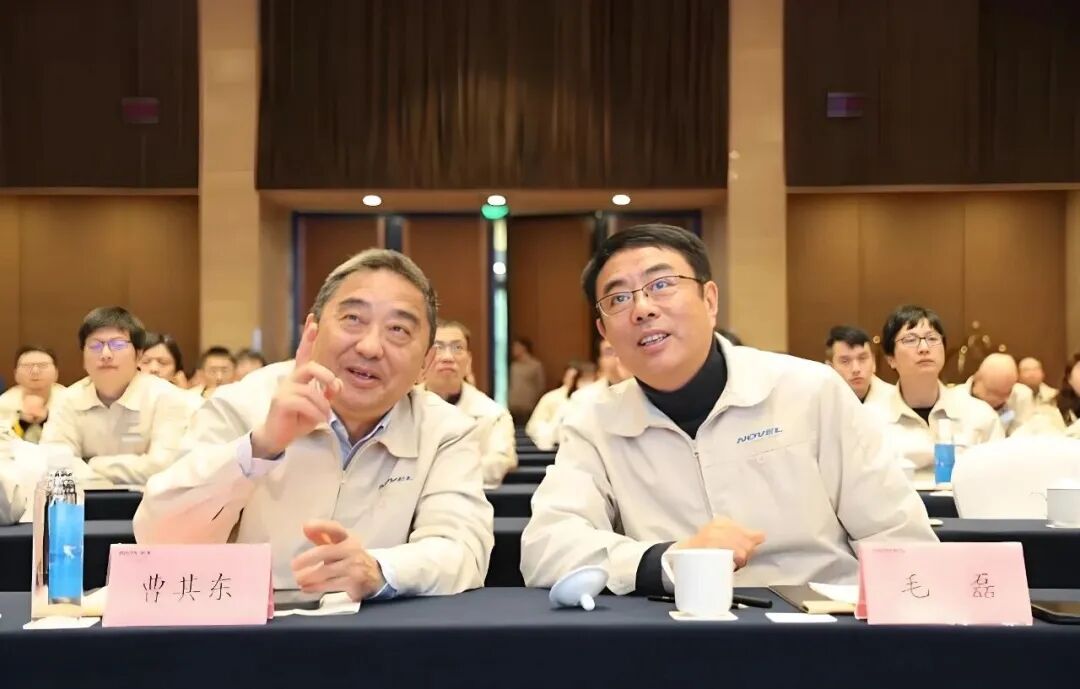
In this transition, Mao Lei concurrently holds the positions of chairman and general manager, with Mao Haoyang, Cui Zhiying, Shen Wenguang, and Lin Guangkao serving as vice general managers, Mao Fengli as chief financial officer, and Xi Jingpeng as board secretary. Vice chairman Cao Zhixin, born in 1986 and Cao Qidong's son, has been actively involved in corporate management, forging a seamless partnership with Mao Lei. The formation of the new core management team not only upholds the company's original vision in the optical field but also injects fresh impetus for sustained growth.
Financial performance offers the most direct insight. In 2025, the company reported revenue of 965 million yuan, up 8.25% year-on-year, with net profit attributable to shareholders reaching 220 million yuan, up 5.41% year-on-year.
In the first quarter of 2026, revenue surged to 264 million yuan, up 20.13% year-on-year, while net profit attributable to shareholders was 46.1364 million yuan, down 17.10% year-on-year, primarily due to non-operating factors such as exchange losses and reduced government subsidies. Despite the profit dip, revenue growth marked the highest for the same period in three years.
Strategically, the company has evolved from a '2+2' business model to a '3+2' portfolio, incorporating 'professional optics' as a core segment. During the '15th Five-Year Plan' period, it aims to accelerate import substitution in high-end scientific instruments and medical equipment while expanding into semiconductors, commercial aerospace, and other sectors.
On July 23, Zhejiang Provincial Party Secretary Wang Hao made Yongxing Optics his first stop in Ningbo—the sole enterprise visited during his trip. Chairman Mao Lei reported on 17 years of industry-university-research collaboration with Zhejiang University, spanning from the Chang'e Lunar Exploration Program to the establishment of the Zhejiang Provincial Key Laboratory of Optoelectronic Autonomous Perception, cultivating over 20 talents at various levels and securing over 30 authorized invention patents.
The three-decade journey of Yongxing Optics not only reflects a history of technological breakthroughs in precision optics but also serves as a microcosm of governance evolution in Chinese private enterprises. The true value of this seamless management transition lies not in the personnel changes themselves but in establishing a replicable succession model for private firms. Through institutionalized and professionalized planning, it achieves stable iteration, providing a blueprint for Zhejiang's manufacturing enterprises and private technology companies nationwide.
When the original aspiration of 'serving the nation through optics and building the enterprise with quality' converges with institutionalized generational succession, Yongxing Optics undergoes a dual calibration from technology to governance. Under the new management team's leadership, how will this enterprise, deeply rooted in precision optics for nearly three decades, expand in incremental markets? OFweek Optics will continue to follow this story.
-
![]()
4.6 Billion Yuan! 301382 Clinches Major Computing Power Deal
-
![]()
Ruide Intelligence and Gudong Intelligence Forge Ahead in Strategic Partnership, Eyeing Trial Production at Intelligent Optics Base in Second Half of the Year!
-
![]()
Thriving Beyond Family Succession: An Optical Pioneer Blazes a Trail for Private Firms
-
![]()
Samsung China Takes Another Step Back
-
![]()
Samsung China Takes Another Strategic Retreat
-
![]()
Xpeng Unveils New Large Five-Seater G9L, He Xiaopeng Claims It Outperforms 99% of Vehicles in the 300,000 RMB Price Range
-
Anthropic’s $10 Billion Multi-Year Compute Deal Unveiled
-
![]()
Bidding Adieu to the 'Wild West' Phase: What is the Competitive Edge of Lightning Warehouses?