Xpeng Unveils New Large Five-Seater G9L, He Xiaopeng Claims It Outperforms 99% of Vehicles in the 300,000 RMB Price Range
 08/05 2026
 347
347
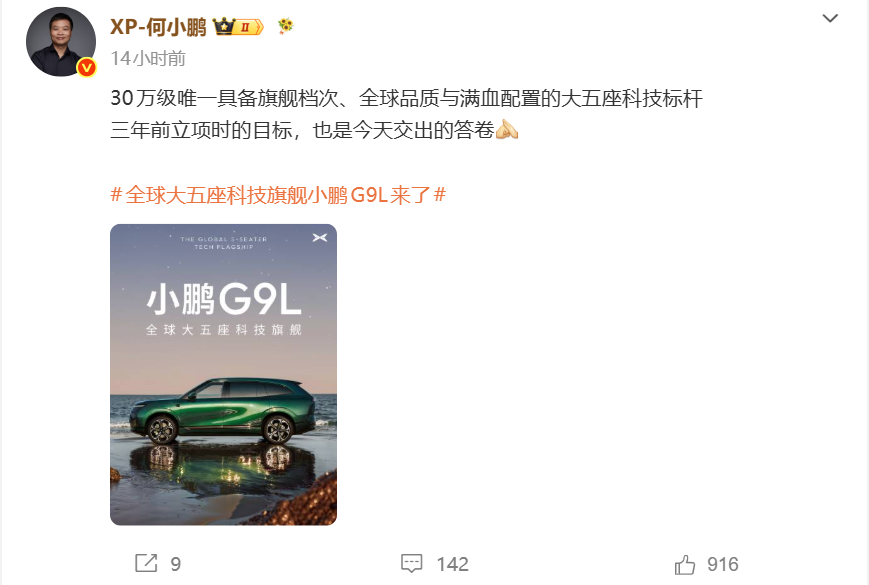
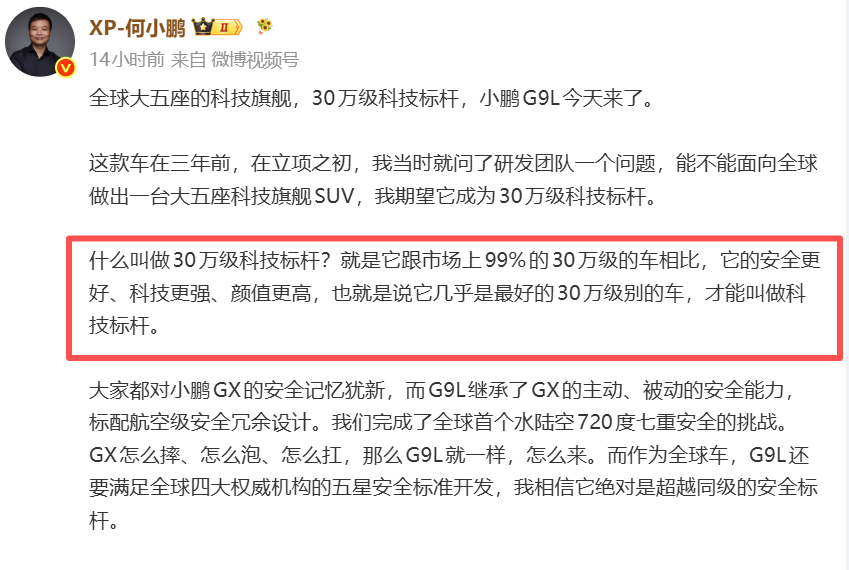
After the successive successes of the GX and Mona L03, Xpeng appears more confident. On August 3, Xpeng Motors unveiled its new model, the G9L, dubbed the 'Large Five-Seater Tech Flagship SUV.' Regarding this vehicle, Xpeng Chairman He Xiaopeng made a bold statement, claiming it far surpasses its competitors. 'What defines a technological benchmark in the 300,000 RMB price range? It means that compared to 99% of vehicles in this market, it offers better safety, stronger technology, and higher aesthetics. In other words, it is almost the best vehicle in the 300,000 RMB range to be called a technological benchmark,' He Xiaopeng said.
This statement is clearly provocative, almost directly shouting, 'The best large five-seater under 300,000 RMB.' To use an internet meme, it's like saying, 'Let me be frank, everyone here is XX.' Of course, anyone can claim to be a 'benchmark,' but having the capability is another matter. What makes the G9L, which has boosted He Xiaopeng's confidence, so special that it deserves to be called a 'benchmark'? He Xiaopeng refers to it as the 'only vehicle in the 300,000 RMB range with flagship-level quality, global standards, and full-spec configuration.' Based on the current official introduction, it can be summarized with five key points.
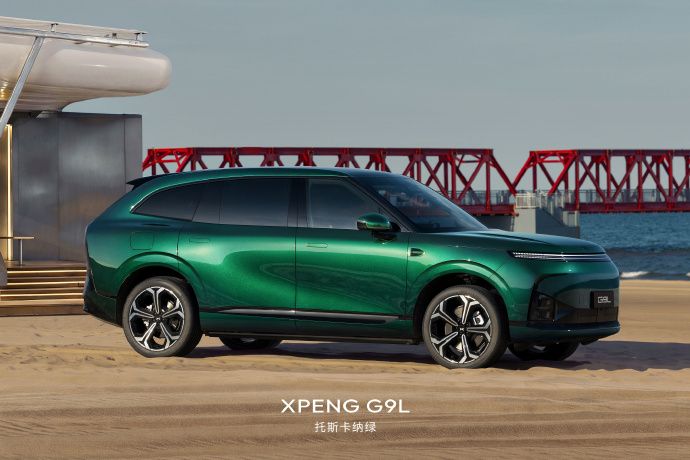
The first is design. At first glance, one might assume the Xpeng G9L is a longer version of the G9, but it is actually more akin to a large five-seater version of the GX, given the completely different platform. He Xiaopeng even mentioned that the G9L inherits the active and passive safety capabilities of the GX, featuring standard aerospace-grade safety redundancy design. In terms of design, the vehicle was developed with a team led by Juanma, who was previously the chief exterior designer at Ferrari. He Xiaopeng specifically highlighted that the design team created two new exclusive colors for the Xpeng G9L—Tuscany Green and Provence Purple. In a sense, this is one of Xpeng's unique competitive points.
The G9L measures 5120mm in length, 1999mm in width, and 1782/1788/1795mm in height (multiple versions), with a wheelbase of 3100mm. Compared to the GX, both the length and wheelbase are shorter, with compressed front and rear overhangs, aiming to enhance handling responsiveness and create a visually compact impact. The overall body is more rounded, with a significantly more sporty rear design, marking a stark contrast to the GX.
The second aspect is intelligent driving. He Xiaopeng hinted in the preview that the vehicle will feature a significant upgrade to Xpeng's second-generation VLA and other technological benchmarks. From a hardware perspective, the G9L is equipped with three Turing AI chips + one 8295P automotive-grade chip, delivering an effective computing power of 2250 TOPS. Thus, its intelligent driving capabilities are beyond doubt, which has always been a strength of Xpeng. The core improvement in this generation of Xpeng's VLA is the enhancement of autonomous understanding and decision-making abilities.
Additionally, the driver incapacitation assistance system is a noteworthy feature. When the system detects that the driver is unable to operate the vehicle, the car can autonomously pull over, activate hazard lights, and call for rescue.
The third aspect is chassis capability. He Xiaopeng stated, 'The chassis and handling of the Xpeng G9L are exceptionally strong. Today, I'll simply mention one achievement: the G9L has set the fastest moose test record in its class, an industry benchmark!' In terms of hardware, it is equipped with 'rear-wheel steering + dual-chamber air suspension.' Among products in the 300,000 RMB range, this combination is currently a must-have for competition and a bonus in the large five-seater market. With rear-wheel steering as standard across all models, the Xpeng G9L has a minimum turning radius of just 5.4 meters, while the dual-chamber air suspension provides better comfort and sporty performance, achieving a balance between the two.
As for the fastest moose test record in its class, the specific figure has not been announced yet and will likely be released after the official product launch.
The fourth aspect is charging and range. The G9L offers both pure electric and extended-range options. The pure electric version is based on an 800V high-voltage silicon carbide platform, with battery pack options of 91.9kWh and 110kWh, offering six CLTC range versions from 672km to 805km. The extended-range version is equipped with a 63.3kWh lithium iron phosphate battery + a 1.5T range extender, providing a WLTC pure electric range of 350km (two-wheel drive) / 325km (four-wheel drive). Among them, the pure electric version, based on the 800V high-voltage SiC platform, supports 5C ultra-fast charging. He Xiaopeng stated that it can replenish 450 kilometers of range in just 9 minutes.
With the recent debut of Xiaomi's two Pengcheng models, which have pushed the pure electric range of extended-range vehicles to 500KM, Xpeng, which was the first to implement large-battery extended-range technology, has been relatively restrained with battery size this time. This might be due to cost control factors or concerns that an overly heavy battery could negatively impact the vehicle's overall performance.
The fifth aspect is configuration and comfort. According to He Xiaopeng, 'full-spec configuration' is a major highlight, but specific details will only be revealed upon the vehicle's market launch, leaving it as a suspense (suspense). Secondly, in terms of comfort, He Xiaopeng claims the vehicle will set a comfort benchmark, with its core feature being the globally First Release (world's first) full-body AI active-fitting seat technology. According to reports, the entire seat is equipped with 91 pressure sensors that can detect even the slightest weight, accurate down to 2 grams, accommodating various body types without the need for repeated adjustments. With just a single button, the seat can automatically adjust to follow changes in sitting posture.
'Comfort' has long been a label promoted by Seres and Li Auto in this market segment. By emphasizing this aspect, Xpeng is clearly aiming to attract a broader customer base beyond those solely interested in intelligence. From the official video, the driver's seat offers 12-way electric adjustment, including 4-way lumbar support, while the rear seat backrest offers electric adjustment from 27°-37°, featuring a 12-layer structure with 26mm slow-rebound foam and chromium-free tanned Nappa leather.
In terms of competition, the Xpeng G9L faces rivals such as Li Auto's twin stars, the 'L6/i6,' Seres M7, Zeekr 7X, Xiaomi Pengcheng N70/90, and products like the IM LS8. Currently, each has its own strengths. Features like the 800V platform, rear-wheel steering, and air suspension are becoming common, and even intelligent driving capabilities show little clear differentiation. In such a competitive environment, the Xpeng G9L is undoubtedly under pressure. However, the core strengths of this vehicle have yet to be fully revealed. Especially in response to the Pengcheng N70/90, Xpeng is likely to have bigger surprises in store.
-
![]()
4.6 Billion Yuan! 301382 Clinches Major Computing Power Deal
-
![]()
Ruide Intelligence and Gudong Intelligence Forge Ahead in Strategic Partnership, Eyeing Trial Production at Intelligent Optics Base in Second Half of the Year!
-
![]()
Thriving Beyond Family Succession: An Optical Pioneer Blazes a Trail for Private Firms
-
![]()
Samsung China Takes Another Step Back
-
![]()
Samsung China Takes Another Strategic Retreat
-
![]()
Xpeng Unveils New Large Five-Seater G9L, He Xiaopeng Claims It Outperforms 99% of Vehicles in the 300,000 RMB Price Range
-
Anthropic’s $10 Billion Multi-Year Compute Deal Unveiled
-
![]()
Bidding Adieu to the 'Wild West' Phase: What is the Competitive Edge of Lightning Warehouses?