I entrusted the task of 'chasing hot topics' to Qianwen Office, but it first learned 'what not to chase'
 08/10 2026
 401
401
Written by | Zeng Xianyong
Produced by | Atong Observation Yongli Business Review Global Business Trends

Recently, I used an AI agent to cover a 'night shift' for the first time.
In the media industry, the biggest fear isn't writing drafts—it's missing information. The global AI circle often releases news in the middle of the night, with OpenAI launching new features or Google releasing model weights, usually around Beijing time in the early morning. On a good day, you catch it immediately; on a bad day, you wake up half a day behind. Even if you see it, you have to get up and organize it yourself.
A few days ago, on August 3, Alibaba Cloud Qianwen officially released the Qwen3.8-Max large model. On the same day, Qianwen Office launched its public beta, and I became one of the first media professionals invited to test it.
I’ve always believed that at this stage, AI’s role isn’t to write for us but to handle the first mile of 'finding, screening, verifying, and writing,' leaving the rest for us to complete carefully.
Chasing hot topics is actually where machines excel—while carbon-based humans sleep, silicon-based beings are on duty; while we’re driving, they’re still monitoring.
More importantly, chasing hot topics isn’t just about knowing things earlier—it’s about discerning what’s worth chasing, what to wait for, and what shouldn’t be written at all when information is chaotic.
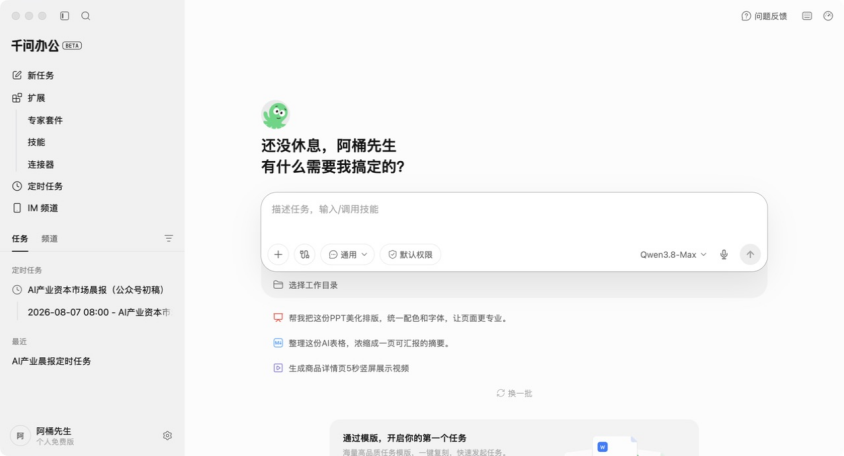
The image above shows Qianwen Office's scheduled task list, where the AI industry morning report and the hot topic radar can run in parallel.
For example, we might spot a hot topic in the morning, see three interpretations by noon, and realize by evening that the most valuable angle has already been drowned in emotion and repetition. For a business WeChat official account, chasing hot topics is more about continuous editorial judgment than news aggregation.
In the past, I’d break this down into scattered tasks: opening a dozen information sources, checking announcements, scanning media, searching for company statements, and then deciding whether to write. The real time-consumer isn’t 'seeing' but verifying and prioritizing. Especially in fast-changing fields like AI, tech, and capital markets, where secondhand interpretations abound, it’s better to be half an hour late than half an hour early with unverified news.
With Qianwen Office, I set up a new scheduled task: the Commercial Hot Topic Tracking Radar. It doesn’t post for me or draw conclusions; it handles the most overlooked yet exhausting part of editorial work—continuous monitoring, clue collection, tagging, cross-verification, and presenting potential topics. I still prefer to handle the final publishing myself—classic media style, right?
01
Define 'What Isn’t a Hot Topic' First
A qualified hot topic workflow starts not by casting the widest net but by excluding content that shouldn’t enter the topic pool. My constraint for Qianwen Office: look back only three hours per round, leave at most three items; if nothing significant, output 'No strong hot topics this period'—no padding reports.
This sounds conservative but sets the right boundary for WeChat official account writing. Readers don’t need a 'trending list' but a curated judgment: why it matters, which industry chain it affects, who will adjust expectations, and whether it’s too late to write today.
Here are my basic criteria:
• Time Window: Only the past three hours to avoid repackaging old news.
• Source Priority: Company officials, exchange/regulatory announcements, and earnings calls first; authoritative business media for supplementation.
• Verification Baseline: Key facts must be confirmed by two sources; unverified clues must be labeled as 'unconfirmed/rumor.'
• Editorial Output: No stock recommendations or investment conclusions—only observation angles and writing timeliness suitable for business commentary.
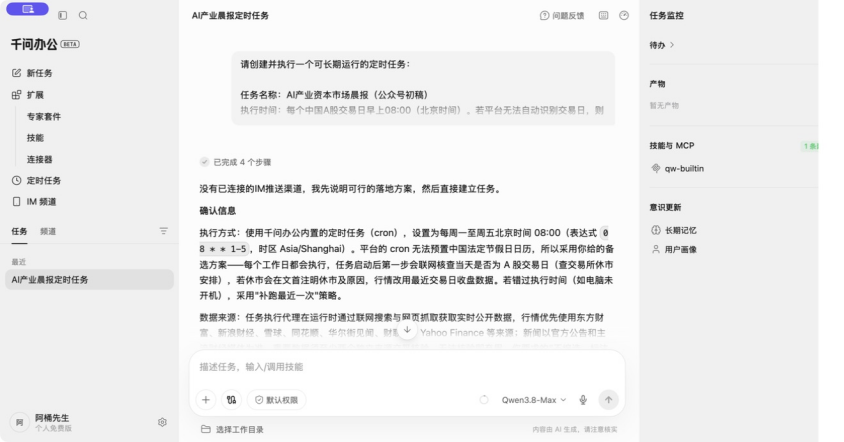
The image above shows the task setup page, where I defined the topic scope, source priority, dual-source verification, and output structure in one go.
02
Break Hot Topic Work into a Pipeline
Later, I set it to run five times on weekdays: 09:30, 11:30, 13:30, 15:30, 17:30. These align with post-market opening sentiment, midday company/industry updates, afternoon market repricing, and the final pre-close topic window. For writers, this isn’t about letting machines 'watch the market' but slicing time into reusable info nodes while you’re in meetings, writing, or interviewing.
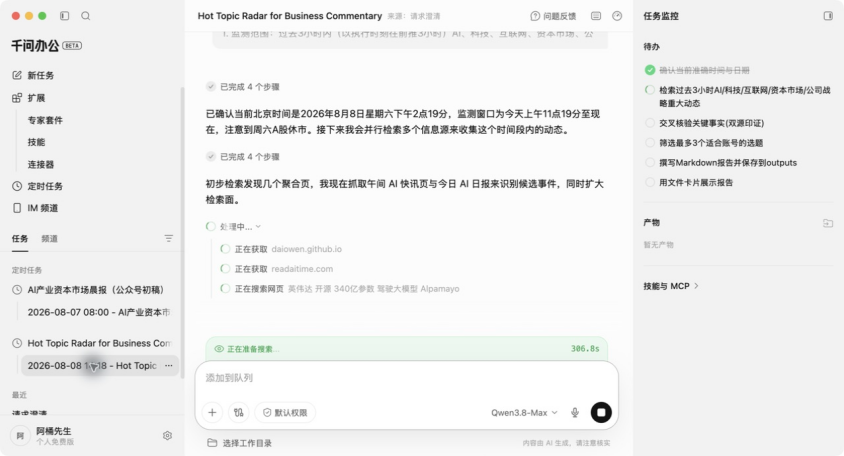
Note: After trial launch, the task monitor lists a full to-do: time confirmation, retrieval, verification, filtering, drafting, and saving.
Qianwen Office splits this task into six steps: confirm current time; retrieve AI, tech, internet, capital market, and corporate strategy info from the past three hours; cross-verify key facts; filter up to three items; write a Markdown report; and place the file in the output area. This step-by-step visibility is crucial—it turns 'what AI is doing' into a transparent process, not a black-box answer.
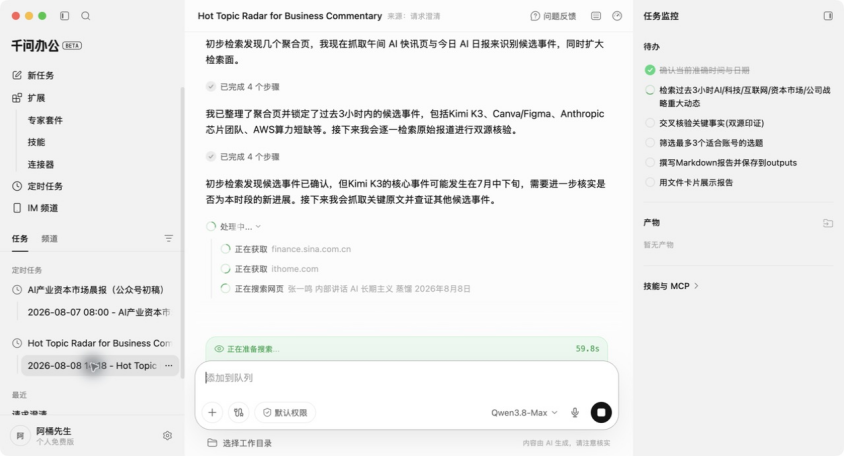
Interestingly, Qianwen Office first aggregates candidate events, then verifies them against original reports and multiple sources, rather than jumping to conclusions.
03
In Trial Runs, I Value Its 'Stopping' More
The trial started by confirming Beijing time and the monitoring window. The system noted it was a weekend with A-share market closure, then scraped AI news, industry daily reports, and media coverage to form candidate events before verifying them against original sources. During the task, it flagged clues like Kimi K3, Canva/Figma, Anthropic’s chip team, and AWS compute shortages as pending verification while warning: some events’ core developments might not fall within the current window and require further checks.
This is exactly what I wanted. The most dangerous moment in hot topic writing is mistaking a 'seems-writeable' story for fact. A true editorial AI shouldn’t just expand text—it should also tell me: 'This timeline is off,' 'Sources are insufficient,' or 'Avoid chasing now.'
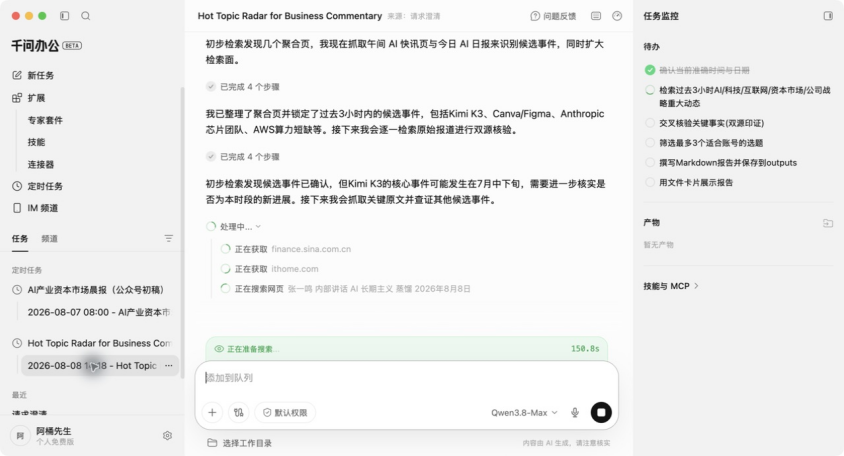
The image above shows candidate events undergoing dual-source verification, with the system scraping original finance and tech media articles and adding new retrieval queries.
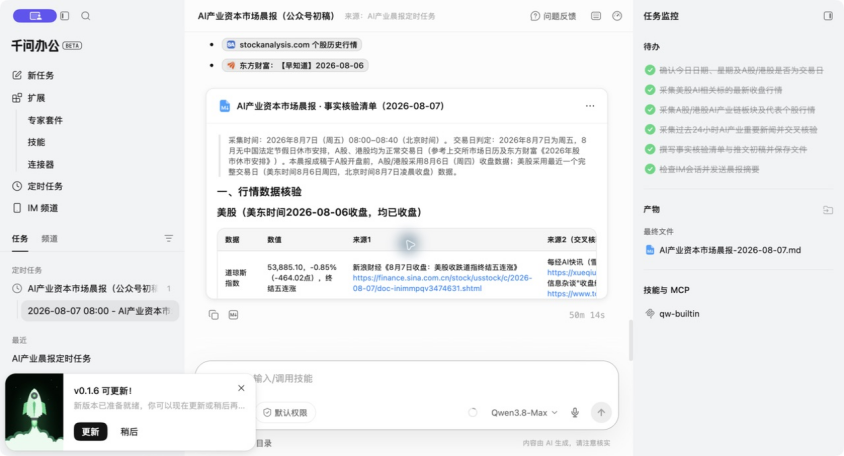
This shows a sample fact-verification output from a previous morning report task, archived as a file for editorial review and citation.
04
It Delivers Not an 'Answer' but an Editorial Desk
I require the hot topic radar’s reports to include ten sections: strong hot topic or not, event title, why it’s worth following, confirmed facts, pending verification info, two commentary angles, three restrained headlines, writing timeliness, account match score, and a fact-verification checklist. This format isn’t about neatness—it’s about making each piece quickly disassemblable by editors.
For example, 'Why It’s Worth Following' demands answers on heat (popularity), timeliness, and commercial impact; 'Commentary Angles' requires two distinct entry points beyond news recaps, such as industry chain, corporate strategy, business model, or organizational capability. At this stage, the Agent isn’t a search bar—it’s a research assistant who organizes materials on your editorial desk.
We used to make similar tables, but they wouldn’t refresh themselves or remind you proactively when a clue was unverified. The Agent’s value lies in turning a static list into a continuous mechanism: the same standards are applied morning, noon, and pre-close, leaving judgment records at different times. Even if the conclusion is 'No strong hot topics today,' that empty result is valuable—it saves the editorial team from updating for the sake of updating.
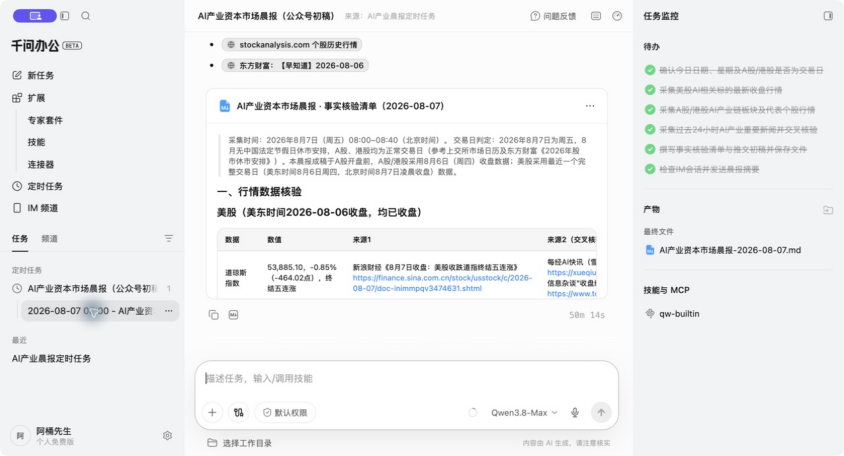
After scheduled tasks complete, structured results, to-do statuses, and generated Markdown outputs can be viewed in Qianwen Office’s chat.
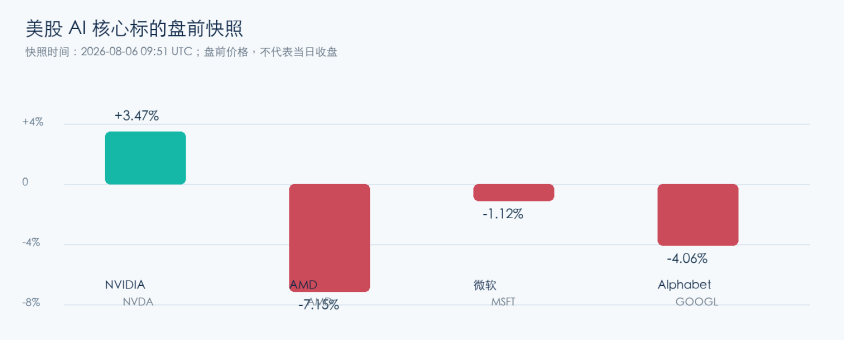
The image above shows a market snapshot from the morning report workflow, where hot topic tracking and pre-market info services complement each other.
05
Chasing Hot Topics Is Still a Human Job
This workflow doesn’t remove editors from the scene—it structures the 'data gathering' grunt work upfront, freeing attention for the irreplaceable parts: Is it worth writing? For whom? Are the arguments valid? Is the tone restrained? Should we wait for more facts?
From Qianwen Office’s trial, its value lies in breaking tasks into persistent operations: scheduling, retrieval, candidate filtering, dual-source verification, and file archiving—all reviewable. For a business WeChat account needing constant updates, this is more practical than generating a polished first draft. What truly needs saving isn’t the author’s judgment but the repetitive, trivial, yet unskippable prep work before judgment.
Of course, such workflows have clear boundaries. Aggregation pages provide clues but can’t replace original disclosures; 'retrieving' ≠ 'verified'; market sentiment can be recorded but not packaged as investment advice. Thus, I keep manual checks before final publishing: open source links, verify timestamps, confirm headlines don’t overstate facts, then decide to write. Human-AI collaboration only works if humans retain judgment—not by outsourcing it but by having systems honestly surface uncertainties.
In the task flow, the hot topic radar runs alongside the AI industry morning report—one handles 'what happened today,' the other 'what’s most writeable now.'
My conclusion: Qianwen Office Agent is best suited for long-term repetitive tasks like 'information radar + fact verification + topic drafting'; final headlines, judgments, and publishing should remain human.
By the way, my delivery standards for Qianwen Office’s hot topic radar are below—new users can reference them: keep at most three items per report; dual-source verify key facts; clearly distinguish confirmed vs. pending; retain links and timestamps; no stock recommendations; reports must include commentary angles, headline candidates, and writing timeliness. This prompt doesn’t try to make the Agent 'think like an editor'—it turns the most critical constraints of editorial work into a mandatory process for every run.
06
Alibaba’s AI Ecosystem Comes into Focus
Over the past two years, large models advanced rapidly, but office integration stalled at one hurdle: AI could search, write reports, and make tables, but the final task closure still required manual human effort.
We call such products 'Office Agents'—a fancy term. 'Agent' means 'representative' or 'broker,' but most current products remain 'advisors,' one step short of true 'executors.'
Break down 'Qianwen': it’s both Alibaba’s large model family and the Qianwen App for general users; Qianwen Office focuses on deep office tasks, moving from general Q&A to task decomposition, tool invocation, and result delivery.
It’s not parallel to DingTalk or Alibaba Cloud: DingTalk handles organizational relationships, communication, docs, and approvals; Alibaba Cloud provides models, compute power, and enterprise infrastructure. Simply put, Qianwen models supply 'brainpower,' Qianwen Office handles 'execution,' DingTalk enables organizational collaboration, and Alibaba Cloud supports scale.
Integrating Wukong, QoderWork, and MuleRun aims to close the loop on Agent capabilities across desktops, clouds, and enterprise collaboration. Alibaba isn’t just chasing a smarter AI document assistant—it’s targeting the next-gen work portal for enterprises.
With Qianwen Office’s debut, Alibaba’s AI ecosystem is becoming clearer. (By Zeng Xianyong)
#World Artificial Intelligence Conference #WAIC #AI #Internet #Edge Side #Large Model #Facemind
-
![]()
The $5 Billion Unicorn Behind ByteDance's Seedance Viral Phenomenon
-
![]()
The $5 Billion Unicorn Driving ByteDance’s Seedance to Global Stardom
-
![]()
Starting at 219,900 Yuan, Equipped with Huawei ADS 5 as Standard, Avita 07L Exudes Sincerity
-
![]()
Tech Titans Clash in AI-Driven Office Solutions, Leaving AI Smartphones in a Tight Spot
-
JD.com, Leveraging Government Subsidies, Officially Raises iPhone Prices: Apple's Strategic Pricing Moves
-
![]()
Is Google Losing Its Vision?
-
![]()
Tech Giants Compete in AI Office, AI Smartphones Face Embarrassment
-
![]()
Starlink V3: Musk’s Ambitious Vision to Construct a ‘Sky Net’ of 100,000 Satellites, Traditional Operators on High Alert