The $5 Billion Unicorn Driving ByteDance’s Seedance to Global Stardom
 08/10 2026
 353
353

The flow of AI innovation is reversing: once, China imported cutting-edge overseas models; now, its homegrown technologies are reshaping global creative industries.
Author: Zhao Weiwei, BlueHole Business
"Join now to unlock 7 days of unlimited access following Seedance 2.5’s launch on Higgsfield."
This tagline from Higgsfield—a U.S.-based AI video generation platform—encapsulates its unique position in the market. Rather than developing proprietary models, Higgsfield acts as a model aggregator, offering scheduling services for third-party video generation models like Google Veo, Kling, and Seedance.
With a lean team of 150 (60 core engineers/product specialists and 70+ film/TV professionals with advertising expertise), Higgsfield has achieved remarkable scale: $500 million in annualized revenue within just 15 months, primarily serving B2B advertising agencies.
The company exemplifies the AI video boom. Valued at $1.3 billion in early 2024, its latest funding round six months later pushed its valuation to $5 billion—a near-quadrupling driven by surging demand for Chinese AI models.
The past six months have also seen ByteDance’s Seedance 2.0 dominate Volcano Engine’s token consumption, with overseas usage approaching 50%. Now, Seedance 2.5’s global rollout is sparking fresh growth.
Chinese video generation models now flood Higgsfield’s platform, with Seedance leading the pack. Others like Kling 3.0, MiniMax H3, Ali Joy Horse, and Wan 2.7 collectively power Higgsfield’s meteoric rise as a U.S. AI unicorn.
This marks a historic shift: overseas models once dominated China’s market; today, Chinese AI supplies the global film and advertising industry. As B2B becomes AI’s most certain growth path—and video generation its most commercially viable niche—Higgsfield’s trajectory reveals two key truths:
Production-Side Insights: Model capabilities are replaceable, but cloud collaboration networks create defensible moats. User-accumulated assets follow a "rich-get-richer" dynamic, where established players dominate.
Commercial Closure: Building end-to-end commercial chains—linking advertising platforms and charging based on value outcomes—enables scalable monetization. Agents play a crucial role in boosting brand sales conversions.
A $500,000 Open-Source Masterclass
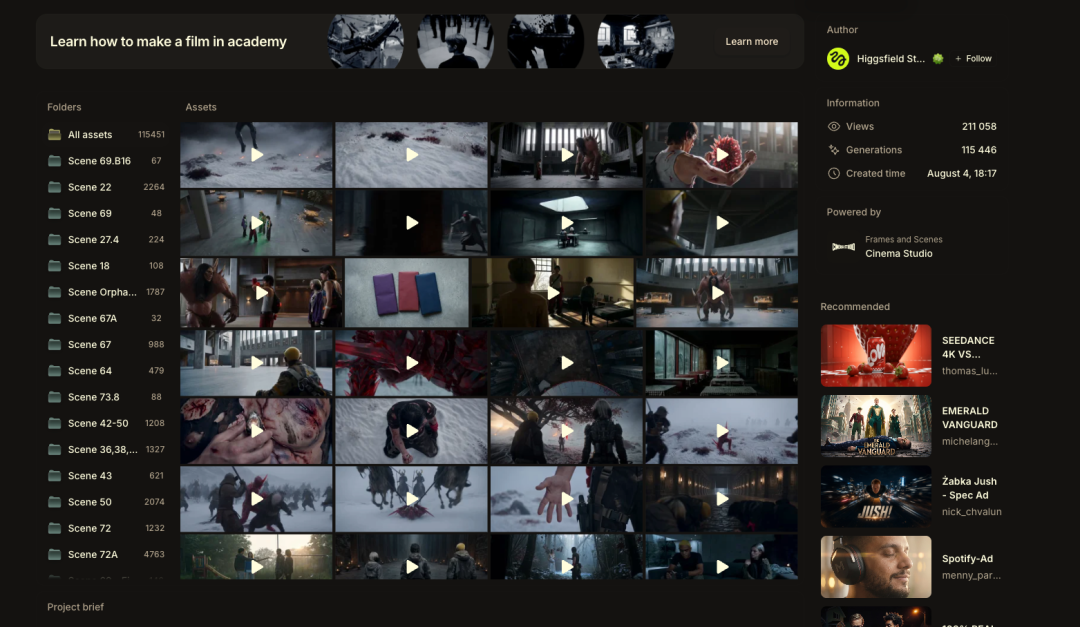
Higgsfield recently democratized AI filmmaking by open-sourcing its methodology for "Hell Grind," a 95-minute AI-generated feature film:
- Produced for $500,000 ($400,000 on computing)
- Generated entirely by Seedance 2.0
- Screened at Cannes Film Festival’s market program
The open-source package includes:
- 115,446 generation records
- 100+ scene-numbered asset folders
- 3,000-word video prompts
- Three methodological documents
Viewed over 300,000 times, this release tackles a systemic industry challenge: video models lack memory. Without detailed prompts, characters morph between shots. Higgsfield’s solution—CINEDANCE—automates prompt generation using standardized rules.
Key innovations include:
Character Consistency: Three-image "character cards" (close-up face, full-body front/back) undergo stress testing across 10 generations with varying poses/lighting. Only assets recognized correctly each time are approved.
Emotional Precision: Instead of words like "sad" or "angry," prompts describe muscle movements: "jaw clenching and releasing," "blood flowing to lips without wiping," "slow blink followed by quick double blink." Dialogue is confined to audio blocks to prevent unintended model behaviors.
Spatial Awareness: Each scene begins with a text-based floor plan marking landmarks, camera positions, and "impassable lines." A one-second establishing shot without dialogue or action helps the model "photograph" spatial relationships.
The material library includes 14,593 rework records (13% of total), reflecting the iterative nature of AI filmmaking. A mid-film action sequence required 4,000–5,000 generations per scene, while later scenes needed just 12–20. As the team noted: "Every rule in this brief is backed by a failed shot."
For the AI film industry, these open-source assets may prove more valuable than the film itself.
Not a Model Maker, But a Model Wholesaler
Higgsfield’s pivot from model development to aggregation was strategic. Co-founders Alex Mashrabov (ex-Snap generative AI) and Yerzat Dulat initially aimed to rival Sora but shifted after realizing no single lab could dominate all scenarios. "New video models emerge weekly," Mashrabov explained. "Binding to one would be a mistake."
For startups, "selling shovels" beats "digging for gold." Higgsfield now offers Google Veo, Kuaishou Kling, and ByteDance Seedance, letting users compare results across models. Critics call it a "wrapper," but Mashrabov counters: "Future software companies will run on models they don’t own. The debate is meaningless."
The real moat lies in collaboration. While models are commoditized, project files, team workflows, and accumulated assets are not. Higgsfield’s edge comes from enabling seamless multi-user collaboration and the network effects that follow.
ByteDance benefits from wholesalers like Higgsfield promoting its models, while Higgsfield gains from exclusive Seedance partnerships and open-source projects like "Hell Grind" to attract investors.
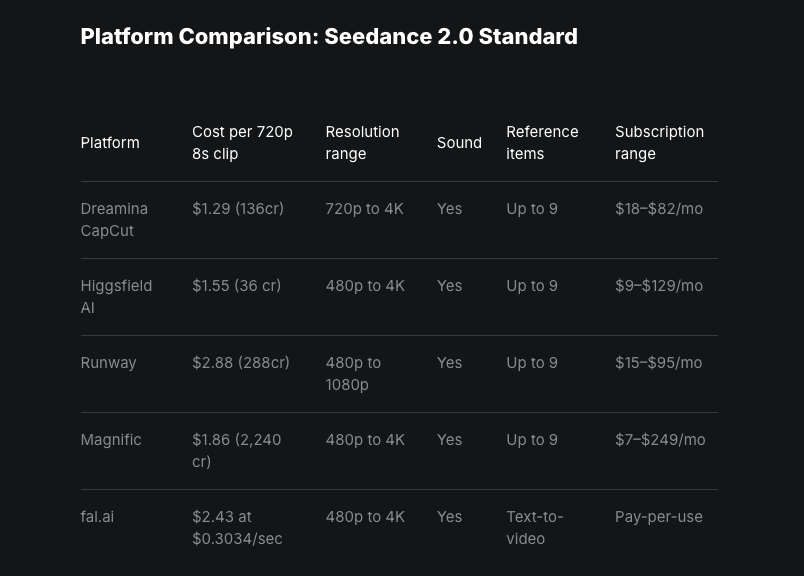
On Higgsfield, users find exclusive Seedance 2.0 Enhanced Fast and Seedance 2.5. Pricing favors high-frequency users: while Dreamina (CapCut) is best for occasional use, Higgsfield’s $9/month entry plan undercuts competitors. About 40% of usage comes from workflow tools like Cinema Studio and Marketing Studio, where average annual spend hits $1,000 (5x Canva’s), with enterprise clients exceeding $200,000.
More critically, Higgsfield has transformed models from tools into workflows. Advertising agencies (70% of revenue) now produce ads in days instead of weeks, iterating on actors, lighting, and variations through software—no crew or location needed.
Riding China’s AI Wave to $5 Billion
Higgsfield’s valuation surge aligns with Chinese AI milestones:
- January 2024: $80M Series led by Accel; $1.3B valuation; $230M annualized revenue.
- February: Seedance 2.0 and Kling 3.0 launch; Higgsfield secures exclusivity.
- June: Revenue tops $500M; $300M–$500M raised at $5B pre-money valuation.
The four-month window between Seedance 2.0 and 2.5 launches saw valuation jump 4x.
The $5B Valuation’s Chinese AI Backbone
On July 31, ByteDance released Seedance 2.5, extending single generations to 30 seconds. Days later, MiniMax launched H3, open-sourcing model weights at $0.011/second (1/12th of Seedance 2.5’s price), instantly topping Hugging Face’s trending list.
Both models now dominate Higgsfield’s platform, with Seedance 2.5 Preview teased for imminent launch and H3 already listed. H3’s overseas rollout outpaces Seedance 2.5.
Multimodal video models are lucrative but competitive. Reports suggest Seedance’s gross margin hits 70%–90%, yet Chinese models increasingly rely on overseas markets:
- Kling: 70%–75% revenue from North America; $1B annualized revenue; Kuaishou plans $2B spinoff.
- Seedance: Overseas calls rose from 33% to 50% by June.
This marks a historic shift: overseas models once dominated China; now, Chinese AI powers global film and advertising.
Distribution platforms like Higgsfield drive this growth, alongside overseas AI video SaaS firms, agencies, and comic platforms accessing models via BytePlus. Google data projects the overseas short drama market will exceed $6B by 2026, growing 60% YoY.
Seedance 2.5 vs. MiniMax H3: The Battle for Dominance
Overseas tech forums debate their strengths:
- Seedance 2.5: Better for long-duration projects with extensive reference materials and frequent revisions (albeit pricier).
- MiniMax H3: Excels at short, clear prompts requiring minimal edits, ideal for videos with a single creative focus.
Technically, H3 adopts an open ecosystem to attract developers, while Seedance 2.5 remains closed-source. Yet the real winners may be aggregators like Higgsfield, which offer "certainty" amid rapid model turnover. Customers’ workflows and commercial closures remain unchanged, whether using Seedance 2.5 or H3.
-
![]()
Dissecting the Underlying Logic of the 'AI Office Entry Battle': How to Become the Ultimate Winner?
-
![]()
OFILM Issues Urgent Clarification on 'Asset Stripping' Rumors, Denies Channeling Benefits to Related Parties of Actual Controller
-
![]()
Securing 80% of Apple’s Shell Quality Inspection Orders: What Gives Huiyan Technology Its Competitive Edge?
-
![]()
Monthly Sales of 1 Unit: Chevrolet's Failure in China and an Excellent Example of Loss Mitigation for Joint Venture Automakers
-
![]()
The Closing of the $50 Billion Pre-IPO Round Looms: Yuezhi Anmian is Revolutionizing Valuation Logic for China’s Large Language Models
-
![]()
Pork Prices Plummet by 13%, Yet Smartphones and Healthcare Costs Soar: Here's Why Your Wallet Feels the Pinch
-
![]()
Storage Costs Skyrocket! Apple iPhone 18 Pro Sees Nearly 40% Cost Hike: Price Increases Loom
-
Musk's SpaceX to Compete with Top Three U.S. Operators: Wild Dream or Future Disruptor?