Is Google Losing Its Innovative Edge?
 08/10 2026
 398
398
In May 2018, Pan Luan penned an article titled "Tencent Has No Dreams," arguing that Tencent was forsaking its product development prowess and entrepreneurial zeal, morphing instead into a mere investment firm. This piece sparked widespread discussion across China's digital landscape, even prompting a direct response from Tencent's founder, Pony Ma.
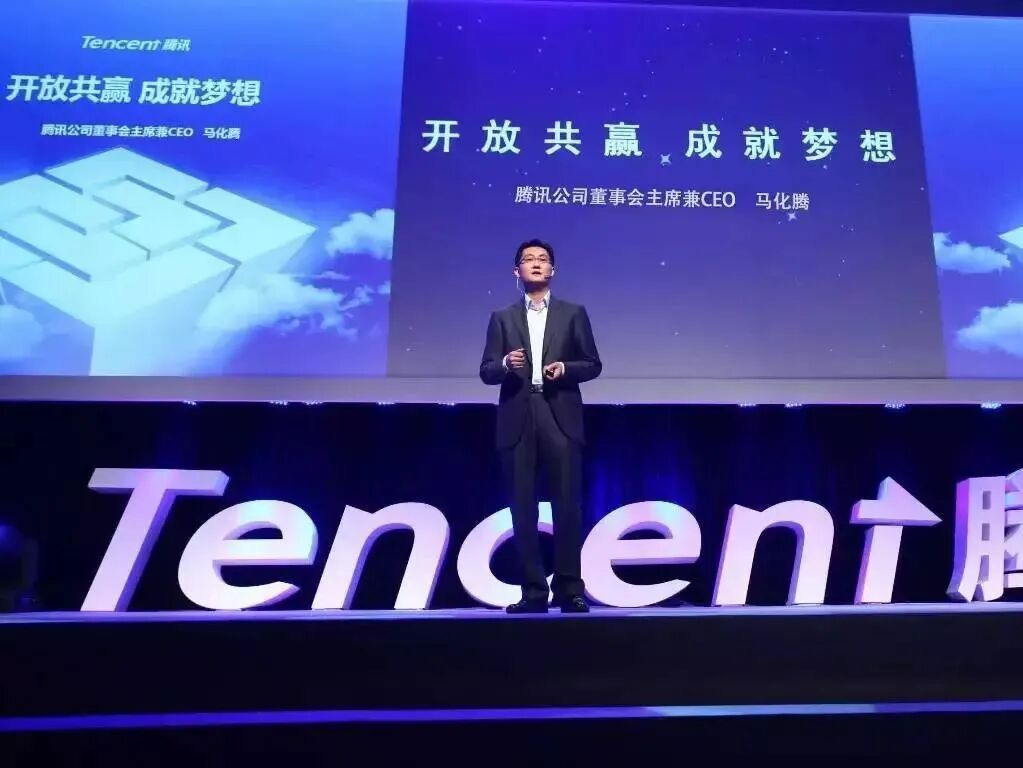
Fast forward eight years, and a similar narrative is unfolding in Silicon Valley—this time, with Google at the center.
Google appears to be losing faith in pioneering AI research, transitioning towards becoming an AI infrastructure provider. It pioneered the Transformer architecture, acquired DeepMind, launched the TPU initiative, and developed a chatbot a year prior to ChatGPT's emergence. Yet, now it finds itself selling computing power to its fiercest rivals, witnessing a steady exodus of top talent, and seeing its flagship model, Gemini, slip out of the global top 10 rankings.
However, Google's situation differs fundamentally from Tencent's. While Tencent invests to safeguard its user base and market dominance, Google invests as a hedge against its own shortcomings in executing cutting-edge technological advancements. Google hasn't abandoned its aspirations; it has merely outsourced them.
I. DeepMind: From Pioneering Lab to Also-Ran
On August 5, Google announced a major leadership shakeup at DeepMind. The announcement itself was straightforward, but the underlying message was clear:
Demis Hassabis, DeepMind's co-founder and CEO, is stepping back from day-to-day operations.
Jeff Dean, Google's chief scientist for 27 years, co-founder of Google Brain, and initiator of the TPU project, is leaving to establish Discovery Loop.
Joining Jeff Dean are Sanjay Ghemawat, Quoc Le, and Oriol Vinyals—three distinguished researchers at the Google Fellow level.
DeepMind CTO Koray Kavukcuoglu will assume responsibility for daily operations, reporting directly to Sundar Pichai.
SemiAnalysis bluntly stated in its report: "In every respect, we believe DeepMind is no longer a cutting-edge lab. Google will continue to release models, but their chances of reclaiming industry-leading (SOTA) status have dwindled to zero."
This decline didn't happen overnight. A closer look at the timeline reveals a brain drain at Google AI that has been ongoing for over two years:
2021: Noam Shazeer, a key contributor to the Transformer paper, leaves Google after the company refuses to release his chatbot, Meena. He subsequently founds Character.AI.
August 2024: Google 'repurchases' Shazeer for $2.7 billion, appointing him as co-lead of Gemini.
June 18, 2026: Shazeer departs Google once again, this time to join OpenAI. By now, all eight authors of the Transformer paper have left Google.
June 19, 2026: John Jumper, the 2024 Nobel laureate in Chemistry and core leader of AlphaFold, leaves DeepMind for Anthropic.
August 5, 2026: Jeff Dean, a symbol of Google's engineering culture and employee number 30, announces his departure. Demis Hassabis steps down from daily management.
A Google employee shared with reporters that Jeff Dean jokes are a staple of engineer culture. Some claim he writes code faster than others can read it, never checks syntax before compiling, and if the compiler flags an error, it must be wrong.
Behind these anecdotes lies Jeff Dean's real impact on Google's tech ecosystem over two decades: MapReduce, Bigtable, Spanner, TensorFlow—any one of these would be groundbreaking. His departure takes half of Google AI with him.
But the greatest irony isn't who left; it's what Google once possessed:
In 2017, eight Google researchers published "Attention Is All You Need," introducing the Transformer architecture. Cited over 260,000 times, it became the technical bedrock for nearly all modern large language models: GPT, Gemini, Claude, DeepSeek.
In 2021, DeepMind researcher Tibo's team built LMChat, a chatbot a full year ahead of ChatGPT. But Google, plagued by self-doubt, refused to release it.
Tibo later wrote on X: "Google was too nervous to release it, and DeepMind was blocked from shipping products that could disrupt Google." He left for OpenAI in July 2024 and now leads Codex.
The company that invented AI feared AI would disrupt itself—a scenario reminiscent of Tencent's hesitation in the short video space. Weishi launched in 2013, disbanded in 2015, and shut down in 2017, when Douyin had fewer than 1 million daily active users.
II. When the CFO Wins the AI War
If DeepMind's decline represents "front-end bleeding," then GCP's ascent is "back-end blood transfusion." The two are two sides of the same coin.
SemiAnalysis's report reveals a critical internal power shift: Gemini and GCP once fiercely competed for computing resources, but now the verdict is clear—Thomas Kurian has emerged victorious.
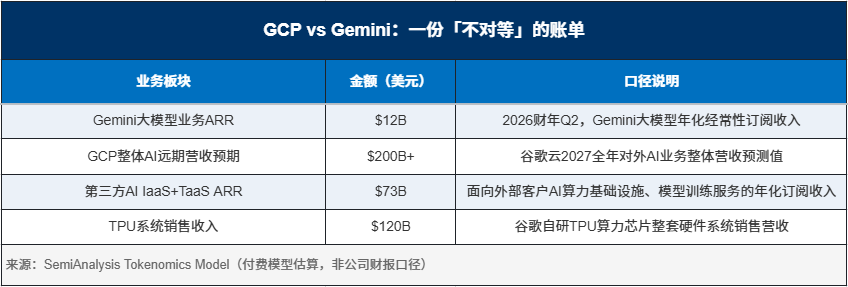
With $200 billion in external sales and EBIT margins exceeding 30%, compared to Gemini's first-party business at just $12 billion, Google's management has made its priorities clear: prioritizing GCP's short-term financial gains over long-term competitiveness in cutting-edge fields.
Even more striking is whom Google sells computing power to. From Q3 2026 to Q4 2027, over 20% of total TPU shipments will go directly to Anthropic. This excludes the hundreds of thousands of TPUs GCP already rents to Anthropic, plus hundreds of thousands more committed to Anthropic and Meta over the next six quarters.
Google invented the Transformer; Anthropic uses it for Claude. Google spent $2.7 billion to bring Shazeer back for Gemini, only for him to defect to OpenAI. Now Google sells TPUs to Anthropic to accelerate Claude's training.
If you've listened to Thomas Kurian's interviews, you know he's no AGI enthusiast. In a podcast, he expressed satisfaction that TPUs are becoming "general infrastructure" supporting Citadel, the Department of Energy, and general high-performance computing. When asked why Google sells computing power to Anthropic despite competing with Gemini, he said it's inevitable for Google as a "platform company."
This isn't unreasonable. But the question remains: when a company's CFO wins the AI war, is it still an AI company?
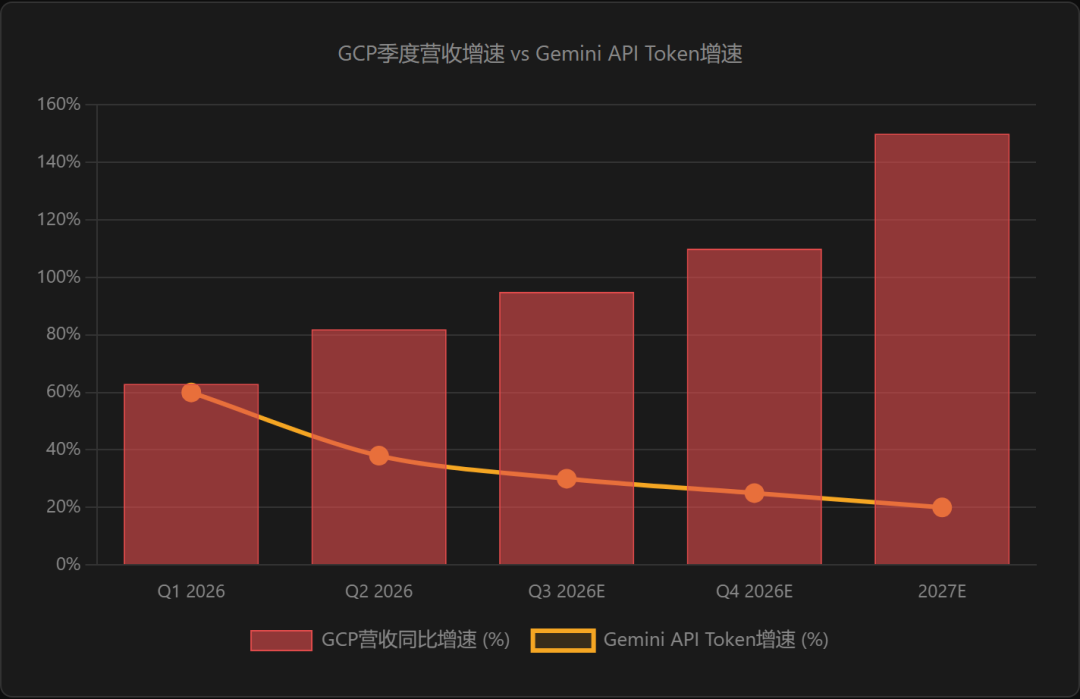
【Chart】chart1
III. First-Ever Negative Cash Flow: Spending Like a Startup, Valued Like Old Money
In Q2 2026, Alphabet delivered a "contradictory" earnings report:
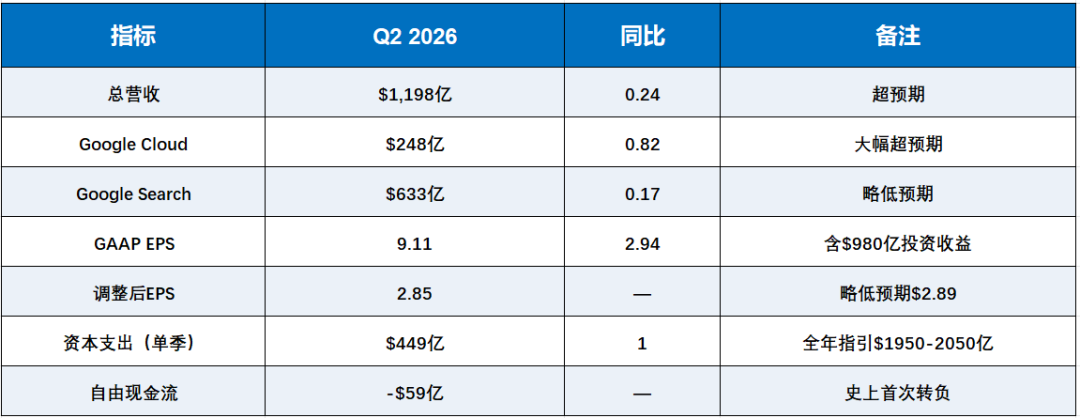
The most noteworthy figures are the last two rows. For the first time in Alphabet's history, quarterly free cash flow turned negative. The market's most reliable cash creator now spends more than it earns.
Of the $9.11 EPS, $6.26 came from unrealized gains in its investment portfolio—mainly appreciation in SpaceX and Anthropic stakes. Excluding this, Google's "real" business profitability is far less impressive.
This mirrors Tencent's 2018 predicament: its profits increasingly came from investment gains, not core business operations, prompting Pan Luan to question whether it had become "an investment company." The difference is Tencent's investments monetized traffic, while Google's hedge against technological execution.
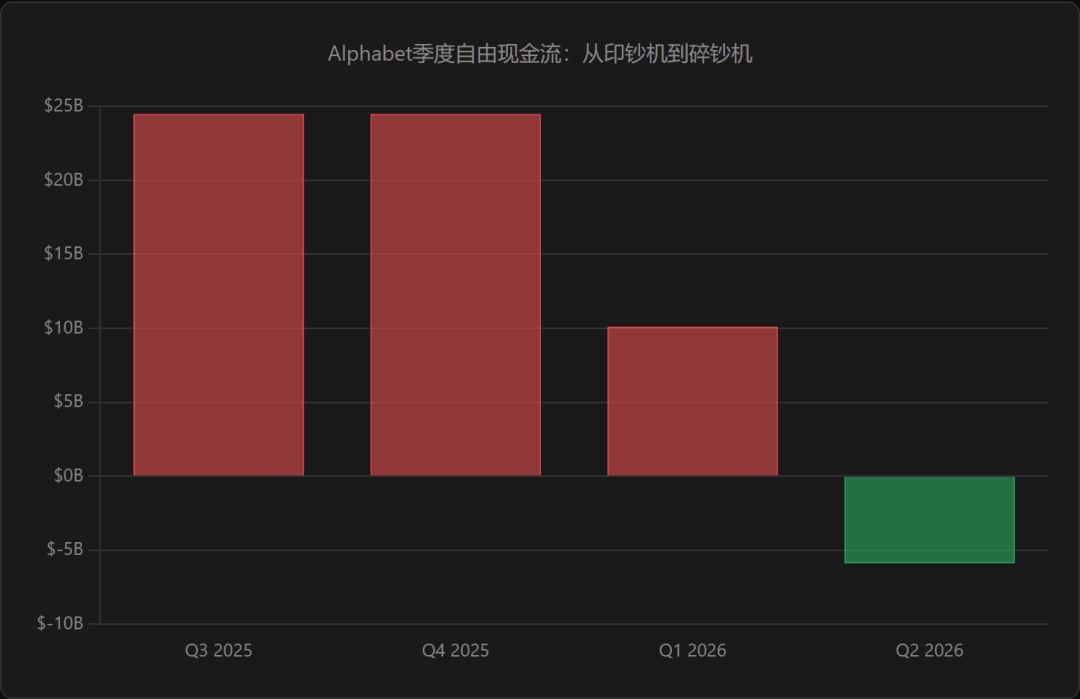
【Chart】chart2
IV. Google Hasn't Abandoned Its Dreams—It's Just Outsourced Them
This is the fundamental difference between Google and Tencent, and what this article must clarify.
Tencent's investment logic is "monetizing social traffic"—outsourcing non-core, non-specialized projects via investment, essentially a "startup tax." Investing in JD, Meituan, and Pinduoduo happened because Tencent couldn't do it itself but could empower with traffic. These investments defend Tencent's social moat.
Google's investment logic is entirely different. It doesn't invest in "what it can't do" but "what it believes in but can't execute." It invests aggressively in cutting-edge tech:
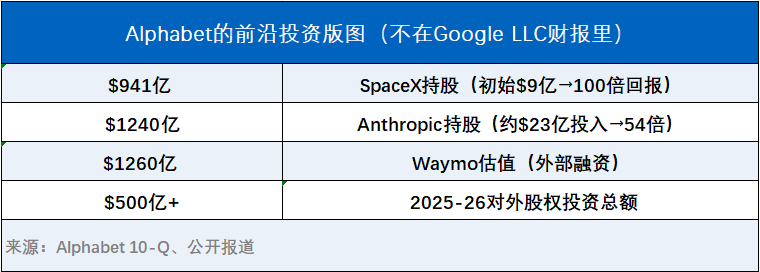
Let's break down this list:
Anthropic: Alphabet commits $40 billion (first $10 billion paid), binding exclusive TPU supply. Stake valued at ~$124 billion. Ironically, Anthropic's Claude uses Google's TPUs to outperform Google's Gemini.
SpaceX: Google invested $900 million in 2015, now worth $94.1 billion—a 100x return. SpaceX's xAI launched Grok 4.6 today—another AI race Google indirectly bets on.
Waymo: Raised $16 billion externally in early 2026, valued at $126 billion. Pichai says it will materially contribute to Alphabet's financials by 2027.
Isomorphic Labs: After stepping down from DeepMind, Hassabis will focus on this AI-driven drug discovery company.
Discovery Loop: Jeff Dean's new venture, backed by Alphabet with funding and computing power. It uses AI to automate scientific research.
GV + CapitalG + Gradient Ventures: Three funds managing over $8 billion, investing in hundreds of companies from AI programming tools to quantum computing.
See the difference?
Tencent invested in JD because it couldn't do e-commerce well; Google invested in Anthropic because it couldn't do AGI well. The former is a capability issue; the latter is a belief issue. Tencent lacks execution; Google lacks that "religious conviction" to "hit the wall head-on."
SemiAnalysis nails it: "Google's problem isn't Jeff Dean or Noam Shazeer—it's an extremely bureaucratic, slow-moving, and strategically timid corporate culture."
So Google made a rational choice: if it can't run at the cutting edge, it will invest in those who can. Sell TPUs to them, rent computing power to them, earn from them via GCP, and invest in their equity via GV. Google became the arms dealer of the AI era—holding stakes in both sides of the war.
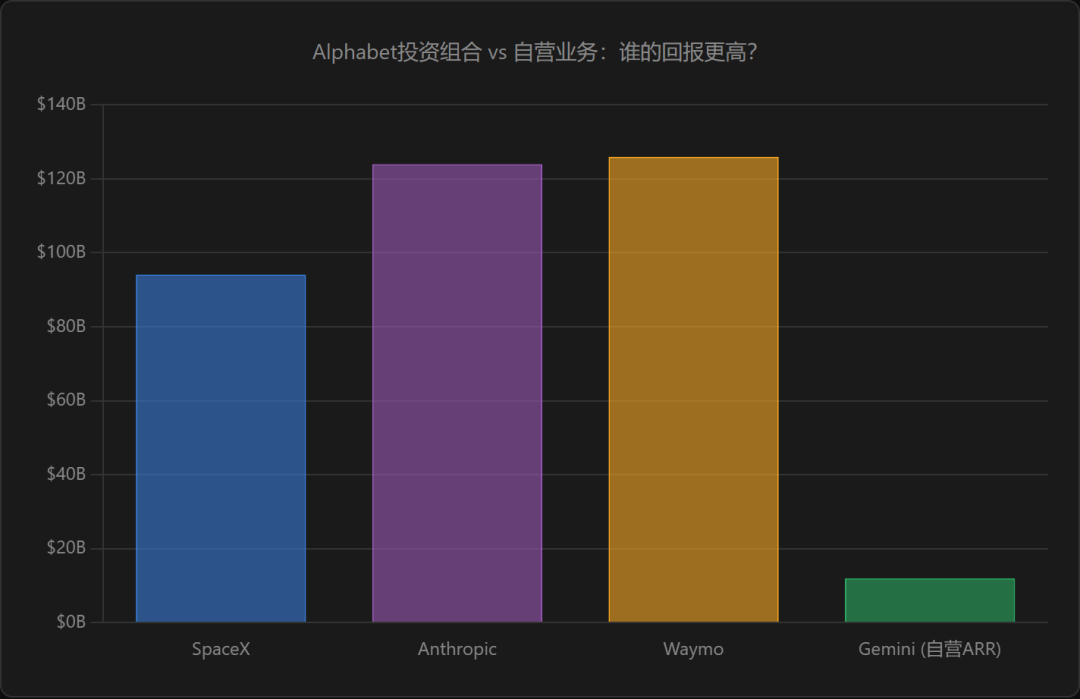
【Chart】chart3
V. Gemini Falls Out of Top 10, But Alphabet Ranks First
This is the full picture of "a Google without dreams":
Google LLC (operating company): Ads + Search are cash cows, GCP is the growth engine, and Gemini is... a product still releasing but no longer anticipated. Gemini 3.5 Pro is repeatedly delayed and never launched; Gemini 3.6 Flash ranks ~21st on Artificial Analysis's intelligence index, behind Muse Spark 1.2, Grok 4.5, and even multiple Chinese open-source models. DeepMind is no longer a cutting-edge lab.
Alphabet Inc. (holding company): Holds $94.1 billion in SpaceX, $124 billion in Anthropic, $126 billion in Waymo. Q2 2026 investment gains hit $98 billion, exceeding same-period $40.8 billion in operating profit. External equity investments exceed $50 billion. It has essentially become a top-tier venture fund with a search engine.
In Q2 2026, the $9.11 EPS can be broken down as follows: $2.85 comes from the “real” business, and $6.26 comes from investment gains. The market is valuing Google at only 17.75 times earnings—this is no longer a valuation for a growth stock but a signal that it is being priced as a value stock.
Is this reasonable?
From one perspective, it is extremely reasonable. If Alphabet’s AI strategy is not “to build the best model” but rather “to build the best AI infrastructure + hold stakes in the best AI companies,” then its moat is deeper than any single lab:
- No matter who wins the model race, they’ll need to buy TPUs—Google sells them.
- No matter who wins the model race, they’ll need cloud infrastructure—GCP provides it.
- No matter who wins the model race, Google holds its stock—directly sharing in the returns.
This is a “bet on all horses” strategy. Its advantage is that it’s almost impossible to lose, but its drawback is that it’s almost impossible to win the most beautifully.
But from another perspective, this strategy has a fatal hidden cost: talent. When the smartest people realize that Google is no longer pursuing AGI but instead chasing GCP’s profit margins, they will choose to leave. Shazeer is gone, Jumper is gone, Jeff Dean is gone. Who will be next?
As that article from TMTPost said: “In AI, the real moat has never been data, computational power, or even model architecture itself. It’s the people willing to stay and push the technological boundaries day after day. And what Google is losing is precisely those people.”
Conclusion
Google hasn't lost its dream. It has simply moved its dream from DeepMind's labs to Alphabet's investment portfolio.
From a P&L perspective, there's nothing wrong with this. In Q2 2026, investment gains were $98 billion, more than double the operating profit from its core business. A single investment in SpaceX returned 100x, and Anthropic's paper return is already 54x. Google may be Wall Street's savviest investor.
But from a technological belief perspective, this is surrender. A company that invented the Transformer, acquired DeepMind, and built a chatbot a year before OpenAI ultimately chose to sell computational power to its competitors
-
![]()
The $5 Billion Unicorn Behind ByteDance's Seedance Viral Phenomenon
-
![]()
The $5 Billion Unicorn Driving ByteDance’s Seedance to Global Stardom
-
![]()
Starting at 219,900 Yuan, Equipped with Huawei ADS 5 as Standard, Avita 07L Exudes Sincerity
-
![]()
Tech Titans Clash in AI-Driven Office Solutions, Leaving AI Smartphones in a Tight Spot
-
JD.com, Leveraging Government Subsidies, Officially Raises iPhone Prices: Apple's Strategic Pricing Moves
-
![]()
Is Google Losing Its Vision?
-
![]()
Tech Giants Compete in AI Office, AI Smartphones Face Embarrassment
-
![]()
Starlink V3: Musk’s Ambitious Vision to Construct a ‘Sky Net’ of 100,000 Satellites, Traditional Operators on High Alert