800V High-Voltage Platform Sees Rapid Growth, with Eight of Top 10 SiC Manufacturers Being Domestic
 08/12 2026
 536
536
During the era dominated by the 400V platform, IGBTs were the mainstream choice for main drives, with SiC being primarily utilized by Tesla. This choice contributed significantly to Tesla's reputation for energy efficiency.
By 2026, with the widespread adoption of the 800V high-voltage platform, the energy efficiency of Chinese electric vehicles is expected to rapidly improve. The voltage doubling and current halving capabilities of this platform, combined with SiC's low-loss and high-voltage resistance characteristics, make it an ideal match.
In 2025, SiC module shipments are projected to reach 3.199 million units, accounting for 16.9% of the total power module market of 18.879 million units. In the first half of 2026, 1.840 million units are expected to be sold, representing 26.8% of the 6.877 million-unit market. The share of SiC has surged by nearly 10 percentage points in just half a year, doubling within a year.
SiC represents growth, while IGBT remains the foundation (as noted in a previous article, in the first half of 2026, IGBT shipments will reach 5.037 million units, accounting for 73.2%). The window for SiC's volume increase coincides with the ramp-up of production capacity by domestic module manufacturers.
Part 1: Top 10 SiC Manufacturers in 1H 2026: UIC Leads, ST Falls to Second Place 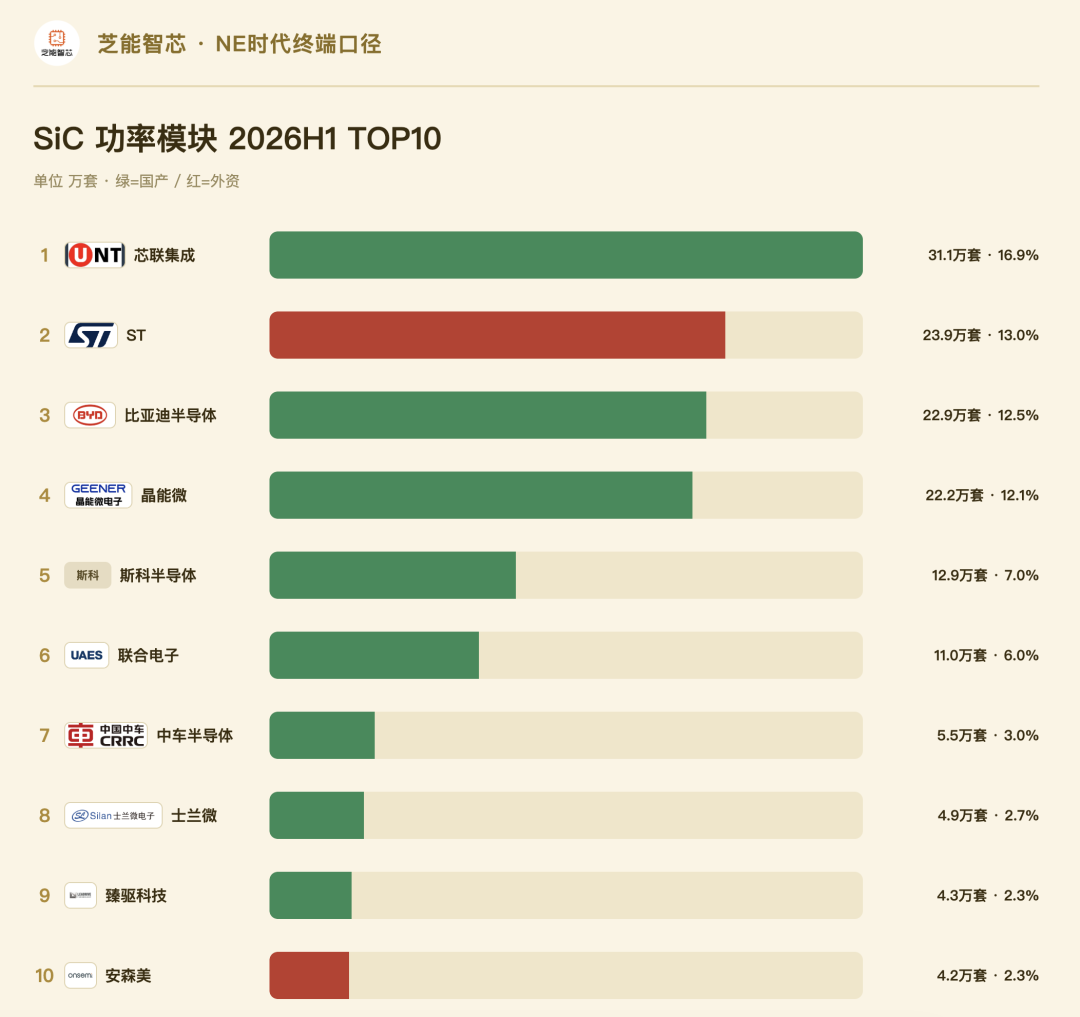
Top 10 SiC Manufacturers in the First Half of 2026:
◎ United Integrated Circuit (UIC) leads with 311,000 units (16.9%), having launched its Phase IV project;
◎ ST holds second place with 239,000 units (13.0%), continuing to increase its SiC production capacity;
◎ BYD Semiconductor ranks third with 229,000 units (12.5%), maintaining a stable core business;
◎ Jingneng Micro ranks fourth with 222,000 units (12.1%), operating three dedicated production lines at full capacity, emerging as the biggest dark horse in this period;
◎ Scorpio Semiconductor ranks fifth with 129,000 units (7.0%), with products from the Li Auto system starting to be used in vehicles since the i8;
◎ United Automotive Electronics (UAES) ranks sixth with 110,000 units (6.0%);
◎ CRRC Semiconductor ranks seventh with 55,000 units (3.0%);
◎ Silan Micro ranks eighth with 49,000 units (2.7%);
◎ ZQ Technology ranks ninth with 43,000 units (2.3%), having just signed a strategic cooperation memorandum with Volkswagen for power modules;
◎ Onsemi ranks tenth with 42,000 units (2.3%).
Among the top ten, eight are domestic manufacturers, with only ST and Onsemi being foreign. Domestic manufacturers account for 62.5% of the market, with no single dominant player.
The main suppliers can be divided into two categories: automakers and Tier 1 self-supply systems (BYD, UAES, ZQ Technology) and independent module manufacturers (UIC, Jingneng Micro, Scorpio Semiconductor, CRRC Semiconductor, Silan Micro).
In China, the cost of SiC is rapidly decreasing, prompting foreign manufacturers to quickly exit. Let's examine the situation over the past three years.
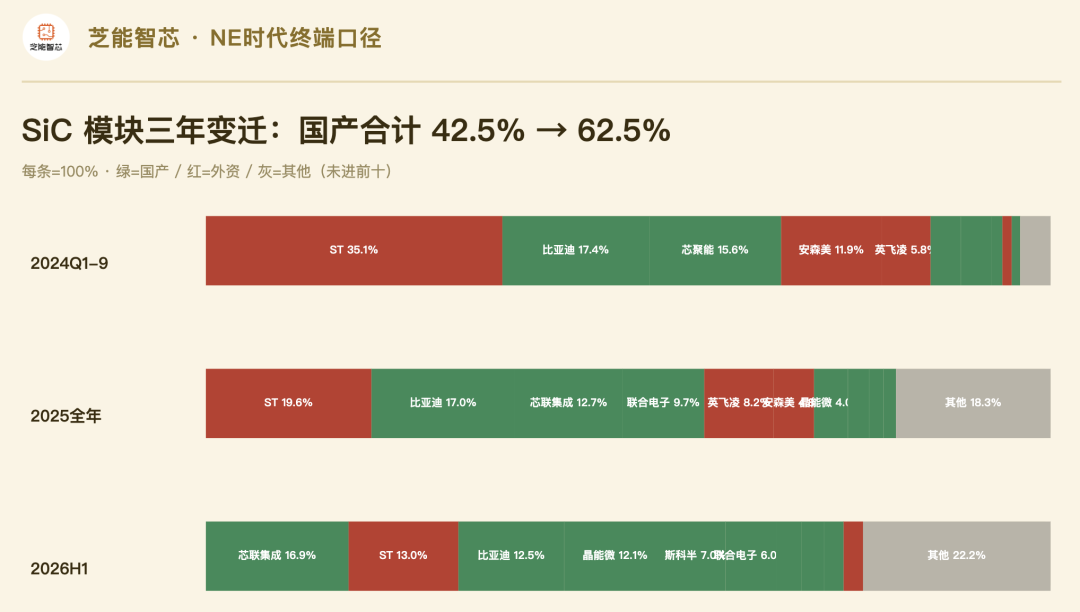
◎ Q1-Q3 2024: ST dominates the market, accounting for 35.1%, nearly equal to the combined share of the other two in the top three. Tesla's sales drive the use of ST's SiC modules. BYD ranks second with 17.4%, XP Power ranks third with 15.6%, and Onsemi ranks fourth with 11.9%. The combined share of the three foreign manufacturers is 52.8%, while the combined share of the top ten domestic manufacturers is 42.5%.
◎ Full Year 2025: ST's share is halved, and UIC enters the top three. ST's share drops to 19.6%, with an absolute volume of 627,000 units, but BYD (545,000 units, 17.0%) is close behind. UIC jumps from seventh to third (407,000 units, 12.7%), thanks to the mass production of China's first 8-inch SiC production line. The combined share of the top ten domestic manufacturers is 49.1%, surpassing foreign manufacturers for the first time.
◎ 1H 2026: UIC takes the lead, and domestic manufacturers account for more than half. UIC leads with 16.9%, while ST falls to second place with 13.0%. Jingneng Micro, Scorpio Semiconductor, CRRC Semiconductor, Silan Micro, and ZQ Technology all enter the top ten. The combined share of the top ten domestic manufacturers is 62.5%, foreign manufacturers account for 15.3%, and the long-tail manufacturers not in the top ten account for 22.2%.
Part 2: SiC in China: The Three-Year Journey of Localization Rate
The pace of SiC module localization is faster than that of overall power modules.
◎ The domestic share of overall power modules increased from 50.2% in 2022 to 73.2% in the first half of 2026, taking four and a half years;
◎ The combined share of the top ten domestic SiC manufacturers increased from 42.5% (Q1-Q3 2024) to 62.5% (1H 2026), taking only two years.
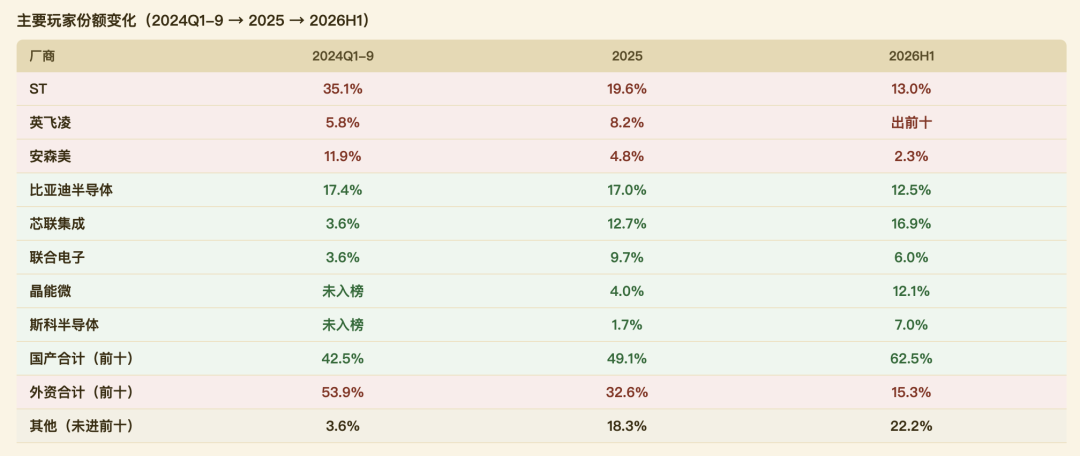
In 2025, the domestic share exceeded 50% (actually higher), and in the first half of 2026, it surged to over 60% (also higher).
◎ The rapid decrease in costs has prompted automakers to promote the dense (Note: The term "dense" may be a typographical error or missing context; it could refer to the "widespread" or "intensive" adoption) increase of 800V models. Even extended-range vehicles with large battery capacities are adopting 800V, leading to a surge in demand for SiC;
◎ Second, domestic manufacturers have bridged the gap in both chips and modules, with UIC and Jingneng Micro having independent production lines;
◎ Third, automakers are willing to give opportunities to domestic modules, with BYD, Li Auto (self-developed), and Geely (Jingneng Micro) all engaging in self-supply or strategic partnerships.
The reasons for foreign manufacturers falling behind are clear: they have the chips, but module packaging needs to align with the production line rhythm and customization needs of automakers, a layer where domestic manufacturers are closer. Infineon had an 8.2% share in 2025 but was not in the top ten in the first half of 2026. ST is still increasing its production capacity, but the loss of market share cannot be quickly recovered in the short term.
Summary
SiC power modules have completed in two and a half years the journey that took overall power modules much longer: from ST's dominance (35.1%) to eight domestic manufacturers sharing the market, with UIC taking the lead (16.9%).
The shift to 800V is accelerating, with the proportion of SiC doubling to 26.8% in one year, and the top ten domestic manufacturers reaching 62.5%. With the leader at only 16.9% and the long-tail at 22.2%, the market structure is not yet set, but the pace of this shift is clearly faster than that of IGBT in the past.
-
![]()
A Week with QianWen Office: The Highs and Lows
-
![]()
It's Time to Invest in China's Auto Industry
-
![]()
An AI Position with an Annual Salary of 1.7 Million Yuan Suddenly Becomes Highly Sought-After
-
![]()
Chevrolet and Skoda Exit China Before Mazda and Peugeot-Citroen
-
![]()
Zuckerberg's Concerns About Superintelligence: Who Holds the Power When the Technology Arrives?
-
![]()
Auto Scene Competition in Full Swing
-
![]()
Just Hit with a $1.4 Trillion Lawsuit, Meta Open-Sources Its 30B "Pocket Rocket" Overnight: Zuckerberg Calls Out DeepSeek, Qwen, Kimi
-
![]()
Samsung Z Fold 8 Ultra Review: A $2,100 Foldable Flagship—What Justifies the Price?