Zhong Shanshan and Wu Xiaobo Don’t Truly ‘Dislike’ E-commerce
 08/12 2026
 448
448

Both Seek to Redefine What Constitutes ‘Quality’ E-commerce
On August 8, Zhong Shanshan, the founder of Nongfu Spring, described e-commerce platforms as "overbearing intermediaries" on CCTV Finance's Dialogue. Two days later, financial writer Wu Xiaobo published an article titled Why I Disagree with Zhong Shanshan’s Perspective, arguing that Zhong had "diagnosed the problem but prescribed the wrong solution."
This sparked a public debate on the pros and cons of e-commerce.
Zhong’s reasoning is straightforward. He contends that e-commerce platforms, under the guise of "disintermediation," have merely replaced traditional middlemen with more dominant ones that control pricing and traffic distribution.
While traditional trading platforms maintain fixed fees, e-commerce platforms can dynamically adjust prices and manipulate traffic for each transaction. This "omnipresent intermediary," he argues, has decimated many urban retailers. He further claims that e-commerce price wars have undermined China’s real economy.

Wu Xiaobo concurs with Zhong’s critique of platforms’ opaque rules and their squeezing of supply chain profits. However, he disagrees on three key points: first, Zhong frames e-commerce as inherently adversarial to other business models; second, he portrays e-commerce and the real economy as opposing forces; third, he reduces consumer spending to mere "material consumption," treating e-commerce growth and urban economic prosperity as a zero-sum game.
Wu further argues that the real issues lie in the "decline of investigative journalism" and regulatory gaps.
On the surface, this is a debate about whether e-commerce is "overbearing." However, when viewed through the lens of China’s commercial history, Zhong and Wu’s positions reveal deeper implications than the debate itself.
01
Does Even ‘China’s Richest Man’ Fear Home Delivery?
Zhong’s criticism is not impulsive. Since late 2024, he has consistently voiced concerns about e-commerce platforms.
In November 2024, he criticized a platform’s pricing system in Ganzhou, Jiangxi, calling it "a significant threat to Chinese brands and industries." In early 2025, he posted three WeChat updates condemning "the four major e-commerce platforms" as "economic meat grinders" and "exploiters of small merchants." In April 2025, he claimed that "farmers nationwide and the entire traditional industry are working for internet platforms."
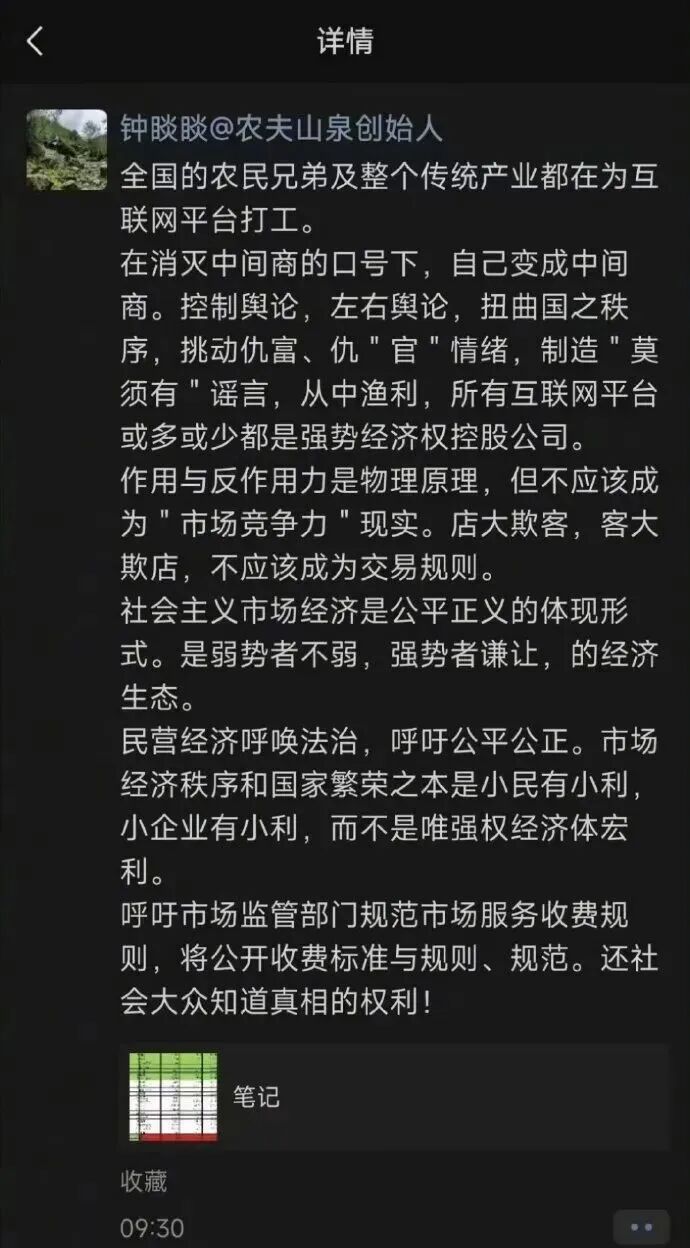
With each statement, his rhetoric intensified—from "threat" to "meat grinder" to "working for platforms"—reflecting growing emotional urgency but consistent concern over the erosion of offline channels’ survival space.
This concern is deeply tied to his business empire. Nongfu Spring’s revenue primarily comes from its offline distributor network, which has been disrupted by e-commerce.
According to Nongfu Spring’s prospectus, from 2017 to 2019 and the first five months of 2020, revenue from distributor sales accounted for 95%, 94.6%, 94.2%, and 93.6% of total revenue, respectively.
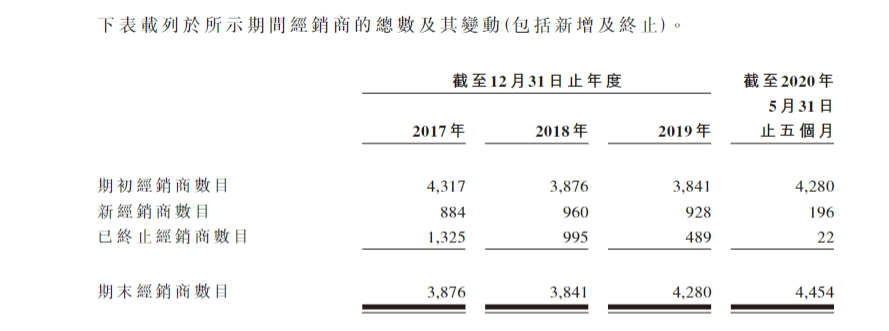
By the end of May 2020, Nongfu Spring had reached over 2.43 million retail outlets nationwide through 4,454 distributors. Guotai Junan Securities reported that by the end of 2023, the number of distributors had grown to around 5,000, with over 3 million outlets.
Zhong explicitly demanded that e-commerce sales not exceed 5% of total revenue. "Otherwise, how will small offline stores survive? What will their owners sell?" The 2025 financial report showed Nongfu Spring’s annual revenue at RMB 52.553 billion, with 95% from offline distributors and e-commerce strictly capped at around 5%, far below the beverage industry’s average online penetration rate of 14.1%.
This offline network, built over three decades, spans urban convenience stores to rural kiosks. Its 3 million outlets form Nongfu Spring’s strongest competitive advantage. E-commerce’s rise not only alters a channel but threatens the foundation of this commercial structure.
From one perspective, Zhong’s concerns are valid.
Since 2026, major regulatory actions against platform economy abuses have surged: in April, the State Administration for Market Regulation fined seven e-commerce platforms RMB 3.597 billion; in June, Huolala was ordered to address antitrust violations and refund RMB 120 million in unreasonable fees to drivers; in July, Ctrip was fined RMB 5.179 billion for abusing market dominance.
These cases collectively highlight how the platform economy, in its rapid expansion, has deviated from its original purpose.
From another angle, e-commerce platforms have created immense value. They broke geographical and temporal barriers, enabling agricultural products from remote regions to reach consumers nationwide and providing low-barrier entrepreneurship opportunities for countless small businesses and individual entrepreneurs.
According to Frost & Sullivan, from 2014 to 2019, China’s soft drink market’s e-commerce channel CAGR was 12.9%, far exceeding traditional channels’ 3.5%. Emerging channels like e-commerce contributed to overall market growth, similar to how Walmart and Amazon achieved new heights together globally.
This explains Zhong’s persistent and intense criticism of e-commerce. He is not advocating for an abstract "real economy" but defending his core business. In 2026, ByteDance founder Zhang Yiming retained his title as China’s richest man with RMB 543.9 billion, while Zhong ranked second with RMB 441.6 billion. The shifting fortunes between these two wealth-creation models may be more persuasive than any theoretical analysis.
Zhong does not dislike e-commerce itself but resents the world it is dismantling—the old commercial order built on multi-tier distribution, information asymmetry, and channel barriers, where Nongfu Spring was once a dominant player.
02
One Criticizes Platforms for Stealing Business, the Other for Their Lack of Rules
As a renowned financial writer, Wu Xiaobo himself benefits from the internet content economy. Since launching his WeChat public account in 2014, he has built a business model centered on knowledge payment and content distribution.
His writings on China’s commercial history, from "Canned Goods for Airplanes" in the early reform era to the pain of SOE restructuring in the 1990s, rely on internet dissemination.
Wu’s critique of Zhong highlights a missing "future narrative" in Zhong’s arguments. Zhong frames e-commerce and offline retail as a zero-sum game.
However, Wu argues that China’s Engel coefficient continues to decline, while demand for cultural experiences rises. Future consumption growth will emerge from incremental markets centered on culture, entertainment, and health, not from competing for shares of the existing material consumption pie.
This reflects a deeper disagreement over "where growth comes from." Zhong sees a zero-sum struggle for existing markets, with e-commerce stealing business from offline retail. Wu sees value creation through technology platforms fostering new consumption patterns and market spaces.
Neither is wrong; they simply operate on different time horizons. Zhong focuses on the present, observing channel shifts, while Wu looks to the future, anticipating structural consumption changes.
Yet Wu is not an unconditional defender of e-commerce platforms. He explicitly agrees with criticisms of super-platforms’ opaque rules and supply chain profit compression, stating that "reform is long overdue."
He proposes two solutions: first, strengthening public oversight and institutional regulation under the rule of law; second, fostering "dragon-slaying youths" through revolutionary technological innovation.
These points address the core issue—not whether to have e-commerce, but how to ensure it operates within rules. Wu believes Zhong "offers no constructive improvements," identifying the problem but prescribing the wrong solution.
This aligns with Zhong’s commercial identity. As a beneficiary of traditional channels, Zhong’s criticism is defensive, aiming to protect his three-decade-old empire.
Wu, as a content economy beneficiary and observer, adopts a "third-party" perspective, neither siding with traditional channels nor fully with platforms, but advocating for "rules."
In this sense, neither Zhong nor Wu truly "dislikes" e-commerce. One defends existing markets; the other calls for rules. Their disagreement reflects the clash of two business logics during a transitional period.
Coincidentally, significant regulatory changes occurred around this debate. In July 2026, the State Administration for Market Regulation and the Ministry of Commerce drafted the E-Commerce Law (Amendment Draft for Solicitation of Comments).
The amendment raised the maximum penalty for certain fixed fines from RMB 2 million to RMB 5 million and introduced a "proportional fine" mechanism, allowing penalties of up to 5% of a company’s previous year’s revenue for particularly severe violations.
That same month, six ministries, including the Ministry of Commerce, issued Guidelines on Better Serving the Real Economy to Promote High-Quality E-Commerce Development, urging platforms to "regulate and optimize fee structures for merchants."
These policy moves indicate that regulators are addressing Zhong’s concerns not by "restricting" platforms but by "regulating" them.
E-commerce eliminated middlemen only to become new ones—this judgment holds. However, even without e-commerce, another set of rules would operate within institutional frameworks.
Zhong resents the force eroding his 3 million outlets; Wu alerts against reducing complex commercial issues to adversarial narratives. Their disagreement reflects two approaches to uncertainty: one emphasizes external control, the other self-evolution.
History often provides answers somewhere in between.
- END -
-
![]()
A Week with QianWen Office: The Highs and Lows
-
![]()
It's Time to Invest in China's Auto Industry
-
![]()
An AI Position with an Annual Salary of 1.7 Million Yuan Suddenly Becomes Highly Sought-After
-
![]()
Chevrolet and Skoda Exit China Before Mazda and Peugeot-Citroen
-
![]()
Zuckerberg's Concerns About Superintelligence: Who Holds the Power When the Technology Arrives?
-
![]()
Auto Scene Competition in Full Swing
-
![]()
Just Hit with a $1.4 Trillion Lawsuit, Meta Open-Sources Its 30B "Pocket Rocket" Overnight: Zuckerberg Calls Out DeepSeek, Qwen, Kimi
-
![]()
Samsung Z Fold 8 Ultra Review: A $2,100 Foldable Flagship—What Justifies the Price?