Rocket Lab: Neutron Launch May Be Postponed. How Can RKLB Compete with SpaceX?
 08/12 2026
 431
431
Rocket Lab released its financial report for the second quarter of 2026 after the close of the U.S. stock market on the morning of August 10 (Beijing Time). The quarterly performance was solid, but the guidance for the next quarter fell significantly short of market expectations for gross margin and Adjusted EBITDA. Details are as follows:
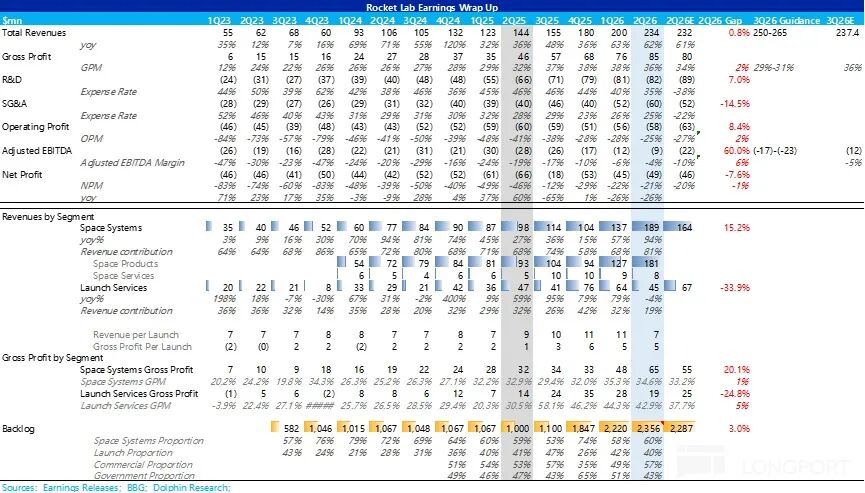
① Total Revenue Slightly Exceeds Expectations: In Q2, Rocket Lab's total revenue reached $230 million, up 62% year-over-year, slightly surpassing market expectations. A breakdown is as follows:
a. Space Systems revenue was $189.5 million, up 94% year-over-year, with accelerated growth driven by two main factors:
Firstly, satellite manufacturing contracts entered a peak delivery period, with significant revenue increases recognized under the percentage-of-completion method (over time) for large long-term contracts, such as SDA Tranche II and Tranche III. These individual projects are substantially larger than component sales, directly driving accelerated revenue growth for this segment.
Secondly, the company completed two strategic acquisitions—Mynaric and Motiv—and included them in the consolidated financial statements for this quarter. Mynaric (laser communication terminals) contributed $13 million in incremental revenue for the quarter while filling a supply chain gap in core communication components for satellite constellations.
b. Rocket launch services revenue was $45 million, down 4% year-over-year, marking the beginning of negative growth:
Although the number of launches increased from 5 to 6 year-over-year, revenue recognition methods dragged down performance. This quarter included two HASTE suborbital hypersonic test missions (revenue recognized under the percentage-of-completion method, with most revenue already confirmed in earlier periods), while ordinary Electron missions in the same period last year used the successful launch recognition method (full revenue recognized at launch). This resulted in a diluted average revenue per launch (decreasing from $9.3 million to $7.4 million).
② Quarterly Gross Margin Exceeds Expectations but Shows Structural Pressure: In Q2, Rocket Lab's overall gross margin was 36%, down 2 percentage points sequentially but higher than the market expectation of 34%. The sequential decline was primarily due to changes in the revenue mix:
a. Revenue Mix Impact: The proportion of low-margin Space Systems revenue increased by 13 percentage points sequentially to 81%, while the proportion of high-margin launch revenue declined.
b. Space Systems gross margin declined sequentially due to an increased proportion of low-margin satellite platform business: In Q2, the Space Systems gross margin was 34.6%, down 0.7 percentage points sequentially, mainly because accelerated deliveries of satellite platform projects (SDA Tranche II/III low-Earth orbit constellations) significantly increased their revenue share.
The project gross margin for satellite platforms is approximately 30%, far lower than high-margin component businesses (reaction wheels, star trackers, satellite separation systems, etc., some exceeding 70%), directly pulling down the segment's overall profitability.
Additionally, Mynaric (laser communication terminals), consolidated in Q2, faced supply chain bottlenecks and had undergone bankruptcy restructuring before the acquisition. Its gross margin was low in the initial post-acquisition period. Referring to SolAero's integration experience, margin recovery will take several quarters.
c. Launch services gross margin also declined sequentially: In Q2, the launch services gross margin was 42.9%, down 1.5 percentage points sequentially, mainly affected by the revenue recognition rhythm of HASTE suborbital missions—HASTE has a relatively low gross margin, and the proportion of revenue recognized under the percentage-of-completion method was low this quarter, pulling down the overall gross margin.
③ Expenses Remain Rigidly Expansive to Support Future Acceleration: R&D expenses increased by 25% year-over-year to $82 million this quarter, primarily because the Neutron medium-lift launch vehicle entered a critical verification phase before its maiden flight. Work on first-stage assembly, second-stage integration, over 400 hot-fire tests of the Archimedes engine, and fairing tests progressed comprehensively, significantly increasing related engineering personnel salaries and testing expenses year-over-year.
Selling, general, and administrative (SG&A) expenses increased by 50% year-over-year to $60 million, mainly due to the simultaneous advancement of multiple acquisition projects, including Iridium, Mynaric, and Motiv, incurring substantial one-time transaction costs for legal, due diligence, and financial advisory services.
④ Operating Profit and Adjusted EBITDA Exceed Expectations: Supported by absolute revenue and gross margin in the quarter, despite rigid expenses, operating profit was -$58 million, still higher than the expected -$63 million. The operating profit margin also improved by 3 percentage points sequentially to -25%.
⑤ Backlog Continues to Increase Sequentially: In Q2, Rocket Lab's backlog reached $2.4 billion, with approximately 40% ($940 million) from launch services orders and 60% ($1.42 billion) from space systems orders. Currently, 45.5% of the backlog ($1.09 billion) is expected to be recognized as revenue within the next 12 months, with the remaining 54.5% to be realized after 12 months.
New contracts signed in Q2 and post-quarter totaled over $1 billion, including $437 million in new launch contracts and $581 million in new space systems contracts. A breakdown is as follows:
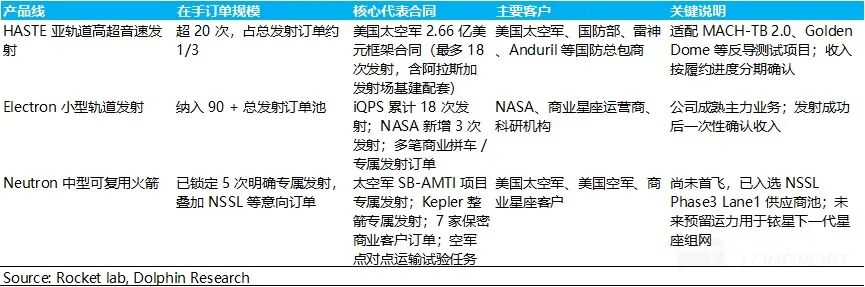
a. Launch Services: 26 new launch contracts were signed in Q2, bringing the post-quarter backlog to over 90 launches, a historical high.
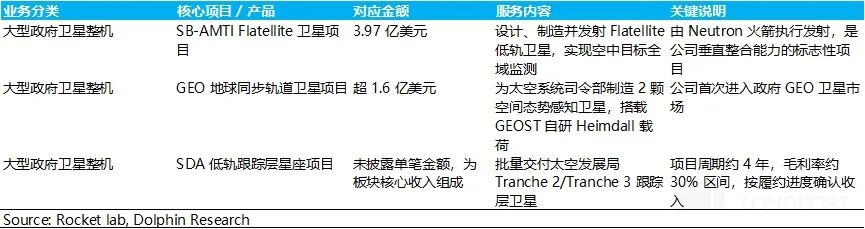
b. Space Systems: New contracts signed in Q2 and post-quarter totaled $581 million, including a $397 million Space Force SB-AMTI space-based air target monitoring project and a contract worth over $160 million to build three GEO satellites.
⑥ Q3 2026 Gross Margin and EBITDA Guidance Significantly Miss Expectations, Declining Sequentially:
The Q3 2026 gross margin guidance (GAAP 29%-31%) was substantially lower than the expected 36%, primarily due to large-scale whole-satellite manufacturing projects such as SDA Tranche II/III entering peak delivery periods in Q3, further increasing the proportion of low-margin revenue.
Newly signed GEO satellite and Flatelite projects are in the initial delivery stages, with additional costs from production ramp-up and process optimization. Combined with a relative decline in the weight of high-margin launch business, this has structurally dragged down the overall gross margin.
With gross margin significantly below expectations, the adjusted EBITDA guidance is -$17 million to -$23 million, also lower than the expected -$12 million. The Adjusted EBITDA margin is expected to decline sequentially by 2-5 percentage points to -6% to -9%.
Overall, Rocket Lab's Q2 performance was acceptable, with revenue, profit, and backlog slightly exceeding expectations. However, guidance for the next quarter significantly missed market expectations for gross margin and Adjusted EBITDA, mainly due to an increased proportion of low-margin whole-satellite manufacturing projects, new GEO satellite and Flatelite projects in the initial ramp-up phase, and a possible further decline in the revenue share of high-margin launch business.
For Rocket Lab, the company is following multiple aspects of SpaceX's development path: expanding rocket capacity (Neutron medium-lift reusable rocket), advancing first-stage reusability technology, and directly owning a ready-made proprietary satellite constellation through the acquisition of Iridium (a model comparable to Starlink), ultimately achieving a closed-loop of "launch—manufacturing—operations."
Details are as follows:
① Neutron is Expected to Make Its Maiden Flight in Q4 2026 but Faces Delay Risks
Neutron is RKLB's key to transitioning from a "small rocket provider" to a "SpaceX challenger." Its core goal is to rival SpaceX's Falcon 9 by achieving first-stage reusability (13-ton LEO capacity vs. F9's ~23 tons) and represents the largest variable in the valuation framework—Neutron's execution risk directly impacts the stock price.
Regarding the maiden flight timeline, Neutron has experienced two delays: originally scheduled for Q4 2025 → Q1 2026 → currently targeted for Q4 2026, with the company aiming to complete the maiden flight within 2026. With only about 4.5 months remaining until year-end, the launch window is objectively narrowing.
In January 2026, Neutron's first-stage tank ruptured during hydrostatic pressure qualification testing, traced to a manufacturing defect caused by a third-party's manual layering process. The company seized this opportunity to transition all subsequent tank manufacturing to internal automated fiber placement (AFP) equipment, eliminating manual manufacturing defects and paving the way for future large-scale production. The AFP process significantly shortens production cycles, with the second vehicle incurring only material-related variable costs without additional personnel or capital investments.
Behind this delay lies the company's strategy of actively balancing maiden flight progress with production readiness—not solely pursuing the earliest maiden flight but striving for Neutron to achieve full-scale production and high-frequency launch capability upon its maiden flight.
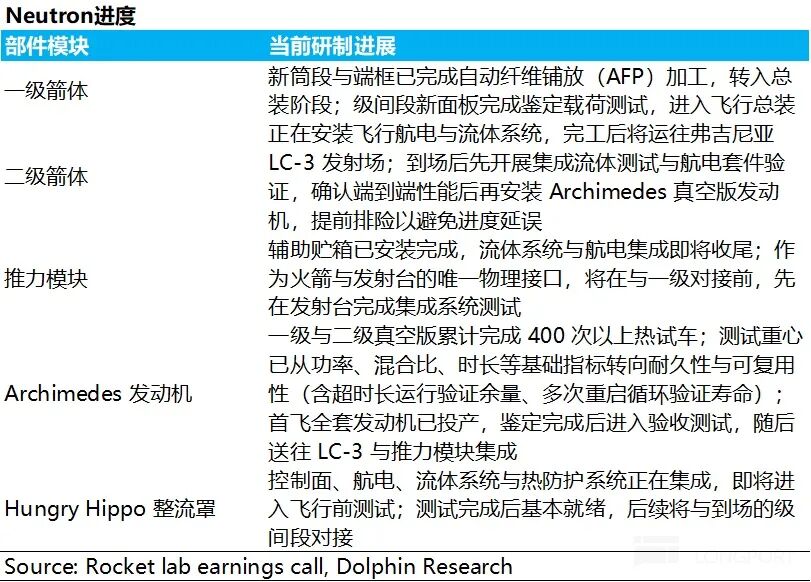
Transitioning tank production from manual to automated reduces quality risks and per-unit manufacturing costs in the long run. Meanwhile, this setback provided more testing time for other core components (Hungry Hippo fairing, second-stage vehicle, Archimedes engine).
As of the end of Q2 2026, all Neutron flight hardware had entered final assembly and integration. The Archimedes engine completed over 400 hot-fire tests, new first-stage tanks (AFP process) were being produced as planned, and second-stage vehicles and fairings were nearing integration completion. Management stated that the overall progress supports the Q4 delivery-to-launch-pad target, but the year-end launch window is narrowing, with delay risks hinging on subsequent first-stage qualification testing and final full-vehicle integration results.
② Acquisition of Iridium: Enabling Full Value Chain Integration from "Launch—Manufacturing—Application" and Establishing Differentiated Competition in Space Applications
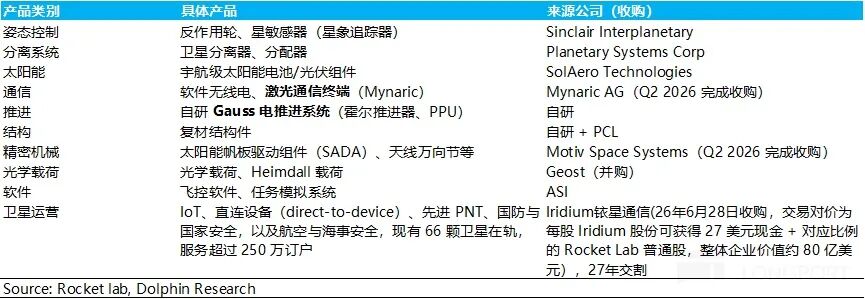
Through successive acquisitions of Motiv (space robotics), Mynaric (laser communications), and Iridium (Iridium Communications), combined with its self-developed electric propulsion systems, Rocket Lab has completed key pieces in three major segments of the space value chain (access to space/launch + space hardware manufacturing + space applications). Rocket Lab has officially become one of only two global players with both high-frequency commercial launch and large-scale satellite manufacturing/operations capabilities.
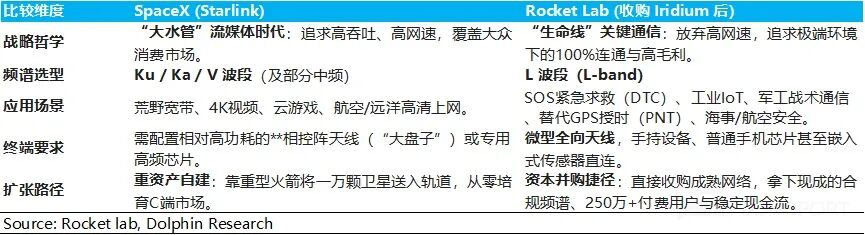
Iridium's L-band spectrum represents a "golden scarce resource" in the global electromagnetic spectrum. Although its data transmission rates range from Kbps to Mbps (not optimized for high-definition video broadband), it offers strong weather penetration (rain fade resistance), zero-angle pointing requirements, and omnidirectional connectivity. These physical attributes—prioritizing absolute stability over high bandwidth—make it a lifeline in extreme environments where connectivity cannot be interrupted, forming precise differentiated competition with SpaceX Starlink's high-bandwidth consumer broadband market.
Applications comprehensively cover industrial IoT, direct-to-cell (DTC/D2D) devices, advanced PNT (timing and positioning), defense and national security private networks, and civil aviation and maritime safety communications.
Building a low-Earth orbit constellation from scratch and obtaining global spectrum licenses typically takes over a decade. This acquisition represents a strategic shortcut for Rocket Lab to bypass the "high-risk, capital-intensive network construction phase"—directly incorporating 66 in-orbit satellites, over 2.5 million high-retention subscribers, exclusive global spectrum licenses, and nearly $870 million in high-repeat annual revenue. The mature business's cash-generating capability will support R&D for the medium-lift Neutron rocket and next-generation satellite platforms.
The transaction is progressing through the Conventional delivery process (regular closing procedures), including Iridium shareholder approval and regulatory reviews, with completion expected by mid-2027. The current focus is on business integration planning and future growth roadmap deployment.
Additionally, the success of Neutron's reusable technology will directly reduce deployment costs for the Iridium constellation.
Regarding Rocket Lab's stock price, Dolphin Research presents three scenarios:
Management's Long-Term Targets: Rocket Lab's management expects the business to scale to: Electron rocket revenue growing to $500 million-$1 billion within 3-5 years; Neutron rocket revenue reaching $1 billion; and the company targeting nearly 30 Electron launches in 2026.
The management also pointed out that the business scale of the space system will still be larger than that of the launch business, with a long-term revenue share of approximately 55%-60% (currently, the space system accounts for about 68% in 26Q1, and is expected to further increase to about 81% in 26Q2).
Neutral Assumption: We assume that the Electron will contribute $530 million in revenue by 2030, the test flight and development of the Neutron will proceed as expected, contributing $900 million in revenue, and the space system business will grow at a CAGR of 40% to approximately $2.6 billion by 2030, totaling approximately $4.1 billion in total revenue for 2030.
Assumption with a Pessimistic Outlook: Our projection indicates that Rocket Lab's total revenue will hover around $2.6 billion by 2030. This estimate encompasses $600 million from its rocket business, reflecting a decelerated growth trajectory for the Electron rocket and potential setbacks such as a delayed maiden flight or a launch frequency for the Neutron rocket that falls short of expectations. The remaining $2 billion is anticipated to stem from the space system business, assuming a 30% Compound Annual Growth Rate (CAGR). This growth projection, however, factors in potential delays associated with the Neutron rocket and a gradual constellation deployment pace.
Assumption with an Optimistic Outlook: We anticipate that Rocket Lab's total revenue will soar to $5.7 billion by 2030. This optimistic scenario hinges on the Neutron rocket successfully achieving first-stage reusability, thereby expediting constellation deployment within the space system business. This advancement is expected to slash constellation launch costs, paving the way for a Starlink-esque space Software as a Service (SaaS) model. However, Rocket Lab aims to differentiate itself from SpaceX's Starlink by catering to scenarios demanding absolute stability and uninterrupted connectivity, albeit with relatively moderate to low internet speeds, as opposed to SpaceX's high-bandwidth offerings.
Consequently, for Rocket Lab, the Neutron rocket represents the linchpin of its valuation "option." The company has set a target to transport the rocket to the launch pad by the fourth quarter of 2026 (within the calendar year), albeit acknowledging the potential for delays contingent on testing progress. Any postponement in launches will diminish the value of this option, potentially triggering a retreat in stock prices.
In the meantime, the Chief Financial Officer (CFO) has articulated that following the Neutron's inaugural successful test flight, the company expects its Adjusted Earnings Before Interest, Taxes, Depreciation, and Amortization (EBITDA) to turn positive in the subsequent quarter. However, it will require an additional 18-24 months for free cash flow to follow suit, as the company must continue to manufacture subsequent rocket stages in advance and bolster its launch inventory. The maiden flight's success will directly dictate the future profitability turning point.
At present, the Neutron's primary risks are concentrated on engineering execution—comprehensive stage testing, the inaugural ignition post-full fueling, and the ultimate integration of the engine and avionics systems all represent high-stakes milestones. On the demand front, the outlook is relatively clear: both commercial and defense clients have placed substantial orders to bolster the Neutron, with the company having already secured five launch orders in advance. The Neutron's foremost challenge lies in demonstrating "timely flight capability" rather than securing buyers. The potential delay risks unveiled during this conference call are poised to exert short-term pressure.
- END -
// Reprint Authorization
This article constitutes an original work by Dolphin Research. Reprinting necessitates obtaining prior authorization.
// Disclaimer and General Disclosure Notice
This report is crafted solely for general comprehensive data purposes, catering to the general viewing and data referencing needs of Dolphin Research users and its affiliated entities. It does not account for the specific investment objectives, investment product inclinations, risk tolerance levels, financial circumstances, or unique needs of any individual recipient. Investors are urged to consult with independent professional advisors prior to making investment decisions based on this report. Any individual making investment decisions predicated on the content or information referenced herein assumes the associated risks. Dolphin Research disclaims any liability for responsibilities or losses that may directly or indirectly arise from the utilization of the data contained within this report. The information and data herein are derived from publicly accessible materials and are intended for reference purposes only. Dolphin Research endeavors to ensure, but does not guarantee, the reliability, accuracy, and completeness of the pertinent information and data.
The information or viewpoints expressed in this report may not be utilized or interpreted as an offer to sell or a solicitation to purchase securities in any jurisdiction. They do not constitute recommendations, inquiries, or endorsements of relevant securities or associated financial instruments. The information, tools, and materials contained in this report are not intended for distribution to jurisdictions where such distribution, publication, provision, or utilization would contravene applicable laws or regulations, or result in Dolphin Research and/or its subsidiaries or affiliated companies being subject to any registration or licensing requirements in such jurisdictions, or to citizens or residents thereof.
This report solely reflects the personal perspectives, insights, and analytical methodologies of the relevant authors and does not represent the stance of Dolphin Research and/or its affiliated institutions.
This report is produced by Dolphin Research, with copyright exclusively vested in Dolphin Research. Without the prior written consent of Dolphin Research, no institution or individual may (i) create, copy, reproduce, duplicate, forward, or generate any form of copies or replicas in any manner, and/or (ii) directly or indirectly redistribute or transfer them to other unauthorized individuals. Dolphin Research reserves all pertinent rights.
-
![]()
A Week with QianWen Office: The Highs and Lows
-
![]()
It's Time to Invest in China's Auto Industry
-
![]()
An AI Position with an Annual Salary of 1.7 Million Yuan Suddenly Becomes Highly Sought-After
-
![]()
Chevrolet and Skoda Exit China Before Mazda and Peugeot-Citroen
-
![]()
Zuckerberg's Concerns About Superintelligence: Who Holds the Power When the Technology Arrives?
-
![]()
Auto Scene Competition in Full Swing
-
![]()
Just Hit with a $1.4 Trillion Lawsuit, Meta Open-Sources Its 30B "Pocket Rocket" Overnight: Zuckerberg Calls Out DeepSeek, Qwen, Kimi
-
![]()
Samsung Z Fold 8 Ultra Review: A $2,100 Foldable Flagship—What Justifies the Price?