The Wealthiest Individual Critiques E-commerce: 'Championing the People' or 'Falling Prey to Business Theft?'
 08/12 2026
 554
554
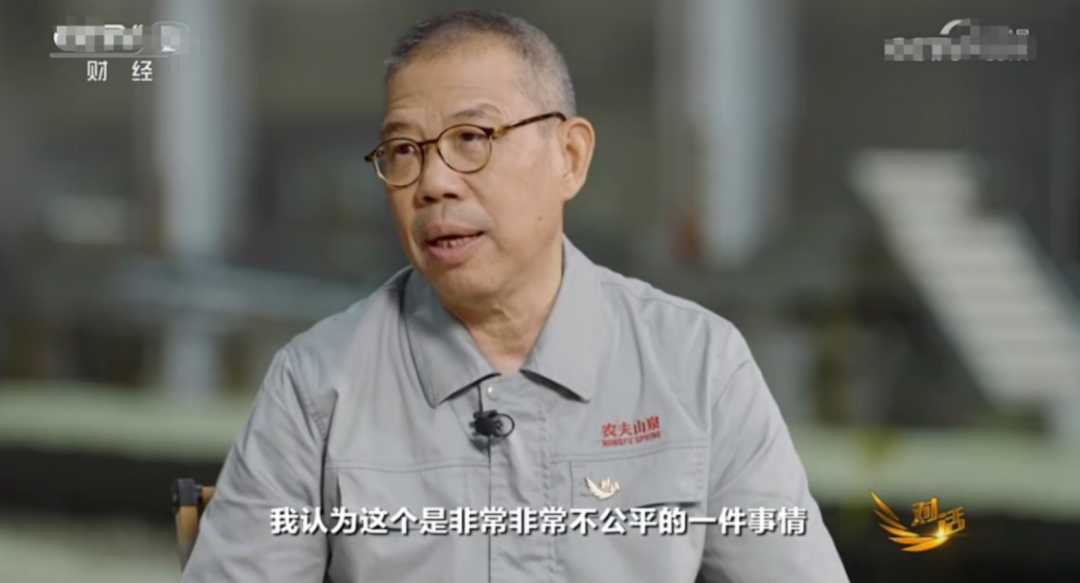
On August 8, Zhong Shanshan, the founder of Nongfu Spring, made another appearance on CCTV Finance's 'Dialogue' program. The 71-year-old former richest man in China once again took aim at e-commerce platforms.
He argued that e-commerce platforms, under the guise of 'eliminating intermediaries,' have not only eradicated traditional middlemen but have themselves become 'even more dominant intermediaries,' exerting control over pricing and traffic distribution. He claimed that these platforms have 'decimated numerous urban retailers.' Furthermore, he contended that e-commerce has drawn young people into their screens, stifling offline emotional engagement and creativity. Finally, he asserted: 'We must rein in platform power through regulations and laws.'
Once the program aired, the internet was abuzz. Supporters exclaimed, 'Finally, a mogul dares to speak the truth,' while critics retorted, 'Doesn't Nongfu Spring also sell on Tmall and JD.com?'
This controversy extends beyond the richest man simply 'championing the people'.


Six Volleys in Two Years, Each More Forceful Than the Last
A review of Zhong Shanshan's timeline of 'critiquing' e-commerce reveals that this is not a spontaneous outburst but a sustained two-year 'targeted campaign'.
In November 2024, while in Ganzhou, Jiangxi, he lambasted e-commerce pricing systems as 'a colossal detriment to Chinese brands and industries' and vowed to 'never engage in live-stream sales.'
In December 2024, he stated that true agricultural support should hinge on industrialization, not the illusion of 'bestsellers' created by traffic.
In January 2025, he bluntly stated on CCTV's 'Dialogue' that 'the internet's relentless pursuit of low prices is undermining China's economy.'
That same month, he posted three consecutive WeChat Moments, branding the 'four major e-commerce platforms' as 'the meat grinder of China's economy' and 'the Zhou Bapi of small and medium-sized businesses.' (Note: 'Zhou Bapi' is a derogatory term for exploitative landlords.)
In April 2025, he wrote that 'farmers nationwide and the entire traditional industry are toiling for internet platforms.'
By August of this year, it marked the sixth volley in two years, with rhetoric escalating from criticism to a policy call for 'reining in power'.
Each time, his language grew more pointed, and his stance more resolute.
Why Him? Because E-commerce Threatens His 'Lifeblood'
Netizens' skepticism is direct: 'Nongfu Spring has official flagship stores on Tmall, JD.com, and Douyin, so why criticize e-commerce?'
The answer lies in Nongfu Spring's business model.
Nongfu Spring's core competitiveness has never been solely about the taste of its products—how different can water be? Its strength lies in its offline distribution channel, cultivated over two decades. Currently, Nongfu Spring boasts around 5,000 distributors covering over 3 million offline retail outlets. Nearly 80% of its market is in third-tier and lower cities, with small family-run stores and shops forming the backbone of its sales network.
This system thrives on brand premium and regional price differentials. The margin between distributor purchase prices and retail prices sustains the entire channel.
But what have e-commerce platforms done? They've facilitated price comparisons across all channels. Once prices become transparent nationwide, distributors are compelled to dump inventory at low prices, systematically eroding brand premiums. Worse, e-commerce platforms can manipulate prices, allocate traffic, and intervene in the profit margins of every transaction at will. Traditional intermediary commissions are transparent, but platform commissions are concealed in advertising fees, promotion fees, and traffic bidding, leaving merchants uncertain of their profits post-sale.
Thus, Zhong Shanshan set a red line for e-commerce sales as a proportion of total revenue—no more than 5%. The 2025 financial report explicitly states: 'By controlling the proportion of e-commerce channel sales, we have stabilized pricing order in the distribution system.'
In simpler terms: E-commerce is encroaching on my offline channel's market share, and I must defend it.
This is not 'championing the people' but a reasonable counterattack after his business was threatened. It's just that he has framed his personal interests as 'advocating for the real economy.'
Has Nongfu Spring's 'Anti-E-commerce' Strategy Paid Off?
Let's examine some key data.
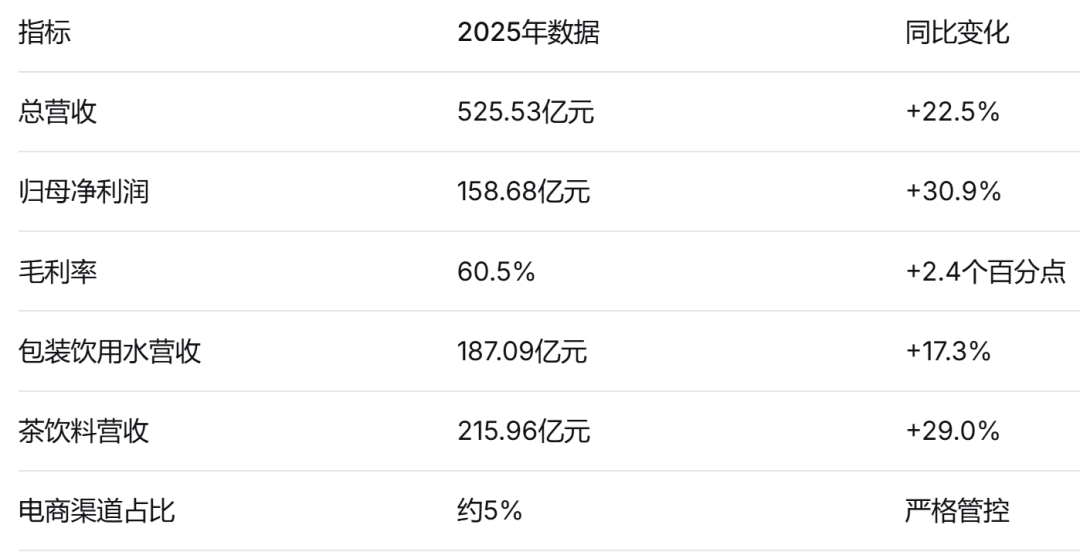
Data Source: Nongfu Spring's 2025 Financial Report
The report is impressive. Revenue surpassed 50 billion yuan for the first time, net profit grew by over 30%, and gross margin returned to above 60%. Nongfu Spring even surpassed Tingyi (Master Kong) to become China's top beverage company.
But this stellar performance underscores Zhong Shanshan's 'positional bias' when critiquing e-commerce.
Nongfu Spring's success stems precisely from its strict adherence to the '5% red line'—avoiding online price wars, not participating in e-commerce discounting, and fully protecting offline channel profit margins. Its high growth is built on a differentiated strategy of 'rejecting e-commerce involvement.' In other words, Nongfu Spring's success is the success of an 'anti-e-commerce model,' not the success of the entire industry.
If all Chinese companies limited e-commerce to 5% of sales, where would today's nearly 16 trillion yuan in online retail volume come from?
Zhong Shanshan is speaking from his own commercial interests, which is understandable. However, framing personal interests as universal values and commercial strategies as moral stances is somewhat hypocritical.
Wu Xiaobo's Rebuttal: 'Diagnosed the Illness, Prescribed the Wrong Medicine'
Business writer Wu Xiaobo responded two days after Zhong's program aired, stating that while he agreed with 70-80% of Zhong's points—such as criticism of platforms' 'black box' rules and compression of supply chain profits—'he diagnosed the illness but prescribed the wrong medicine.'
Wu disagreed on three core points:
First, Zhong frames e-commerce and offline retail as an 'us vs. them' conflict. This is factually incorrect and unproductive. With sluggish domestic demand today, treating e-commerce as the 'imagined enemy' of offline retail only fosters ineffective emotional venting.
Second, Zhong pits e-commerce against the real economy, which is absurd. Over the past 30 years, progress in Chinese manufacturing, logistics, and finance has been largely driven by technological advancements and model innovations tied to internet platforms. In the AI era, this synergy will only intensify.
Third, Zhong reduces consumption to 'material consumption,' viewing e-commerce growth and urban prosperity as a zero-sum game. In reality, China's Engel coefficient (share of income spent on food) continues to decline, while demand for culture, entertainment, and health rises. Future consumption growth will stem from cultural entertainment and health, not from competing over existing material consumption.
Wu added a jab: While Zhong is right to criticize platforms' 'black boxes' and profit compression, he offers no constructive solutions. Merely criticizing or shouting 'rein in power' doesn't solve problems.
E-commerce Platforms' Problems Cannot Be Overlooked
While Zhong's rhetoric is extreme, the issues he raises cannot be entirely dismissed.
E-commerce platforms do have significant problems:
Opaque traffic allocation. A merchant's visibility and costs on a platform heavily depend on algorithms. How and why algorithms are adjusted is unknown to merchants. While Zhong's claim that 'every order's price is adjusted' is hyperbolic, the direction is correct.
Low-price wars harm the supply chain. Platforms, chasing traffic, constantly push merchants into price wars. Merchants face a dilemma: 'No discounts mean no orders, but discounts mean no profits.' With profits squeezed to the limit, they cut corners and lower standards, leading to a 'bad money drives out good' outcome.
Opaque fees. Traditional channels have transparent profit structures—purchase price, selling price, and profit are clear. But e-commerce platforms' fees are scattered across commissions, advertising, promotion, logistics, and after-sales, making it hard for merchants to calculate the true cost of a transaction.
These issues are real and have drawn regulatory attention. In 2025, the State Administration for Market Regulation noted that 'low-price wars, opaque fees, and other chaos in e-commerce not only harm consumers and merchants but also hinder high-quality development of the real economy.'
Zhong is right about part of the problem, but his solution—'rein in platform power'—is overly simplistic and heavy-handed.
E-commerce Platforms' Value Cannot Be Overlooked Either
After discussing the problems, let's talk about value—a topic Zhong rarely mentions publicly.
Consider the data: In 2025, China's online retail volume reached 15.97 trillion yuan, up 8.6% year-on-year. Online retail of physical goods hit 13.09 trillion yuan, accounting for 26.1% of total retail sales of consumer goods. China's e-commerce market has ranked first globally for 13 consecutive years.
This is not just a corporate achievement but an upgrade of the country's commercial infrastructure.
What have e-commerce platforms done? They've brought factories and consumers closer, allowing small brands to sell nationwide. They've enabled agricultural products from remote areas to reach urban consumers overnight.
They've created an efficient system integrating payments, logistics, reviews, and after-sales. They've generated tens of millions of jobs, from couriers to livestream hosts, from operators to customer service reps.
As Wu Xiaobo put it: Framing e-commerce as the enemy of the real economy is 'even more absurd and detached from reality.' E-commerce is part of the real economy—it sells physical goods, relies on physical logistics, and serves physical consumers.
Zhong's '5% red line' is a wise commercial strategy for Nongfu Spring, but if all companies followed suit, we might still be struggling to buy bottled water from distant regions.
Business Is Business, Principles Are Principles
What is the essence of this controversy?
It's the instinctive counterattack of a traditional channel incumbent facing technological disruption.
Zhong Shanshan is neither a saint nor a villain. He's a businessman—an extremely successful one. His criticism contains genuine insights into industry problems but also a precise defense of his commercial interests. The two are intertwined, making it hard to distinguish 'public interest' from 'self-interest.'
E-commerce platforms are wrong and must reform. Low-price wars, algorithmic opacity, and opaque fees must be addressed. But the solution is not to pit e-commerce against offline channels or to impose blanket restrictions under the slogan of 'limiting power.'
Wu Xiaobo offered a nuanced view: Once 'dragon slayers become dragons,' it's impossible to reform them through persuasion. 'The only solution is revolutionary technological innovation that calls forth new 'dragon slayers.''
Old commercial orders are being broken, and new ones are emerging. In this process, there will be winners and losers, beneficiaries and victims. Zhong's anger is a microcosm of this era.
Business is business, principles are principles. Framing personal interests as universal values and commercial strategies as moral stances is something all onlookers should ponder carefully.
-
![]()
A Week with QianWen Office: The Highs and Lows
-
![]()
It's Time to Invest in China's Auto Industry
-
![]()
An AI Position with an Annual Salary of 1.7 Million Yuan Suddenly Becomes Highly Sought-After
-
![]()
Chevrolet and Skoda Exit China Before Mazda and Peugeot-Citroen
-
![]()
Zuckerberg's Concerns About Superintelligence: Who Holds the Power When the Technology Arrives?
-
![]()
Auto Scene Competition in Full Swing
-
![]()
Just Hit with a $1.4 Trillion Lawsuit, Meta Open-Sources Its 30B "Pocket Rocket" Overnight: Zuckerberg Calls Out DeepSeek, Qwen, Kimi
-
![]()
Samsung Z Fold 8 Ultra Review: A $2,100 Foldable Flagship—What Justifies the Price?