Tencent's Revived Aspirations: Yet the Market Remains Unconvinced
 08/14 2026
 386
386
In May 2018, Pan Luan penned an article titled 'Tencent Has Lost Its Dreams,' contending that the nearly two-decade-old tech giant was losing its product innovation edge and entrepreneurial zeal, morphing into an investment firm that prioritized ROI above all else—where 'projects and users could easily become collateral damage' in the pursuit of profit.
Eight years on, the narrative has shifted dramatically. On August 12, 2026, Tencent unveiled its Q2 earnings report—a stark contrast to the accusations of yesteryear. Rather than monetizing computing power through cloud services for immediate gains, Tencent opted to integrate it into its proprietary models and applications, accepting a negative cash flow for the quarter and a staggering RMB 10.5 billion AI-related loss.
This was no ordinary earnings report devoid of ambition. On the contrary, it was a report brimming with 'so many dreams that the market resents it for burning money.'
As of today's close, Tencent's shares have plummeted another 4.46% to HK$441, with Morgan Stanley slashing its target price by 15%. The cost of Tencent's revived aspirations is being met with a resounding thumbs-down from the capital markets.
I. An Earnings Report That Defies Expectations
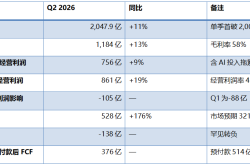
Let's delve into the numbers. The beauty of this financial snapshot lies in its contrast: the top four lines dazzle, while the bottom four raise eyebrows.
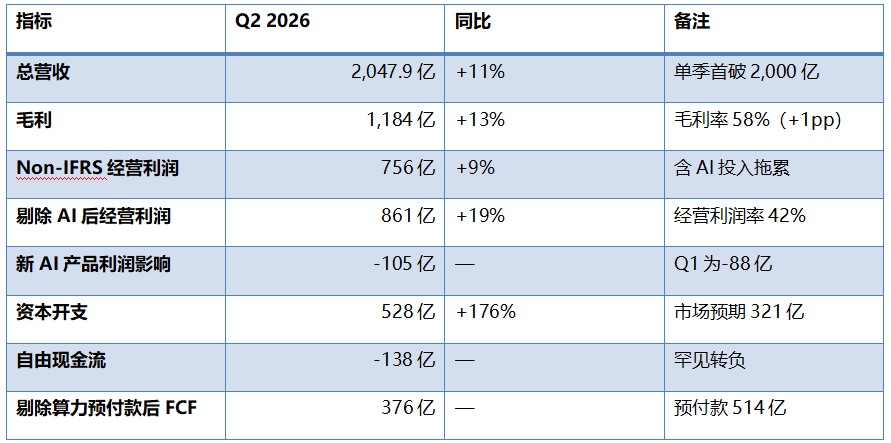
Gross margin climbed from 57% to 58%, marketing services revenue surged by 22% YoY, domestic gaming revenue jumped by 17% YoY, and WeChat MAUs reached a staggering 1.439 billion—core cash cows are not just maintaining momentum but accelerating. Excluding AI investments, operating profit margin improved from 39% to 42%. Tencent's core business is more profitable than ever.
Yet, the market fixated on another set of figures: capital expenditures soared by 176% YoY, free cash flow plummeted to -RMB 13.8 billion, and AI products incurred a RMB 10.5 billion quarterly loss. Hence, the stock price took a hit.
The question looms: Was this RMB 10.5 billion loss 'burned away' in vain, or was it a strategic 'investment'? Did the RMB 51.4 billion prepaid computing power 'disappear,' or did it 'transform into something more valuable'?
II. Why Tencent Chose a Different Path
The most telling statement from the earnings call wasn't Ma Huateng's 'three-tier architecture' but a nearly overlooked remark by Chief Strategy Officer James Mitchell during the computing power allocation discussion—
'If we leased our computing power to third parties, we could almost immediately recover equipment depreciation costs. Many emerging cloud providers operate this way... But in reality, we have a different approach, executing a longer-term strategy. We will allocate most of our new computing power to in-house large models, striving for industry-leading standards while deploying and popularizing our self-developed AI applications to dominate the domestic market.'
In investment terms: Tencent could have instantly monetized its computing power through cloud services, boosting short-term profits. Given the current tight GPU leasing market, subleasing this RMB 51.4 billion prepayment could have recovered depreciation within a few quarters—a script Wall Street loves for 'immediate monetization.'
But Tencent chose a different path.
During the same call, Martin Lau succinctly outlined the priority order for computing power usage—first for in-house models, then for refining applications, and finally for leasing:
First priority: Training larger, better Hunyuan series models (Hy4 is in training, set for release this year);
Second priority: Providing inference computing power for in-house AI applications (WorkBuddy, Xiaowei, CodeBuddy);
Third priority: Only then using remaining capacity for leasing.
This is a highly counterintuitive choice. With RMB 51.4 billion in computing power at hand during a market frenzy where 'selling GPU leases is like selling money printers,' reserving top priority for your own model—one not yet at the cutting edge, with an application matrix not yet generating revenue—is not 'financial optimization' but 'strategic foresight.'
And this choice is precisely the antithesis of the accusations in the 2018 article 'Tencent Has Lost Its Dreams.'
Eight Years of Tencent: From 'ROI First' to 'Dreams First'
Pan Luan once criticized Tencent: 'Once I see ROI hit its limit, I'll cut it.' Eight years later, Tencent is doing the opposite: Despite poor short-term ROI and a RMB 10.5 billion loss, it chooses to keep investing. This is the essence of dreams—bearing short-term costs for long-term beliefs.
III. Contrast with Google: Who Outsourced Their Dreams?
Comparing Tencent's earnings report with Alphabet's Q2 2026 (which we discussed last week) reveals a stark divergence.
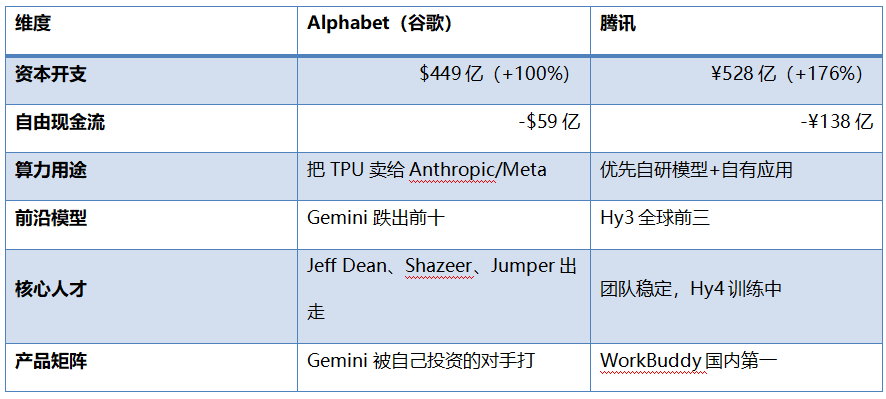
Google's strategy: Since we can't lead the frontier, let's fund those who can—selling TPUs to Anthropic, leasing computing power to Meta, and investing in their equity through GV. Google LLC becomes 'a top-tier VC fund with a search engine.' As SemiAnalysis put it: 'Google's problem isn't Jeff Dean or Shazeer but its extremely bureaucratic, slow-moving, and strategically timid corporate culture.'
Tencent's strategy is the polar opposite. It doesn't invest in external AI companies—it invests in itself.
Over these eight years, the fair value of Tencent's external investment portfolio has steadily declined from its peak—as of end-June, the fair value of equity in listed investment companies was RMB 487.2 billion, down from RMB 547.1 billion at end-March. It distributed JD.com, distributed Meituan, and progressively monetized and returned many investment targets to shareholders. Meanwhile, capital expenditures surged from RMB 79.2 billion for all of 2025 to RMB 84.7 billion in H1 2026—exceeding last year's total in just six months.
What Tencent is doing is essentially an internalization of dreams: liquidating 'external dreams' in its investment portfolio to fund its own models, applications, and computing power.
So while Alphabet has been dubbed 'the company that outsourced its dreams,' Tencent's earnings report shows it bringing dreams back home from its investment portfolio.
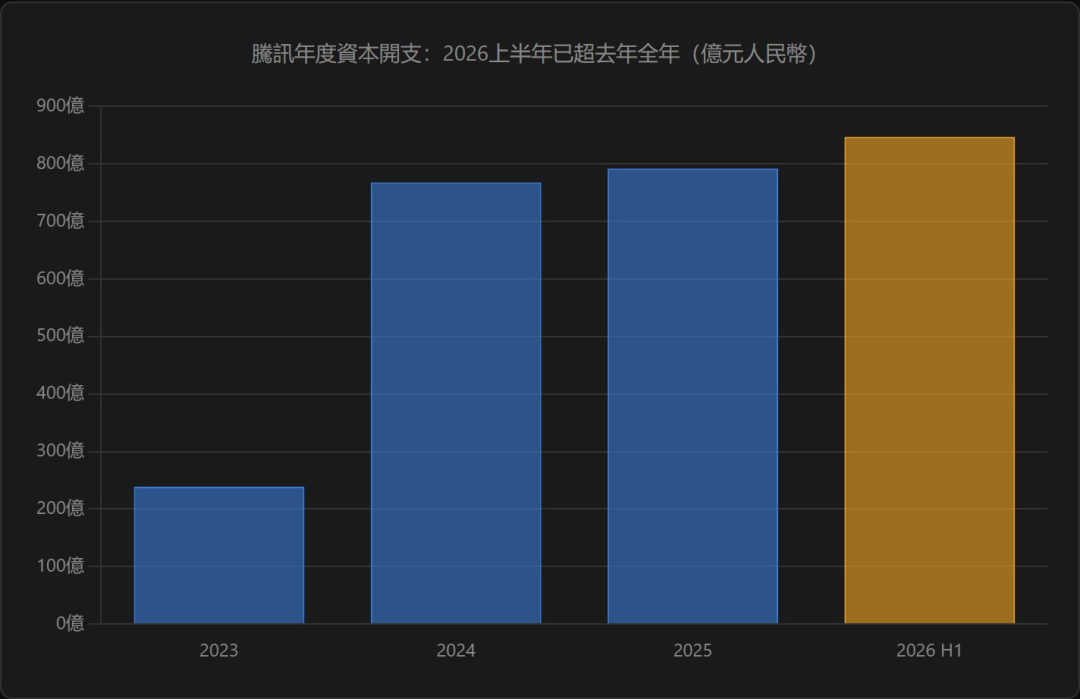
Tencent's annual capital expenditures: H1 2026 already exceeded full-year 2025 (RMB billions)
IV. Evidence of 'Investing' Computing Power
If Tencent were just throwing money away without results, that would be reckless. But if it's using computing power to acquire real users and real token consumption—that's building for the future.
This quarter's earnings report provides a solid evidence chain:
Q2 2026:
Official release of Hunyuan Hy3. Consistently ranked among the top three globally in token consumption on the OpenRouter platform, with daily token usage 7x that of the preview version.
June 2026: WorkBuddy PC version recorded 20.97 million monthly visits, ranking first among domestic同类 (same kind) products, exceeding the sum of the second and third place.
Q2 2026: WeChat's native AI assistant 'Xiaowei' began grayscale testing, penetrating 16 WeChat entry points from chat pages to Moments.
Q3 2026: Hy4 planned for near-term launch, with model scale further expanded from Hy3 and enhanced multimodal capabilities.
Several key details warrant highlighting.
First, Hy3's token usage is 7x that of the preview version. Token consumption is the hard indicator of an AI product's true value—not launch PPTs, not user registration numbers, but people actually using your model. Hy3 accounts for 60% of model selection among WorkBuddy's self-select model users and became the platform's top-called model within 72 hours of integrating ima Copilot.
Second, WorkBuddy's monthly visits exceed ByteDance's Trae and Alibaba's QoderWork combined. This marks Tencent's AI office application surpassing Alibaba and ByteDance in the ToB arena for the first time—unimaginable under the eight-year-old narrative of 'Tencent lacks ToB genes.'
Third, Xiaowei's 16 entry points. With WeChat's 1.439 billion MAUs, grayscaling the AI assistant across all entry points represents China's largest-ever AI product distribution experiment. No external computing power leasing business could justify RMB 51.4 billion in prepaid computing power like 'full WeChat AI integration.'
Tencent's AI Product Matrix: What Computing Power Became
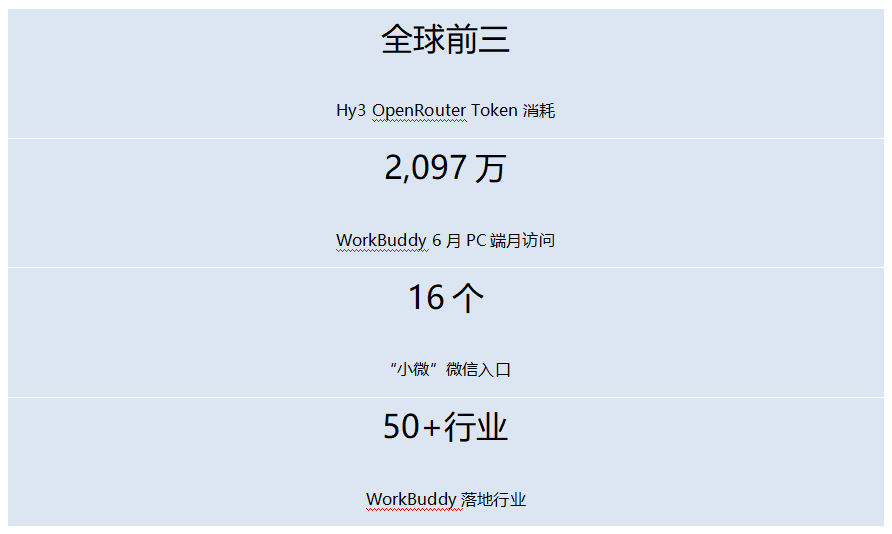
So when you ask, 'Where did Tencent's RMB 51.4 billion in prepaid computing power go?'—the answer isn't 'cloud server rooms' but 'global top-three token consumption, domestic No.1 AI office applications, and WeChat AI entry points for 1.439 billion MAUs.'
V. Why Did the Market Vote With Its Feet?
If the logic holds, why did the market still react negatively?
Three reasons, none complex.
First, the visual shock of -RMB 13.8 billion in free cash flow. Tencent is one of Hong Kong's most stable cash flow machines, rarely seeing negative quarterly cash flow in the past decade. Investors accustomed to 'Tencent printing RMB 30-40 billion in cash each quarter' panicked at -RMB 13.8 billion. Even with the company explaining 'it was RMB 37.6 billion excluding computing power prepayments,' the market's reflex had already formed.
Second, the expanding trend of RMB 10.5 billion in AI product losses. Q1 was RMB 8.8 billion, Q2 RMB 10.5 billion. If Q3 rises further to RMB 12-13 billion, full-year AI losses could hit RMB 45-50 billion. This would directly suppress Non-IFRS net profit growth from 'double digits' to 'single-digit flat'—the basis for Morgan Stanley's 15% target price cut and forecast of 'flat earnings in H2 2026 to 2027.'
Third, signals of potential buyback reductions. Tencent mentioned on the call that 'if capital expenditures continue rising, we may reduce buyback scale.' For long-term funds treating Tencent as a 'buyback + dividend' cash cow, this was nearly a faith crisis—implying Tencent's capital allocation priorities are shifting from 'returning to shareholders' to 'investing in the future.'
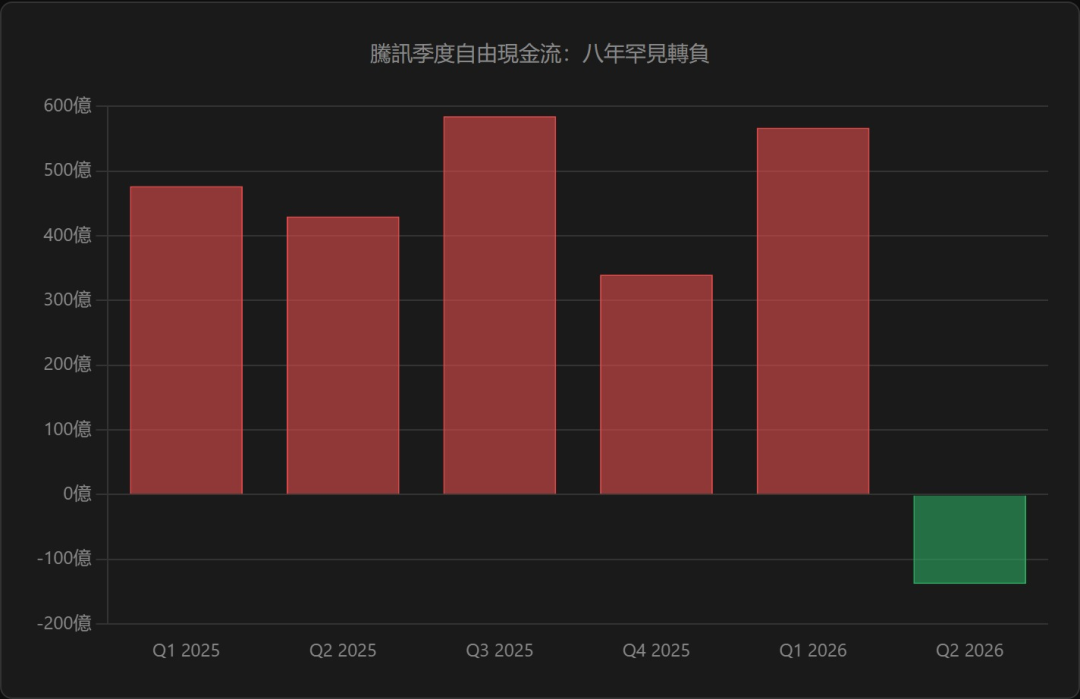
Tencent's quarterly free cash flow: Rare negative turn in eight years
All three reasons are real, reasonable, and undeniable in the short term. So the market's reaction isn't irrational—it's 'perfectly self-consistent under a short-term perspective.'
But here's the issue: Just because the market's reaction makes sense short-term doesn't mean it's correct long-term.
VI. The Valuation Anchor Problem: What Does 13x PE Buy?
Let's crunch the numbers. Tencent's H1 2026 Non-IFRS net profit attributable to shareholders was RMB 136.3 billion, with full-year Non-IFRS net profit expected at RMB 260-280 billion. Current market cap: ~HK$4.0 trillion (~RMB 3.7 trillion), corresponding to:
Static PE (GAAP): ~16x;
Static PE (Non-IFRS): ~13-14x;
'Core business PE' excluding AI investments: ~11-12x (estimated).
For comparison:
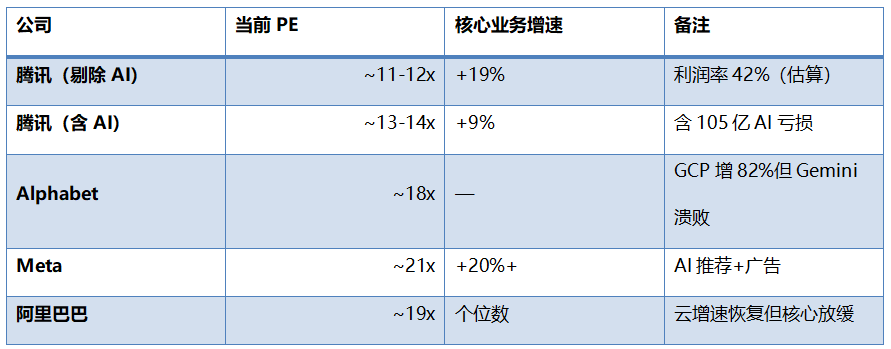
What does this valuation imply? It means the market is pricing Tencent as a 'mature cash cow growing at 9%'—not as a 'transforming company with core business +19%, AI investments yielding global top-three models and domestic No.1 AI office applications.'
The RMB 10.5 billion AI loss is treated by the market as pure 'expense,' but it actually includes: Hy3/Hy4 training costs, WorkBuddy inference costs, Xiaowei's grayscale promotion costs, CodeBuddy's R&D—all capital expenditures expensed through accounting, essentially amortizing future 3-5 year moats onto the income statement prematurely.
If capitalized, Tencent's 'true' operating profit for the quarter would approach RMB 86.1 billion + partial AI investment amortization—corresponding to a core business PE of perhaps only ~11x. And this valuation levels price in the extreme assumption that 'Tencent will never grow again.'
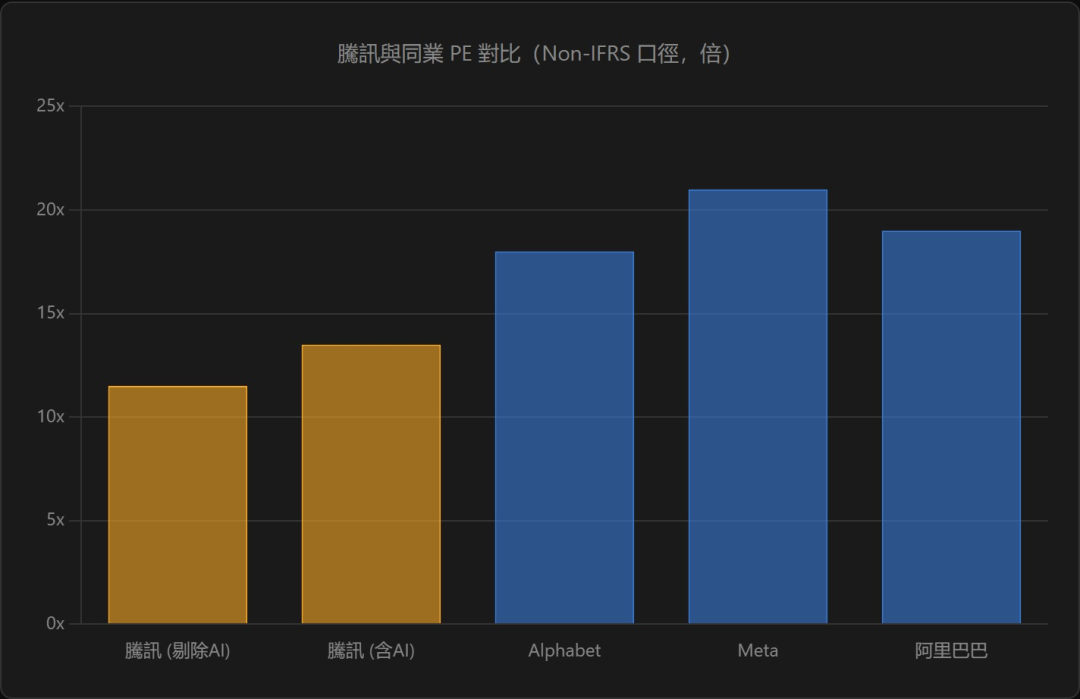
Tencent vs. Peers PE Comparison (Non-IFRS basis, x)
VII. The Capital Market's Paradox: Having It Both Ways
This brings us to the core point of this article. Over the past decade, Tencent has faced two entirely opposite accusations in the capital markets:

In 2018, Pan Luan criticized Tencent for 'having no emotional attachment to internal
Judging from the reaction of today's stock price, the answer appears to be a resounding "no." The market, with a -4.46% plunge, seems to be telling Tencent: "Your aspirations are commendable, but we preferred the Tencent of 2018—generating RMB 30 billion in cash every quarter, not squandering funds, not spinning tales, but consistently paying dividends and repurchasing shares."
Yet, this very aspect is what renders this earnings report so captivating. Tencent could have easily opted to lease out the RMB 51.4 billion in prepayments for computing power, could have streamlined its AI product lineup to safeguard profits, and could have persisted as a company with "no grand dreams but a handsome cash flow." However, it chose a different path.
It elected to train Hy4. It decided to integrate Xiaowei into 16 WeChat access points. It aimed to make WorkBuddy the pinnacle in China. It embraced a RMB 10.5 billion loss and a -RMB 13.8 billion free cash flow. This is not the behavior of a company devoid of dreams. Rather, it is the hallmark of a company that has brought its dreams back to the forefront.
Investors often desire the best of both worlds. Yet, the market will not simultaneously cater to the expectations of having both dreams and short-term profits. The truth will only emerge when one of these expectations is shattered—either dreams crumble and valuations continue to nosedive, or dreams are realized and valuations rebound.
In the capital markets, one must resist the urge to follow the herd. Eight years ago, when everyone criticized Tencent for lacking ambition, you should have questioned: Are its core businesses truly stagnant? Eight years later, when everyone lambasts Tencent for burning through cash, you should inquire: Are its AI investments truly fruitless?
Only by comprehending a company's intrinsic value can you discern favorable buying opportunities amidst the clamor and patiently await the market's perspective to shift.
-
![]()
Honda's Shift from In-House R&D: A Strategic Retreat to Realism
-
![]()
Head of Software R&D at Li Auto’s Chip Division Resigns
-
![]()
Tencent's Revived Aspirations: Yet the Market Remains Unconvinced
-
Nie Qiang Falls Short in Reviving Hongqi’s New Energy Dreams
-
![]()
Pix Exclusive丨EXEED Adjusts Reporting Line Again, Chery's 'Overseas Leader' Zhang Guibing Takes Over from Li Xueyong
-
![]()
I never expected Doubao to change the game in this way.
-
![]()
Pinduoduo Excels in Marketing! Is ‘Fastest Arrival by Tomorrow’ Just a Play on Words?
-
![]()
Integrating DJI Pocket Tech into a Phone: Who Is Honor’s Target Audience?