Liblib Eyes Listing: Can This Large Model 'Middleman' Be Valued at $3 Billion?
 08/17 2026
 525
525

Strategic subsidies for short-term gains, long-term focus on user acquisition.
On August 5th, Bloomberg reported that YanYu Technology (also known as Evoken) has embarked on preparations for an initial public offering (IPO) in Hong Kong, with a new funding round valuing the company at $3 billion. Just three months prior, the company had secured nearly $300 million in a Series B+ funding round, achieving a post-investment valuation exceeding $2 billion and setting a record for the highest single-round financing in China's AI application sector.
While the company's name may still be relatively unknown to the general public, its products are making significant strides in the AI creativity market. Through rapid product updates and iterations, YanYu Technology navigates within the boundaries set by industry giants, identifying niche opportunities and swiftly capitalizing on them.
Over the past three years, the company has launched five products: the image model community Liblib, the design agent product Lovart (Chinese version: Xingliu), the AI video creation platform LibTV, and the Sora-competing AI video application Zaoci. As of May 2026, the company's ARR (Annual Recurring Revenue) has surpassed $300 million, with projections shared with investors indicating that ARR could reach up to $700 million by the end of the year.
In comparison, Goldman Sachs predicts that Kling AI will achieve $1 billion in ARR by the end of the year, suggesting that YanYu Technology has reached revenue levels comparable to model manufacturers through its AI applications.
Despite the diverse positioning of its products, their design philosophy remains remarkably consistent: they do not create models but rather sell 'how to effectively utilize model capabilities.'
'Our value lies in adding a layer on top of the models—alignment,' says Chen Mian, the founder of YanYu Technology. According to him, the core of this series of products is to bridge the gap between model capabilities and user needs.
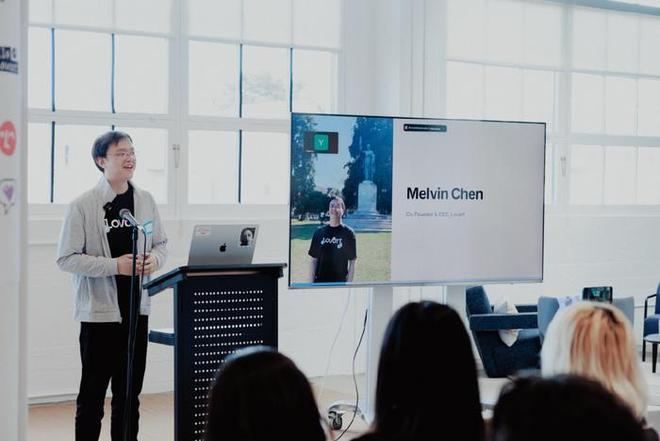 Chen Mian, Founder of YanYu Technology
Chen Mian previously served as the Global Commercialization Lead for Jianying and CapCut and was one of ByteDance's youngest product executives (senior management, level 4-1). This background explains YanYu Technology's initial strategy: recognizing the opportunities in AI tools, starting with a model community, and then delving deeper into more specialized fields.
However, the challenges are also apparent.
As someone from the internet era, Chen Mian is acutely aware of the difficulties in building competitive moats for AI applications. Major players hold pricing power over models and can swiftly replicate product matrices. Even in emerging areas of AI applications, they must confront age-old internet-era problems: how to sustain their niche business when industry giants begin to follow suit?
YanYu Technology's journey is that of an AI application company that started as a 'middleman' for large models, racing against time.
Its growth hinges on the time difference before major players wake up; its profits bet on user inertia in purchasing subscriptions but not fully utilizing them. The final verdict will be revealed at the IPO.
How Liblib, which does not create models, sustains its model business
The story of YanYu Technology begins with Liblib.
In 2023, Chen Mian left ByteDance to establish LiblibAI. At the time, the complete open-sourcing of Stable Diffusion opened up new opportunities in the image model field: users could 'feed' image data based on its models and train various models to generate specific image effects through fine-tuning methods like LoRA (Low-Rank Adaptation) and VAE (Variational Autoencoder).
Within the vast Stable Diffusion model ecosystem, communities akin to the 'GitHub of the AIGC world' gradually emerged, including Civitai, founded in late 2022, and LiblibAI, founded in 2023. These communities established themselves as hubs for model creators to upload their fine-tuned models and earn revenue based on usage, while users could find the styles they needed directly from the community and invoke the corresponding models.

However, as model capabilities caught up, the value of 'specific styles' was significantly diluted. Especially when Nano-Banana and others began generating images directly, the ecological influence of Stable Diffusion began to wane.
Consequently, Liblib underwent a 2.0 upgrade. Compared to its previous identity as a 'model fine-tuning community,' it transformed into a creative platform, with underlying models replaced by a series of multimodal models like Seedream and Qwen, and the application interface resembling the familiar one-click generation dialogue windows we know today.
But the experience from the 1.0 era was not entirely in vain.
In the 2.0 era, many of Liblib's differentiated features bear traces of the 1.0 period. For example, the retained workflows allow users to directly invoke models trained by others, 'reaping the benefits.' For instance, by uploading a computer image, users can directly apply cases from the workflow to transform it into a product image for e-commerce websites. This is Liblib's advantage in selecting the design sector—it is specialized enough to be truly applicable in practical work scenarios.
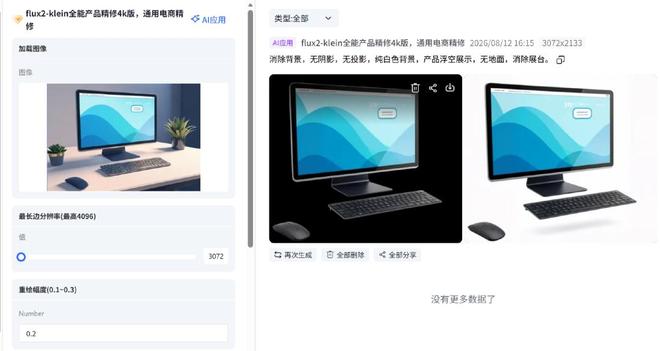
However, as a 'middleman' for large models, its revenue model is not particularly sophisticated—relying on selling price differentials: on one hand, sourcing various new models and cheaper channels to list them; on the other hand, calculating costs and packaging them into packages for sale.
In the realm of multimodal model intermediaries, the classic approach is a price war.
Take ByteDance's Seedance 2.5 as an example. On Jimeng, its invocation cost is approximately 1.5 yuan per second. Other platforms price it much lower: oiioii offers Seedance 2.5 at 0.27 yuan per second; Liblib provides a limited-time 58% discount, bringing it down to 0.4 yuan per second.
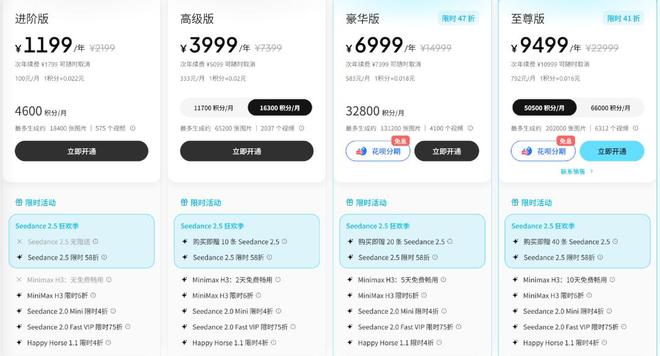
How do these platforms manage to lower prices?
First, they secure discounts through official cooperation. For example, Liblib signed a leading annual framework agreement with ByteDance, allowing it to receive certain rebates. However, as the official provider, ByteDance clearly cannot offer such low discounts, meaning that the actual selling prices of various platforms are already far lower than the subsidies received.
Second, they find cheap API channels. In reality, the industry is flooded with API sources of complex origins: such as bulk applications for free token discounts through overseas student status certifications. Some even engage in 'passing off inferior products as superior ones,' such as displaying the use of Seedance but actually invoking cheaper mini or fast versions for part of the invocations.
Regarding the latter, Chen Mian explicitly denied it: 'This is very damaging to long-term interests and simply not worth doing.'
Third, they design the payment model. Liblib's membership points are set to expire after 30 days, becoming invalid if not fully utilized by the end of the month. For the platform, unused points translate into profits.
In Chen Mian's words, this is more akin to the payment model of gyms: 'Users buy 1 million points but only use 200,000, leaving 800,000 as our profit.' He further explained, 'You could say that most tool products are weekly active products, not daily active ones. Even for Jianying and Adobe, a stable retained user only has an LT 30 (active days within 30 days) of around 5 days.'
However, this statement can also be interpreted differently—gyms' competitive advantages lie in location and habit, whereas AI tools have almost no migration costs. Users may not use up their credits or may stop coming next month.
The conclusion is harsh: if users fully utilize their credits, Liblib would lose money based on the actual model costs.
This business is essentially not about selling tools but betting on user inertia. It profits from money spent but not fully utilized. However, to achieve growth, more people must be encouraged to 'use it vigorously.' There is an inherent tension between profit and growth.
Chen Mian is aware that operating as an intermediary for video models is not a sustainable business, and YanYu Technology needs healthier revenue streams through its products.
Lovart and LibTV: Seizing the Window of Opportunity
If Liblib is the foundation of YanYu Technology, then subsequent products like Lovart and LibTV serve as 'growth engines' to drive up valuations and attract capital.
Building on model platforms, YanYu Technology's subsequent expansions focus on products that, while still grounded in model capabilities, place greater emphasis on product design, offering more room for monetization.
Lovart is a prime example, positioned as a specialized agent assistant product for the design field, launched as the world's first design agent. In March 2025, the release of the general-purpose agent product Manus ignited imagination across the sector. According to Enlightened AI, the Lovart team was formed within LiblibAI just three days later. Like Manus, Lovart initially required an invitation code for registration, with codes once being resold for as high as 500 yuan each.

Speed has always been YanYu Technology's approach to seizing niche markets. Compared to the design agent products intensively launched by major players this year, Lovart gained a nearly one-year head start.
'Frankly, agents are not yet mature. But if we wait for them to mature, it won't be an opportunity for entrepreneurs, especially not for application entrepreneurs, since we don't control the models,' Chen Mian said.
The core of Lovart's advantage lies in two aspects: first, using agent logic to manage content generation steps, enhancing the quality of final outputs. For example, to generate a set of cards, it invokes models better at analysis to break down tasks, searches for corresponding images as design inspiration based on the user's described style and theme, and only proceeds with image generation after the user confirms the plan.
Second, it addresses designers' pain points by integrating various AI tool capabilities into the product and optimizing them for specific purposes. For instance, the initially launched 'text-image separation' capability allows designers to directly extract text from images and modify it by typing, rather than relying on model-generated image 'draws.'
However, this capability is not entirely new, as live text extraction functions have been available on smartphones for years, such as Apple's Live Text feature launched in 2021.
Later updates to Lovart resemble standardizing large model capabilities, achieving practicality while enhancing modification effects. Take the text editing function as an example: it can directly recognize and extract text from images, allowing users to modify it within a text box, synchronously updating the original image's text without altering its design.
While Lovart has not disclosed specific technologies, we speculate that it may use OCR for text recognition and extraction, then feed the extracted text into Lovart's preset prompt templates for corresponding models to complete text modification and replacement.

When asked why they could develop such functions ahead of others, Chen Mian said, 'Because most people wouldn't do this before model capabilities advanced. There have been several rapid advancements this year: GPT-4o updated Image-1 (the text-to-image model in the 4o series), significantly improving instruction following, consistency, and text generation capabilities... These changes happened too quickly, so most people haven't caught up yet.'
However, as model capabilities continue to iterate and upgrade, some innovative features are being absorbed by new large models. Still taking the text editing function as an example, if we directly provide the request to modify an article to GPT-image2, the model can similarly achieve localized text modifications, even demonstrating stronger consistency than Lovart.

In comparison, YanYu Technology's Xingliu, seen as the domestic version of Lovart, resembles a 'streamlined version' in terms of both pricing and feature updates—Xingliu's monthly membership is priced at 99 yuan, while Lovart's lowest pricing is $29.9 per month. Functionally, Xingliu has not synchronized Lovart's product features, such as brand suites and font generators.
To experience the effects firsthand, Guangzhui Intelligence tested Lovart and Xingliu.
We had both generate images based on Xingliu AI's demo template, 'create a set of Hello Kitty board game cards.' Every image generated by Lovart aligned with the theme and confirmed the plan; Xingliu invoked cheaper models, producing results that fell significantly short in terms of refinement. Halfway through, it forgot the board game theme, turning into generic cards with unclear Chinese characters.
Overall, Xingliu appears to be a 'downgraded version' created to meet domestic market demand.


Lovart represents an innovation from general-purpose to specialized fields, while LibTV, as a latecomer, faces a more challenging narrative.
This year, YanYu Technology continued its approach of creating products in niche hit sectors, launching the AI video generation product LibTV. Its product design offers little novelty. For example, features like infinite canvas and node-based workflows are already available from model developers and some AI short drama platforms. The most notable feature is the Skill function, but it still relies on community co-creation, packaging script generation, storyboard design, visual generation, and post-production editing into pluggable Skills.
 Skills empower AI to manage the entire workflow, from scriptwriting to the final video output.
Judging by the outcomes, however, Yanyu Technology has capitalized on the trend of viral content to discover new avenues for growth. In an interview, Chen Mian noted that LibTV's ascent from zero to $100,000 in daily revenue was "remarkably swift," with peak daily earnings soaring to $1 million within a month. Out of the $300 million in Annual Recurring Revenue (ARR), LibTV contributed over half.
Yet, how much of this success can be attributed to the product's inherent strengths, and how much is merely "riding the wave" of industry expansion?
For comparison, consider Kunlun Tech's AI short drama platform. Fang Han, Chairman and CEO of Kunlun Tech, disclosed that the platform has made a significant breakthrough with $700 million in ARR, securing the top spot among overseas short drama platforms. Kuaishou's Kling also boasts nearly $500 million in ARR.
In essence, both Lovart and LibTV embody Yanyu Technology's standardized strategy—identifying trends, developing products, and then swiftly iterating to introduce additional features to capitalize on market opportunities.
Nevertheless, this strategy does not always yield success. For instance, last year, Yanyu Technology launched a new product, Zaoci, modeled after Sora's App. However, just as Sora was shut down by OpenAI, Zaoci failed to make a substantial impact in the market.
 Schematic of Zaoci App's official website
The failure of Zaoci underscores that the same strategy is not universally effective. When the window of opportunity closes or competitors are sufficiently strong, speed alone cannot create a sustainable advantage. What Yanyu Technology truly depends on is its capacity to continually identify the next untapped market window and leverage capital to expand it.
With adequate funding, they can consistently create a few key product categories to sustain their business operations.
How far can Yanyu Technology progress with its narrow competitive moat?
Can Yanyu Technology, which is gearing up for an IPO, present a compelling growth story? At this juncture, it appears less than promising.
Considering that large language models can achieve gross margins of 60% or higher, although Liblib asserts it has positive gross margins, they are clearly not substantial. In response, Chen Mian stated that it is typical for AI application products to currently have gross margins below 30%. However, from a market standpoint, whether investors will embrace a low-margin commercialization narrative remains uncertain.
Once Yanyu Technology's financial statements are made public, we will conduct further tracking and provide a detailed analysis.
Meanwhile, Lovart and LibTV are set to face an even more daunting challenge this year.
As previously mentioned, Yanyu Technology's survival strategy hinges on exploiting time differences. This approach is only effective during the window period when major players have not yet fully penetrated niche markets and model capabilities have not yet filtered down to segmented applications, enabling them to establish a slight differentiation barrier through first-mover advantage.
For example, Liblib is a model community product targeting Civitai overseas, capitalizing on the absence of similar offerings in China. Lovart applies the Manus approach to niche design sectors, capturing both overseas and domestic markets. LibTV recognized the potential of AI short dramas and achieved product-market fit (PMF).
However, in more lucrative sectors, major players are poised to enter the fray, and none will willingly relinquish this "profitable" market.
In the design agent sector where Lovart operates, major players have already begun to make their move. Tencent fully launched its first self-developed creative agent, Miora, in July, also targeting niche sectors such as brand design and film and television creativity.
 Miora, courtesy of Tencent
Consequently, Yanyu Technology must continually fuel this strategy through financing and new product launches. By swiftly introducing products, acquiring customers at low costs, and cross-promoting within their product matrix, they aim to build value at the traffic level.
To sustain its edge, the crux for Yanyu Technology lies in whether its products can retain the accumulated user base. In the vertical design sector, Liblib has already amassed 30 million users, and their product matrix can mutually promote each other—LiblibAI accumulates creators and community assets, Lovart validates the monetization potential of design scenarios, and LibTV capitalizes on the industry window of AI short dramas. The three products collaborate in the vertical sector, creating a synergistic promotional dynamic.
Chen Mian remarked that without his involvement, these three products might have evolved into three separate startups, each with a slimmer chance of survival.
However, the sustainability of this approach appears bleak based on the data from the three products. According to QbitAI Think Tank statistics, in July 2026, Liblib's traffic reached 1.731 million visits, down from over 3 million visits in December 2025. Lovart's overseas traffic also declined from a peak of over 4 million visits to around 2.9 million visits in July this year. LibTV vanished from the AI creation rankings in July this year, after registering 1.9 million visits last month.
The harsh reality is starkly different from what Yanyu Technology once relied on.
AI tools seldom inspire user loyalty. Whoever offers lower prices, greater user-friendliness, and can keep pace with model iterations more swiftly will temporarily remain in the game.
Perhaps this approach never possessed a true competitive moat to begin with, but rather a series of accelerating time differences. Yanyu Technology needs to demonstrate that before the next window of opportunity arrives, it can discover something truly unique to itself.
-
![]()
From a 1.4 Billion Yuan Loss to an Estimated 500 Million Yuan Profit: Generative AI Paves the Way for SenseTime’s Turnaround
-
![]()
After Testing CatPaw, I See the Second Half of Meituan's AI Game
-
![]()
In the AI Era, How Much Is Doubao’s Entrance Pricing Power Worth in Terms of Commission?
-
In Line with HJ 1480 - 2026! Hikvision Launches Specialized Products for Video Surveillance Systems in Pollution Discharge Monitoring
-
![]()
The Next Corolla: How Toyota is Reinventing the 'National Car' Amid Global Automotive Industry Changes - NHK's 'Inside Toyota'
-
![]()
HONOR Robot Phone: A Revolutionary Smartphone or Just a Compelling Tale?
-
![]()
Short Dramas with Face-Swapping and Talent Show Debuts: AI Begins to 'Mass-Produce Stars'
-
![]()
Beijing Public Transport Group Launches Tender for Bus Procurement Worth 1.2 Billion Yuan