Alibaba’s Profit Dives 75%: Where Has All the Money Gone?
 08/24 2026
 507
507
Cover image | Official website of Alibaba Group
On August 20, Alibaba unveiled its latest quarterly financial results.
In the first quarter of fiscal year 2027, revenue soared to RMB 268.953 billion, marking a 9% year-on-year increase; however, net profit plummeted to RMB 10.444 billion, a staggering 75% drop compared to the same period last year. Meanwhile, revenue from AI cloud and computing services surged to RMB 48.437 billion, up 45% year-on-year.
At first glance, it’s tempting to conclude that Alibaba is sacrificing profits to fuel AI growth.
However, Vito, an Alibaba investor and author of the WeChat Official Account 'Daily Insights,' disagrees.
'These two figures aren't necessarily interconnected,' Vito explained to Pencil News. He noted that Alibaba's reported profits are swayed by non-operational factors, such as investments, and that the profit decline was more significantly impacted by business investments, like those in Taobao Flash Sales.
To grasp the financial dynamics of AI-related operations, one should examine two key aspects: the revenue already generated by the business and Alibaba's plans for further investment.
The former stands at RMB 5.628 billion. In the second quarter, Alibaba's operating profit from AI cloud and computing services reached RMB 5.628 billion, soaring by 133% year-on-year, indicating that the business has commenced generating profits.
The latter amounts to RMB 67.68 billion. This represents Alibaba's investment in a single quarter for long-term expenditures, such as purchasing servers, chips, and constructing data centers, marking a 75% year-on-year increase, primarily directed towards AI infrastructure.
On one hand, the business is already profitable; on the other, it's still aggressively expanding.
Previously, Alibaba announced plans to invest at least RMB 380 billion over the next three years in cloud and AI hardware infrastructure, with roughly half already executed.
The fact that AI has started yielding profits has emboldened Alibaba to spend even more.
- 01 -
Enterprise AI Businesses Are Already Turning a Profit
'AI commercialization should be assessed from two angles,' Vito told Pencil News. 'In the B2B sector, commercialization is already quite evident. However, in the B2C sector, true commercialization is still a distant prospect.'
In his view, Alibaba's strategy is straightforward: secure B2B profits first while actively exploring and positioning itself in the B2C market.
The latest financial report substantiates this assessment.
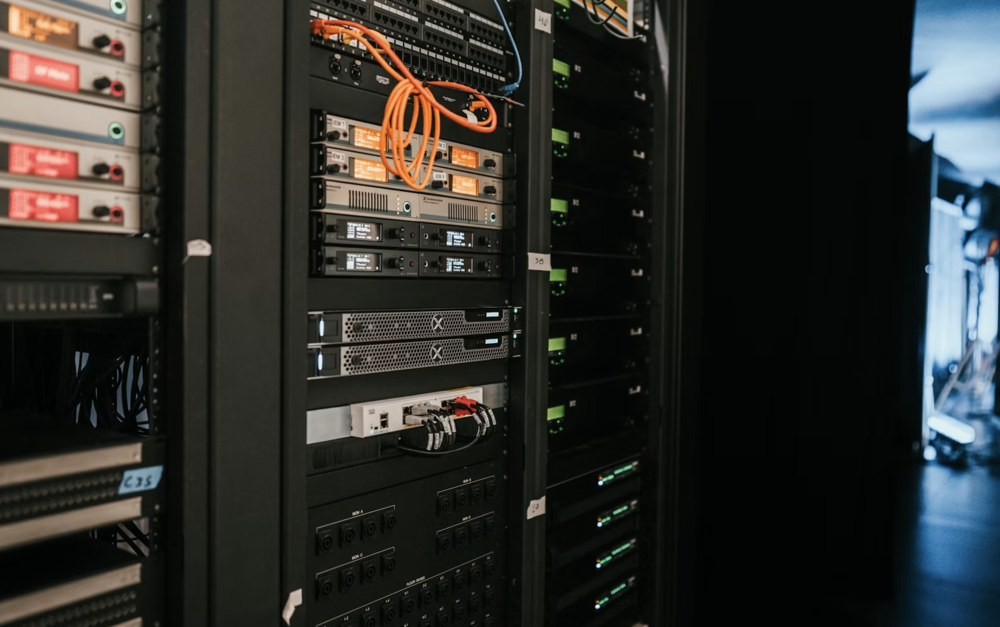 AI demand is propelling cloud providers to continually expand their computing infrastructure. Image source: Unsplash
In the second quarter, Alibaba's AI cloud and computing services, which genuinely demand substantial investment, generated RMB 48.437 billion in revenue, up 45% year-on-year; adjusted EBITA reached RMB 5.628 billion, up 133% year-on-year.
Conversely, Alibaba's newly established 'AI Labs and Applications' segment reported revenue of RMB 3.338 billion, up 16% year-on-year, but adjusted EBITA showed a loss of RMB 13.861 billion (compared to a loss of RMB 3.224 billion in the same period last year). Alibaba attributed the expanded loss to increased investments in AI capabilities and higher inference costs for the Qianwen App.
While these two segments cannot be simply equated with B2B and B2C, they at least illustrate a reality: cloud and computing services are closest to profitability, while consumer-facing AI applications are still in a heavy investment phase.
Enterprise money is easier to come by, as Anthropic has also discovered, with over 70% of its revenue stemming from enterprise customers, the world's largest AI unicorn.
Alibaba holds an even greater advantage—it has been in the cloud computing business for over a decade.
Enterprises in need of GPUs can rent from Alibaba Cloud; those requiring model access can utilize Qianwen; those needing databases, storage, and inference services can remain within Alibaba's ecosystem.
With the advent of AI, Alibaba doesn't need to construct a business system from scratch; it merely needs to infuse its existing pipelines with a higher-value commodity.
In the past, it sold CPUs, databases, and storage; now, it's selling 'intelligence.'
- 02 -
Three-Year Payback? Alibaba Embarks on a 'Factory-Building' Spree
Vito believes that the true focus of Alibaba's AI growth has shifted to capital expenditures.
'The crux lies in how much needs to be invested in the future and what returns these investments can yield. This is the real issue and represents the greatest risk or opportunity,' he said.
According to Alibaba's disclosures, at current gross margin levels, capital investments in AI infrastructure can reach break-even in about three years.
If Alibaba can indeed recoup costs in three years, its continued purchases of cards and construction of data centers make sense.
Because AI is increasingly resembling a manufacturing business.
Traditional internet companies are 'lightweight,' with software replicable for countless users. But AI is different: each additional user query necessitates another run on a chip; each additional batch of tokens called by enterprises requires more servers, electricity, and storage.
'Intelligence' is evolving into a commodity that needs to be produced.
From this perspective, Alibaba's quarterly expenditure of RMB 67.68 billion mirrors manufacturing companies buying equipment and building factories: first, purchasing chips and servers, constructing data centers, then processing computing power into tokens, model APIs, and cloud services for sale.
As long as demand remains robust, capital expenditures are not merely 'burning money' but expanding production.
The deployment of billions of yuan in capital expenditures will also funnel money to a longer supply chain.
After sifting through recent AI infrastructure investments, Pencil News's industrial large model 'Little Pencil Opportunity Officer' discovered that opportunities are spreading upstream from chips to power.
This year in August, NVIDIA planned to invest up to $3 billion in Lancium, a developer of power infrastructure for data centers. As GPUs are no longer the sole bottleneck, infrastructure such as land, power, and data centers is becoming the new beneficiary.
The business of 'selling shovels' for AI is extending from selling chips to supplying power.
For Alibaba, another key is reducing the unit cost of computing power.
If cloud providers persist in purchasing expensive AI chips externally, a significant portion of their profits will be claimed by upstream suppliers. This is why Pingtouge, which seemed distant from Alibaba's core retail business before, has suddenly gained prominence.
The latest financial report reveals that Pingtouge's Zhenwu series chips have been adopted by over 650 external customers and more than 20 industries through Alibaba Cloud services.
However, Vito does not believe that today's high return rates can be sustained long-term. In his view, 'computing power is essentially an undifferentiated commodity, akin to energy.'
'The current exorbitant prices of chips and storage are undoubtedly overvalued, and shortages are temporary. This is the biggest risk in the current AI economy,' he said.
Google is expanding its TPU offerings, Amazon is expanding Trainium, and Alibaba is developing its own chips. As supply increases, the prices of large model APIs continue to decline.
Thus, a paradox emerges:
Precisely because AI infrastructure is profitable now, everyone is rushing to expand production; but when everyone starts expanding, today's high return rates may vanish.
If AI demand continues to outpace supply, the RMB 380 billion will secure future production capacity; if computing power becomes surplus and prices plummet, these data centers could become costly fixed assets.
- 03 -
Alibaba's Greatest Strength in AI Lies in Retail
The closer AI becomes to a capital-intensive business, the more crucial sustained cash flow becomes.
Vito believes, 'Giants like Alibaba do possess the advantage of cash cows, but they also suffer from bureaucratic inefficiencies. Overall, I tend to think that in a capital-heavy game like AI, giants will have more advantages.'
This is also the most significant difference between today's Alibaba and that of three to five years ago.
'Three to five years ago, Alibaba was essentially an e-commerce company. Now, while e-commerce remains its foundation and cash cow, the advent of the AI era has made Alibaba Cloud's original business foundation its greatest asset. Even layouts like the Academy of Discovery and Pingtouge, which seemed like 'strategic idle pieces' before, have suddenly become wild cards,' he said.
When betting on AI, Alibaba's greatest confidence may not stem from a specific model but from the cash flow generated by Taobao and Tmall. This quarter, its instant retail business reported revenue of RMB 53.295 billion, up 45% year-on-year.
Chairman Joseph Tsai disclosed this year that Alibaba's core e-commerce business generates approximately $25 billion in free cash flow annually. This means that even as AI necessitates continuous purchases of cards, construction of data centers, and subsidies for applications, Alibaba still possesses a massive 'money printer' supplying funds.
This is not unique to Alibaba. Google has search advertising, Microsoft has Azure, Meta has social advertising, and Tencent has gaming. Almost all participants in the global AI race first have a profitable existing business and then use its profits to fund the AI war.
The more pronounced the advantages of giants, the more the profit-making methods of startups must evolve.
Future opportunities for AI startups may increasingly lie not in competing head-on with Alibaba, Tencent, or ByteDance on foundational models but in areas where giants cannot or will not delve deeply, such as vertical scenarios in coding, healthcare, law, and industry.
These companies do not need to own the largest models or build data centers worth billions of yuan themselves. What they truly need is to find willing-to-pay customers and use existing large models to solve a sufficiently valuable problem.
For Chinese startups, competing with Alibaba, ByteDance, and Tencent on who has more GPUs is almost a futile endeavor; but if they possess data that giants lack, delve deeply into an industry that giants do not understand, or can solve a high-value problem at a lower cost, they still have opportunities to make money.
Vito judges, 'If startups cannot achieve significant advantages in certain areas, they are likely to perish in the inevitable bubble burst.'
Previously, the AI industry increasingly compared one thing: who can make money.
The same holds true for Alibaba.
Today, e-commerce generates cash, cloud computing sells computing power, Qianwen provides model capabilities, and Pingtouge attempts to reduce chip costs. After the advent of AI, pieces scattered across the chessboard over the past decade have suddenly been strung together.
After the financial report's release, Alibaba's U.S.-listed shares initially fell over 4% pre-market but closed up 1.26%.
The market ultimately comprehended the financial report—the profit decline is superficial; AI profitability is the essence. Behind the 75% drop is not decline but a high-stakes gamble: a gamble on a three-year payback computing model, on unceasing AI demand, and on a winner-takes-all outcome in a capital-intensive mode.
This article does not constitute any investment advice.
-
![]()
Registered Capital Slashed to 372 Million Yuan! Yutong Optical Finalizes Industrial and Commercial Change Registration
-
![]()
Zhuque-3 Successfully Lands, and 'Time Traveler' Secures Another ¥100 Million in Funding: China's Commercial Space Industry Experiences a 'Dynamic August'
-
![]()
Autohome Faces a Shrinking Window of Opportunity
-
![]()
Even a Titan Like Musk Has Faced Setbacks in Fulfilling Promises
-
![]()
AI Office: The End of the Racing Era, Context Becomes the Key to Success
-
![]()
Domestic Vehicle Chassis Revolution ②: The Steering Wheel Remains, But Mechanical Connections in the Steering System Are Decreasing
-
![]()
Exploring MiniMax Design: Can Video Editing Be as Simple as Speaking?
-
![]()
Why Can SenseTime Achieve Profitability While CloudWalk Still Faces Challenges, Despite Both Adopting Large Models?