Registered Capital Slashed to 372 Million Yuan! Yutong Optical Finalizes Industrial and Commercial Change Registration
 08/24 2026
 438
438
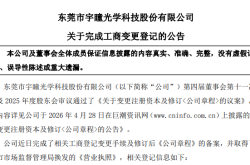
On August 21, Yutong Optical made an announcement stating that the company had successfully completed the formalities for industrial and commercial registration of changes. It had submitted the revised 'Articles of Association' for record-keeping and secured the reissued 'Business License' from the Dongguan Market Supervision Administration.
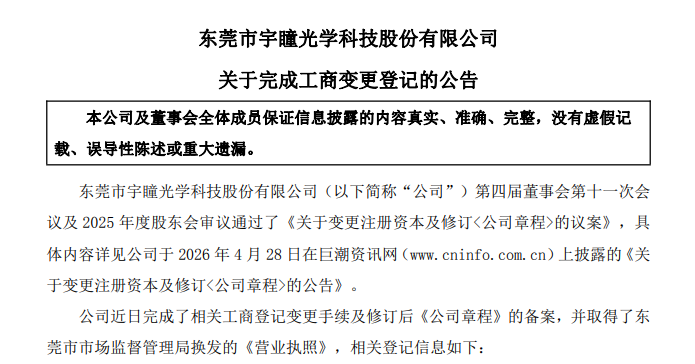
Consequently, the company's registered capital has been officially revised to 371,689,981 yuan. This alteration had already received the green light from the 11th meeting of the fourth session of the company's board of directors and the 2025 annual shareholders' meeting.
The company emphasized that the completion of the industrial and commercial registration of changes signifies the full accomplishment of the legal procedures for adjusting the registered capital and amending the articles of association. This move will further guarantee the compliance of the company's business operations.
Amidst the optimization and restructuring of its capital, Yutong Optical has markedly quickened the pace of its industrial expansion. Lately, Yutong Optical's micro-nano optics and optical component module project in Dongguan has been advancing steadily as per the predetermined schedule. It is reported that the project, which concluded land acquisition in June 2026, is situated in Shatou Community, Chang'an Town. With a total investment of roughly 350 million yuan, it spans an area of about 22.48 acres.
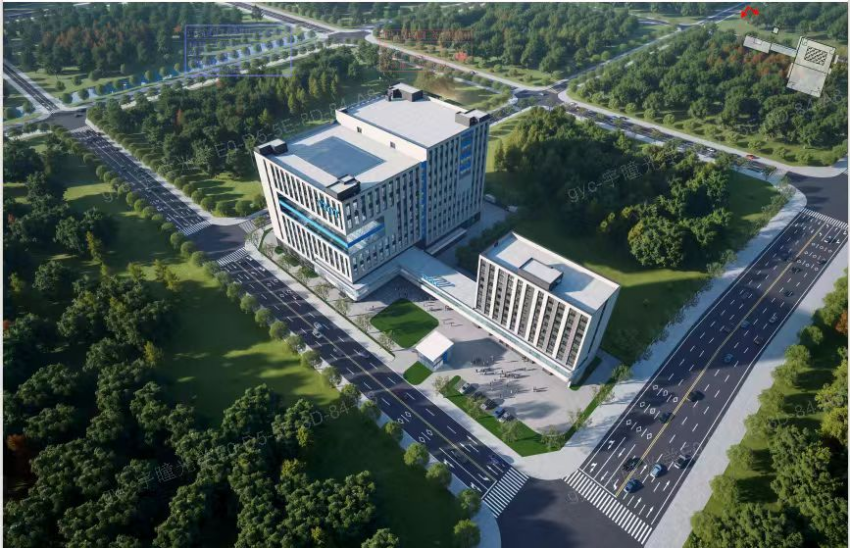
Once the project is fully operational, it is anticipated to yield an annual output of 1 million micro-nano optical products, 2 million optical modules, and 4 million optical lenses. The new facility will mainly focus on the research, development, and production of high-end precision optical modules, micro-nano optical-related products, and core precision optical communication components across three key areas.
Within the micro-nano optics domain, product lines such as metalenses, optical waveguides, and silicon lenses will be deployed. In the optical communication sector, the emphasis will be on developing core precision components like glass aspherics, freeform surfaces, collimating lenses, and glass substrates. The project is slated to commence operations gradually in the latter half of 2027.
-
![]()
Registered Capital Slashed to 372 Million Yuan! Yutong Optical Finalizes Industrial and Commercial Change Registration
-
![]()
Zhuque-3 Successfully Lands, and 'Time Traveler' Secures Another ¥100 Million in Funding: China's Commercial Space Industry Experiences a 'Dynamic August'
-
![]()
Autohome Faces a Shrinking Window of Opportunity
-
![]()
Even a Titan Like Musk Has Faced Setbacks in Fulfilling Promises
-
![]()
AI Office: The End of the Racing Era, Context Becomes the Key to Success
-
![]()
Domestic Vehicle Chassis Revolution ②: The Steering Wheel Remains, But Mechanical Connections in the Steering System Are Decreasing
-
![]()
Exploring MiniMax Design: Can Video Editing Be as Simple as Speaking?
-
![]()
Why Can SenseTime Achieve Profitability While CloudWalk Still Faces Challenges, Despite Both Adopting Large Models?