Domestic Vehicle Chassis Revolution ②: The Steering Wheel Remains, But Mechanical Connections in the Steering System Are Decreasing
 08/24 2026
 340
340
In 2026, discussions around steer-by-wire and rear-wheel steering will dominate the automotive steering landscape.
In the first half of 2026, EPS (Electric Power Steering) will remain the dominant market presence.
DP-EPS (Dual Pinion Electric Power Steering) accounts for 41.53%, C-EPS (Column-assisted EPS) for 32.14%, R-EPS (Rack-assisted EPS) for 17.66%, and P-EPS (Pinion-assisted EPS) for 4.98%. All these solutions retain mechanical connections, differing only in motor placement, assistance methods, load capacity, and cost.
SBW (Steer-by-Wire) and RWS (Rear-Wheel Steering) are gaining momentum.
◎ In June, SBW sales reached 22,300 units, with a penetration rate of 1.34%;
◎ RWS sales reached 66,800 units, with a penetration rate of 4.01%.
One alters the control chain between the steering wheel and front wheels, while the other enables rear-wheel steering, preparing vehicles for performance demands and L2+ advanced driving assistance in lateral motion control.
Part 1: Shifts in Technology Shares Within EPS 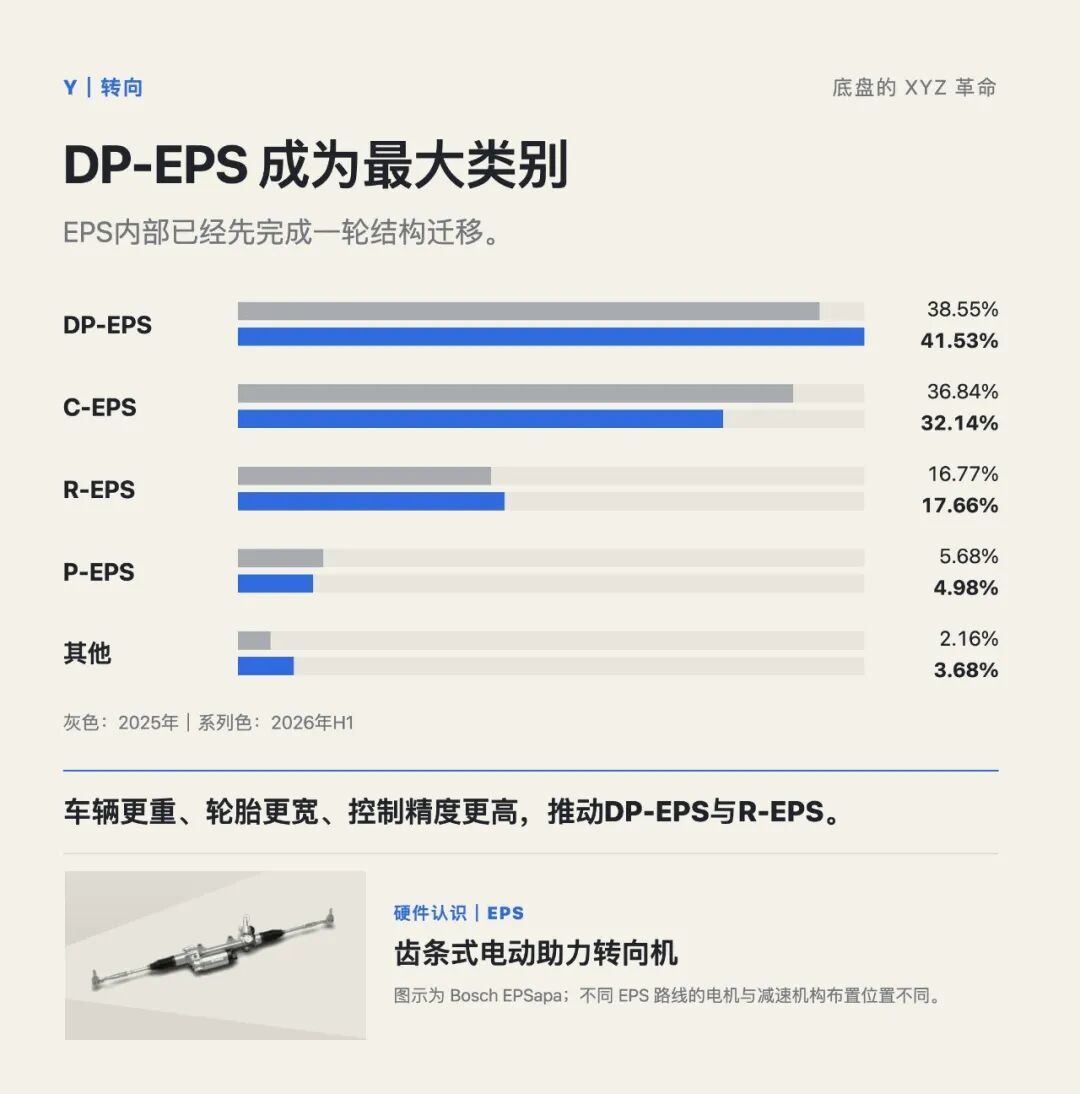
EPS stands for Electric Power Steering. Based on the location of the motor and reduction gear, it can be categorized into C-EPS, P-EPS, DP-EPS, and R-EPS.
◎ C-EPS places the motor on the steering column, offering low cost and compact structure, commonly used in smaller vehicles.
◎ P-EPS provides assistance directly at the pinion.
◎ DP-EPS uses a dual-pinion structure, separating driver input from motor assistance for improved response, precision, and platform adaptability.
◎ R-EPS acts directly on the rack, providing greater assistance and is more suitable for mid-to-large and high-performance vehicles.
From 2025 to the first half of 2026:
◎ DP-EPS share increased from 38.55% to 41.53%, becoming the largest category;
◎ C-EPS share decreased from 36.84% to 32.14%;
◎ R-EPS share rose slightly from 16.77% to 17.66%;
◎ P-EPS share dropped from 5.68% to 4.98%.
Changes in EPS steering systems are linked to vehicle upsizing and improved advanced driving assistance capabilities.
◎ Heavier vehicles and wider tires require higher steering system output;
◎ High-speed navigation, automatic parking, and emergency evasion demand faster assistance response and higher control precision.
As a result, DP-EPS and R-EPS shares are rising, while C-EPS, despite its cost advantage, is seeing its applicability shrink.
Brand choices reflect these differences.
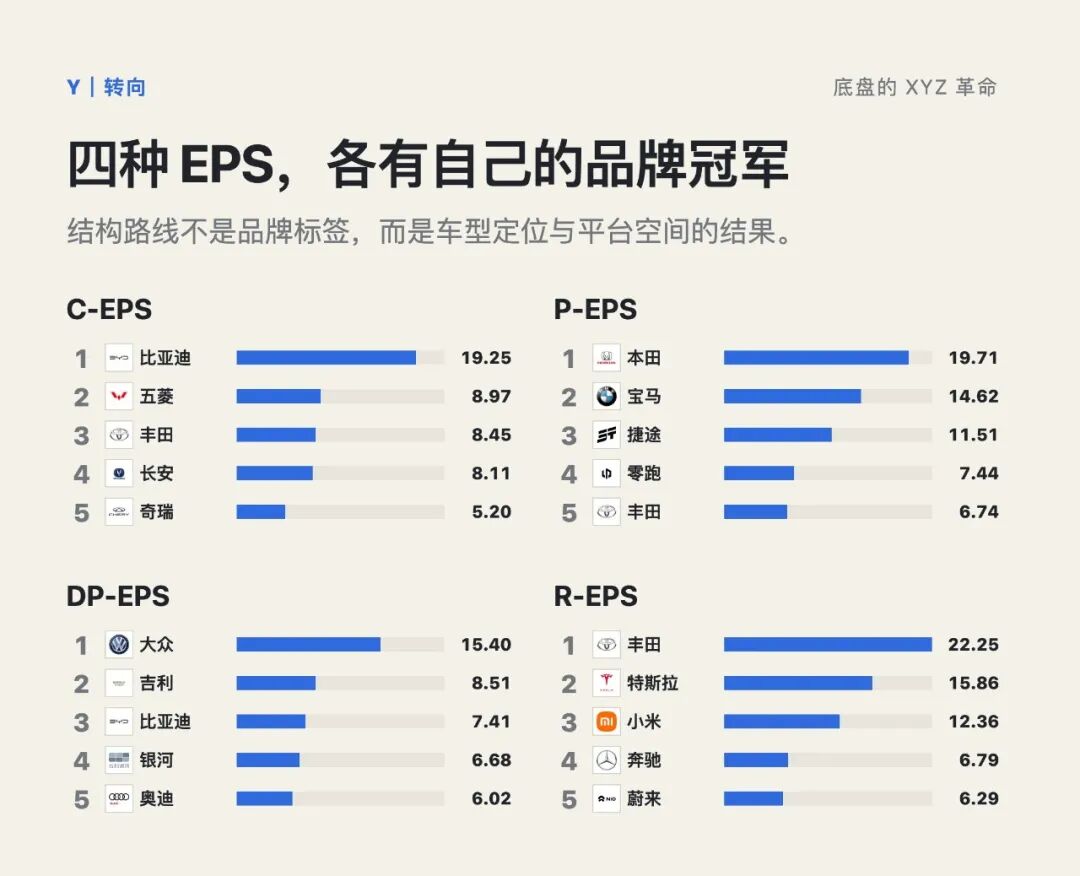
◎ In C-EPS, BYD accounts for 19.25%, followed by Wuling, Toyota, and Changan;
◎ DP-EPS brand distribution is more dispersed, with Volkswagen at 15.40%, Geely at 8.51%, and BYD at 7.41%;
◎ In R-EPS, Toyota leads with 22.25%, Tesla at 15.86%, and Xiaomi at 12.36%.
Given varying EPS demands across vehicles, the same brand may use different solutions for different models.
The core of steering route selection remains vehicle weight, positioning, platform space, and target steering feel. Previously more stable, domestic suppliers are now being introduced.
Part 2: What is the Core of Steer-by-Wire (SBW)?
Steer-by-Wire eliminates the continuous mechanical connection between the steering wheel and the steered wheels.
The driver's steering actions are read by sensors, the controller calculates the target steering angle, and the actuator drives the wheels. Without mechanical linkage, the steering ratio can be adjusted based on speed and scenario.
◎ During low-speed parking, the steering wheel requires fewer turns;
◎ At high speeds, the system can reduce sensitivity for greater stability.
The steering wheel is no longer directly affected by front-wheel impacts, and road feel can be recreated through feedback motors.
These advantages also explain the challenges of SBW.
Mechanical linkage originally served as the final backup. Without it, the steering angle sensor, controller, actuator motor, communication, and power supply must all have redundancy. The system must not only know where the driver wants to go but also continue controlling the vehicle if one channel fails.
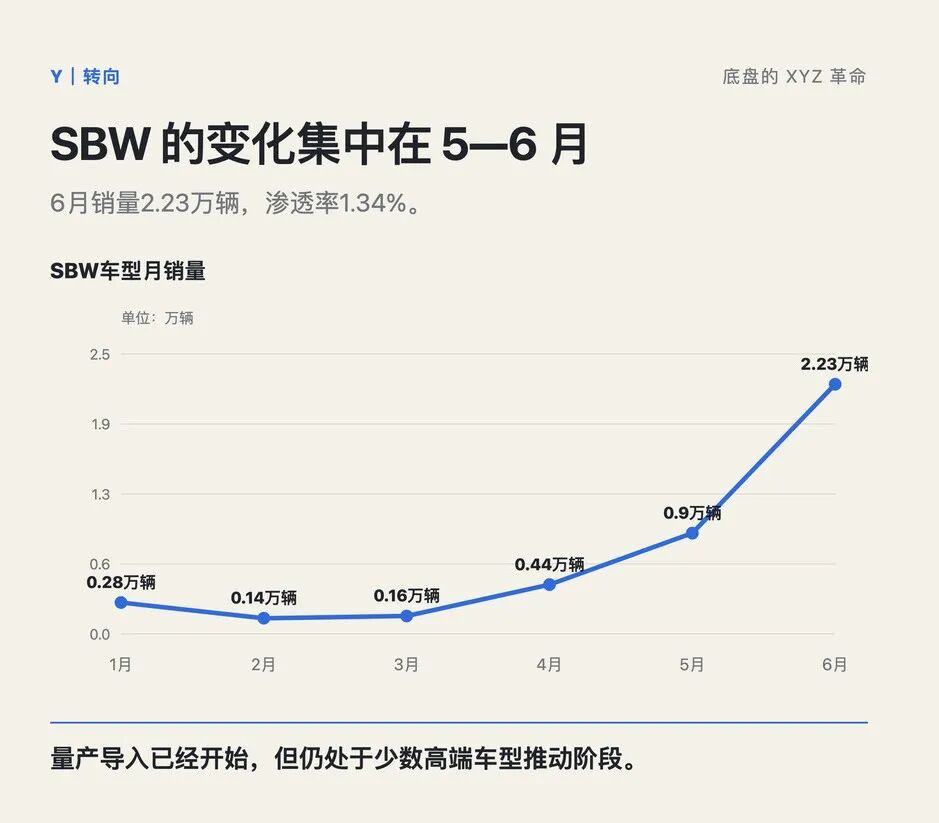
In the first half of 2026, SBW's monthly penetration rate rose from 0.18% in January to 1.34% in June, with sales increasing from 2,800 to 22,300 units. Growth primarily occurred in May and June, indicating a significant impact from new model introductions on current data.
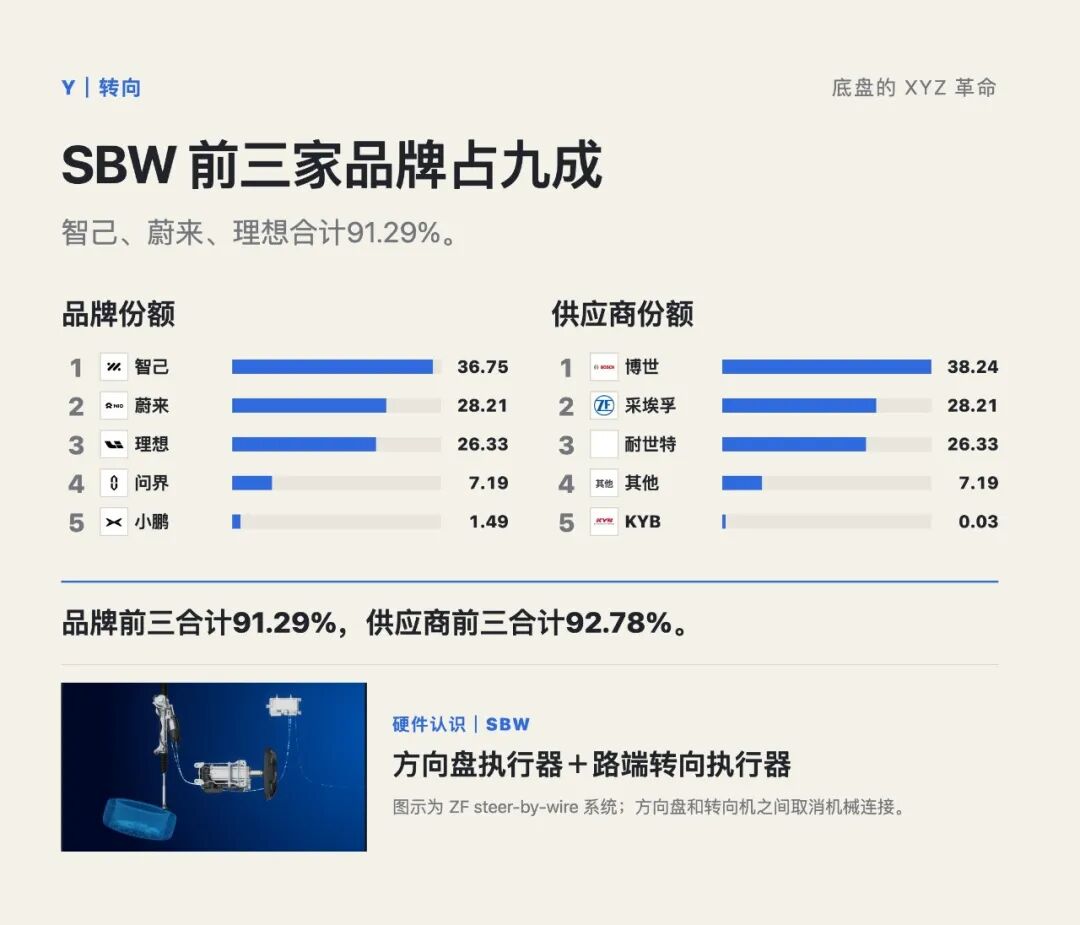
◎ Among brand shares, IM Motors accounts for 36.75%, NIO for 28.21%, and Li Auto for 26.33%, together exceeding 90%.
◎ The supply side is concentrated among companies like Bosch, ZF, and Nexteer.
Currently, SBW remains a feature of a few high-end models, with cost, regulatory validation, and long-term reliability still posing barriers to mass-market adoption. Consumers are not yet convinced (no one knows yet).
Part 3: Growth of Rear-Wheel Steering (RWS) Driven by Increasingly Large Vehicles
Rear-wheel steering does not eliminate front-wheel steering but adds an actuator to the rear axle.
◎ At low speeds, the rear wheels steer in the opposite direction to the front wheels, reducing the turning radius. A large SUV over five meters long and with an axle base over three meters can achieve maneuverability close to that of a mid-size car in underground garages and narrow roads.
◎ At high speeds, the rear wheels steer in the same direction as the front wheels, reducing body sway and making lane changes more stable.
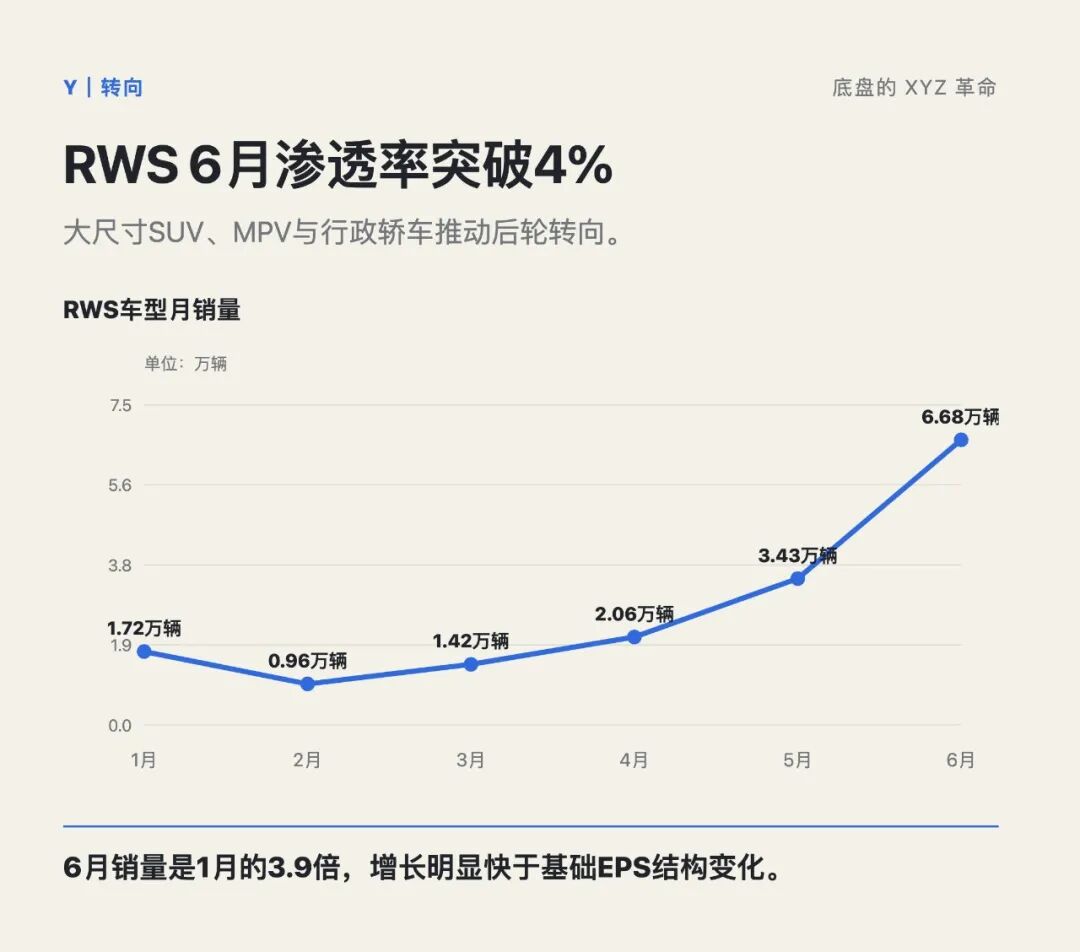
The expansion of vehicle sizes is the most direct driver of RWS growth. Previously used mainly in luxury sedans and high-performance cars, RWS is now increasingly found in large new energy SUVs, MPVs, and executive sedans, as user demand for "easy-to-drive large vehicles" becomes more pronounced.
Reports show that RWS monthly sales increased from 17,200 units in January to 66,800 units in June, with penetration rising from 1.13% to 4.01%. IM Motors accounts for 20.07% of relevant model sales, Denza for 16.85%, and XPENG for 12.35%. VOYAH, NIO, Li Auto, Volkswagen, and AITO also offer RWS.
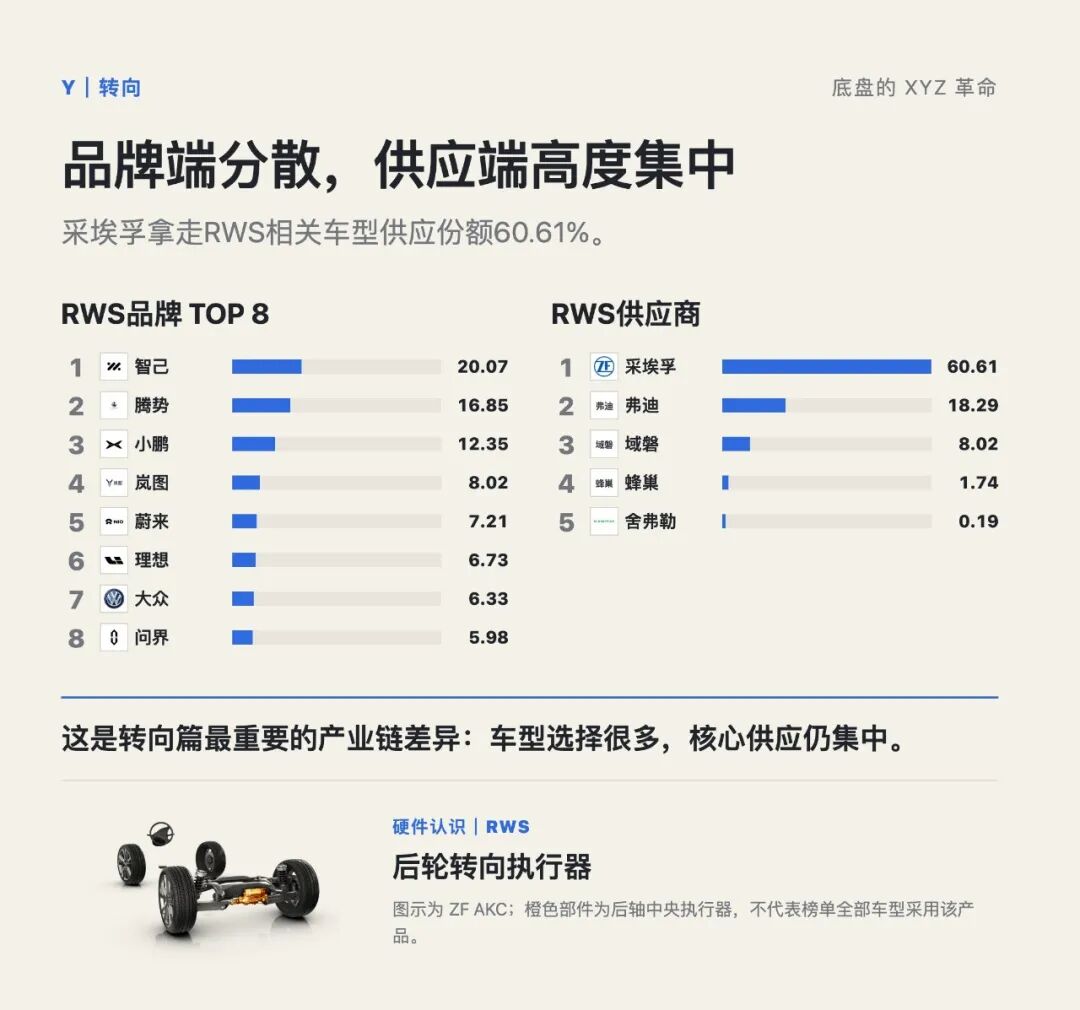
The supplier structure is more concentrated than the brand structure.
ZF accounts for 60.61%, Fudi about 18.29%, with the remaining share distributed among companies like Yupan, Hive, and Schaeffler. High concentration indicates that rear-wheel steering remains a market with high technical and customer barriers.
Steer-by-wire and rear-wheel steering are often included in the same "technology share chart" as C/P/DP/R-EPS. C/P/DP/R-EPS describe the structure of front-wheel steering assistors; SBW describes how steering wheel commands reach the front wheels; RWS describes whether the rear wheels participate in steering.
A vehicle can use both SBW and RWS or combine R-EPS with RWS.
We can view this in three layers: basic front-wheel assist structure, control chain from steering wheel to front wheels, and whether the rear wheels have steering capability.
The direction of next-generation chassis technology involves coordinating front and rear wheel angles, four-wheel braking forces, and suspension support, ultimately requiring integrated allocation by a vehicle motion control system.
During emergency evasion, the system can simultaneously adjust front and rear wheel angles and left and right wheel braking forces; during high-speed lane changes, the suspension can also help suppress body roll.
Summary
In the first half of 2026, steering system trends can be understood as follows:
The first is continuous upgrades within EPS. DP-EPS has become mainstream, and R-EPS has seen modest growth, reflecting increases in vehicle weight, size, and control precision.
The second is the expansion of lateral control boundaries. SBW is beginning to eliminate mechanical control chains, while RWS brings rear wheels into the steering system. The former had a June penetration rate of only 1.34%, while the latter reached 4.01%, spreading from a few flagship models to more platforms.
Steering system changes are significant, focusing not just on steering feel and turning radius but also on how well they can iterate with advanced driving assistance systems during communication failures, actuator failures, and extreme evasion maneuvers.
-
![]()
Registered Capital Slashed to 372 Million Yuan! Yutong Optical Finalizes Industrial and Commercial Change Registration
-
![]()
Zhuque-3 Successfully Lands, and 'Time Traveler' Secures Another ¥100 Million in Funding: China's Commercial Space Industry Experiences a 'Dynamic August'
-
![]()
Autohome Faces a Shrinking Window of Opportunity
-
![]()
Even a Titan Like Musk Has Faced Setbacks in Fulfilling Promises
-
![]()
AI Office: The End of the Racing Era, Context Becomes the Key to Success
-
![]()
Domestic Vehicle Chassis Revolution ②: The Steering Wheel Remains, But Mechanical Connections in the Steering System Are Decreasing
-
![]()
Exploring MiniMax Design: Can Video Editing Be as Simple as Speaking?
-
![]()
Why Can SenseTime Achieve Profitability While CloudWalk Still Faces Challenges, Despite Both Adopting Large Models?