Even a Titan Like Musk Has Faced Setbacks in Fulfilling Promises
 08/24 2026
 490
490
Delayed Launches, Production Halts, and Recalls
”
Author | Wang Lei
Editor | Qin Zhangyong
Musk has been navigating through a challenging period lately.
Not long ago, Tesla officially announced that the Cybercab launch event would be held on September 3, 2026, signaling the long-awaited official release of the Robotaxi, which had faced multiple delays.
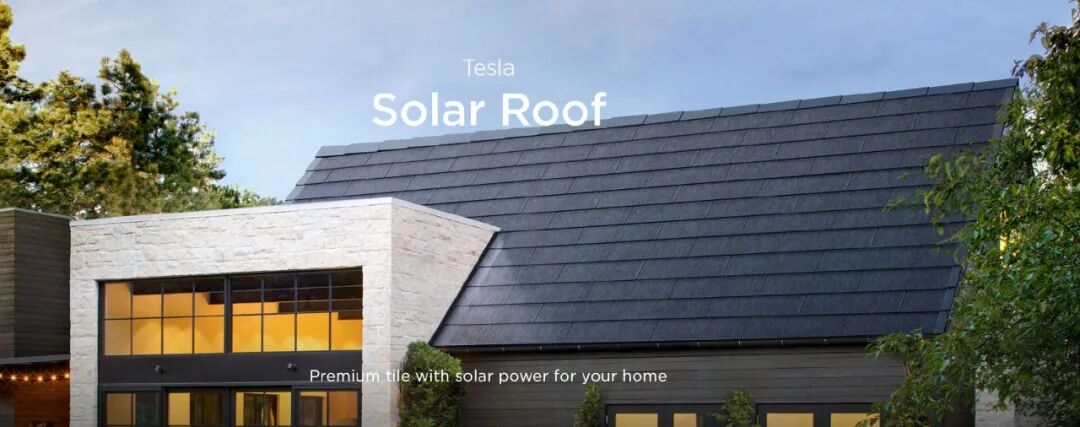
However, almost simultaneously, overseas media outlet Electrek reported that Tesla had discontinued a project that had been commercialized for a decade—the Solar Roof.
Currently, Tesla has ceased production of its solar roof product, the Solar Roof, and has informed third-party installers that it will only continue to offer traditional solar panels in the future.
Internally, Tesla determined that the product was no longer financially sustainable, i.e., it lacked economic viability.
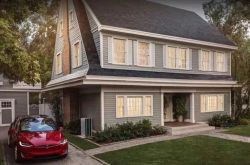
Originally unveiled in 2016 on the set of 'Desperate Housewives,' the Solar Roof, once hailed as a revolutionary 'building-integrated photovoltaic' solution, ultimately failed to overcome the most fundamental obstacle: cost, after a decade.
The challenging period doesn't end there. Shortly after recalling nearly 3 million Tesla models in China, Tesla quietly removed China from the list of countries where FSD (Supervised) is available...
01 A Decade-Long Dream Dashed
Although Tesla has not yet officially announced the discontinuation, the Solar Roof's standalone entry has been discreetly removed from the energy business menu on Tesla's current official website, which now only displays Solar Panels, Powerwall, and Megapack.
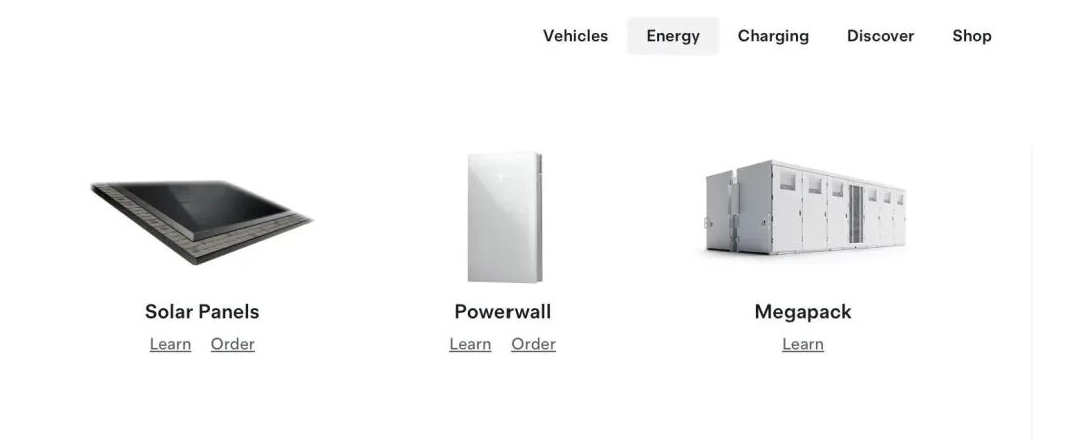
Even if one attempts to access the old URL, it automatically redirects to the traditional solar panel page, effectively confirming a signal: the product line is entering a substantive phase-out stage.
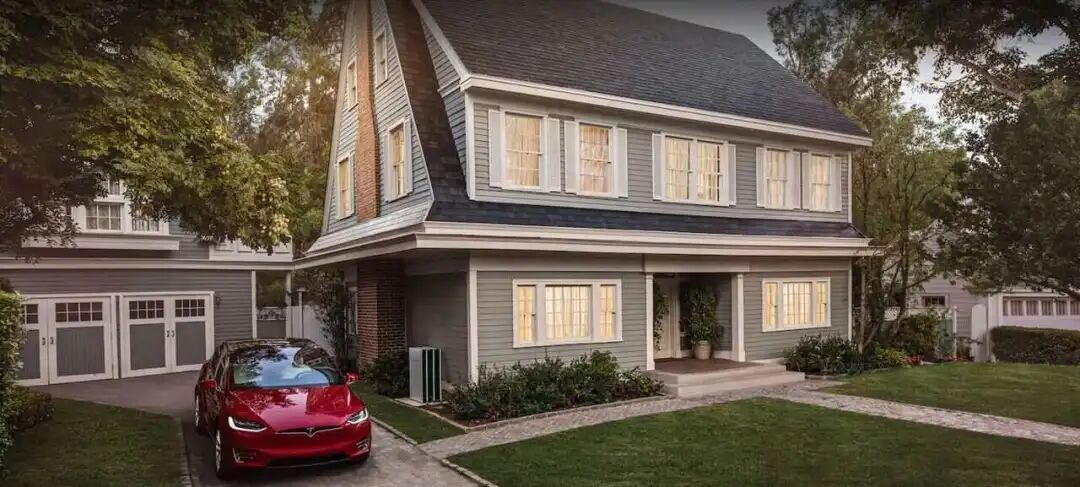
Rewinding to October 2016, to persuade Tesla shareholders to approve the $2.6 billion acquisition of the near-bankrupt SolarCity, Musk confidently showcased a 'solar tile' at Universal Studios Hollywood in Los Angeles. This tile, resembling an ordinary roof, had built-in power generation capabilities.
His vision at the time was to integrate photovoltaic cells into roof tiles, enabling the roof itself to generate electricity. This would make it both aesthetically pleasing and capable of replacing traditional roofs, with a combined cost even lower than that of 'a traditional roof plus conventional solar panels.' When linked with the home energy storage system Powerwall, it would form a self-sufficient home energy system.
This plan was considered the 'next-generation home solar solution' at the time, and Tesla's acquisition of SolarCity in 2016 was largely driven by this vision.
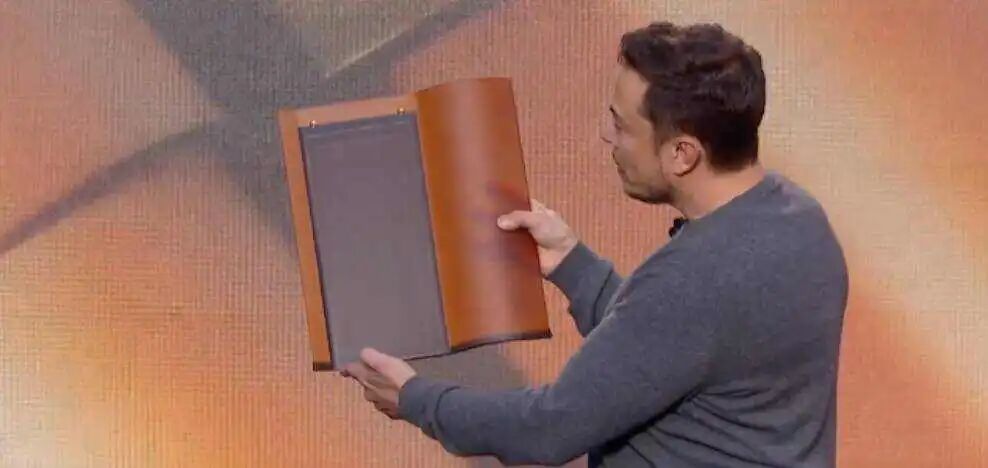
Musk promised to achieve 1,000 installations per week by the end of 2019.
However, years later, statistics from energy consultancy Wood Mackenzie directly revealed the true situation of the Solar Roof. At its peak installation period, Tesla's actual production and installation volume were only 21 to 32 units per week, with a completion rate of less than 5% of the promised figure.
From its official mass production in 2020 to 2023, the Solar Roof had only been installed in about 3,000 homes across the United States. Tesla once disputed this figure but never released its own data.
In fact, starting in early 2024, Tesla no longer separately disclosed Solar Roof installation data in its quarterly financial reports. Subsequently, the product almost disappeared from the company's marketing activities, suggesting that Tesla may have already been considering shutting it down.
Tesla had once painted a beautiful picture for the Solar Roof, claiming it would have a lower total cost than 'a new traditional roof plus conventional solar panels,' with an early quoted price of about $22 per square foot, or roughly $72,000 for an entire roof.
The idea was also appealing: treating the roof like a car body and the tiles like components inside the car. However, Tesla underestimated the on-site uncertainties and maintenance costs associated with 'roofs' as architectural components, none of which could be standardized like screwing in bolts.
Reality dealt Tesla a resounding blow. After most installations were completed, the final price for most households fell around $150,000, double Tesla's initial estimate. Some reports even indicated that individual installation quotes had reached $200,000.
Although prices varied depending on the specific house, the high cost quickly eroded the product's appeal.
Moreover, in 2021, Tesla significantly raised the price of the Solar Roof, with some contracted customer prices soaring from about $72,000 to about $146,000. The massive bills triggered collective user rights protection, ultimately forcing Tesla to reach a $6 million legal settlement in 2023.
On the surface, the Solar Roof's failure was due to its high price and small market, but at its core, it was a mismatch between the product logic and the maintenance chain.
Traditional solar panels are standardized modules with low worker training costs and good adaptability to roof structures. The Solar Roof, however, required the entire roof to use these tiles, imposing specific requirements on the roof's shape, slope, and orientation, significantly increasing installation complexity. Each installation was a custom project, leading to slow installation and high costs.
Furthermore, the Solar Roof required specially made photovoltaic glass tiles. Without scale, costs could not be reduced, and these issues combined dragged gross margins to an unacceptable level.
Even Musk once admitted that Tesla had made a big mistake, as roofs were too complex. Some roofs were uneven, some had problematic bases, and some could not support solar tiles. If customized solutions were to be provided, costs simply could not be reduced.
So, after struggling for 10 years, Musk had no choice but to cut losses and shut down the project.
02 Pseudo-Technology Should Not Override Reality
The Solar Roof's decade-long story leaves a simple reminder: no matter how innovative or beautiful a technology's form or concept may be, if it deviates from practical realities, it cannot survive.
The same principle applies to automobiles.
On August 22, the State Administration for Market Regulation (SAMR) disclosed the largest single-round recall in Chinese automotive history, involving over 7 million vehicles from 11 automakers. Tesla, with nearly 3 million vehicles, became the 'leading actor' in this recall.
The time frame covered ranged from August 2018 to February 2026, affecting all models of domestically produced and imported Model 3, Model Y, Model S, and Model X. No one was spared.
What does this mean? After operating in the Chinese market for so many years, Tesla has sold just over 3 million Model Y and Model 3 vehicles combined. This recall essentially wiped out almost the entire fleet.
The reason for the recall was straightforward: the emergency mechanical handle inside the vehicle was too similar in color to the interior, making it difficult to identify and operate. In extreme scenarios, such as severe collisions causing the vehicle's low-voltage system to fail, it could affect the ability of occupants to quickly open the doors and escape, as well as hinder rescue efforts by people outside the vehicle, posing a safety hazard.
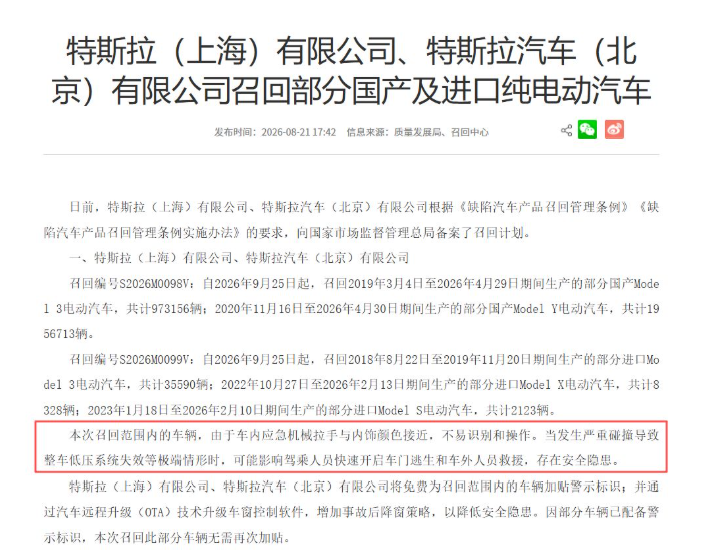
Such a wide-ranging recall cannot be blamed on others. In the past, to create a sense of technological sophistication and enhance product recognition, Tesla placed excessive emphasis on aesthetic appearance, prioritizing the integrated visual effect of interior color schemes to create a so-called 'premium feel.' This made the door opening function overly reliant on the vehicle's electronic control system, neglecting the most basic and core requirement for mechanical escape devices: ease of identification and operation.
When aesthetic design conflicts with safety fundamentals, the industry will inevitably enforce corrections.
Fortunately, this recall does not require vehicles to be brought in for door disassembly. Tesla directly offered two solutions: one is to affix a conspicuous warning label inside the vehicle door free of charge, clearly marking the location of the emergency handle. The second solution is an OTA upgrade introducing a 'post-collision automatic window lowering' strategy: upon detecting a collision, all passenger-side windows automatically lower, providing additional escape routes for occupants and rescuers even if the doors cannot be opened.
It is worth mentioning that Tesla's chief designer, Franz von Holzhausen, had previously confirmed that Tesla is redesigning both interior and exterior door handles, integrating manual and electronic release into a single, intuitive interface.
The solution has already been showcased on the Cybercab—a single clear physical button on the inside serves as both an electronic unlock and a mechanical emergency release. Future mass-produced models will likely adopt this design.
Another recall involved over 2.74 million domestically produced Model 3 and Model Y vehicles. When the assisted steering function is enabled and the vehicle is in a combined driving assistance system state, the existing steering wheel torque monitoring is insufficient to ensure driver attention.
Tesla's solution is to add another layer of cabin camera monitoring on top of the existing steering wheel torque monitoring. If the driver's gaze strays, prompts are immediately given. If corrections are not made after prompts, the system will take further measures.
Recently, it's not just this incident that has tarnished Tesla's reputation.
Around the same time, on August 22, Tesla's official website updated the global list of regions where FSD Supervised is available.
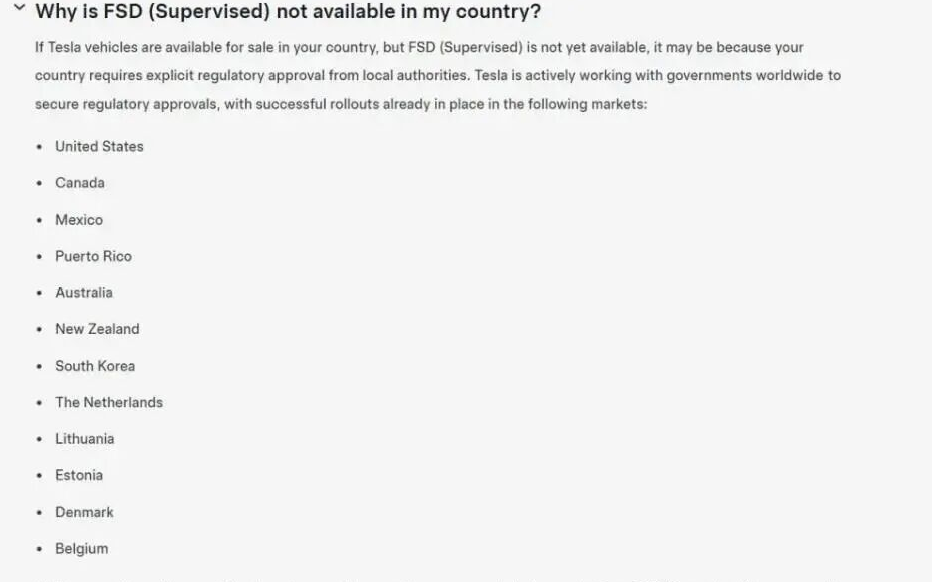
However, the latest list now includes only 12 countries or regions: the United States, Canada, Mexico, Puerto Rico, Australia, New Zealand, South Korea, the Netherlands, Lithuania, Estonia, Denmark, and Belgium.
China, which had previously appeared on the list, is now gone.
Originally, in May of this year, Tesla officially announced on multiple social media platforms that FSD was available in 10 countries and regions, with China prominently included. At the time, many owners felt that 'the wait was finally over.'
Yet, three months later, it was removed again. This signal undoubtedly means that Tesla's FSD entry into China has been 'put on hold' once more. Tesla's CFO had even stated last quarter that they were 'striving to obtain broader approval by the third quarter of 2026.'
Now, it seems this timeline, like the pies Musk always draws, will always be 'next year for sure.'
Today, Tesla is caught in a paradox: telling the most imaginative stories but being repeatedly corrected by reality and unable to deliver on its promises. From the Solar Roof to FSD, even a titan like Musk has faced setbacks in fulfilling promises.
-
![]()
Registered Capital Slashed to 372 Million Yuan! Yutong Optical Finalizes Industrial and Commercial Change Registration
-
![]()
Zhuque-3 Successfully Lands, and 'Time Traveler' Secures Another ¥100 Million in Funding: China's Commercial Space Industry Experiences a 'Dynamic August'
-
![]()
Autohome Faces a Shrinking Window of Opportunity
-
![]()
Even a Titan Like Musk Has Faced Setbacks in Fulfilling Promises
-
![]()
AI Office: The End of the Racing Era, Context Becomes the Key to Success
-
![]()
Domestic Vehicle Chassis Revolution ②: The Steering Wheel Remains, But Mechanical Connections in the Steering System Are Decreasing
-
![]()
Exploring MiniMax Design: Can Video Editing Be as Simple as Speaking?
-
![]()
Why Can SenseTime Achieve Profitability While CloudWalk Still Faces Challenges, Despite Both Adopting Large Models?