Who is the Mastermind Behind the Resurgence of "Cattle Return"?
 08/24 2026
 404
404
Another remarkable milestone in the annals of Chinese cinema, and indeed, in the broader tapestry of Chinese commercial history.
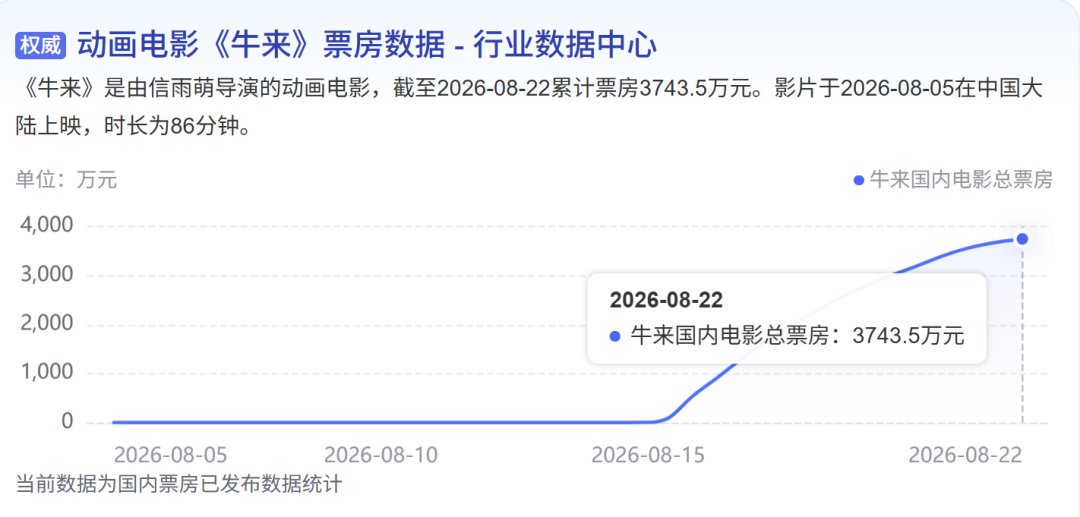
An animated film, initially grossing a mere 7,169 yuan over nine days and attracting only 236 viewers nationwide, suddenly catapulted onto the box office charts, amassing over 37 million yuan in ticket sales.
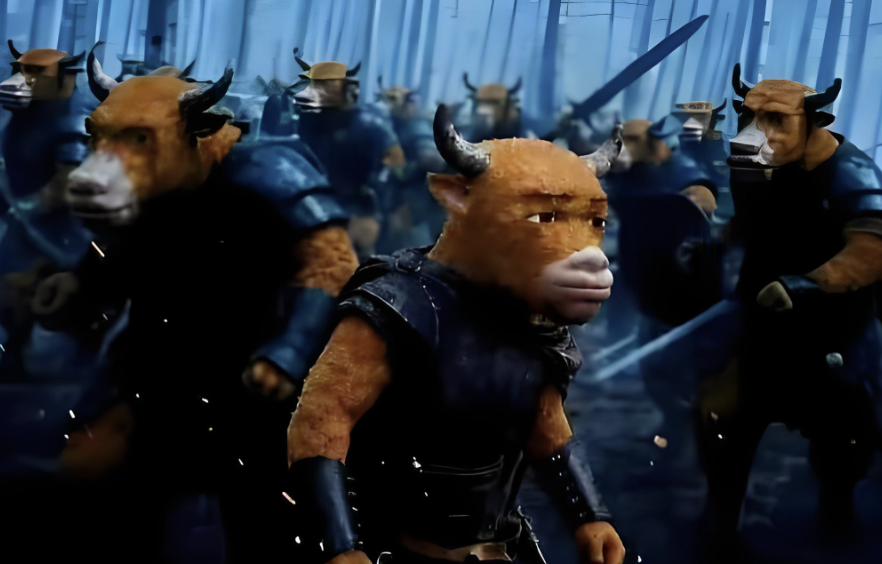
"Cattle Return" achieved its remarkable comeback without the backing of celebrity endorsements, a sophisticated marketing campaign, or significant word-of-mouth buzz. Initially, what drew netizens' attention was its rudimentary modeling, stiff animations, and astonishingly low box office performance.
Audiences first treated it as a joke, then turned the joke into a trending topic, and finally transformed that trending topic into packed screenings and substantial revenue.
This resurgence is more akin to a cinematic phenomenon than the film itself. The narrative on screen was five years in the making by Xin Yumeng and her mother, Sun Lifang. The narrative outside the screen was rewritten by the entire internet in just a few days.
From 342 yuan to 37 million yuan: How did online traffic ignite this phenomenon?
"Cattle Return" was released on August 5th, grossing only 342 yuan on its opening day. It entered cinemas almost unheralded, with no trailers, no roadshows, and minimal promotional materials. After nine days, its cumulative box office reached 7,169 yuan, with a total of 236 viewers, teetering on the brink of obscurity.
Under normal circumstances, it would have quietly faded away after screenings dwindled to zero, failing to make even a ripple.
At noon on August 14th, the Weibo trending topic "Cattle Return box office at 7,352 yuan (not 10,000)" caught the public's eye. The figure was so unusual that many initially suspected a typographical error, thinking a '10,000' was missing.
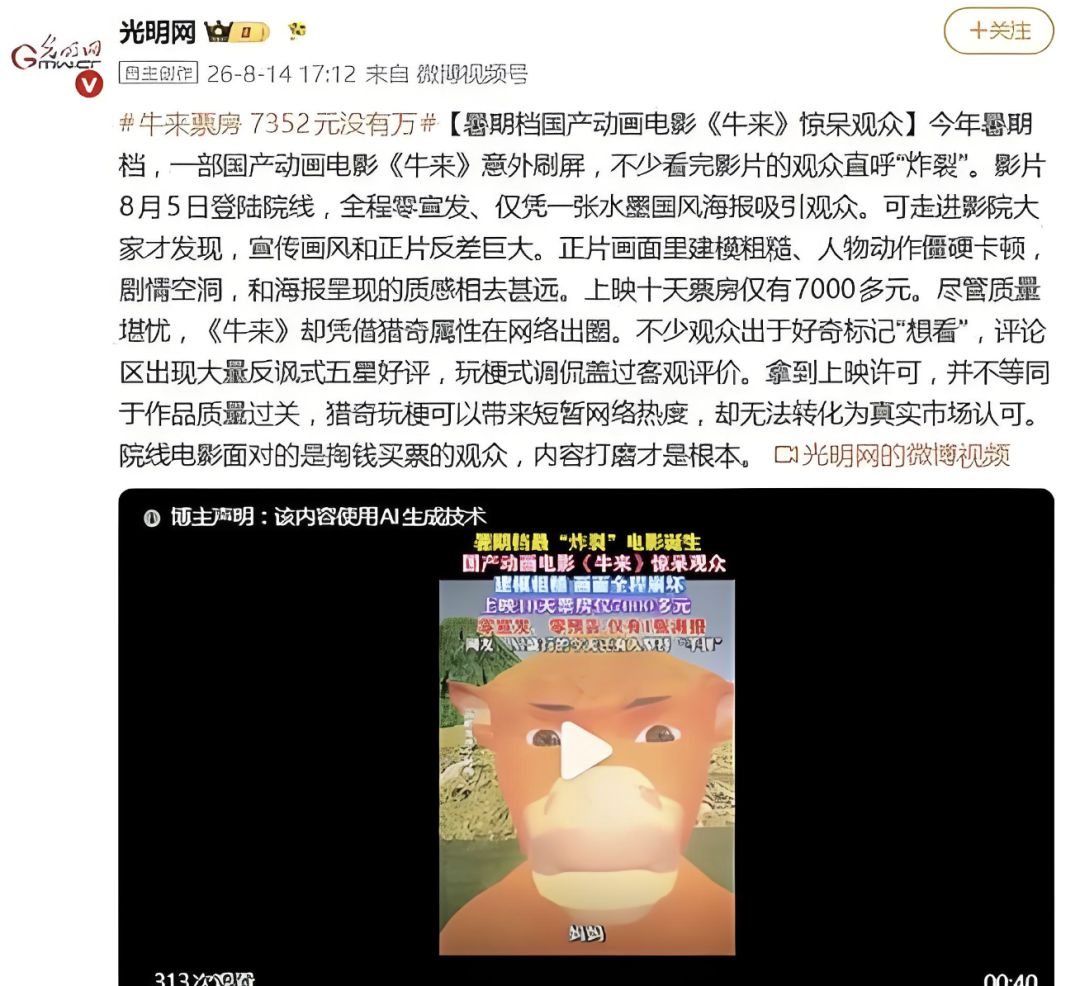
As film clips leaked, the simplistic characters, mismatched voiceovers, and disjointed plot quickly became fodder for secondary creations. "Kung Fu Women's Football" was reimagined as "Kung Fu Cattle Football," while stock traders interpreted "Cattle Return" as a harbinger of a "bull market." A children's animation was dissected into memes by different online communities.
On the day the trending topic emerged, the film's cumulative box office had just surpassed 10,000 yuan, but theaters were already sensing the surge in online traffic and shifting demand.
Public reports indicate that from August 14th to 15th, nationwide daily screenings rose from 21 to 359. Another report, based on full-day screening plans, showed an increase from 16 screenings on August 14th to 1,779 on August 15th.
While the two figures were sampled at different times, they both pointed to the same trend: cinemas were scrambling to catch up with the online traffic overnight.
On August 15th, audiences began buying tickets to 'witness history.' Some theaters added extra screenings, while staff interacted with audiences in costumed mascot outfits. Laughter, roasts (tucao, or 'roasting'), and post-screening reactions were captured in short videos.
The film was no longer just a passive object of viewing; the cinema itself became a hub of content production. Real-time updates flew thick and fast, and by 10:43 PM, cumulative box office (including advance sales) had surpassed 2 million yuan.
On August 16th and 17th, daily box office reached approximately 6.087 million yuan and 8.201 million yuan, respectively. Background details, such as the five-year production process by the mother-daughter duo, the distributor's advice against releasing the film, and the production company's origins as a renovation firm, were gradually unearthed by the media.
Beyond mere curiosity, the emotions of ordinary people pursuing their dreams clumsily began to fuel the dissemination. Meanwhile, screenwriter Wang Hailin raised suspicions of platform or institutional involvement, adding fuel to the controversy.
By August 19th, Maoyan Pro showed cumulative box office at approximately 27.53 million yuan.
As of August 22nd, cumulative box office had reached nearly 37.15 million yuan. Over eight days, this figure had grown approximately 3,377 times compared to the roughly 11,000 yuan recorded on August 14th.
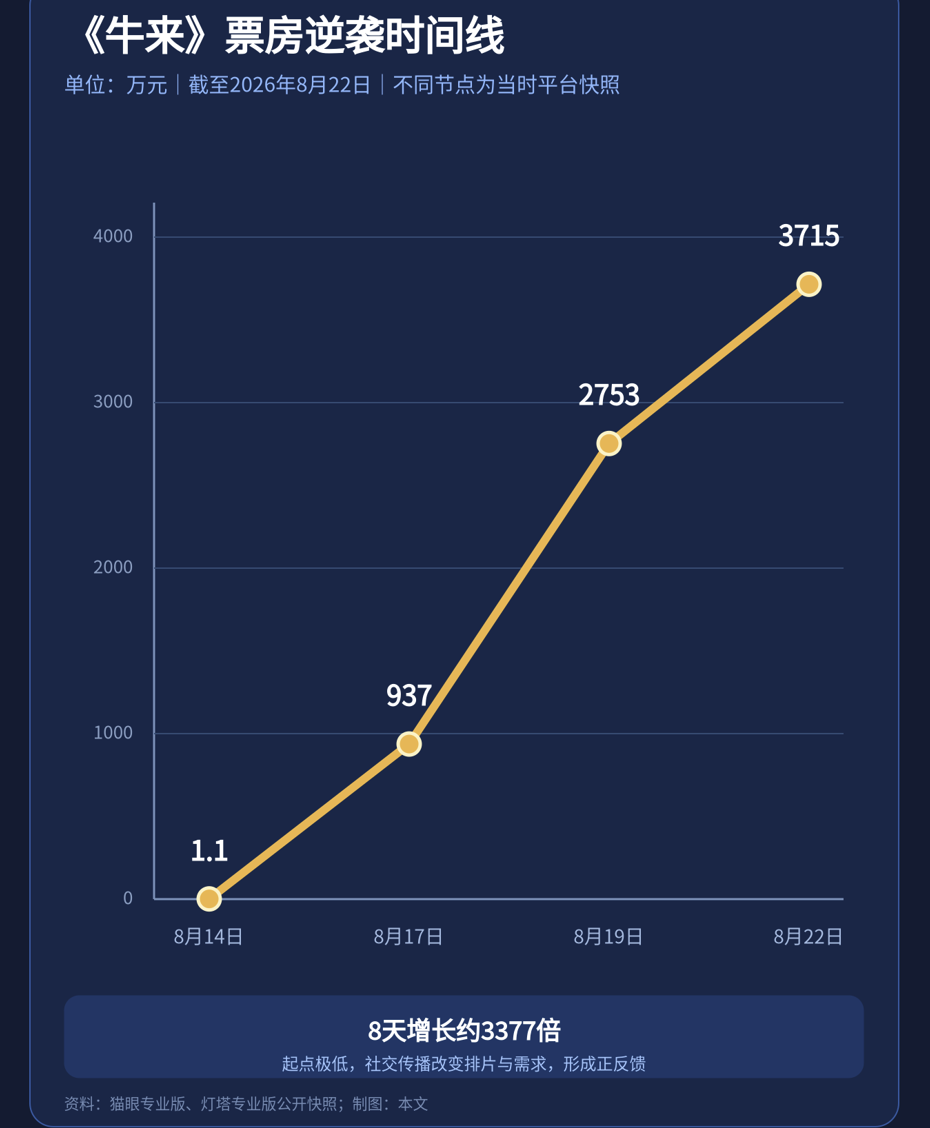
The most fascinating aspect of this timeline is how each node fueled the next.
Low box office created contrast, contrast created trending topics, trending topics drove ticket purchases, ticket purchases forced theaters to add screenings, and added screenings and box office records became new topics of discussion.
Dissemination no longer served the film; dissemination began directly participating in box office generation.

Who is riding the wave?
Claims of 'major platforms orchestrating the phenomenon' remain speculative within the industry and online. No public information—such as contracts, advertising spend, financial records, or platform statements—proves that any single entity engineered the entire explosion in popularity.
The director stated that the team did not purchase trending topics, and the producers previously admitted to lacking experience in managing social media accounts. Attributing all the attention to an invisible hand is convenient but fails to explain the complex relay of real-world dissemination.
What is truly visible is a coalition of temporary allies.
Self-media outlets spotted the extreme contrast of '7,352 yuan (not 10,000),' ordinary users contributed roasts (tucao), memes, and screening screenshots, stock traders imbued the title with bullish symbolism, theaters responded with added screenings and live interactions, and platform algorithms continuously rewarded content with high engagement (comments, shares, watch time).
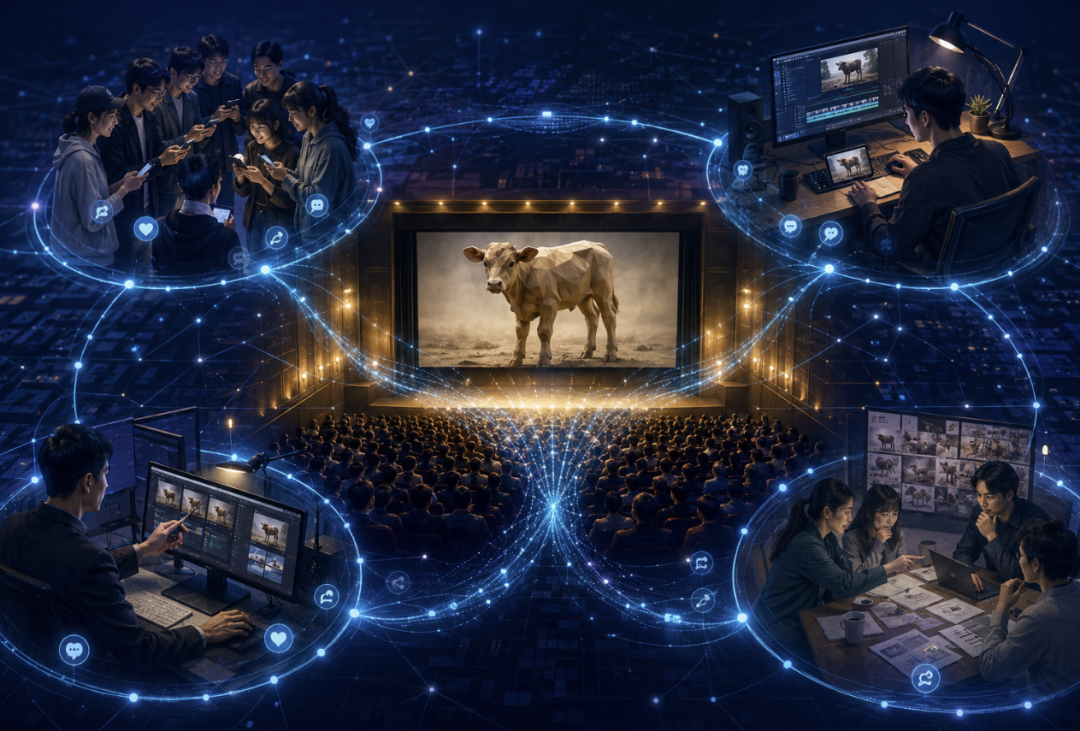
Media investigations supplemented the emotional narrative of the mother-daughter duo's five-year creative journey, while industry critics pushed the conversation toward standards of work, marketing mechanisms, and cinema admission thresholds.
No one needed centralized command. Each party acted in its own self-interest, yet collectively orchestrated a remarkably impactful dissemination campaign.
In the era of online traffic, the 'behind-the-scenes' has expanded from a single conference room into a self-reinforcing distribution mechanism.
The dissemination path is frighteningly clear: a personal roast on a niche platform → algorithmic amplification → nationwide onlookers (weiguan, or 'onlooking') → offline consumption → secondary creations → attracting even more consumers.

This is a perfectly closed traffic flywheel.
What audiences bought was a ticket to participate in the spectacle
Describing "Cattle Return" as 'ugly' explains only the initial clicks, not why thousands later flocked to theaters.
Industrialized content grows increasingly polished—and increasingly interchangeable. Standard visuals, standard emotions, and standard celebrity lineups are often swiped away by users in seconds.
"Cattle Return" stood out for its crudeness, even developing a recognizable 'ugliness.' It discomforted but also held attention.
In the algorithmic age, 'anomaly' itself is the greatest traffic password. The core driver of "Cattle Return"'s explosion was not content quality but 'contrast': the exquisite (jingzhi, or 'refined') ink-wash posters versus the crude in-film modeling, the dignity of a theatrical release versus the grassroots nature of the production team, the minuscule box office figures versus the massive online buzz.
Under algorithmic recommendation logic, 'anomalies' are far more visible and amplifiable than 'excellence.'
Audience attention has shifted from 'watching something good' to 'watching the spectacle.' This is not the success of a single film but the success of a collective performance art. Audiences know full well it's terrible yet willingly pay 30 yuan to sit in a theater and laugh for 86 minutes.
Another emotional undercurrent stems from fatigue with over-packaged content. Audiences haven't suddenly abandoned quality standards but are willing to spend a few dozen yuan on a weekend to participate in a guilt-free collective joke. Afterward, sharing ticket stubs, writing witty remarks, and joining debates may deliver more social value than the film's content itself.
The mother-daughter duo's five-year journey using secondhand equipment added a layer of tenderness to the frenzy. While their technical flaws could be mocked, their determination to bring a work to the big screen was understandable.
Curiosity, sympathy, defiance, meme-making, and support coexisted without conflict.
Today's public sentiment is rarely uniform; it resembles a constantly boiling pot of soup. As long as everyone can scoop out their preferred spoonful, the topic will keep simmering.
How much does the director actually earn from the box office?
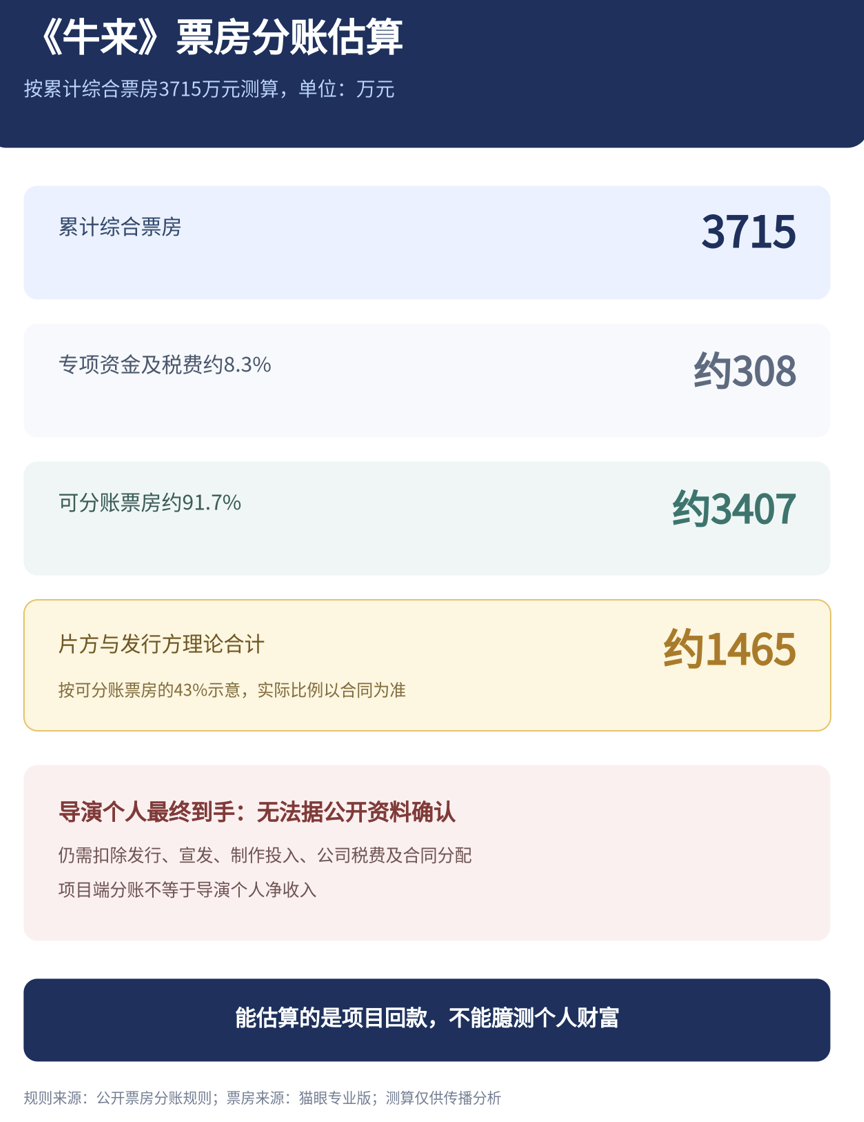
Under domestic revenue-sharing rules, approximately 5% of total box office is deducted as the Film Industry Development Special Fund, and roughly 3.3% goes to taxes. The remaining amount forms the distributable box office.
For domestic films, producers are entitled to no less than 43% of the distributable box office in principle, though the actual proportion is determined by contracts.
Based on static calculations using the 37.15 million yuan (as of August 22nd) comprehensive box office, the distributable box office is approximately 34.07 million yuan.
At 43%, the producer and distributor would theoretically share around 14.65 million yuan. After deducting distribution fees, marketing expenses, five years of production costs, corporate taxes, and allocations to various parties per contracts, the director's personal income cannot be confirmed without full disclosure of costs and agreements.
What can be reasonably inferred at this stage is that the project is likely to recoup tens of millions of yuan. Framing project revenue-sharing as the director's net income may seem sensational but conflates three entirely distinct accounts: box office, corporate revenue, and personal earnings.
A success that's hard to replicate
The lessons "Cattle Return" offers to the content industry have nothing to do with crude production; the key lies in rethinking how attention is formed.
The initial impetus for dissemination often stems from a conflict instantly understandable to all. A 7,169-yuan box office, a five-year production by two people, and crude animation on the big screen—these details spark curiosity without explanation.
Many projects habitually list cast, investment, and technology but lack a contradiction worth sharing publicly.
Audiences no longer wish to be passive viewers. They want to rewrite titles, create memes, take sides, share ticket stubs, and personally participate in the evolution of a trending topic. A work must leave blank spaces for users to insert themselves. Much of "Cattle Return"'s dissemination efficiency came from its being re-edited, reinterpreted, and renamed across the internet.
Yet such success is extremely difficult to replicate. The first crudely anomalous film is a spectacle; the second, a calculated imitation. Curiosity may briefly bypass quality thresholds but cannot sustain repeat viewings or replace creative talent.
Anyone concluding from "Cattle Return" that 'worse works fare better' sees only the lightning illuminating the sky but forgets that lightning provides no lasting power.
The producers' restraint deserves praise. Amid waves of praise and criticism, the creators acknowledged flaws in visuals and narrative without rushing to package their accidental victory as an artistic revolution.
Sudden traffic most easily leads to self-misjudgment. Understanding where heat originates is harder than enjoying it. In this, the mother-daughter duo appears more rational and pragmatic than many online influencers.
Reviewing the entire dissemination event, it resembles a scenario in my rural hometown in Hebei: a family raises an unusually silly-looking cow, which is then 'publicized' (gossiped about) by elderly women chatting at the village entrance. Young villagers pick up on it, using new methods of spreading the word, sparking onlookers (weiguan, or 'onlooking') across the entire village and town.
Reflections it brings us
"Cattle Return" did not rewrite animation industry standards but revealed new signs in the attention market. In the past, films waited for audience evaluations after release; now, audience evaluations, mockery, secondary creations, and debates continue to reshape a film's commercial fate.
The film lasted only 86 minutes on screen but has been 'sequelized' by countless internet users online.
Traffic offers ordinary creators a chance to be seen but also exposes the increasingly sharp edges of the content market.
Moderate, stable works without flaws or personality
While curiosity might initially draw audiences into theaters, they are unlikely to continue purchasing tickets if the humor remains stagnant and unoriginal.
A wave of online traffic has unexpectedly thrust an awkward calf into the limelight.
In the glow of the spotlight, everyone seems to believe in miracles.
Yet, as the lights fade, what truly endures hinges on the creators' ability to transform that fleeting moment of attention into a steady beacon, guiding their future endeavors.
Remain composed and persistently forge ahead.
-
![]()
Registered Capital Slashed to 372 Million Yuan! Yutong Optical Finalizes Industrial and Commercial Change Registration
-
![]()
Zhuque-3 Successfully Lands, and 'Time Traveler' Secures Another ¥100 Million in Funding: China's Commercial Space Industry Experiences a 'Dynamic August'
-
![]()
Autohome Faces a Shrinking Window of Opportunity
-
![]()
Even a Titan Like Musk Has Faced Setbacks in Fulfilling Promises
-
![]()
AI Office: The End of the Racing Era, Context Becomes the Key to Success
-
![]()
Domestic Vehicle Chassis Revolution ②: The Steering Wheel Remains, But Mechanical Connections in the Steering System Are Decreasing
-
![]()
Exploring MiniMax Design: Can Video Editing Be as Simple as Speaking?
-
![]()
Why Can SenseTime Achieve Profitability While CloudWalk Still Faces Challenges, Despite Both Adopting Large Models?