「Wholesale-Retail Price Inversion」 Drives Luxury Market Price Wars: From 'Open Promotions' to 'Covert Discounts'!
 01/13 2026
 479
479
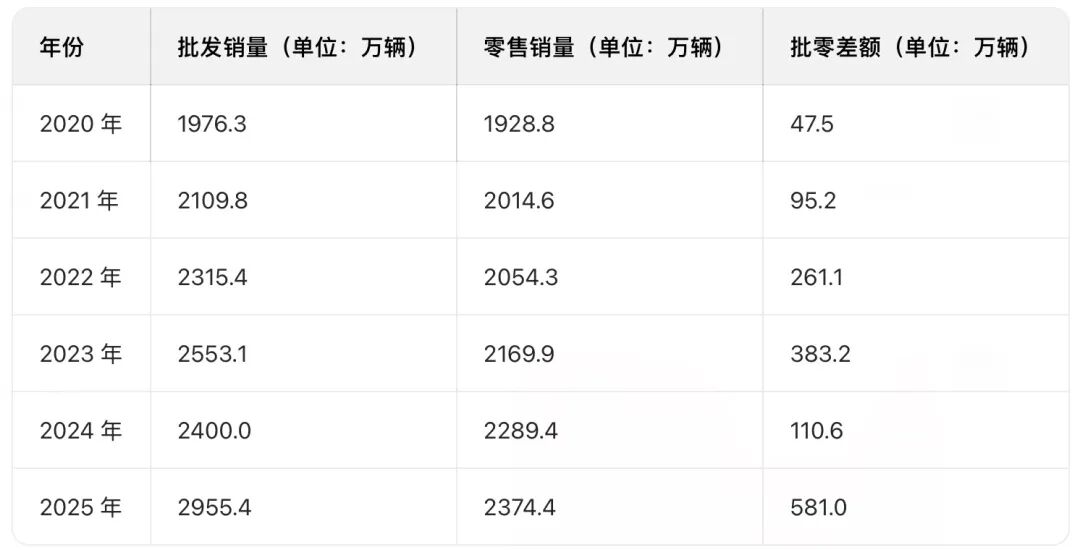
On January 11, the Passenger Car Market Information Link Branch unveiled a 'celebratory report' that caught the public eye: In 2025, China's passenger vehicle market churned out a cumulative 29.633 million units, marking a 10.4% year-on-year surge; wholesale sales soared to 29.554 million units, up 8.8% year-on-year; while retail sales climbed to 23.744 million units, a 3.8% increase from the previous year.
However, beneath this seemingly rosy report lies a starkly different reality: The gap between wholesale and retail sales has ballooned to nearly 6 million units. This indicates that a substantial portion of new vehicles is not reaching consumers but is instead languishing within the distribution network.
To put things in perspective, this figure was less than 500,000 units in 2020, marking a staggering tenfold increase in just five years. Indeed, this is not a fleeting market fluctuation but a concentrated outbreak of a fundamental imbalance between supply and demand.
Unsurprisingly, luxury automakers, previously regarded as the bedrock of industry value, will bear the brunt of this pressure and face the most significant challenges ahead.
Editor | Li Jiaqi
Image Source | Internet
1
Wholesale-Retail Price Inversion: Automakers and Dealers Caught in a 'Fire and Ice' Dilemma
The persistent escalation of 'wholesale-retail price inversion' stems from a trifecta of policy adjustments, channel pressures, and market weakness. This contradiction, which surfaced in the latter half of last year, has culminated in a 'structural imbalance' with a 6 million unit gap.
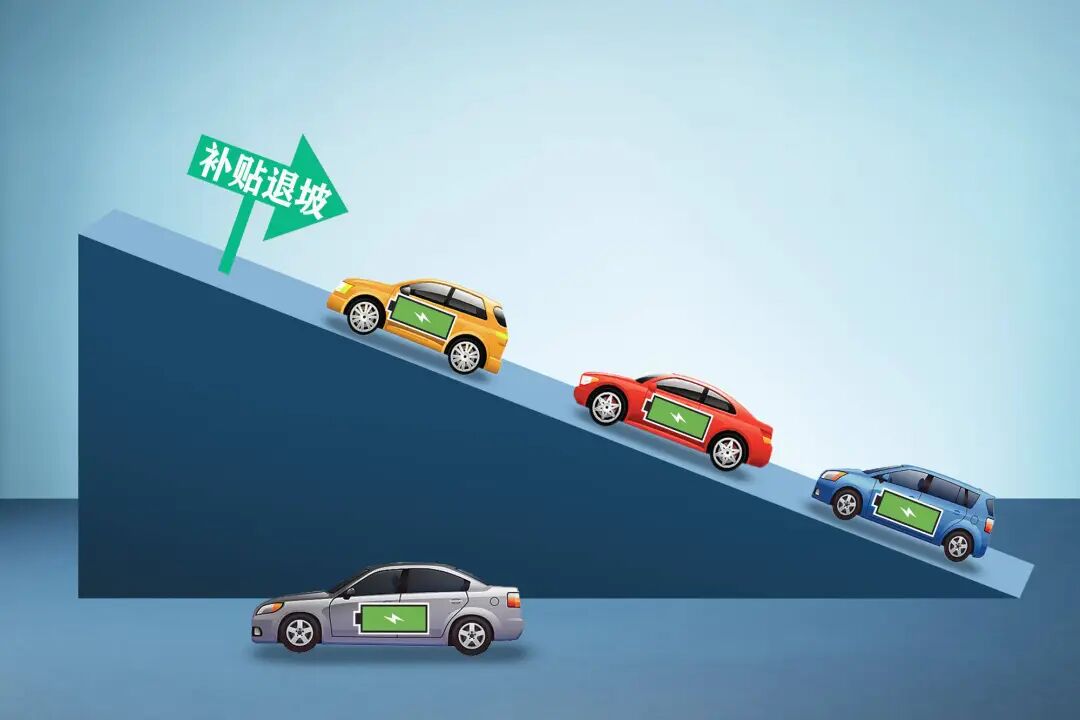
Starting this year, preferential policies for new energy vehicle purchase taxes have officially 'scaled back,' shifting from full exemption to a 50% reduction. Meanwhile, the subsidy approach under the 'Two New' automotive policy has evolved, transitioning from fixed subsidies to those based on vehicle price proportions. Although the subsidy cap remains unchanged, the actual subsidy strength for lower-priced models has effectively diminished.
Originally, policy-level adjustments were expected to stimulate consumer enthusiasm at the terminal level, encouraging them to seize the final opportunity. However, they have inadvertently intensified consumers' wait-and-see attitude. In response to the subsidy rollback, automakers have introduced 'purchase tax floor' policies, pledging to cover tax differences. Yet, this has led some consumers to adopt a 'wait for the bottom price' mentality. Coupled with the depletion of local trade-in subsidy funds, multiple regions, including Beijing and Hangzhou, have successively halted scrappage subsidies, creating a 'policy vacuum period' and further prolonging the decision-making cycle for major consumer purchases like automobiles.
In stark contrast to the 'weakness' in terminal consumption, OEMs have been reveling in sustained growth and sales surges in the fourth quarter.
By the end of 2025, it is evident that nearly all mainstream automakers have delivered impressive results. BYD's monthly sales approached 500,000 units, setting a new benchmark for Chinese automakers; Geely Auto achieved double-digit growth both year-on-year and month-on-month for nine consecutive months, with November sales surpassing 310,000 units; Chery Group's new energy vehicle monthly sales exceeded 116,000 units, a year-on-year increase of over 50%; Changan Auto's new energy vehicle sales also hit a historic high of 125,000 units, with multiple brands such as Deepal, Qiyuan, and Avita flourishing...
Upon closer inspection, it becomes apparent that behind this 'thriving' picture, dealers are silently bearing the brunt. In November of last year, the China Automobile Dealers Association issued a warning that the dealer inventory warning index for the month had climbed to 55.6%, well above the 50% threshold, with an average inventory depth exceeding 44 days. This implies that a significant portion of the sales growth did not stem from genuine demand from terminal consumers but was rather the result of OEMs pushing large volumes of inventory onto dealers.
Around the Guangzhou Auto Show, a slew of new models were launched, placing dealers in a precarious position where they had to both drive sales for new products and digest existing inventory, such as older configurations and slow-selling colors. These vehicles were difficult to sell at retail and equally challenging to resell, creating a negative cycle of 'unsellable, unreturnable, and capital-intensive.'
This has led to a persistent deterioration in the price inversion phenomenon within the dealer industry. Data shows that 74.4% of dealers are experiencing price inversion, with 43.6% facing severe price inversion exceeding 15%. A sales manager at a Japanese brand 4S store once did a simple calculation: For a model with a manufacturer's suggested retail price (MSRP) of 200,000 yuan, the factory subsidy brings the purchase price down to 195,000 yuan. However, the actual market transaction price has dropped to 180,000 yuan, resulting in a loss of 15,000 yuan per vehicle sold.
Luxury brands, with their higher per-unit value, suffer from even greater price inversion and higher capital occupation costs. Some small and medium-sized luxury brand dealers have loss ratios far exceeding the industry average. This explains why, since last year, multiple dealer stores of traditional OEMs have closed down, ranging from Yonghao Audi, the largest Audi brand 4S store in Tianjin, to Xingdebao, BMW's first global 5S store in Beijing, and numerous automotive 4S stores in Xiamen, Chengdu, Chongqing, Harbin, and other locations.
2
At the Start of 2026, Auto Dealers May Face a New Wave of 'M&A' (Mergers and Acquisitions)
Not long ago, Morgan Stanley released a research report stating that capacity reductions in the mainland automotive industry are driving industry consolidation, with luxury auto dealers set to benefit first. The direct impact of severe dealer pressures and expanding loss ratios is likely to trigger a new wave of mergers and acquisitions in the automotive industry in the first quarter of this year, just after the start of the year.
Over the past two years, the survival space for small and medium-sized dealers has been continuously shrinking. In 2024, the number of dealer network closures exceeded 4,000. In the first half of 2025, the number of 4S stores nationwide decreased by a net of 650, with 2,749 stores closing their networks. As the wholesale-retail price inversion continues to widen, this trend will further intensify in 2026.
During market downturns, leading dealer groups often leverage their capital advantages to seize 4S store resources through self-construction, mergers, and acquisitions, particularly targeting high-quality regional outlets of luxury brands. Although these outlets may face short-term losses, their long-term brand value and customer resource advantages are significant. Mergers and acquisitions not only enable scale expansion but also optimize resource allocation.
The most recent example occurred in 2021 when, hit by the pandemic, over 1,400 4S stores were deregistered nationwide in the first half of the year, with more than 1,000 stores closing their networks—equivalent to four or five 4S stores shutting down each day. During the same period, according to incomplete statistics, there were 11 integration, reorganization, and merger and acquisition events among 4S store dealer groups in 2021, involving listed companies such as Pangda, Zhongsheng, Zhengtong, and Yongda.
Now, history is repeating itself. A typical case is Zhongsheng Group. Against the backdrop of widespread industry contraction, Zhongsheng Group invested in adding over 50 new 4S stores throughout 2025, including nine in the fourth quarter. These stores are primarily located in core business districts or transportation hubs of first- and second-tier cities. The property resources in these areas, during industry boom periods, could cost 200-400 million yuan per store for construction. Now, leveraging the opportunity of some small and medium-sized dealers closing their networks, Zhongsheng can acquire mature outlets at lower costs.
For the industry, this concentration helps improve overall efficiency, effectively reduces circulation costs, and addresses the pain points of traditional dealers, such as 'price inversion and service chaos.' For consumers, the expansion of leading groups like Zhongsheng means a more transparent price system, more standardized service processes, and more comprehensive after-sales support, driving the industry to transition from 'price competition' to 'service and value competition.'
It is foreseeable that in 2026, large dealer groups will focus on targeting high-quality regional outlets of luxury brands, with mergers and acquisitions for scale expansion and resource optimization becoming more prevalent. Meanwhile, small luxury brand dealers, unable to bear the pressure, will either be acquired or close their networks, or they will focus on niche areas such as new energy vehicles and used cars to survive.
3
Behind the 6 Million Unit Gap: A 'Systemic Restructuring' of Automakers' Channel Strategies!
Looking back, the wave of mergers and acquisitions is an inevitable requirement for the restructuring of wholesale-retail relationships in the automotive industry. Only by breaking the old model of 'OEMs pushing inventory and dealers bearing the pressure' and establishing a benign and dynamic wholesale-retail relationship can the industry emerge from its predicament. This restructuring process has already taken the lead in some companies, forming distinctive practical paths.
A typical case is BMW. This New Year's Day, BMW China updated its official website prices, with concentrated price reductions on 31 models, some of which saw price drops exceeding 300,000 yuan. In the increasingly fierce market environment of price wars, this move was naturally interpreted by the outside world as 'BMW abandoning its luxury status' and 'BMW joining the price war.'
However, upon closer inspection, it becomes evident that among the 31 models subject to price reductions, all are niche models without exception, such as the 2 Series Gran Coupe, specific high-end variants of the 7 Series, and models like the X1, X2, and X6, which have seen diminishing market presence. Directly and significantly reducing the prices of these models through official channels is essentially aimed at synchronously lowering dealers' vehicle purchase costs, thereby reducing their substantial losses caused by price inversion.
Meanwhile, BMW plans to complete the restructuring of its dealer network by mid-2026, transforming some sales and after-sales service outlets into those providing after-sales support only.
Essentially, this is an attempt to preserve the fundamental channel network through 'downsizing' when market demand is insufficient to support sales scale, avoiding a systemic collapse of the network. Early this year, BMW will also fully implement an agency direct sales model in China, where dealers will no longer bear inventory pressure. Instead, the automaker will be responsible for inventory management and provide funding for various marketing and sales activities.
It is worth noting that BMW is not the only company that has recognized the channel crisis and taken measures to alleviate dealer pressure. Since last year, SAIC Volkswagen has reformed its dealer assessment system, shifting from focusing on wholesale sales to assessing retail performance and increasing the weight of service quality in assessments to over 50%. FAW-Audi advocates replacing large stores with lightweight small stores, such as its pilot Quzhou Xinao store, which has a building area of 1,200 square meters and a total investment of only 1.86 million yuan. Additionally, it has introduced temporary channel risk reinforcement stores, encouraging investors to cover fourth- and fifth-tier cities through a satellite store model...
It is certain that these adjustments to dealer channels by automakers are not simply a contraction but a systemic restructuring involving scale, service, profitability, and other aspects in response to the impact of new energy vehicles and market inventory competition. They represent a systemic response aimed at rebuilding a healthy commercial ecosystem, and their outcomes are likely to directly influence the industry's direction in the next stage.
End
-
![]()
Enflame Tech's IPO Journey: Navigating Over 5.9 Billion Yuan in Losses and Soaring Debt in Q1 This Year
-
![]()
Trillion-Yuan Giant Li Shufu 'Streamlines': Could Levc Be the Casualty?
-
![]()
AI Competes for Electricity and Generates Power in the Gobi Desert
-
![]()
The First Batch of Victims of the AI Bubble: Programmers
-
![]()
ByteDance, DJI, and Xiaohongshu Secure Top Three Positions Among China’s Fastest-Growing Unicorns
-
Tesla's in-car voice system in China is finally learning to 'understand human language'
-
![]()
Foreigners Are Amazed: Chinese Electric Vehicle Drive Systems Unveil Innovative 'Poses'
-
![]()
700,000 Brothers and the Future of Robots: Behind JD.com's 'Nirvana Plan'