IM and Xiaomi Step into the Arena: Intelligent Agents Officially Take the Stage! Automakers Relying Solely on Screens Face Obsolescence
 03/26 2026
 492
492
Is Integrating Agents into Vehicles Just a Marketing Ploy, or a Genuine Necessity?
The development pace of OpenClaw's 'Xiaolongxia' (Little Lobster) has been astonishingly rapid. Just half a month ago, discussions revolved around how to 'install Xiaolongxia' on computers, and within the next half-month, 'Xiaolongxia' was already being integrated into automobiles.
Recently, IM Motors unveiled the IM Ultra Agent, powered by Alibaba's QianWen large model. This system seamlessly connects the drive-by-wire chassis, IM AD intelligent driving model, and intelligent cabin model, enabling users to perform complex tasks such as vehicle control, itinerary planning, and accessing lifestyle services simply by voicing their needs.
Previously, intelligent vehicles were primarily characterized by the inclusion of voice assistants capable of responding to user commands. Now, intelligent vehicles have evolved into intelligent entities capable of movement and perception.
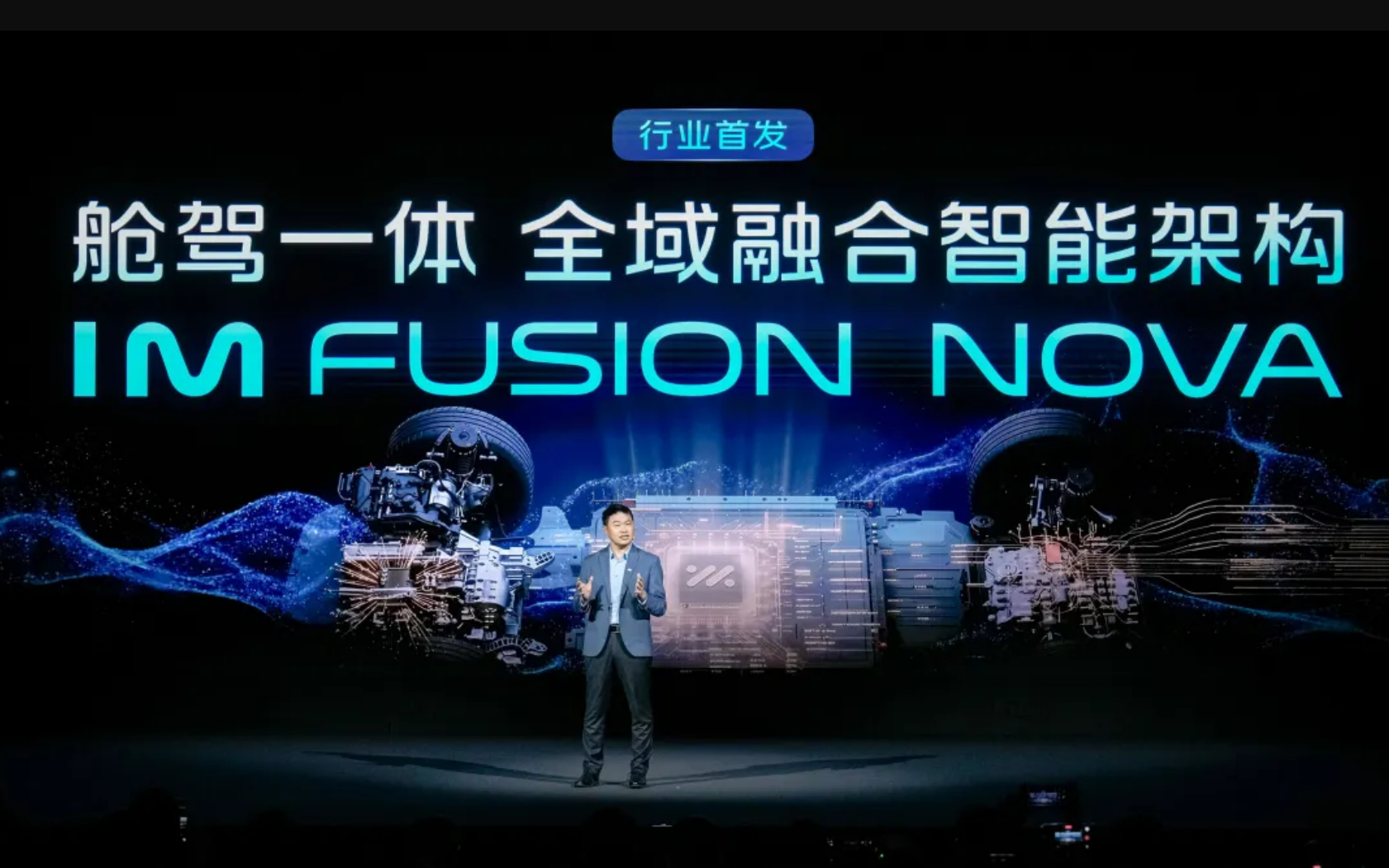
(Image Source: IM Official Image)
Conceptually, this is the vision, but the question remains: Is the term 'intelligent entity' just another speculative concept in the evolution of automotive intelligence, or is it a tangible promise?
'Question-and-Answer' Interactions Are Outdated! Proactive Intelligence Is the Future
Concepts like OpenClaw and Agents have recently surged in popularity, yet for the past two to three years, the intelligent development of cars has largely progressed at a snail's pace. Although occasionally, novel and intriguing concepts emerge, providing users with a sense of freshness, such as adding more screens or enabling cars to execute a series of commands, these features essentially remain human-vehicle Q&A interactions.
The underlying logic of this voice control interaction is straightforward: users trigger keywords within the operational lexicon, and the car responds according to the preset code in the lexicon. The richer the command library, the smarter the car appears.
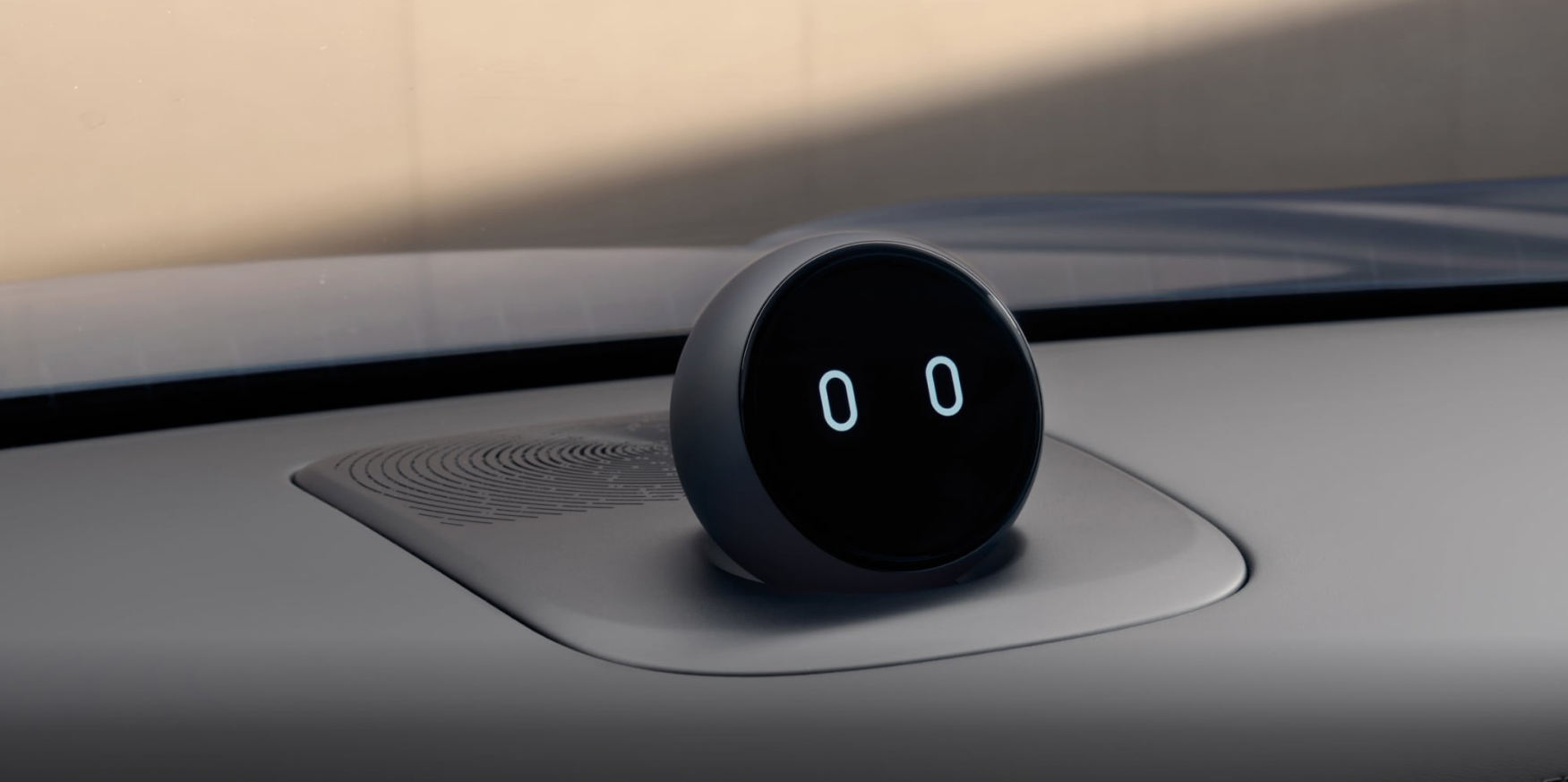
(Image Source: NIO Official Website)
However, this so-called intelligence merely treats the car as a 'marionette,' moving only when prompted. Users speak a command, and the car follows suit, completely lacking autonomous thinking capabilities.
User demands are becoming increasingly diverse. Q&A interactions can no longer represent true automotive intelligence; instead, it is crucial to enable key domains such as the chassis, cabin, intelligent driving, and powertrain to work in synergy.
This is where the Agent comes into play. Through deep thinking, it transforms Q&A interactions into 'proactive intent understanding behaviors,' upgrading to a proactive thinking intelligent entity that controls the entire vehicle.
Some may question the necessity of automotive intelligent entities capable of proactive thinking. We can illustrate the difference with and without an Agent by considering a common family travel scenario:
Take the most typical family travel scenario: when music and navigation sounds are playing inside the car, and family members, including children, are fast asleep in the back, IM's IM Ultra Agent can observe through in-car cameras that the rear passengers are asleep and proactively remind the driver to switch the entire vehicle to comfort mode.
Upon confirmation, the Agent automatically transfers the music and navigation sounds to the main driver's headrest speakers for separate playback; simultaneously, it adjusts the powertrain and suspension to comfort mode and independently regulates the air conditioning temperature across different zones.
Throughout this process, the driver only needs to press OK on the steering wheel to confirm, and the sleeping passengers in the back will hardly notice anything.
Conversely, if operating according to passive response commands, the driver would need to issue voice commands like 'Help me switch the driving mode to comfort,' 'Set the rear air conditioning to 25 degrees,' and 'Lower the volume to level 3.' After the user finishes this string of voice commands, regardless of whether the system can support executing a series of commands, the sleeping family members in the car would likely be awakened, which does not effectively demonstrate the power of intelligence.
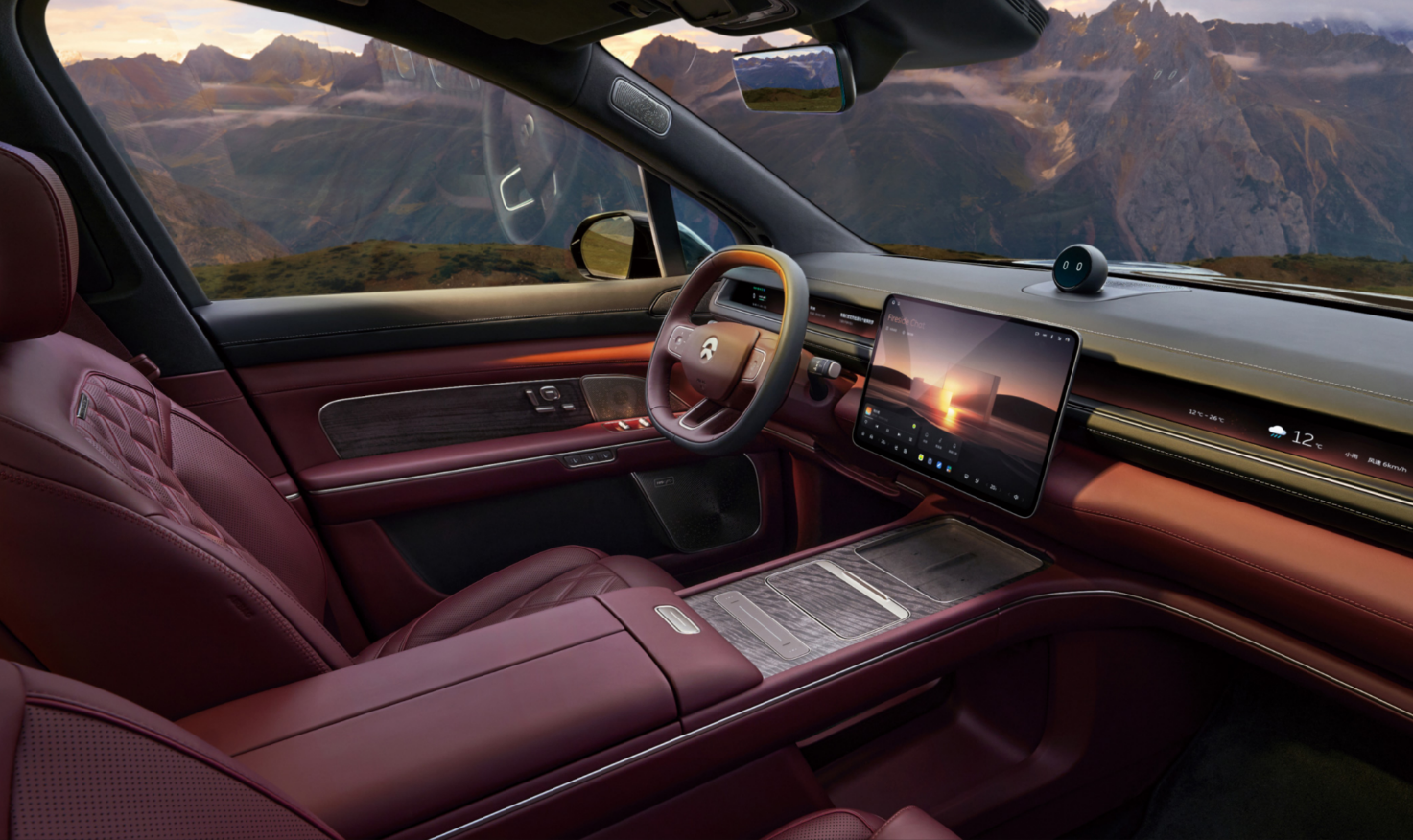
(Image Source: NIO Official Website)
Current automotive intelligent entities have largely met the intelligent needs of travel, but the imagination for automotive intelligent entities extends far beyond the car. Once they achieve cross-scenario collaboration, the multi-dimensional integration of 'human-vehicle-home' will naturally follow.
For example, on a rainy day after work, users might simply issue the command 'Come downstairs to pick me up after work' to their phones, and the Agent can proactively think based on real-time information around the car, such as traffic congestion and weather forecasts.
The car's subsequent operations should include: activating the intelligent driving system to drive from the parking lot to the user's office building to wait; automatically adjusting the in-car air conditioning temperature to an appropriate range based on the outside temperature; identifying the user's face through the FaceID system outside the car and automatically opening the door after confirming the face ID; automatically selecting a congestion-free route home based on navigation information after the user gets in the car.
Meanwhile, the Agent issues commands to smart home devices at home, such as air conditioners, water heaters, and lights, to prepare the home in advance. After the user arrives home and gets out of the car, it then calls the intelligent driving system to park automatically according to preset parking space information. Throughout this entire operation, the user can achieve nearly zero intervention.
These operations may seem far-fetched, but they are not wild guesses by Dianchetong; rather, they are envisaged based on the existing level of automotive hardware. Their actual implementation is only hindered by L3 conditional autonomous driving and an Agent capable of proactive thinking.
As the Agent is continuously trained and optimized, coupled with the addition of more hardware to the car, the degree of automotive intelligence may far exceed what we currently imagine.
IM, Xiaomi, Huawei Enter the Fray: The Battle of Intelligent Entities Begins
When IM Motors unveiled the IM Ultra Agent, it claimed to be the 'first automotive intelligent entity,' but in reality, brands like Geely, Huawei ADS, and Xiaomi are also constantly exploring intelligent entities, albeit with different progress and paths.
From Dianchetong's perspective, a truly powerful automotive intelligent entity cannot solely focus on the car itself or stop at simple 'human-vehicle-home' collaboration; more critical is a comprehensive layout of the entire ecosystem.
If we broaden our perspective to the entire ecosystem, the car plays the role of 'hands and feet' in the system, with the Agent serving as the 'brain' that issues commands.
Understanding this relationship makes it clear that who first claims to be the 'first intelligent entity' is not as important as who can first expand their ecological footprint.
From this perspective, IM's IM Ultra Agent does have its background advantages.
Backed by Alibaba's QianWen large model, it can be applied in a wide range of scenarios, such as integrating with Alipay to enable automatic payment when vehicles enter and exit parking lots or pass through toll roads; integrating with Taobao and Cainiao systems to allow deliveries and takeout to be sent directly to the car; integrating with Hema systems to enable the car to autonomously complete grocery shopping, essentially solving trivial lifestyle consumption issues.
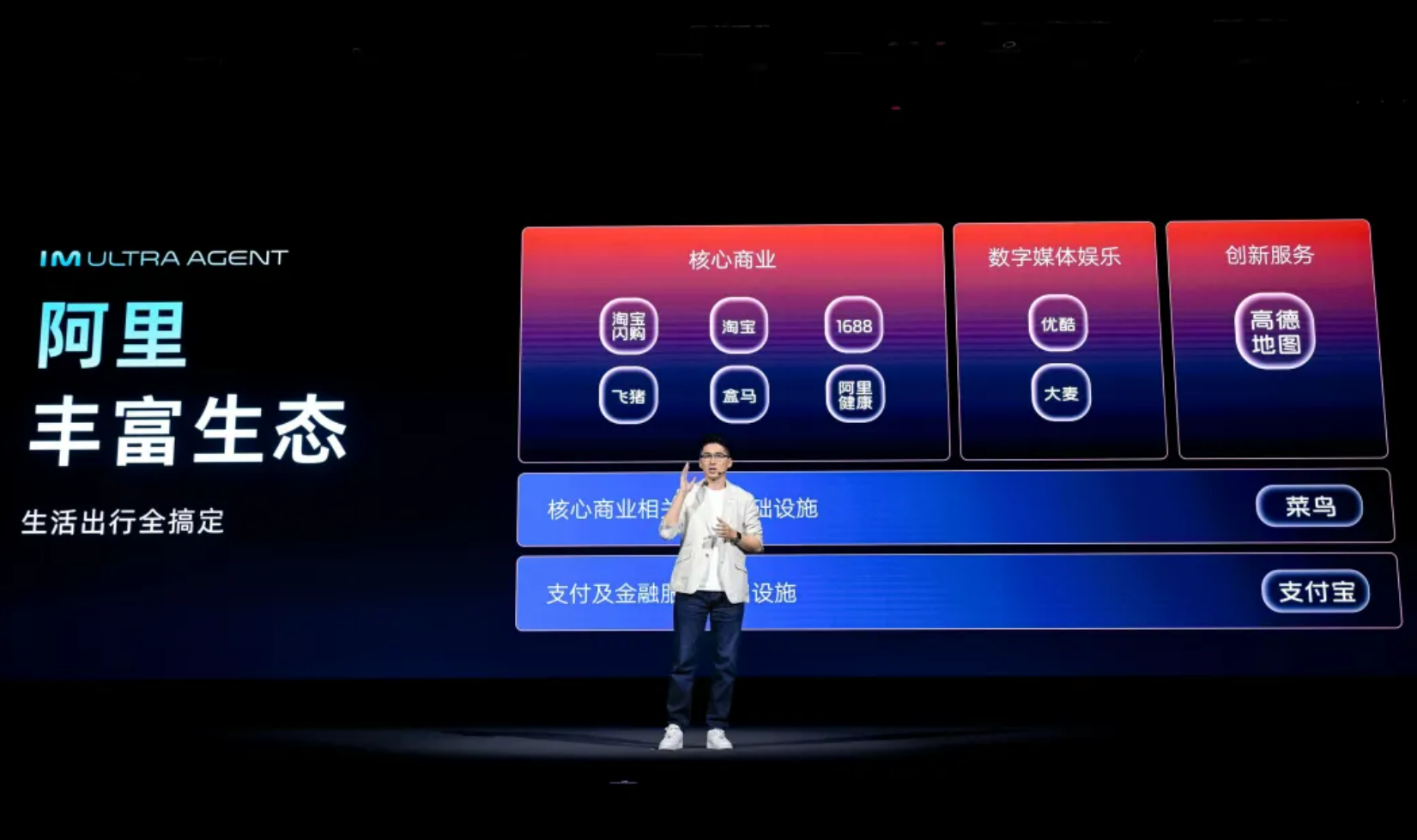
(Image Source: IM Official Image)
For work-related travel, the IM Ultra Agent can also handle tasks such as travel ticket booking, DingTalk collaborative office work, warehouse logistics management, and cloud computing, combined with multi-dimensional control over the vehicle's intelligent driving and cabin, effectively combining the roles of assistant, driver, and butler, giving a glimpse of what future automotive intelligent entities might look like.
However, whether these experiences are truly viable depends on the IM LS8, which is the first to be equipped with the IM Ultra Agent.
Looking at the domestic automotive market, besides IM's IM Ultra Agent, several other brands have also introduced their own Agents, such as Xiaomi's MiclawAgent and Huawei's Xiaoyi Intelligent Entity.
Xiaomi boasts an exceptional ecosystem and a strong layout in the automotive industry. From the outset, Xiaomi Automotive has embraced the 'human-vehicle-home' concept, but to truly connect these three elements, a linking intelligent entity is needed.
To this end, Xiaomi launched the MiclawAgent in March. Although its development is currently limited to the software level, given Xiaomi's pace, breaking through hardware barriers and bringing it onboard should only be a matter of time.
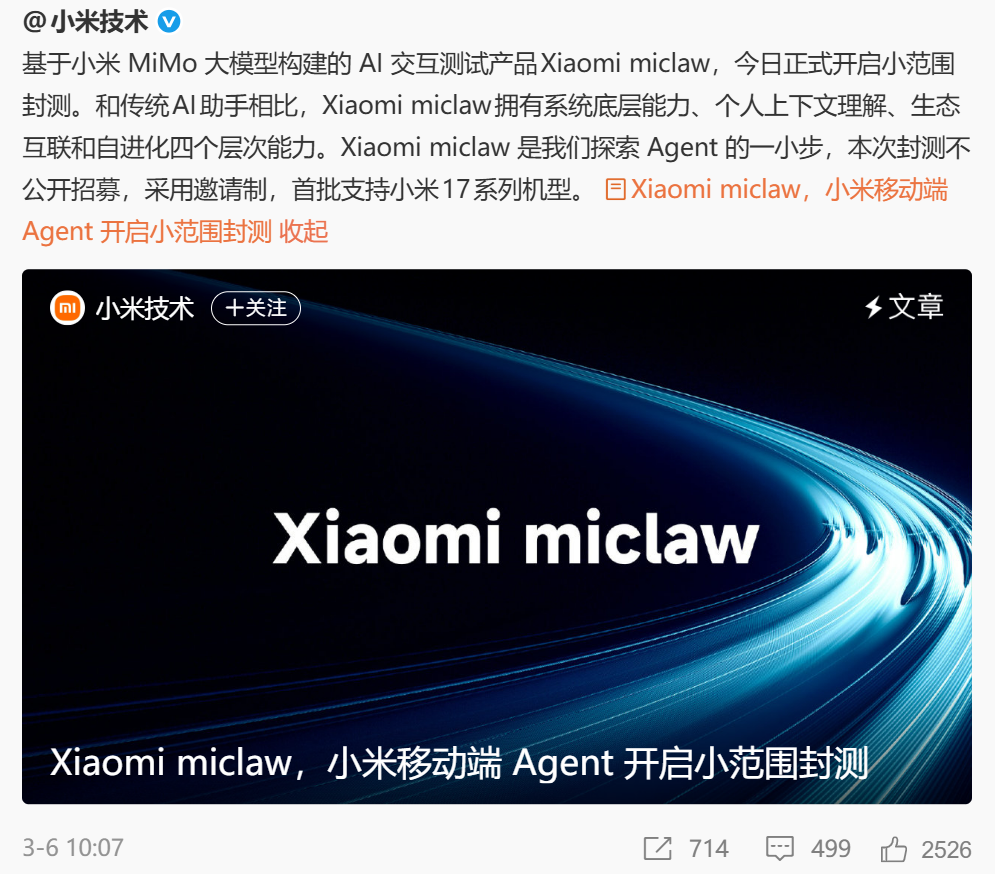
(Image Source: Screenshot of Xiaomi Technology's Weibo Post)
On Huawei's side, the Xiaoyi Intelligent Entity has already started rolling out to HarmonyOS Intelligent Driving users. Although it does not yet have the authority to control the entire vehicle, as users continuously 'feed' it data, the Xiaoyi Intelligent Entity will develop stronger autonomous awareness. Through future OTA upgrades, it will be able to do more and more for users, potentially becoming a crucial piece in Huawei ADS's development of automotive intelligent entities.
Some automakers are still trying to prove their intelligent advantages by the number and size of screens, but honestly, this approach is outdated. The upcoming competition will focus on whose Agent can think better and whose ecosystem covers a broader range, enabling users to get things done efficiently and effectively, which is the key to winning market recognition.
Addressing Two Major Concerns About Agents Onboard, Once and for All
Users who have previously played with 'Xiaolongxia' on PC and heard that Agents are being brought onboard cars might wonder: How can safety be ensured? How many underlying permissions are needed to call upon so many functions? And with so many Tokens being burned, will the cost of using the car skyrocket?
These concerns are understandable, but the reality is different. Agents in automotive scenarios and general-purpose scenarios on PC have fundamentally different operational logics.
First, let's talk about safety and privacy. 'Xiaolongxia' on PC mainly relies on the computational power of cloud-based large models to execute commands, exposing our files and operation records in the data transmission chain, thus raising safety and privacy concerns.
Automotive intelligent entities, however, operate on a 'vehicle-end primary, cloud-end secondary' logic. Core data from the intelligent cabin, high-level intelligent driving, and drive-by-wire chassis are all processed on the vehicle-end chip and do not need to be uploaded to the cloud, physically achieving 'data stays within the car.'
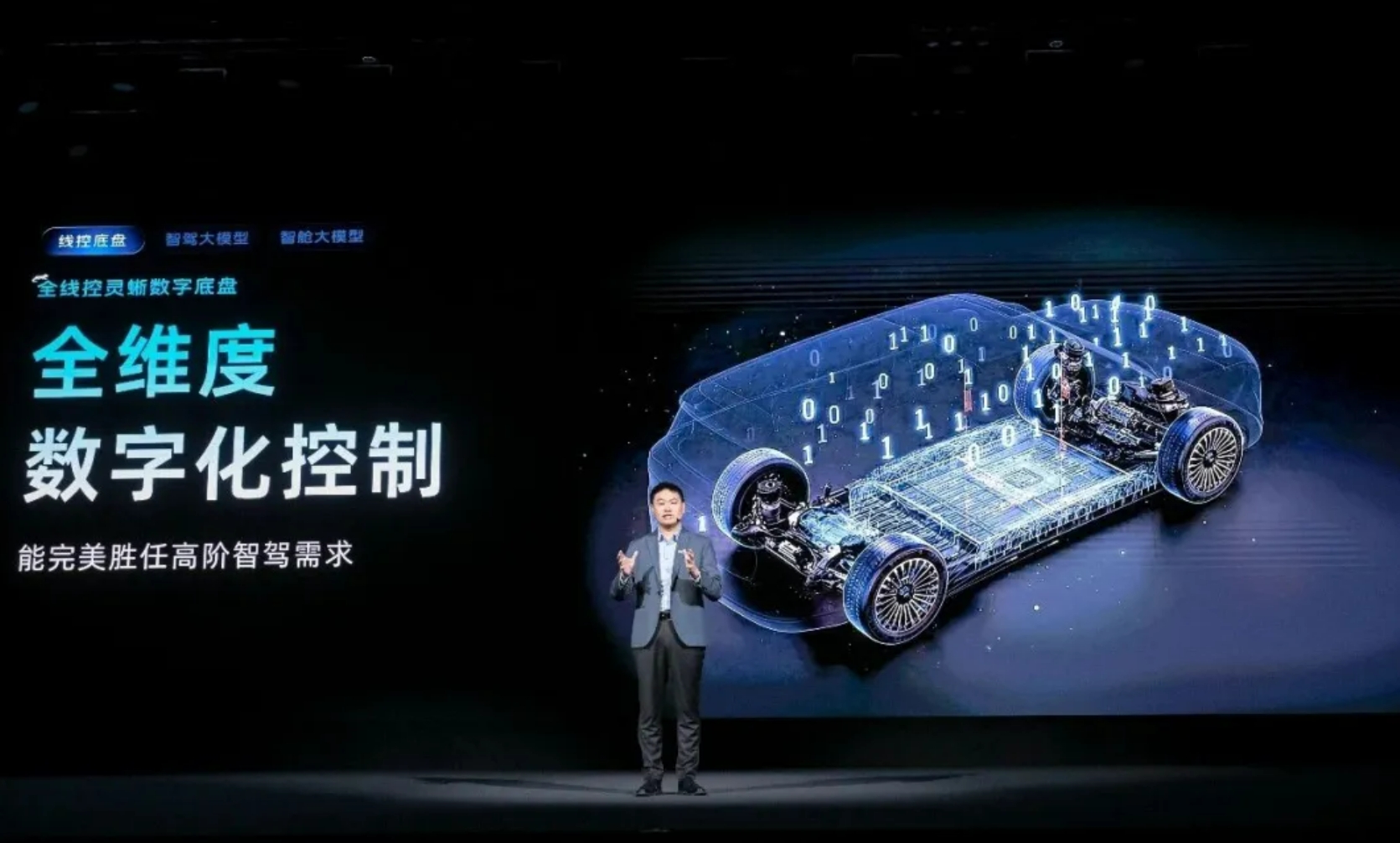
(Image Source: IM Official Image)
Now, let's address the issue of Token consumption. Since automotive intelligent entities can process data on the vehicle-end without massive cloud-based computational demands, there is no situation of massive Token consumption, and usage costs naturally remain low.
For example, it would be absurd if, when a user says 'go to the charging station to charge,' the Agent calls upon a cloud-based large model to ponder whether the user wants to charge with 'hydroelectric,' 'thermal,' or 'nuclear' power. Even if there is a need to call upon the cloud, the Token cost would be negligible.
After discussing safety and cost, let's revisit the question at the beginning of the article: Is the automotive intelligent entity just a fictional concept?
Dianchetong believes not. It is more like pointing a direction for automotive intelligence, showing consumers what the future of intelligent vehicles looks like. Bringing Agents onboard essentially lowers the operational barriers for users and serves as an assistant to help people use cars better.
However, one thing must be clear: automotive intelligent entities must be paired with a complete ecosystem to maximize their effectiveness. If they only revolve around the car itself, they are no more than 'Xiaolongxia' kept in a fishbowl, looking fresh but unable to swim out.
(Cover Image Source: IM Official Image)
Xiaolongxia, OpenClaw, Xiaomi, IM, Huawei
Source: Leikeji
All images in this article are from 123RF's licensed image library.
-
![]()
The Unstoppable Rise of 'Optical Progress and Copper Decline': Sunny Optical’s Strategic Vision for the Next Decade
-
![]()
AI + Going Global in the Second Half: No Intermission for Robot Vacuum Cleaners
-
![]()
The Suffering Endured in E-commerce, Walmart Doesn't Want to Repeat in AI
-
![]()
What Does the Doubling of New Energy Vehicle Exports Mean?
-
![]()
Ghosn: 'Only I Can Save Nissan'
-
![]()
Volkswagen Lays Off 100,000 Employees, The Elephant Sits Down
-
![]()
Expanding Production Capacity! Yutong Optics Acquires Approximately 1.5 Hectares of Industrial Land in Chang'an, Dongguan
-
![]()
Why Is Nokia Making a Comeback in the AI Era?