2026 New Energy Year Start Showdown: Chery Rhino Battery vs BYD's Second-Generation Blade Battery
 03/26 2026
 494
494
Author | E V · Yi
Editor | Dexin
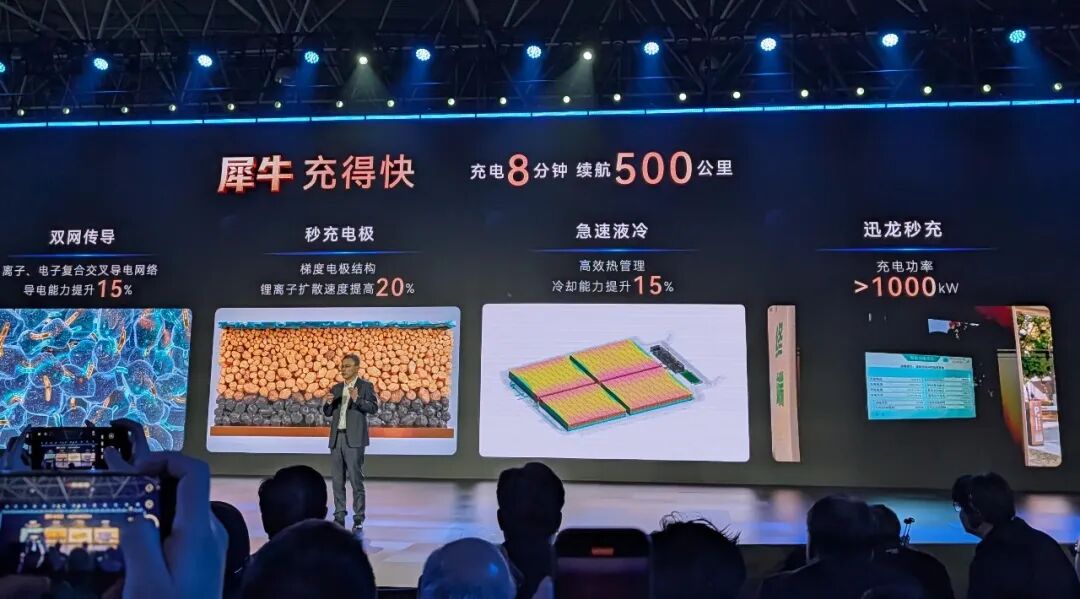
On March 18th, just half a month after BYD unveiled its second-generation Blade Battery, Chery introduced the Rhino Battery.
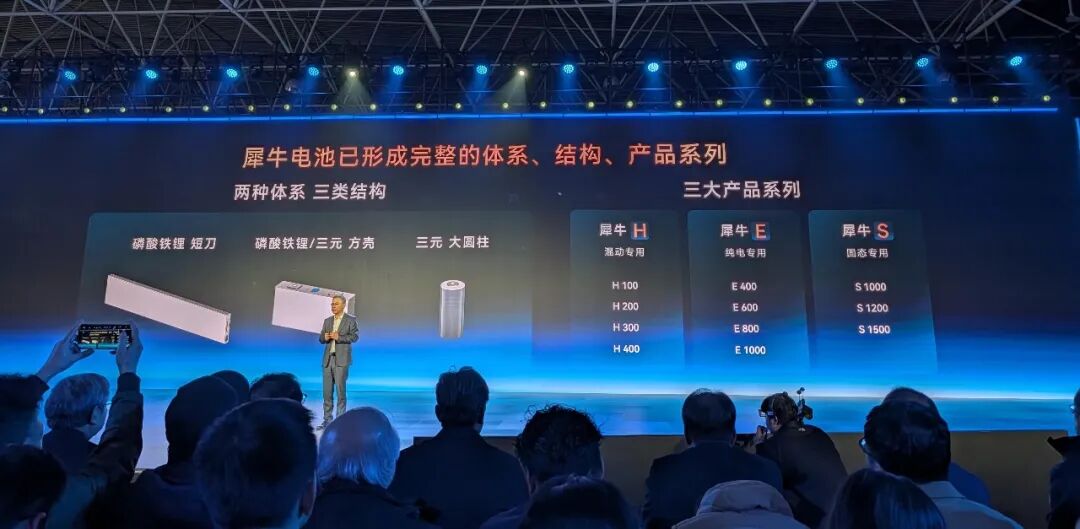
Unlike BYD's adherence to a single LFP technology path, the Rhino Battery adopts a 'dual-system' design—simultaneously compatible with LFP and NCM chemistries. It builds a universal platform covering multiple powertrains, with specialized sub-series: the H series for hybrids, the E series for pure electric vehicles (EVs), and the future-oriented S series for solid-state applications.
The following analysis delves into its technical advantages and implementation logic across four dimensions: core technology, platform layout, supporting technologies, and competitor comparison.
1. Technical Breakdown of Chery's Rhino Battery
The Rhino Battery's core technology stems from systematic material-level innovation and differentiated customization.
Rather than adopting a 'one-size-fits-all' approach, it optimizes LFP and NCM systems for the specific energy demands of hybrid and pure EV operating conditions, achieving a 'single platform, dual routes, leveraging strengths' technical outcome.
(1) Cathode Materials: Dual-System Optimization Balancing Safety and Performance
LFP: Safe, long-cycle life, low-cost, suitable for high-frequency hybrid operation.
Building on LFP's inherent safety, the Rhino Battery employs single-crystal modification technology, preparing cathode material particles into a highly intact, dense single-crystal structure. This effectively reduces inter-particle interface impedance, enhancing electron conduction efficiency and structural stability.
Surface coating modifications form a highly conductive, stable protective layer on particle surfaces, further minimizing side reactions during charging/discharging, and strengthening high-temperature resistance and cycle stability.
Tested to increase thermal decomposition temperature by over 15% compared to conventional LFP materials, it fundamentally suppresses thermal runaway risks. This suits hybrid models' frequent charge/discharge and temperature fluctuation demands, slowing battery degradation to match engine lifespans.
NCM: Focuses on high energy density, high-rate fast charging, and low-temperature performance, supporting long EV range.
Using a high-stability single-crystal NCM cathode + gradient doping + lattice optimization technology, it precisely controls material microstructure and elemental composition, improving crystal structure integrity and lattice strength to boost lithium-ion transmission rates and electron conductivity.
While retaining NCM's high energy density (≥280Wh/kg) and long-range advantages, it enhances high-temperature cycle stability by over 30%, addressing traditional NCM's thermal stability weakness. It stably supports 1200kW high-power fast charging, meeting long-range EVs' dual demands for energy density and charging efficiency.
(2) Anode Materials: Unified Architecture + Differentiated Formulations
The Rhino Battery uniformly adopts a 'low-strain graphite + silicon-carbon composite' anode architecture across both systems, addressing traditional anodes' volume expansion and rapid cycle degradation issues.
Low-strain graphite optimizes layered structures to control volume expansion within 8% during charging/discharging, significantly improving cycle stability. Silicon-carbon composites, through nanoscale silicon particle dispersion and carbon matrix coating, ensure structural safety while boosting anode capacity to over 550mAh/g, supporting fast charging and energy density improvements.
Based on scenario-specific needs, the dual systems use different silicon-carbon ratios:
LFP Version: Silicon content at 5%-8%, prioritizing ultra-long cycle life (≥80% capacity retention after 5000 cycles), low expansion, and high reliability for hybrid models' frequent charge/discharge scenarios. NCM Version: Silicon content increased to 12%-15%, emphasizing high capacity, high-rate fast charging (supporting >3C charging rates), and long range, meeting EVs' range and charging efficiency needs.
(3) Separators and Electrolytes: Differentiated Support for Performance and Safety
As the battery's 'ion channels' and 'safety barriers,' the Rhino Battery employs differentiated separator and electrolyte solutions for each system to maximize advantages:
LFP System: Focuses on long cycle life, wide temperature tolerance, and low cost. It uses a high-mechanical-strength PP/PE composite separator, optimized for thickness and porosity (40%-45% porosity), improving ion conduction efficiency and high-temperature shrinkage resistance. Paired with a high-stability electrolyte containing novel corrosion inhibitors and antioxidants, it effectively suppresses SEI film growth and electrolyte decomposition, achieving over 5000 cycles while operating across -40°C to 60°C, suitable for hybrid models' complex operating conditions.
NCM System: Prioritizes high voltage, high rate, and flame retardancy. It uses a high-voltage oxidation-resistant electrolyte compatible with >4.4V platforms, boosting cell energy density while meeting 1200kW high-power charging's ion transmission needs. Flame-retardant additives and self-healing film-forming agents enable high-temperature self-extinguishing and uniform SEI film growth, enhancing interface stability. Paired with a nanocrystalline ceramic-coated separator (3-5μm coating thickness), it raises heat shrinkage temperature above 180°C and puncture resistance by 50%, effectively containing thermal runaway and improving system safety margins.
In summary, the Rhino Battery's material system centers on 'deep customization for dual routes': the LFP version optimizes for 'safety, longevity, and durability' for hybrids; the NCM version upgrades for 'high energy, fast charging, and stable safety' for EVs. Through synergistic material design, it breaks the trade-offs among fast charging, lifespan, and safety, achieving optimal overall performance.
2. Platform-Based Layout: H/E/S Series Covering All Powertrains
The Rhino Battery's H, E, and S series are tailored to the distinct energy demands of different powertrains, with clear distinctions in technical positioning, energy management strategies, and production timelines, precisely matching hybrid, pure EV, and future solid-state scenarios.
Specific parameters and adaptation logic are shown in the table below:
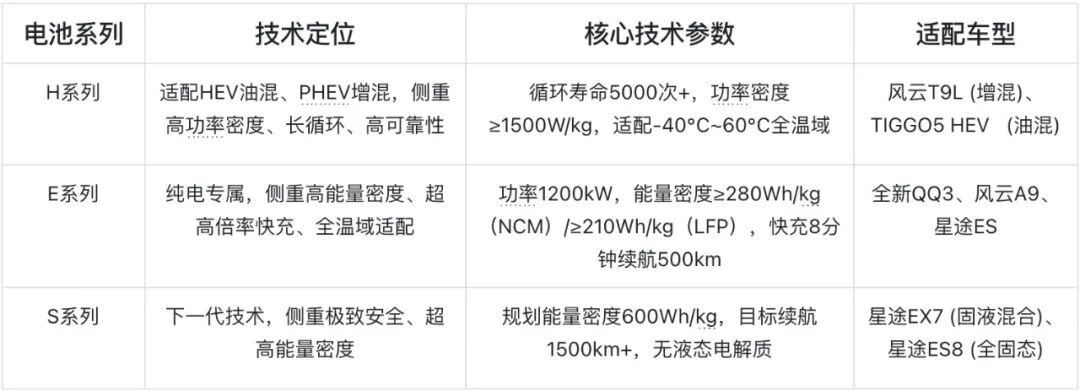
The core differences among the three series stem from varying powertrain energy demands, with specific technical rationales as follows:
Hybrid H Series: Acts as an 'energy buffer pool,' prioritizing high-frequency charge/discharge stability and instantaneous high-power output over high capacity.
Using the LFP system, it optimizes power density and cycle life, maintaining ≥80% capacity after 5000 cycles to match engine lifespans (around 15 years/300,000 km). This suits hybrid models' 'engine charging, battery assisting' operation, reducing fuel consumption while enhancing power response.
Pure EV E Series: As the sole energy source in EVs, it prioritizes high energy density, ultra-fast charging, and all-temperature stability.
Covering both LFP and NCM systems, the NCM version focuses on long range (≥280Wh/kg energy density) and fast charging (1200kW power), while the LFP version emphasizes safety and low cost. Paired with all-climate thermal management and comprehensive electrical safety systems, it achieves synergistic optimization of range, charging, and safety.
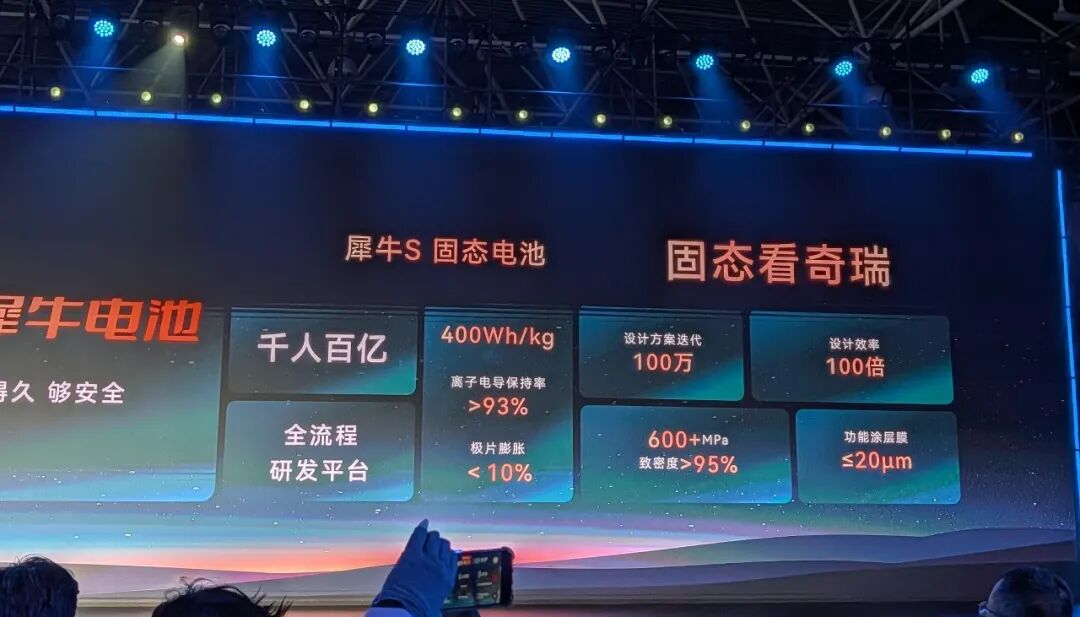
Solid-State S Series: Represents next-gen battery technology, core to replacing liquid electrolytes and separators with solid-state electrolytes.
This eliminates flammable media, achieving a leap in safety performance while breakthrough ing 600Wh/kg energy density for a target range of 1500km+.
Chery has completed semi-solid-state battery development, with vehicle validation slated for Q4 2026, and plans for all-solid-state batteries to enter production in 2027, forming a 'liquid-semi-solid-all-solid' technology iteration roadmap.
Overall, the Rhino Battery's H, E, and S platform series achieve full-scenario coverage from current mass production to future layouts, addressing core pain points of current hybrid and EV models while preemptively securing a leading position in solid-state battery technology.
3. Supporting Technology Analysis: Ultra-Fast Charging, V2G, and Nuclear Fusion
The Chery Rhino Battery is not an isolated product but integrates into an 'vehicle-storage-charging-grid-cloud-carbon' energy ecosystem, supported by Xunlong ultra-fast charging stations, V2G grid regulation technology, and controlled nuclear fusion research, forming a 'current charging-medium-term storage-long-term energy' full-chain technology layout.
The following analyzes the technical principles:
Xunlong Ultra-Fast Charging Station: Technical Logic for 1200kW Rapid Charging
The Xunlong station aims to deliver '8-minute charging for 500km range,' with its core being 'megawatt-class power output + high-efficiency energy conversion + intelligent thermal management' hardware-software synergy.
Megawatt Power Platform: Adopts an '800V vehicle platform + liquid-cooled current boost' solution. The vehicle supports 800V high-voltage input, while the station uses liquid cooling to increase charging cable current capacity to 600-800A, achieving 1200kW peak power output when combined with 800V voltage. Multi-module parallel technology dynamically adjusts power based on vehicle needs, balancing fast charging and safety.
Energy Conversion: Uses next-gen silicon carbide (SiC) power devices instead of traditional silicon-based (IGBT) devices. SiC devices offer higher breakdown voltage (≥1700V), lower switching losses (>70% reduction vs IGBT), and higher temperature resistance (up to 200°C), enabling >96.5% charging system efficiency, significantly reducing energy loss and improving charging speed.
Oil-Immersed Liquid Cooling Thermal Management: For heat generated during high-power charging, it employs oil-immersed liquid cooling, with cooling oil circulating through embedded channels in charging cables and connectors to dissipate heat, keeping temperatures below 60°C. Optimized cable design reduces diameter by 30% vs traditional fast chargers, enhancing usability while ensuring long-term high-power charging stability.
V2G Grid Regulation: Bidirectional Energy Interaction Between EVs and Grid
V2G (Vehicle-to-Grid) enables bidirectional energy flow between EVs and the grid, turning EVs into 'mobile energy storage units,' based on 'intelligent scheduling + bidirectional charging/discharging.'
Core Operation: Charges during off-peak hours (grid load <60%) when electricity prices are low, storing cheap energy; discharges during peak hours (grid load >80%) when prices are high, feeding stored energy back to the grid to 'shave peaks and fill valleys,' alleviating grid supply pressure.
Technical Support: Requires three core components—intelligent bidirectional charging stations (supporting bidirectional energy transfer, ≥95% conversion efficiency), vehicle-side bidirectional onboard chargers (OBC), and cloud-based energy scheduling platforms. Chery has developed a 'grid load dynamic regulation charging control method,' using cloud big data to analyze grid load and automatically control vehicle charging/discharging timing and power.
Revenue Potential: Based on current peak-valley electricity price differentials (peak price ~1.5 yuan/kWh, off-peak ~0.3 yuan/kWh), a single vehicle can generate 1000-1500 yuan in additional monthly revenue through V2G, while reducing grid peak-shaving costs, creating a win-win for owners and the grid.
Chery has incorporated V2G into its 'Ten Cities, Hundred Stations' vehicle-grid interaction plan, aiming to build over 20,000 V2G-compatible charging stations by 2029.
Controlled Nuclear Fusion: Ultimate Clean Energy Source
Chery's controlled nuclear fusion research targets the 'energy source' for new energy vehicles.
Controlled nuclear fusion artificially controls nuclear fusion reactions using light nuclei like deuterium and tritium, with nearly inexhaustible fuel (deuterium from seawater) and no long-lived radioactive waste, representing true zero-emission, sustainable clean energy. Commercialization would eliminate fossil fuel dependence, achieving energy freedom.
Through its Green Energy subsidiary and partnerships with institutions like the Institute of Plasma Physics, Chinese Academy of Sciences, Chery focuses on three core areas: fusion materials (high-temperature, radiation-resistant), reaction devices (miniaturized tokamaks), and automotive applications, advancing from lab to engineering exploration, prioritizing compact, low-cost fusion power generation technology.
Controlled nuclear fusion is a long-term technology layout with commercialization expected in 15-20 years. Compared to solid-state batteries, its timeline is longer, forming a 'current-medium-long-term' energy technology echelon with ultra-fast charging and V2G.
4. Chery Rhino vs BYD Second-Generation Blade Battery
The Chery Rhino Battery and BYD's second-generation Blade Battery represent two major domestic power battery technology routes, with significant differences in technical approaches, core parameters, and implementation progress.
Charging Performance Core Parameters
Chery Rhino Battery: Peak charging power 1200kW, official tests show 8-minute charging for 500km range, efficient charging interval 10%-80%, compatible with 800V platforms, charging rate >3C.
BYD Second-Generation Blade Battery: Peak charging power 1500kW, third-party tests show 5-minute charging from 10% to 70%, 9 minutes to 97%, with stable efficiency across all charging stages, compatible with 800V platforms, charging rate >4C.
BYD holds advantages in peak power and charging speed, offering a fuel-car-like full-range fast charging experience. Chery's Rhino Battery meets daily needs, with its efficient interval covering mainstream charging scenarios.
Low-Temperature Performance Test Data
Chery Rhino Battery: Validated across -40°C to 60°C, with ≥80% charging efficiency and ≥75% discharge capacity retention at -30°C (specific charging time not disclosed).
BYD Second-Generation Blade Battery: Tested at -30°C, charging from 20% to 97% takes only 3 minutes longer than room temperature, with ≥90% charging efficiency and ≥80% discharge capacity retention, backed by concrete test data.
Both adapt to extreme cold, but BYD's specific test data demonstrates superior low-temperature charging performance, better suited for northern users.
Cycle Life Core Indicators
Chery Rhino Battery: Clearly states 5000-cycle lifespan with ≥80% capacity retention, optimized for hybrid models to match engine lifespans (~15 years/300,000 km).
BYD Second-Generation Blade Battery: No specific cycle count disclosed, but leveraging LFP's inherent advantages and 'lithium-ion high-speed channel' technology, expected lifespan exceeds 4000 cycles with ≥80% capacity retention.
Chery makes commitments with clear parameters, which are more persuasive.
Core Material Technology Roadmap
Chery Rhino Battery: Dual-system design (LFP + NCM), with gradient doping + single-crystal modification for the cathode, and low-strain graphite + silicon-carbon composite for the anode. It focuses on fine-tuning within the existing material system, emphasizing performance balance.
BYD's Second-Generation Blade Battery: Single LFP system, featuring lithium manganese iron phosphate (LMFP) cathode + silicon-carbon anode. It represents a new-generation upgrade within the LFP system, prioritizing improvements in energy density and fast-charging performance.
Chery follows a 'dual-system balance' approach, suitable for multiple scenarios; BYD adopts a 'single-system upgrade' approach, focusing on pure electric scenarios. Both technology roadmaps have their own emphases.
Safety Protection Technology Solutions
Chery Rhino Battery: Triple protection system (material protection + 1300MPa Rhino Shield structure + Rhino Cloud intelligent early warning). Thermal runaway of a single cell does not propagate, passing all extreme safety tests, with an emphasis on multi-level, comprehensive protection.
BYD's Second-Generation Blade Battery: Intrinsic safety + structural optimization (blade structure + full-chain internal resistance reduction), reducing heat generation from the source. It passes needle puncture tests without fire or explosion, focusing on intrinsic safety of materials and structure.
Both safety standards far exceed national standards, with different implementation paths, yet both provide reliable safety guarantees without significant weaknesses.
Strategic Layout
Chery Rhino Battery: Three series (H/E/S), covering hybrid, pure electric, and solid-state technologies. Hybrid solid-liquid batteries will be introduced in Q4 2026, with full solid-state battery validation in vehicles by 2027. The roadmap is aggressive, emphasizing forward-looking layout (layout).
BYD's Second-Generation Blade Battery: Focuses on in-depth exploration of the LFP system, with a cautious approach to solid-state batteries. It plans to initiate batch demonstration installations around 2027, adopting a pragmatic style and emphasizing the implementation of existing technologies.
Chery emphasizes the breadth and forward-looking nature of its technological layout , while BYD focuses on the depth and scalability of existing technologies.
Implementation Status and Mass Production Scale
Chery Rhino Battery: Installed in models such as the all-new QQ3 and Fengyun T9L, currently in the initial implementation stage. The model coverage is relatively narrow, and large-scale popularization has not yet been achieved.
BYD's Second-Generation Blade Battery: It has been fully switched across more than ten models, including the Fangchengbao Titan 3 and Haishi 06, covering the entire price range from 150,000 to 1,500,000 yuan. It has achieved large-scale mass production and widespread adoption.
BYD's implementation progress is faster, with significant scalability advantages; Chery is in the early stages of implementation.
Core Positioning
Chery Rhino Battery: Balanced layout for all scenarios, take into account both (taking into account) both the present and the future. It focuses on 'multi-scenario adaptation + technological foresight,' creating a battery platform that covers all powertrain types.
BYD's Second-Generation Blade Battery: Focuses on pure electric scenarios, emphasizing 'extreme fast charging + mass production popularization.' It explores the potential of existing technologies to enhance the current driving experience for users.
There is no absolute superiority or inferiority in technology roadmaps; adaptation to demand is key.
Chery Rhino Battery and BYD's Second-Generation Blade Battery essentially represent two different product philosophies and technology roadmaps, with no absolute superiority or inferiority. The core depends on user needs and usage scenarios:
If pursuing 'extreme current experience + scalable guarantees': BYD's Second-Generation Blade Battery is superior. Its 1500kW extreme fast charging, excellent low-temperature performance, and coverage across all price ranges provide users with a more mature and convenient driving experience, suitable for users who prioritize current charging efficiency and diverse model choices. If valuing 'future potential + all-scenario adaptation': Chery Rhino Battery has more advantages. Its dual-system design, clear timeline for solid-state battery implementation, and complete energy ecosystem layout can better adapt to multi-scenario needs such as hybrid and pure electric, suitable for users who prioritize long-term technological iteration and multi-powertrain choices.
As benchmarks of China's new energy power battery technology, their differentiated technology roadmaps drive continuous progress in the industry. Ultimately, the beneficiaries will be the broad consumer base, highlighting China's technological strength in the new energy sector.
-
![]()
The Unstoppable Rise of 'Optical Progress and Copper Decline': Sunny Optical’s Strategic Vision for the Next Decade
-
![]()
AI + Going Global in the Second Half: No Intermission for Robot Vacuum Cleaners
-
![]()
The Suffering Endured in E-commerce, Walmart Doesn't Want to Repeat in AI
-
![]()
What Does the Doubling of New Energy Vehicle Exports Mean?
-
![]()
Ghosn: 'Only I Can Save Nissan'
-
![]()
Volkswagen Lays Off 100,000 Employees, The Elephant Sits Down
-
![]()
Expanding Production Capacity! Yutong Optics Acquires Approximately 1.5 Hectares of Industrial Land in Chang'an, Dongguan
-
![]()
Why Is Nokia Making a Comeback in the AI Era?