Why Did OpenAI Take the Drastic Step of Shutting Down Sora? Unveiling the Three Major Business Logics
 03/26 2026
 584
584
Editor's Note:
In March 2026, the AI industry witnessed a major turning point: OpenAI officially announced the shutdown of its Sora video generation platform, which had been live for just six months, and simultaneously terminated its $1 billion strategic collaboration and equity investment plan with Disney. Once hailed as the 'video version of GPT' and a catalyst for the global multimodal AI boom, this high-profile project rapidly declined from its peak. Behind this seemingly radical decision lies not merely a technological setback but OpenAI's inevitable choice to sprint IPO (push for an initial public offering), optimize resource allocation, and focus on core profitability.

Disney's $1 Billion Divestment Sparks a Turning Point
The Cliff-Like Fall of Sora from Deification to Exit
In February 2024, OpenAI released a technical preview of Sora, instantly revolutionizing industry perceptions with its realistic physical rendering, seamless scene transitions, and cross-duration video generation capabilities. Capital markets lauded it as the 'pioneer of the AI video era.' At the time, Sora was not only OpenAI's core foray into multimodal AI but also a star asset pursued by capital markets. Upon its launch, it topped the App Store's free chart, with invitation codes for the secondary market fetching exorbitant prices. Many believed it would replicate ChatGPT's commercialization miracle and become the company's second growth engine.
The turning point came in early 2026 when OpenAI struck a major deal with Disney: Disney planned to invest $1 billion in OpenAI, granting access to over 200 classic IPs, including Marvel, Pixar, and Star Wars, for Sora's training and content generation. The two sides aimed to co-create customized video content for Disney's streaming platform, Disney+. This deal was seen as a benchmark for deep integration between AI and the content industry, addressing Sora's copyright challenges while providing OpenAI with stable cash flow and valuation support. Sora appeared to be on the verge of scalable monetization.
However, just three months after the agreement, OpenAI abruptly announced the shutdown of Sora, prompting Disney to terminate all collaboration and investment plans. This seemingly win-win partnership ended hastily, shocking the industry. On one side, the Sora team bid farewell with regret; on the other, capital markets buzzed with discussions about OpenAI's strategic pivot. From being the center of attention to a sudden shutdown, Sora's lifecycle lasted less than two years, revealing the harsh realities of the consumer-grade AI video sector and OpenAI's rational trade-offs regarding commercial returns, resource efficiency, and IPO prospects.
Reviewing Sora's rise and fall, its collapse was not sudden but the culmination of long-standing contradictions. Technologically, video generation quality was unstable, and computational demands were exorbitant. Legally, copyright disputes and IP infringement risks were rampant. Commercially, the monetization path was unclear, and the return on investment was severely imbalanced. These three dilemmas compounded, making it difficult to reverse the trend even with Disney's support. Ultimately, OpenAI made the 'drastic decision' to abandon non-core businesses and focus on enterprise-level AI services capable of delivering stable profits.

Three Major Business Dilemmas
The Core Reasons Behind Sora's Inevitable Demise
Technological Bottlenecks: Computational Black Hole + Quality Fluctuations, Total ROI Imbalance
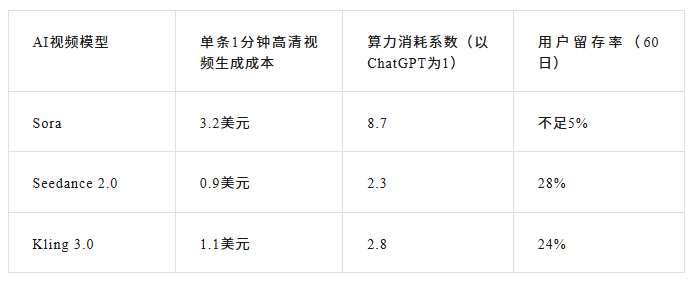
From its inception, Sora was labeled internally at OpenAI as a 'computational drag.' As a text-to-video large model, Sora's computational demands far exceeded ChatGPT's by several times. Generating a one-minute high-definition video required GPU computational power equivalent to ChatGPT processing thousands of text conversations, with inference costs remaining prohibitively high. According to industry estimates, Sora's average cost per video generation was approximately **$3.2**, while competitors like Seedance 2.0 and Kling 3.0 cost just $0.8–$1.2 per video, making Sora's cost premium 2–3 times higher.
Beyond high costs, Sora's technical stability was a fatal flaw. Despite impressive demo-stage results, post-launch issues like video distortion, stuttering, and logical inconsistencies frequently arose, with long-form video coherence sharply declining and user experience falling far short of expectations. Even with continuous R&D investment, model iteration speeds could not keep pace with computational demands, leaving a large amount of (a large amount of) GPU resources occupied and squeezing computational allocations for core products like ChatGPT and Codex.
For OpenAI, racing toward an IPO, computational resources are a core strategic asset that must be allocated to high-return businesses. ChatGPT achieved stable profitability through subscription models and enterprise services, while Sora continued to burn cash without positive returns, becoming the company's 'financial black hole.' With competitors like Anthropic and Google intensifying their focus on enterprise-level AI, OpenAI could not tolerate core resources being consumed by inefficient projects. Shutting down Sora became an inevitable choice for resource optimization.
Copyright Risks: Compliance Red Lines Are Hard to Cross, Content Ecosystem Stalls
Copyright disputes over AI-generated content loomed over Sora like the Sword of Damocles. Sora's training data relied heavily on publicly available internet videos, film clips, and anime works, with training conducted without original authors' authorization, sparking global backlash from the content industry. In November 2025, Japan's CODA Association, along with dozens of content companies including Studio Ghibli, publicly urged OpenAI to cease using their content for Sora's training and demanded substantial compensation. Hollywood screenwriters and directors' guilds also protested repeatedly, accusing Sora of infringing on original copyrights and squeezing creators' livelihoods.
Even OpenAI's IP licensing agreement with Disney failed to fully resolve copyright challenges. On one hand, Disney only granted access to select classic IPs and imposed strict restrictions on the style, scenes, and usage of generated content, limiting Sora's ability to deliver personalized and diverse creations. On the other hand, Sora-generated content was prone to IP infringement, character distortion, and ambiguous copyright ownership, exposing it to massive litigation risks upon commercialization. OpenAI attempted to build a copyright compliance system, but the costs were prohibitively high, and infringement could not be entirely prevented, with compliance expenses far exceeding expectations.
For Disney, IP is its core asset, and no infringement risks could be tolerated. Sora's technical instability and frequent copyright hazards made Disney realize that the partnership would not yield benefits but could damage its brand value. OpenAI's shutdown of Sora and Disney's divestment fundamentally reflected both sides' mutual avoidance of copyright risks, underscoring the difficulty of commercializing consumer-grade AI video amid an immature compliance framework.
Monetization Dilemma: Vague Models + User Churn, Commercial Closure Fails
In contrast to ChatGPT's clear profit path, Sora's commercialization efforts stalled. ChatGPT achieved annualized revenue in the tens of billions through ChatGPT Plus ($20/month), enterprise customization services, and API usage fees, leading the AI industry in user retention and paid conversion rates. Sora, however, never found a viable monetization model from launch to shutdown.
Initially, Sora was offered as an exclusive feature for ChatGPT Plus/Pro members, attempting to leverage existing paid users for traffic. However, high generation costs deterred OpenAI from lifting usage limits, severely degrading member experiences. Later, a standalone app was launched with pay-per-use and subscription models, but the $15 monthly subscription price far exceeded competitors, and video quality remained inconsistent, resulting in extremely low user willingness to pay. Data showed that after Sora's standalone app launch, downloads plummeted, with 60-day retention rates below 5% and virtually no effective paid users, completely breaking the commercialization loop.
From a business logic perspective, the consumer-grade market for AI video generation remains immature, with users primarily engaging in trial-based experiences lacking long-term payment motivation. Meanwhile, enterprise demand focuses on short-video marketing and film production, where Sora's general-purpose model could not meet customization needs and its costs were prohibitive for B-side clients. Despite massive R&D and computational investments, Sora failed to generate revenue, becoming OpenAI's 'unprofitable business.' Its cancellation was all but inevitable.

Strategic Retrenchment and Focus Shift
OpenAI's Inevitable Choice to Focus on Enterprise-Level AI
Product Matrix Evolution: From All-Out Expansion to Precision Focus, Core Businesses Emerge
OpenAI's product matrix evolution clearly reflects its strategic pivot. Early on, OpenAI centered on ChatGPT while expanding horizontally into multimodal, video, code, robotics, and other fields, aiming to build a full-category AI ecosystem. Sora epitomized this horizontal expansion. However, as the IPO approached, the company began streamlining its product lineup, shedding non-core, low-profit projects to allocate resources entirely to high-return businesses.
Key milestones in OpenAI's product matrix: ChatGPT launched in 2022, initiating commercialization; Sora released in 2024, venturing into multimodal; enterprise-grade ChatGPT and Codex upgrades launched in 2025; Sora shut down in 2026, with desktop, Codex, and browser tools integrated into a super-app focused on enterprise services and AI agents.
The core logic behind this shift is the capital market's demand for profitability. With a valuation of $730 billion, OpenAI must demonstrate stable profitability and a clear growth path ahead of its IPO. ChatGPT, as the cash cow, contributes over 90% of the company's revenue, while experimental projects like Sora not only failed to profit but also dragged down overall financial performance. Shutting down Sora was both a loss-cutting measure and a signal to the capital market: OpenAI would return to commercial fundamentals and focus on core businesses capable of sustained value creation.
Future Layout: Deepening Enterprise Market Penetration, Building AI Productivity Tools
After canceling Sora, OpenAI explicitly shifted its strategic focus to enterprise-level AI services and productivity tools. On one hand, it integrated existing core products into an all-in-one super-app, offering enterprises full-stack services encompassing text generation, code development, data analysis, and intelligent customer support to enhance B-side user stickiness and payment value. On the other hand, it ramped up computational infrastructure to optimize resource allocation, freeing up space for next-generation large model training while advancing long-term technologies like AI agents and robotics simulation to build technical moats.
Compared to the fierce competition and profitability challenges in the consumer-grade AI market, the enterprise-level AI sector offers strong payment capacity, stable demand, and long lifecycle advantages. Currently, giants like Anthropic, Google, and Microsoft are doubling down on enterprise-level AI. OpenAI's shutdown of Sora aims to concentrate resources to compete for B-side market share. The original Sora team will pivot to long-term R&D projects like robotics technology and world simulation, serving the company's AGI strategy while mitigating short-term commercial risks.

Conclusion
AI Must Abandon Flashy Tech Stunts; Commercial Fundamentals Determine Success or Failure
OpenAI's cancellation of Sora is not just a strategic adjustment by one company but a wind vane (a weather vane) for the entire AI industry. Over the past two years, capital has fanaticism (run rampant) in AI video, multimodal, and other fields, with companies blindly pursuing technological flashiness while neglecting commercialization and compliance risks, leaving many projects mired in financial losses. Sora's exit marks the AI industry's shift from 'technology-first' to 'business-first,' with profitability, resource efficiency, and compliance safety becoming core evaluation criteria.
For AI companies, technological innovation must align with commercial viability. Blindly entering niche sectors and consuming core resources ultimately leads to elimination. OpenAI's choices tell the industry: even with cutting-edge technology, businesses must respect commercial laws, focus on core strengths, refine profit models, and survive fierce competition. For capital, AI investments will become more rational, steering clear of experimental projects without monetization paths and focusing on enterprise-level services with real demand and stable cash flows.
Sora's departure is not the end of the AI video era but the industry's return to rationality. OpenAI's drastic move may seem to sacrifice a star project, but it preserves its core competitiveness and IPO prospects. In the future, as computational costs decline and copyright frameworks mature, the AI video sector will still have opportunities, but only players balancing technology, compliance, and commercial logic will truly prevail. Meanwhile, OpenAI, unburdened by Sora, will embark on a new journey in the enterprise-level AI market.
-
![]()
The Allure of 'Acquisition Spree': Li Shufu's Left Turn, Xu Jiayin's Right
-
![]()
Strategic Transformation Yields Results: Phoenix Optics Reports 10.9% YoY Rise in Core Net Profit for H1 2026
-
![]()
Three Key Growth Trajectories Synergize! Crystal-Optech Reports 3.478 Billion Yuan in Revenue for H1 2026
-
![]()
Semi-Annual Report Sparks XPENG Motors Buzz
-
![]()
1.6 Billion Big Order Secured! SeeYA Technology's Revenue Soars by 287.87% in the First Half of the Year
-
![]()
Baidu's Profits Plunge by 68%: Unraveling the Mystery Behind the Numbers
-
![]()
Baidu’s Profits Tumble by 68%! Where Has All the Money Gone?
-
![]()
Hynix’s Taobao Store Shuts Down Abruptly: What Should Customers Do About Warranty Services for Memory Modules?