Nearly 400,000 RMB for Volkswagen's New Energy ID. ERA 9X: Is It Truly a Match for Domestic Cars?
 03/31 2026
 422
422
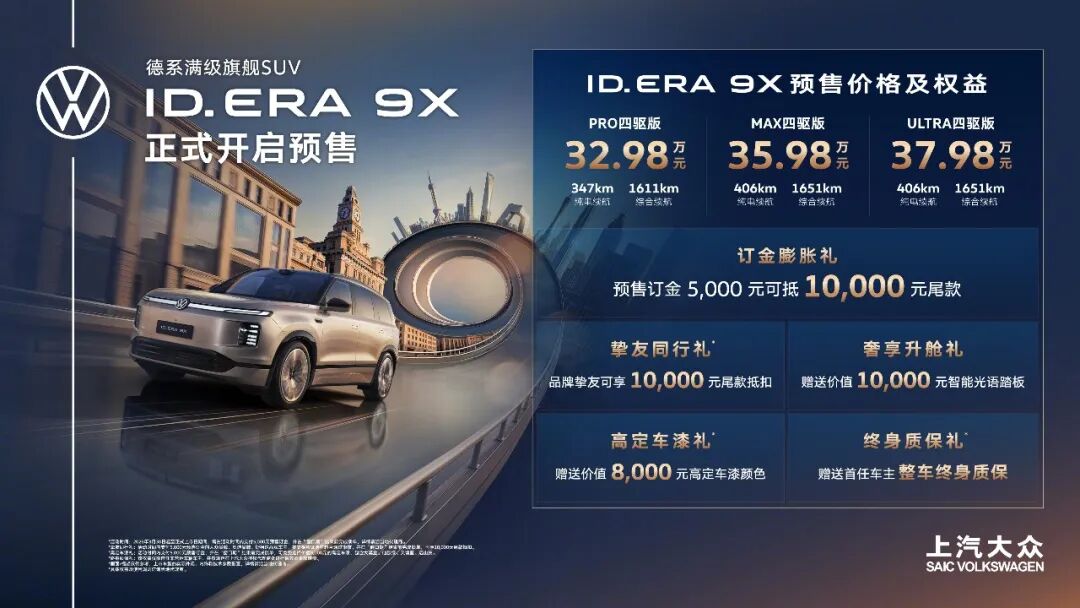
Recently, SAIC Volkswagen's grand flagship SUV, the ID. ERA 9X, has officially commenced pre-sales. The unveiling of its price range, spanning from 329,800 to 379,800 RMB, has ignited a firestorm across the automotive industry and public opinion sphere.
Against the backdrop of the recent Portugal round of the FIM World Superbike Championship, where domestic motorcycle manufacturer Zhang Xue Motorcycle clinched victory by nearly four seconds, shattering the long-standing dominance of international powerhouses such as Ducati and Yamaha in the middleweight category and achieving a historic milestone for Chinese motorcycle manufacturers.
Amidst this context, a joint venture brand is introducing a new energy SUV with an average price tag hovering around 350,000 RMB. Has SAIC Volkswagen lost its marbles? Venturing into the fiercely competitive Chinese new energy market with such a hefty price!
Let's first delve into the stark realities of the market.
Firstly, the competitive landscape is stifling. China's high-end new energy market is now firmly in the grasp of domestic independent brands and emerging forces. In the full-size D-class SUV segment, priced above 400,000 RMB, stand the Huawei-backed, tech-laden Aito M9 (priced around 469,800-569,800 RMB) and the Li Auto L9, which excels in understanding family users' needs, maximizing space utilization, and offering 'fridge, TV, and big sofa' features to the fullest (priced around 429,800-459,800 RMB). These two behemoths almost monopolize the shopping lists of high-end family users. In the 300,000-400,000 RMB range, the Li Auto L8 maintains a steady footing, while fierce contenders like the Wey Blue Mountain (around 299,800-326,800 RMB), with its exceptional chassis mechanics and focus on mapless intelligent driving, are intensely vying for market share. Faced with domestically produced cars that are configured to the extreme, new energy vehicles from joint venture brands appear inherently inferior.
Secondly, consumers have an ingrained perception that joint venture new energy vehicles 'must come with hefty discounts.' Over the past few years, joint venture brands have faltered in the new energy race, constantly playing catch-up in the two core areas of 'advanced intelligent driving' and 'smart cockpits.' Previously, both Volkswagen's own ID series and other joint venture brands' pure electric models often required massive discounts of tens of thousands or even over a hundred thousand RMB at the dealership level to barely secure a foothold in the market. Now, suddenly launching a flagship model with a top-end price nearing 380,000 RMB, it's challenging for consumers to readily accept such a 'brand premium.'
The core pain point lies in the 'structural cost burden' imposed by traditional automakers' massive systems. Insiders can do the math: compared to the efficient 'direct sales store + short and flat' business model favored by today's new automotive forces, Volkswagen boasts an extremely vast traditional dealership network (over a thousand 4S stores) with astronomical annual operating expenses. From the parts factory to the final assembly line, a vehicle passes through various levels of the supply chain and multiple agents before reaching the end consumer for delivery. Each level of the supply chain and distribution system must have sufficient profit margins.
This layered cost-adding system burden is simply too heavy. Therefore, when the ID. ERA 9X is priced at nearly 330,000 RMB for the base model, public opinion easily reaches a logically self-consistent conclusion: this car is priced so high not because the product itself is worth it, but because consumers are footing the bill for Volkswagen's massive system burden, high marketing expenses, and dealership channel profits.
Surrounded by formidable competitors in a red ocean, burdened with heavy historical baggage, and suspected of having a joint venture brand premium, the ID. ERA 9X seems destined for a 'high start, low finish' failure.
However, when we cast aside stereotypes about the joint venture system and market sentiment, and simply place this car under scrutiny, examining its underlying engineering architecture and BOM (Bill of Materials) cost sheet, another set of stark, cold, hard core data reveals a starkly different reality:
1. Cross-class physical dimensions (D-class size, C-class pricing)
Dimensions: The ID. ERA 9X boasts a length of 5207mm and a wheelbase of 3070mm.
Status comparison: From an engineering perspective, it's a standard D-class (full-size) large six-seater SUV, directly competing in physical size with the Li Auto L9 and Aito M9, priced between 420,000 and 560,000 RMB. Yet its pricing (starting at 329,800 RMB) crashes into the mid-to-large (C-class) SUV market with a smaller physical footprint.
2. Extremely high-end underlying hardware (breaking joint venture norms, full specs from entry level)
Traditional joint venture cars often resort to using 'bare-bones versions to lower the starting price,' but the ID. ERA 9X's 329,800 RMB entry-level model comes standard with the following core hardware:
Chassis standard: Full active rear-wheel steering system (previously seen mostly on million-RMB luxury cars to enhance handling flexibility for full-size behemoths).
Intelligent driving standard: Full 192-line LiDAR and the first to feature Momenta R7 reinforcement learning world model, including lifetime access to the Xingyun Intelligent Assisted Driving System (supports parking spot to parking spot).
Cockpit standard: Full 800V high-voltage fast-charging platform, dynamic zero-gravity seats for the front passenger and second row.
3. Top-tier three-electric system specifications
Battery data: The Max and Ultra versions are equipped with a massive 65.2kWh CATL Xiaoyao ultra-large battery.
Status comparison: This battery specification is at the pinnacle of the current extended-range SUV market, enabling a CLTC pure electric range exceeding 406km.
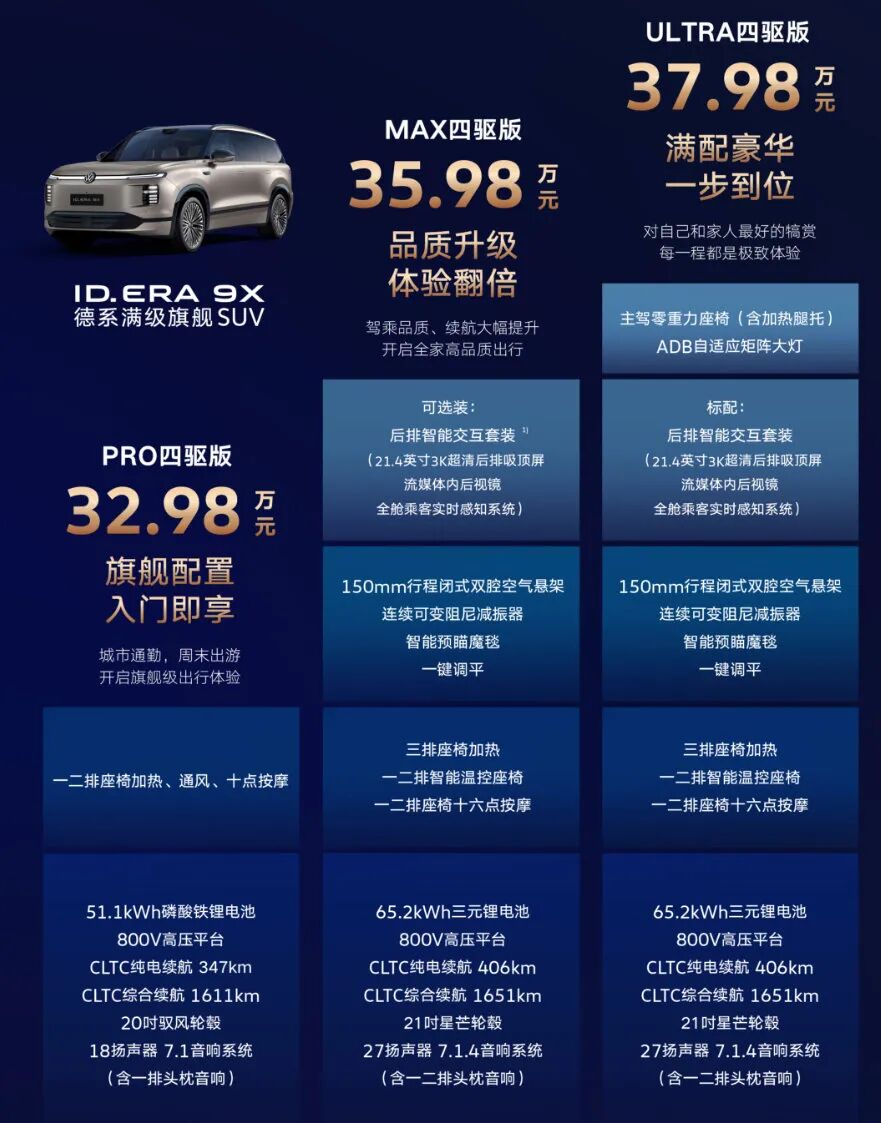
On one hand, there's the heavy channel burden, somewhat passive market presence, and seemingly high absolute pricing of traditional joint venture brands. On the other, there's a full-size body over 5.2 meters long, standard rear-wheel steering and 192-line LiDAR across all trims, and a massive 65.2-degree battery.
When these extremely contradictory realities converge in a single vehicle, is the SAIC Volkswagen ID. ERA 9X a relic of a joint venture, clinging to old ways and pricing arrogantly? Or is it a ruthless assassin, compressing its own system profits and using extreme BOM costs to attempt a game-changing move in the high-end market? In the 300,000+ RMB budget range, can this extremely rational hardware foundation break through the brand barriers erected by new forces and outsell the booming domestic cars?
This question can probably only be answered by the most authentic order volume. As for the conclusion, let's leave it for discussion in the comments section.
-
![]()
Five Emerging Golden Entrepreneurial Pathways in the Agent Ecosystem: A Deep Dive into the Report (Part 2)
-
![]()
GEM-TIPS Makes Its Debut at Shenzhen International AI Expo: “Octopus AI Brain” + Intelligent Agent Cluster Pave New Ways for Industrial Intelligence
-
![]()
'China's Pioneer Domestic GPU Stock' Moore Threads Posts Profit in Q1, Yet True Profitability Unverified
-
![]()
Hynix Employees Await 3 Million Won in Bonuses, Samsung Employees Go on Strike: A Dramatic Clash Between Korea's Memory Giants
-
![]()
Twelve Years On, Can Cheng Yixiao Steer Kling to Another Victory?
-
![]()
From Data Scarcity to Open Source Boom: How China's Embodied AI Data Industry Can Break Through
-
Trend丨Indium Phosphide (InP) Prices Soar Amid AI Boom, with Cycles and Disruptions Set to Continue
-
![]()
One Article to Decode 'Computing Power Inflation': Why AI Costs Less for You While Computing Power Firms Rake in Profits