Is It Down to a Daily Payment of Just 29 Yuan?!
 03/31 2026
 539
539
The Price War Evolves into a Financial Showdown
"I applied for Xiaomi Auto's 7-year low-interest financing scheme, submitted my six-month individual tax records, and got approval within ten minutes," recounted Mr. Zhang (a pseudonym), a proud owner of an SU7 Pro who has already taken delivery of his car. He clarified that his 7-year low-interest loan isn't a financial leasing arrangement as rumored online; instead, it's facilitated through Ping An Bank, requiring no collateral for the vehicle registration certificate or other assets, and it's eligible for national interest subsidies. Since the start of this year, eye-catching phrases like "7-year ultra-low interest, easy Tesla ownership," "cost of a daily cup of milk tea," "down payments from just 32,500 yuan," and "monthly payments of 1,918 yuan" have replaced cash discount promotions, becoming the new frontier in automakers' competition. According to incomplete statistics, nearly 20 automotive brands—including Tesla, Xiaomi, Li Auto, XPeng, NIO, Seres, Zeekr, Chery, Geely, and Changan—have rolled out "7-year low-interest loan" financial incentives. Nissan even offers an "8-year ultra-long-term low-interest" plan.
Traditionally, auto loan terms spanned 3 to 5 years. This year's low-interest financing schemes have extended the loan period to an unprecedented 7 years. Industry experts attribute this shift to policy changes and market competition. On one hand, in March of the previous year, the State Administration for Market Regulation temporarily extended the maximum term for personal consumer loans from commercial banks from 5 to 7 years. On the other hand, the phase-out of new energy vehicle purchase tax subsidies has spurred automakers to stimulate consumer demand through innovative financial tools.
The allure of monthly payments around 2,000 yuan has indeed enticed many consumers to purchase vehicles. However, financial plans, which have transitioned from profit centers to promotional tools, are not as straightforward as they appear. A prime example is the nature of the contracts. Some 4S dealerships market financial leasing as "manufacturer-backed auto loans," using low down payment rhetoric to attract customers while obscuring the "lease-to-own" nature of the deals. Ultimately, consumers may face the risk of losing both their vehicle and their investment.
For consumers, whether reaping the benefits of a "price war" or a "financial war," meticulously scrutinizing the nature of loan contracts and all terms to avoid pitfalls is the only way to truly "come out on top."
A Collective Escalation
Facing mounting pressures—including regulatory efforts to curb "overcompetition," the phase-out of purchase tax subsidies, and a resurgence in fuel vehicle sales—competition among new energy brands has intensified. Many automakers have been compelled to join this "financial war," employing flexible financing plans to lower the barrier to car ownership and capture market share.
This battle was initiated by Tesla. Since January 6, when Tesla first introduced a limited-time "7-year ultra-low interest" financing plan in the Chinese market, over 20 automotive brands have followed suit. However, each brand has tailored its financial plan according to its market strategy, with varying focuses on down payment ratios, annualized interest rates, and additional conditions.
For instance, Tesla's 7-year low-interest plan utilizes a bank-secured loan model with an annualized interest rate as low as 0.5% (equivalent to an annual percentage rate of approximately 0.98%). Its most critical feature is that vehicle ownership transfers to the consumer immediately upon delivery, sidestepping the "lease-to-own" pitfall from the outset.
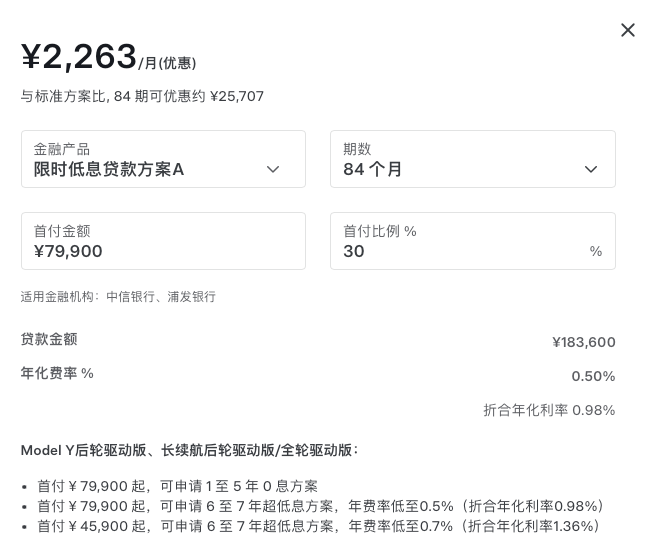
Image source: Tesla
NIO also collaborates with banks, offering an even lower annualized interest rate of 0.49% in the industry. It explicitly promises no financial service fees and waives prepayment penalties, further reducing the additional costs of car ownership.
Brands like Xiaomi, Leapmotor, XPeng, and BYD focus on lowering the entry barrier, setting minimum down payment ratios at 15% and annualized interest rates around 1%–2%.
For example, Fangchengbao offers a plan with down payments starting at 32,000 yuan and a 7-year loan with an annualized interest rate of 1.5%, covering the Bao 5 long-range version and all Titan 7 models. Taking the top-spec Titan 7, priced at 219,800 yuan, as an example: with a down payment of 72,800 yuan and a loan of 147,000 yuan, the total interest over 7 years is approximately 15,400 yuan, resulting in monthly payments of 1,933 yuan. Ocean Network promotes a "daily payment as low as 29 yuan" slogan, equating to the cost of a daily cup of milk tea or coffee.
XPeng supports 6–7 year low-interest financing across all models, with down payments starting at 15% and an annual interest rate of 2.86%. Some models, like the MONA M03, offer monthly payments as low as 1,355 yuan. Leapmotor's 7-year low-interest plan also starts at a 15% down payment. For example, the B01 model requires a minimum down payment of just 13,800 yuan under the 7-year plan, with daily payments as low as 33 yuan.
Some automakers offer interest-free periods for certain models in the initial years. For example, Li Auto's i8 and MEGA models qualify for a "7-year loan with 3 years interest-free" policy—0% interest for the first 3 years and an annual interest rate of 4.75% for the remaining 4 years. IM Motors introduces a fleet-wide plan featuring "7-year ultra-long loan, 0% down payment, 0% interest for the first 3 years, and no prepayment penalties after 3 years."
Nissan even extends the battlefield further, offering a "0% down payment, 8-year ultra-long low-interest loan" for the Teana·HarmonyOS Cockpit model. Taking the Teana·HarmonyOS Cockpit Comfort Edition, priced at 129,900 yuan, as an example: with 0% down payment and 96-month installments, the interest rate is 4.88%.
The financial plans introduced by these automakers all aim to achieve one goal: reducing monthly payments to around 2,000 yuan, instantly giving consumers the impression that "I can afford this." These low monthly and daily payment figures intuitively showcase their strong appeal to younger demographics.
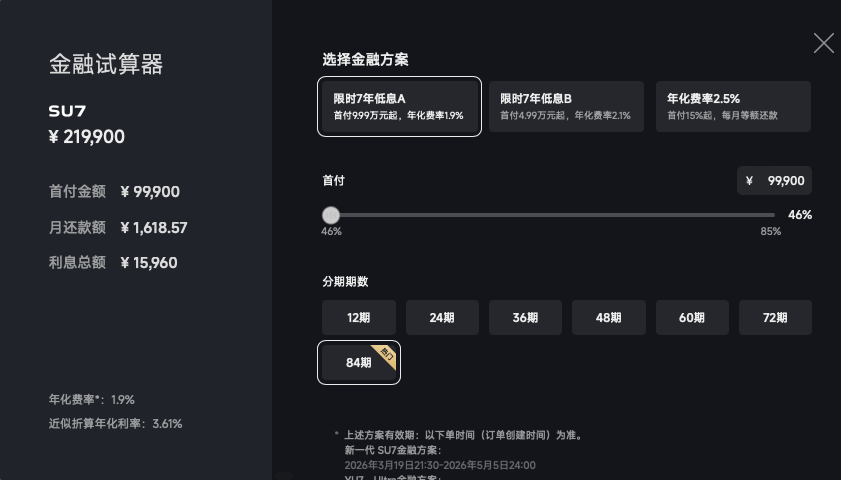
Image source: Xiaomi Auto
Industry insiders are not surprised by this trend. After all, direct price cuts can harm brand value, but financial plans can make consumers feel like they are "getting a bargain" through clever design. Building on traditional methods like official price reductions and end-of-line discounts, 7-year low-interest loans have become a popular new promotional tool among mainstream automakers. By combining ultra-long loan terms with low or subsidized interest rates, they significantly reduce monthly payments, becoming a mainstream competitive tool alongside "price wars" in the automotive market.
According to iResearch's "2024 Young Consumers' Car-Buying Behavior Report," 68% of users aged 25–35 consider "whether monthly payments are below 20% of their salary" a core decision-making factor. Automakers' calculations have once again "hit the mark."
Beware of Hidden Risks
The seven-year ultra-long loans on the market generally fall into two categories: bank loans and financial leasing models. Compared to banks' stringent risk control systems, financial leasing approvals are often more lenient, with faster disbursement and potentially no requirement for bank statements or income verification.
Currently, except for Tesla and NIO, most other brands rely on automotive financial leasing companies under their parent automakers or third-party financial institutions.
The fundamental difference between automaker-led financial leasing models and traditional bank auto loans lies in the legal relationship and property ownership. Bank loan plans are governed by the Civil Code's provisions on loan contracts and security interests, ensuring strong compliance and stable funding sources. In contrast, financial leasing products feature a separation of ownership and usage rights. Until consumers fully pay off the vehicle purchase price and all fees, the vehicle's ownership remains with the financial leasing company. In other words, with direct bank loans, vehicle ownership transfers to the consumer immediately, whereas with financial leasing, ownership remains with the leasing company until the loan is fully repaid, leaving the consumer with only usage rights until then.
More alarmingly, there is the risk of default. The ultra-long repayment cycle is fraught with uncertainty, meaning risks and costs are quietly extended—one of the main reasons financial institutions impose stricter approval criteria for consumers opting for 7-year ultra-low-interest loans.
A Tesla salesperson noted that approval for the 5-year interest-free plan is relatively straightforward, with more bank options available. However, the 7-year low-interest approval process has higher personal qualification requirements, and many customers who failed the final review switched to the 5-year interest-free option.
Financial leasing models bypass such thresholds. While offering faster approval, they come with numerous issues. For example, transferring ownership, reselling, major modifications, or even certain insurance claims may require the leasing company's cooperation, adding complexity for consumers. Additionally, prepaying a financial leasing loan incurs higher penalties than a bank loan.
According to data from third-party complaint platforms, 32% of automotive financial disputes stem from hidden service fees, while 15% of consumers encounter prepayment penalty traps.
Therefore, when choosing 7-year low-interest products, consumers should carefully evaluate offerings from third-party leasing companies, clearly distinguish between direct leasing and sale-and-leaseback arrangements in terms of property ownership, and calculate the total cost of car ownership, including any hidden service fees and prepayment penalty costs. They must avoid focusing solely on short-term low monthly payments.
This article is original content from China Auto News. Feel free to share it, but media outlets must credit the author and source before reprinting. Any media or self-media creating video or audio content based on this article will face legal consequences.
-
![]()
Five Emerging Golden Entrepreneurial Pathways in the Agent Ecosystem: A Deep Dive into the Report (Part 2)
-
![]()
GEM-TIPS Makes Its Debut at Shenzhen International AI Expo: “Octopus AI Brain” + Intelligent Agent Cluster Pave New Ways for Industrial Intelligence
-
![]()
'China's Pioneer Domestic GPU Stock' Moore Threads Posts Profit in Q1, Yet True Profitability Unverified
-
![]()
Hynix Employees Await 3 Million Won in Bonuses, Samsung Employees Go on Strike: A Dramatic Clash Between Korea's Memory Giants
-
![]()
Twelve Years On, Can Cheng Yixiao Steer Kling to Another Victory?
-
![]()
From Data Scarcity to Open Source Boom: How China's Embodied AI Data Industry Can Break Through
-
Trend丨Indium Phosphide (InP) Prices Soar Amid AI Boom, with Cycles and Disruptions Set to Continue
-
![]()
One Article to Decode 'Computing Power Inflation': Why AI Costs Less for You While Computing Power Firms Rake in Profits