Tesla's 'Star Factory Director' Song Gang Set to Join Xiaomi: Is Wang Hua's Statement Disproven?
 04/02 2026
 471
471
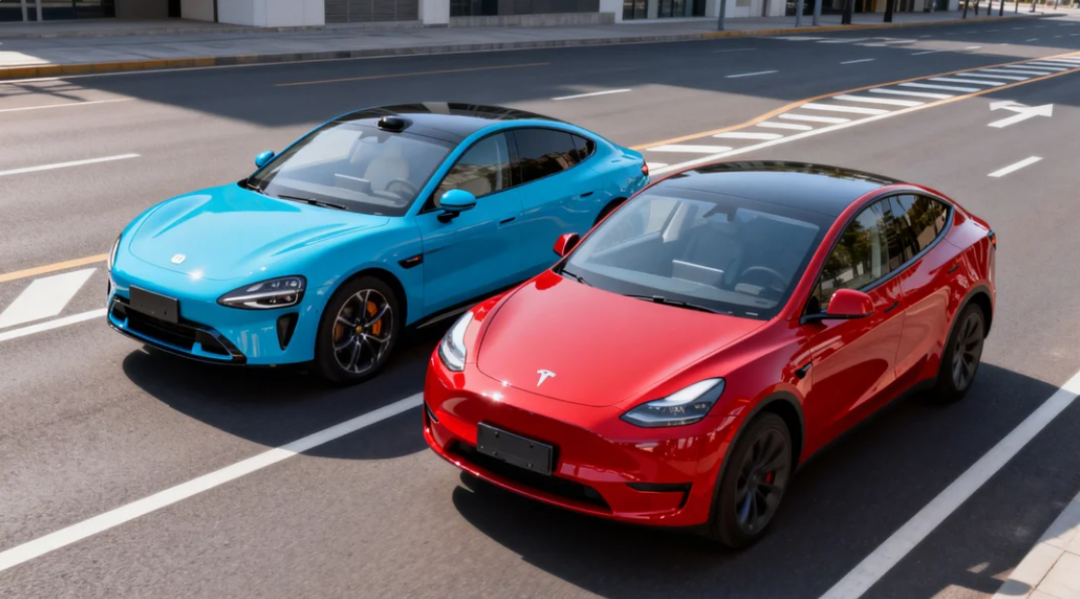
Xiaomi Still Can't Shake Its 'Tesla Obsession'
Is Xiaomi Poaching Another Tesla Executive?
On April 1, Lan Jing News reported that Song Gang, the former Vice President of Manufacturing at Tesla's Shanghai Gigafactory and a pivotal figure in its construction and production acceleration, is poised to join Xiaomi Auto.
According to reports, Song Gang had previously worked at General Motors and Ford before joining Tesla in 2018 as Vice President of Manufacturing at the Shanghai Gigafactory, earning him the moniker 'Star Factory Director.' On December 18, 2024, Song Gang departed from Tesla and joined Envision Energy five days later as Senior Vice President of Integrated Supply Chain.
This is not the first instance of Song Gang being linked to Xiaomi Auto. In fact, when the 'Star Factory Director' left Tesla, rumors swirled that he would join Xiaomi Auto. Xiaomi's Wang Hua even posted on Weibo, stating, 'The widely rumored Factory Director Song is indeed excellent, but our own Factory Director Ji at Xiaomi Auto is also outstanding. Enough said!'
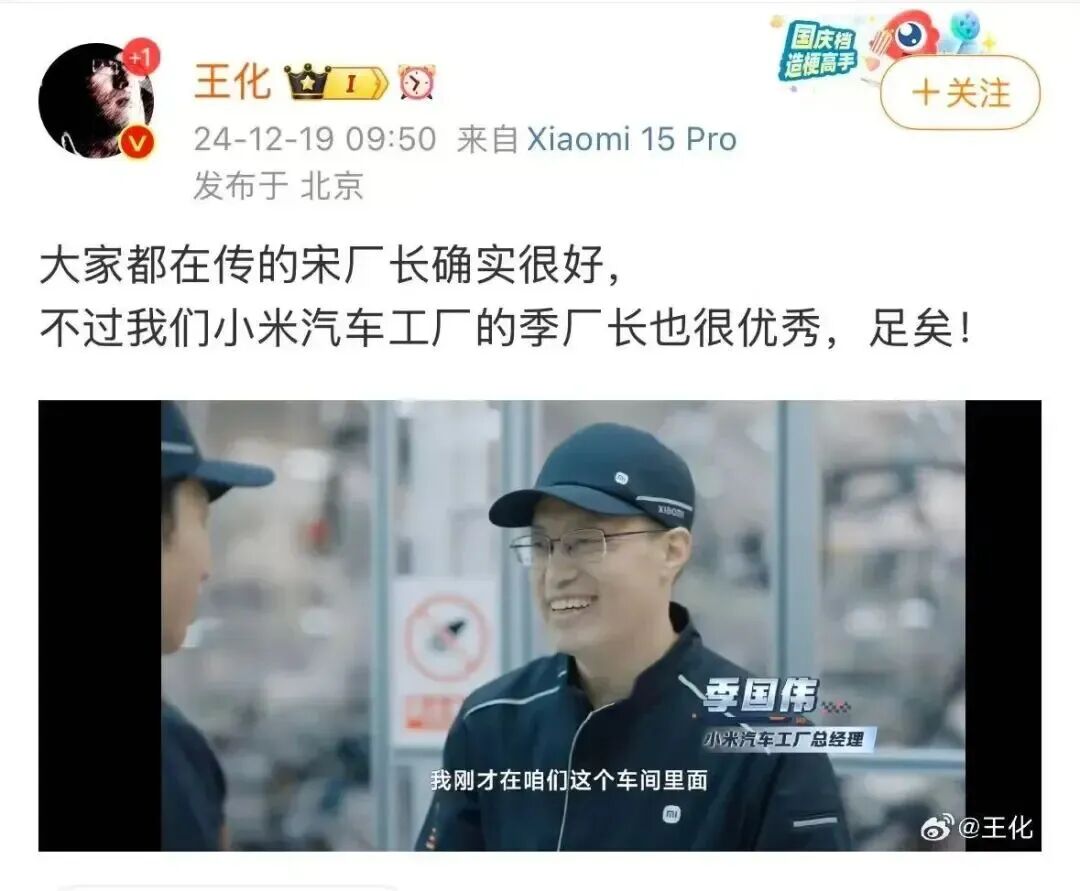
This statement was perceived as a denial of Song Gang's joining, but over a year later, the rumors have resurfaced. Currently, Xiaomi has not yet issued a public response.
So, what accomplishments did Song Gang achieve at Tesla? What capabilities of his does Xiaomi Auto value? Why is Xiaomi recruiting a significant number of former Tesla employees?
01
The Architect Behind Tesla's 'Shanghai Miracle'
If one were to pen a biography of key figures in China's new energy vehicle manufacturing history, Song Gang would undoubtedly be an indispensable name in the era of electrification. He is not only a manufacturing expert trained in the traditional auto industry but also a core operator who steered Tesla through its 'production capacity crisis' and achieved a remarkable global turnaround.
Before joining Tesla, Song Gang worked at Ford and SAIC-GM, and the characteristics of these two companies are deeply ingrained in him.
As the pioneer of modern automotive assembly line production, the Ford system's core legacy is its relentless pursuit of 'standardization.' Song Gang's most crucial takeaway from Ford was how to break down complex automotive manufacturing processes into standardized actions that assembly line workers could strictly execute.
His experience at SAIC-GM equipped him with the 'micro-operation' ability to manage a vast supply chain. As a benchmark for lean production among domestic joint-venture automakers, working at GM allowed Song Gang to thoroughly understand the nuances of the local supply chain: how to find suppliers, how to control costs, and how to ensure that thousands of components arrive precisely on schedule for the production line.
With this dual background from traditional automakers, Song Gang opened the door to Tesla's Shanghai Gigafactory in 2018. At that time, Elon Musk was mired in the 'production capacity crisis' of the Model 3 due to an excessive pursuit of full automation, even producing that famous 'world-famous photo' of himself sleeping on the factory floor.
After joining, Song Gang did not adopt Musk's utopian vision of a 'fully automated, unmanned factory.' Instead, he utilized the most rigorous and mature production line management system from traditional joint-venture automakers to support Tesla's aggressive engineering design.
Under his leadership, the Shanghai Factory not only achieved the industry myth of 'starting construction, beginning production, and delivering vehicles all in the same year' but also rapidly ramped up Model 3 production to a thousand units per week within a short time. By the time the Model Y was launched, the Shanghai Phase II factory became the most efficient and stable vehicle manufacturing base globally in terms of production line efficiency and quality, arguably saving Tesla's business.
In addition to ramping up production capacity, Song Gang also promoted the localization of Tesla's Chinese components, raising the localization rate of parts at the Shanghai Factory to over 95%. This not only significantly reduced manufacturing costs but also provided Musk with a steady stream of ammunition for his subsequent global 'price wars.'
By the time of his departure, Song Gang oversaw four core manufacturing systems at the Shanghai Factory: Phase I (mainly producing the Model 3), Phase II (mainly producing the Model Y), the battery factory, and the motor factory. He was the most authoritative core figure in Tesla China, second only to Zhu Xiaotong, President of Greater China.
This is likely why Xiaomi ultimately recruited Song Gang.
If Lei Jun and Ji Guowei (current Factory Director of Xiaomi Auto) solved the problem of 'going from 0 to 1'—building and selling cars explosively—in Xiaomi's first two years of car manufacturing, then by 2026, Xiaomi faces the challenge of 'going from 1 to 100'—scaled growth.
Simply put, Xiaomi now faces two major challenges: extreme production capacity ramp-up and complex multi-factory coordination.
First, consider production capacity. Although the waiting time for Xiaomi cars is no longer as exaggerated as the six months to a year at launch, this does not mean the production capacity pressure will ease in 2026, as Lei Jun has already made bold claims.
According to the target announced by Lei Jun at the beginning of the year, Xiaomi Auto aims to deliver 550,000 vehicles in 2026. Based on the cumulative delivery data of about 79,000 vehicles in the first quarter, this means that starting from April, Xiaomi's average monthly delivery must increase to at least 52,000 vehicles.
What does 52,000 vehicles represent? It is nearly 2.6 times the current quarterly monthly average and even surpasses the all-time high of 50,000 vehicles in a single month set in December 2025. In other words, Xiaomi Auto must sprint at a record-breaking pace every month from now on.
To handle the massive orders, Xiaomi's factory layout has fully expanded. Public information shows that Xiaomi's Phase I and Phase II factories in Beijing are already operating at full capacity, with an annual production capacity of 300,000 to 330,000 vehicles. The newly launched Beijing Phase III factory (designed for an annual capacity of 150,000 vehicles) after the Spring Festival and the Wuhan factory (designed for an annual capacity of 150,000 vehicles), set to start production in May 2026, are key increments for Xiaomi to achieve this year's target.
This leads to the most critical question: How to quickly start production at the new factories? How to ensure high-quality, standardized production when all four bases are operating simultaneously?
When a single super factory becomes a cross-regional, multi-base collaboration, and when monthly production increases from 10,000 to 20,000 units to 50,000 to 60,000 units, this is no longer an ordinary 'screw-tightening' issue but an extremely complex systems engineering problem. How to quickly ramp up the yield rate of new production lines? How to manage the logistics scheduling of thousands of components? More importantly, how to ensure quality control does not fail amid explosive sales growth?
In China's new energy vehicle industry, very few people can perfectly answer these questions. And Song Gang happens to be the most suitable candidate.
Judging from his resume, Song Gang oversaw four core manufacturing systems—Phase I, Phase II, battery, and motor—at Tesla in his later years. He knows too well where the 'pitfalls' of multi-factory coordination and cross-regional scheduling lie and how to seamlessly replicate a mature production standard to new production lines.
So, it's not that Factory Director Ji is no longer 'competent,' but rather that Xiaomi Auto has grown to a scale where it must introduce a higher-dimensional manufacturing system. Song Gang's entry is essentially Lei Jun buying targeted insurance for Xiaomi Auto's 'scaled war' in 2026.
02
From 'Porsche Aesthetics' to 'Tesla System'
Xiaomi wants far more than just Tesla's 'Star Factory Director.'
According to Jiemian News, on April 1, Kong Yanshuang, former General Manager of Tesla China, has joined Xiaomi and will replace Li Xiaorui, the former Director of Xiaomi Auto, to take full charge of automotive sales. Kong Yanshuang joined in early March and is currently in a work handover period. Xiaomi has not yet officially announced her formal position internally.
Public information shows that Kong Yanshuang is a core executive at Tesla China, having served as General Manager of Tesla's South China Region and General Manager of the China Region, among other roles. She has long been responsible for Tesla's sales system layout and brand promotion in the Chinese market.
This handover of the sales head is highly significant. Li Xiaorui, the predecessor, was formerly General Manager of the Great Wall Haval brand, representing the steady channel expansion capabilities of traditional automakers. He helped Xiaomi win the '0 to 1' initial battle. Kong Yanshuang, on the other hand, represents Tesla's direct sales and delivery system, which pursues ultimate sales per square meter and high conversion rates with a minimal SKU. Under the pressure of delivering 550,000 vehicles this year, Xiaomi needs a sales general who can handle 'massive throughput.'
In addition to these top executives in sales and manufacturing, Xiaomi is also making precise moves in the more hardcore production line technology sector.
According to Dian Dong Zhi Jia, You Hailong, the former Production Head of Tesla's Body Shop, may have also joined Xiaomi Auto.
Body welding is one of the four major automotive processes (stamping, welding, painting, and assembly) that extremely tests precision, automation rate, and production line rhythm. This further confirms that Xiaomi's recruitment in the manufacturing sector aims to bring over Tesla's 'core team' for efficient operation.
This is just the most recent talent acquisition. In fact, Xiaomi's 'targeted recruitment' of Tesla and even all competitors has been a consistent long-term strategy since Lei Jun announced car manufacturing in 2021.
The most typical example is Li Tianyuan, the 'soul figure' who led the design of the Xiaomi SU7 and is the Chief Designer of Xiaomi Auto.
As Tesla's first Chinese designer, Li Tianyuan was deeply involved in the exterior and interior design of the Model 3 and Model Y. Shortly after Lei Jun announced car manufacturing in 2021, Li Tianyuan quickly joined. The SU7's ability to go viral upon release with its minimalist lines, extremely low drag coefficient, and highly tech-savvy appearance is rooted in the 'Silicon Valley aesthetics' Li Tianyuan brought, which differs from traditional automakers.
On the Technology R&D end, which is invisible to the outside world, Xiaomi already has a 'Tesla-style' framework internally. Among Xiaomi's core R&D team in its early stages, whether in the underlying architecture of the three electric systems (battery, motor, and electric control) or in the evolution of the pure vision route for autonomous driving, a large number of former Tesla engineering backbones have been absorbed.
It can be said that for a long time to come, Tesla fans may be surprised to find more and more familiar shadows in Xiaomi Auto's subsequent products and terminal experiences. However, this is by no means a simple 'copying' but a higher-dimensional upgrade.
Xiaomi's true strength lies in its extremely powerful 'fusion and evolution' capability. When Tesla's globally market-validated, most efficient underlying hardware manufacturing and commercial circulation closed loop collide with Xiaomi's 'human-vehicle-home full ecosystem,' its profound local software and hardware supply chain collaboration capabilities, and Lei Jun's phenomenal user operation and marketing skills, it will inevitably trigger a chemical reaction where 1+1 is far greater than 2.
The expensive 'tuition' Tesla paid while navigating through 'production capacity crisis' and the 'direct sales exploration period' has now been transformed into practical experience within Xiaomi's executive team. In this sense, Xiaomi Auto is now rightfully 'standing on Tesla's shoulders.'
For the entire new energy vehicle industry, a Xiaomi Auto equipped with a top-tier internet brain and fully assembled with Tesla-level 'steel bones' may be the true trump card Lei Jun is unveiling in 2026, the year of the most intense competition in China's new energy vehicle industry.
- END -
-
![]()
Revenue and Net Profit of 20 Listed Domestic Automakers in Q1 2026
-
![]()
The Fading Frenzy for 'Lobster': OpenClaw Traffic Plummets, QClaw Nearly Vanishes
-
![]()
Three Paths for Computing Power Energy Storage: The Divergent Strategies of Kstar, Shoto, and Sungrow | Xinliu AIDC Column
-
![]()
Tencent Music Embraces Authenticity Amidst AI Surge
-
Hot Topic | The Advent of Computing Power Futures: A Redistribution of Pricing Influence in the AI Sector
-
![]()
China's New 'Rare Earth Moment' Emerges—This Time, It's Fiber Optics
-
![]()
Equal Strength at the Dinner Table: Understanding the New Industrial Landscape Between China and the U.S. Through a Banquet
-
![]()
The Attack of 618: Apple iPhone 17 Sees Price Drop, Why Did Huawei Enjoy 90 Sell Like Hotcakes Before?