Seres Begins to Hedge Its Bets
 04/03 2026
 411
411
Introduction
The Stronger AITO's Sales, the More Anxious Seres Appears
While most automakers are still grappling with profitability, Seres has released a financial report that is the envy of its peers. Its revenue, cash flow, and sales of high-end models all point to a remarkable success story.
However, the brighter the spotlight of market attention, the deeper the challenges that lurk in the shadows. The stronger AITO's sales, the higher Seres's profile rises, and the clearer and more pressing become the competitive pressures, path dependencies, and future choices it faces.
Yet, on its first day of listing on the Hong Kong stock market, Seres's stock fell below its issue price. Since then, the market value of Seres's vehicles has continued to decline. As of the close on April 1, 2026, its Hong Kong stock price had dropped by approximately 37% from the issue price of HK$131.5, with its market value shrinking by more than 30%.
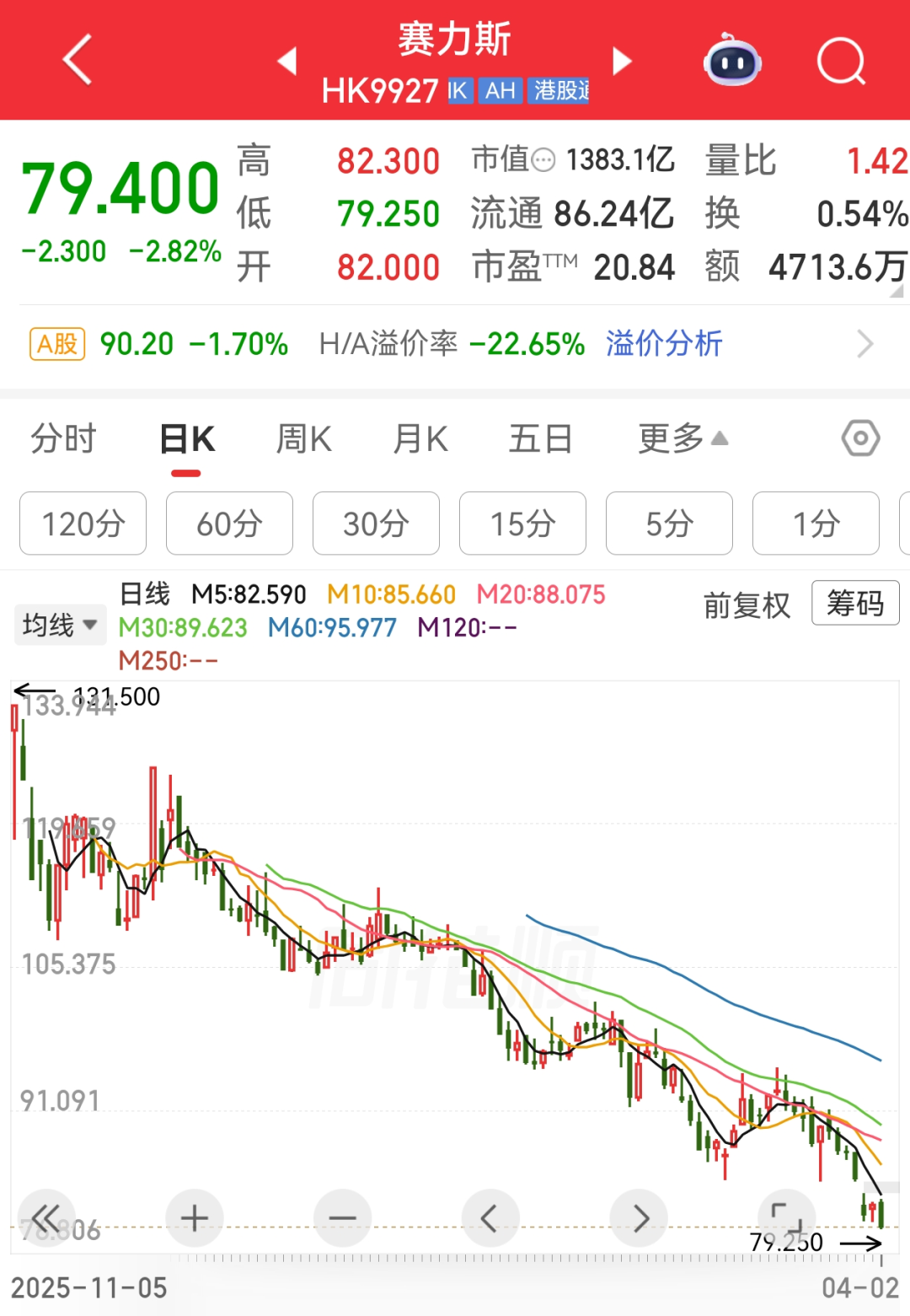
In contrast to its strong sales and record-breaking revenue, the persistent sluggishness of its stock price reveals deeper market concerns: the stronger AITO's sales, the more the growth model and future prospects that Seres relies on trigger stronger anxiety among investors.
Sober Dependence and Dual Strategies
Seres's 2025 financial report data is truly impressive: its annual revenue surged to RMB 165.054 billion, up 13.7% year-on-year; net operating cash flow reached RMB 28.914 billion, a significant increase of 28.4% year-on-year. What is even more remarkable to its peers is its financial strength: as of the end of the year, the company had nearly RMB 87.3 billion in cash on hand.
The AITO brand is the absolute performance anchor for Seres. In 2025, the AITO series accounted for over 80% of the company's sales, with its average transaction price rising to RMB 391,000. Among them, the AITO M9 delivered over 110,000 units throughout the year, maintaining its title as the sales champion in the price range above RMB 500,000; the AITO M8 delivered over 150,000 units, and the AITO M7 delivered over 110,000 units annually, also ranking at the forefront in their respective market segments.
Undoubtedly, with the AITO series delivering 426,000 units throughout the year, Seres solidified its leading position in China's high-end new energy vehicle market in 2025.
The shift towards high-end products has brought substantial profit margins. During the reporting period, the gross profit margin of the company's new energy vehicle business reached 28.76%, up 2.55 percentage points year-on-year; total profit increased by more than 50% year-on-year to RMB 7.470 billion; net profit attributable to shareholders of the listed company was RMB 5.96 billion, achieving profitability for two consecutive years.
In the JL&F '2025 Second Half New Energy Vehicle Brand Health Research Report,' the AITO brand ranked first in key indicators such as Net Promoter Score (NPS) and brand development confidence index. The enhancement of brand value has granted it valuable pricing power and user loyalty in the fiercely competitive market.
However, Seres's management is more aware than anyone that the 'soul' of this remarkable achievement comes from Huawei. From intelligent cockpits to advanced driver-assistance systems (ADS), Huawei's solutions define the core competitiveness of AITO products and constitute Seres's deepest 'path dependency.' This deep integration was an unparalleled accelerator in the early stages but also casts a shadow over the company's independence and long-term valuation.
Faced with this core contradiction, Seres is sparing no expense in building a 'second growth curve' to construct a technological moat independent of Huawei, while also deepening its alliance through capital ties, elevating the cooperative relationship from the business level to a community of shared interests.
The company's annual research and development investment soared to RMB 12.51 billion, a staggering 77.4% year-on-year increase. The allocation of this 'financial power' is significant: in addition to the ADS jointly developed with Huawei, resources are heavily focused on the upgrade of the Magic Cube technology platform 2.0, intelligent powertrains, intelligent safety, and other foundational core technologies. With R&D personnel accounting for 41.1% and a cumulative total of over 8,000 authorized patents, Seres is clearly attempting to accumulate independent capabilities in key areas such as vehicle platforms and three-electric systems (battery, motor, electronic control).
More forward-looking is the company's venture into innovative businesses such as intelligent robots, seen as a crucial move to respond to the industry's intelligent transformation and seek new growth points. All of this is preparation for a potential 'post-Huawei era' or shifts in technology routes.
At the same time, Seres has chosen another seemingly contradictory path—further binding itself to Huawei. During the reporting period, the company completed a strategic investment of RMB 11.5 billion in cash to acquire a 9.36% stake in Shenzhen Yinwang Intelligent Technology Co., Ltd., Huawei's independent automotive BU company.
This is no longer merely a procurement partnership but an attempt to deeply align the interests of both parties through capital ties, shifting from passive dependence to active alliance. This move aims to ensure a prioritized position within Huawei's intelligent automotive ecosystem and share in the long-term dividends of its technological development.
This contradictory investment clearly reveals Seres's anxiety and calculations: it fears losing dominance due to over-reliance on Huawei while also worrying that a distant relationship would forfeit its greatest competitive advantage. Thus, in 2025, when AITO sales peaked, Seres was simultaneously investing heavily to build its technological foundation and spending generously to purchase a ticket to Huawei's future core circle. Whether this dual strategy will succeed remains to be seen over time.
New Challenges After A+H Listing
On November 5 of the previous year, the company was listed on the Main Board of the Hong Kong Stock Exchange, becoming the first luxury new energy vehicle manufacturer to be dual-listed in both A-shares and H-shares, raising a net amount of approximately HK$14.098 billion.
This move significantly optimized its financial structure: as of the end of 2025, the company had RMB 87.287 billion in cash, its asset-liability ratio decreased to 70.91%, and net assets attributable to shareholders of the listed company surged to RMB 40.918 billion.
However, behind the impressive financial report, challenges are equally evident.
First, competition in the high-end market is intensifying. In 2025, no absolute leading brand has emerged in China's high-end new energy vehicle market. While AITO is at the forefront, it faces direct competition from Tesla, Li Auto, NIO, and Zeekr, while traditional luxury brands (BBA) are accelerating their electrification transformation and continuously lowering prices. Moreover, the deep reliance on key partner Huawei is a double-edged sword, as the AITO's high-end narrative will face increasing pressure as Huawei's technology becomes more widely adopted.
Second, technology routes bring uncertainty. Seres is currently one of the biggest winners in the extended-range (ER) route, but industry trends are subtly shifting. Data from the China Passenger Car Association shows that in 2025, battery electric vehicles (BEVs) accounted for over 60% of new energy vehicle sales, while the market share of ER models is narrowing. Even Li Auto, the leader in ER vehicles, is accelerating its transition to BEVs.
The market consensus is that while ER is a powerful tool for expansion before the charging network is perfect, BEVs are the ultimate solution in the long run. Although Seres Chairman Zhang Xinghai emphasizes 'promoting the development of diverse electric technology routes based on meeting user needs,' and the Magic Cube platform is also compatible with BEVs, AITO's current best-selling models and user perception are still firmly tied to 'intelligent extended-range' technology. As ultra-fast charging networks become denser and battery range continues to improve, how long will Seres's 'ER trump card' remain effective?
Third, Seres's product lineup is overly reliant on one segment. Its success is almost entirely bet on the AITO brand's SUV models (M9, M8, M7).
While this was a precise differentiation strategy during the rise phase, it also carries risks. Choosing ER + SUV in the SUV-dominated high-end market is not wrong, but look at the competitors: NIO can deliver over 22,000 units of its ES8 large BEV SUV in December alone; although Li Auto's ER models are under pressure, its L6 model sold 166,500 units last year, accounting for 40% of its total sales.
In fast-growing market segments such as sedans and MPVs, Seres remains absent. Although it has released the Magic Cube platform 2.0, which can cover multiple categories, when specific new models will launch and whether they will succeed remains uncertain. The singularity of its product matrix means weaker resistance to market fluctuations and competitive risks.
Finally, its internationalization process is still in its infancy. Compared to automakers like Chery and BYD, which have already expanded overseas on a large scale, Seres's global layout is still in its early stages. As domestic market growth slows, going global has become a must for all leading Chinese automakers. Seres needs to quickly catch up in this regard.
Looking back at 2025, the landscape of new energy vehicle startups has been reshaped. The focus is no longer just on sales volume but on who can survive longer and better.
Through a series of capital operations, including listing on the Hong Kong stock market, acquiring factories, and investing in Huawei's automotive BU, Seres has built a strong financial safety net. Its challenges have shifted from 'how to survive' to 'how to continue leading.' It needs to answer: In the long run of intelligentization, how to balance leveraging Huawei's strength with cultivating its core technologies? As going global becomes a necessity, can its global layout keep pace quickly? And is its forward-looking bet on robots a pragmatic second growth curve or a distant dream?
The story of Seres is no longer just about a dark horse's comeback but a deeper narrative of how a high-end brand navigates technology route choices, product matrix expansion, and the defense of its high-end position to find a sustainable future. The stronger AITO's sales, the more urgent these long-term questions become—perhaps this is the true source of its anxiety.
-
![]()
Chip Market Booms as AI Hardware Goes Mainstream
-
![]()
【Jialichuang】Participates in the 'OFweek 2026 China Intelligent Manufacturing Industry Annual Awards'
-
![]()
Car Companies Unite in 'Humanoid Creation': The Embodied AI Revolution Transforming the Automotive Industry
-
![]()
XREAL, a Realist in the Smart Glasses Space
-
![]()
68% Surge in Market Enthusiasm: The Game Behind Cerebras' Rise to Fame and the AI Chip Race
-
![]()
The Boom of Short Drama Going Global: In the 3.6 Billion Market, Only a Few Are Truly Making Money
-
![]()
Alibaba AI: Flourishing Amidst Challenges
-
![]()
Surge of Short Drama Exports: Only a Few Truly Profit in the $3.6 Billion Market